
Agriculture in Uganda is the growing of crops and the rearing of livestock for food, income and raw materials, and it anchors the lives of most Ugandan families. The NCDC Senior 3 Agriculture syllabus records that more than 70% of the population is directly involved in agricultural production, and that the sector contributes over 25% of gross domestic product.
Uganda’s journey runs from early subsistence farming, through colonial cash crops, to modern farming that must now deliver food security for a growing nation.

Early farming in Uganda
Early farming in Uganda was subsistence farming. Families grew food for their own tables and reared livestock for milk, meat and status, with only a small surplus sold when the harvest allowed. Crops such as bananas, millet and yams supplied the daily food, while cattle such as the long-horned Ankole were kept for cultural reasons as much as for milk.
- Subsistence farming was the foundation of early farming in Uganda: households grew what they ate and ate what they grew, selling only a small surplus when the harvest allowed.
- Staple crops such as bananas, millet and yams supplied the daily carbohydrate food that kept a family fed through the seasons and between harvests.
- Livestock rearing ran alongside the crops, so a family’s cattle, goats and poultry provided milk, meat, hides and manure for the garden.
- The Ankole long-horned cattle of southwestern Uganda were kept for cultural reasons, as a buffer against drought and disease, and for income from selling live animals. This is the breed covered in the breeds and physical selection of production cattle notes.
- Indigenous cattle breeds — the Ankole, the Zebu and the Nganda — are well adapted to local heat, disease and feed shortages, which made them the natural choice for early herders.
- Simple hand tools did the work, because early farmers cleared, planted, weeded and harvested with hoes and other hand implements rather than with machines.
- Communal life shaped the work, since planting, harvesting and herding were shared by families, clans and whole villages instead of being done alone.
- Culture and ritual were woven into farming, as crops and animals appeared in ceremonies, marriage customs and the daily social life of the community.
- Seasons and rainfall set the farming calendar, so families planted when the rains came and harvested when their crops had matured.
- Food storage mattered greatly, because households dried or stored grain and other food to carry the family through dry periods and lean months.
- Indigenous knowledge guided the farmer, who chose local seed, knew the soils and read the weather from long experience handed down the generations.
- Crop diversity on one plot was common, with several crops grown together so that a family still had food if one crop failed.
- No purchased inputs were needed, because early farmers used saved seed, animal manure and family labour, which kept costs low even though yields stayed modest.
- Seasonal herding saw cattle keepers move animals to water and pasture in drier months, a practice still seen in Uganda’s cattle corridor today.

Common mistake: writing that “subsistence farming means farmers produce nothing to sell.” Subsistence farmers sell a small surplus when they can; the point is that most of what they grow is for the family’s own food, not for a market.
The colonial period and cash crops
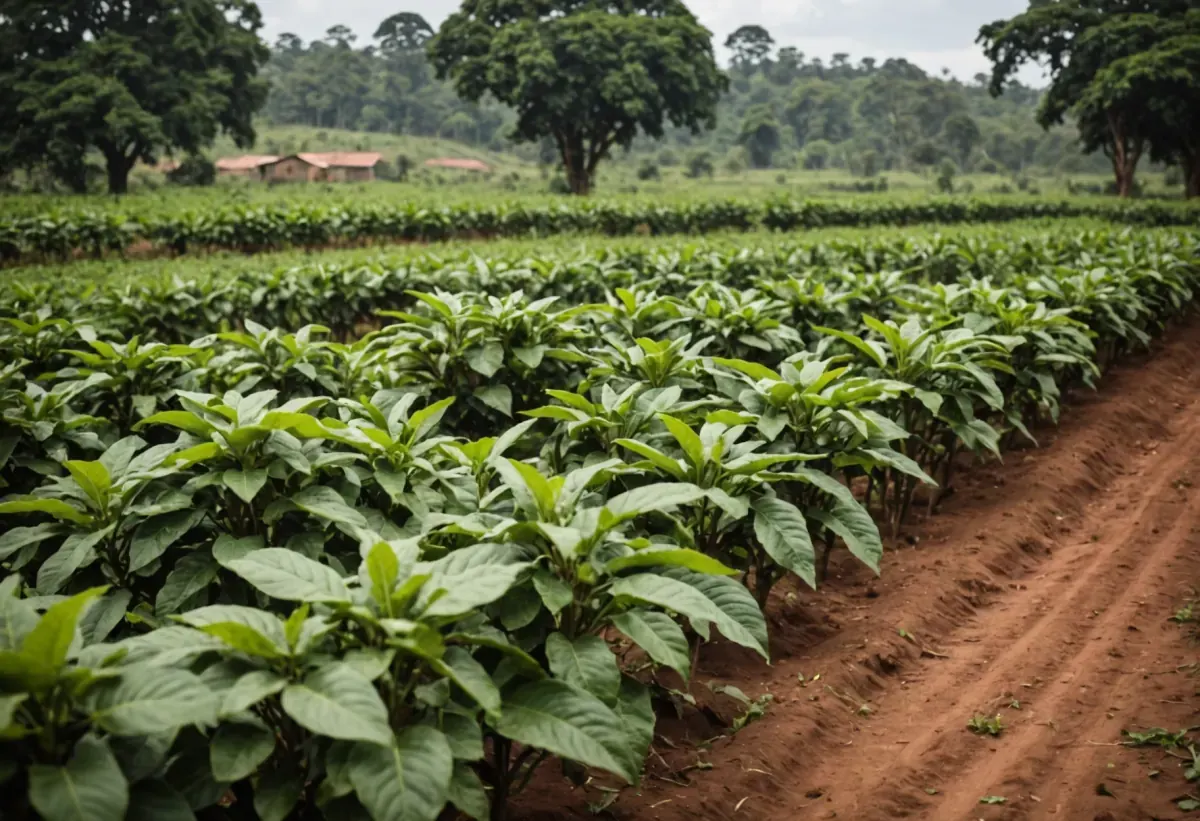
The colonial period changed agriculture in Uganda by steering farmers away from growing mainly for the family and toward cash crops grown for export. Cotton and coffee became the main cash crops, and farmers were moved into growing them alongside, and sometimes instead of, their food crops. This linked Uganda’s farms to a global market for raw materials, often through monoculture — planting a single crop over a wide area.
A Ugandan example shows the chain. Cotton grown by farmers in Bukwo is sold to a ginnery, which cleans the raw cotton into lint, and the lint is then spun into textiles. The farmer at the bottom of that chain sells raw, unprocessed cotton, which is why the farmer carries no value-added tax on it.
| Crop | Type | Grown for |
|---|---|---|
| Bananas (matooke) | Food crop | Staple food, cooked and eaten daily across central and western Uganda. |
| Millet | Food crop | Cereal grain used for porridge and for local brew. |
| Maize | Food crop | Staple grain for posho and flour, with maize bran used as animal feed. |
| Beans | Food crop | Protein-rich food eaten with matooke, posho or rice. |
| Rice | Food crop | Staple grain grown in wetlands and under irrigation. |
| Cassava | Food crop | Starchy root food and a drought-tolerant reserve crop. |
| Sweet potatoes | Food crop | Root food, with the vines fed to livestock. |
| Sorghum | Food crop | Cereal for food and brew, also used as animal feed. |
| Coffee | Cash crop | Grown for its beans, which are sold on the global market for export income. |
| Cotton | Cash crop | Grown for its fibre (lint), which is ginned and spun into textiles. |
| Tea | Cash crop | Grown for its leaves, which are processed for drinking; Uganda’s highlands suit tea plantations. |
| Sugar cane | Cash crop | Grown for sugar, with molasses and bagasse used as energy feed for livestock. |
| Soyabean | Oilseed crop | An oilseed whose soybean meal is a protein source in animal feed. |
| Sunflower | Oilseed crop | An oilseed whose sunflower cake is a protein source in animal feed. |
Exam tip: when you classify crops, name what the crop is grown for, not just the crop. Cotton is a cash crop because it is grown for sale as lint; maize is a food crop because most of it is eaten, even though a surplus is sold.
Agriculture after independence
After independence, agriculture in Uganda survived political upheaval and economic hardship, and it stayed the backbone of the economy. The country’s own syllabus records a huge expansion: land under agricultural production rose from 8 million acres in 1997 to 40 million acres. The same document records that more than 70% of the population is directly involved in agricultural production.
- Agriculture stayed the backbone, for even through the political upheaval and economic hardship that followed independence, farming remained the main source of work and income for most Ugandans.
- The 1997 baseline was small, since the NCDC Agriculture syllabus records only 8 million acres of land under agricultural production in that year.
- Expansion then accelerated, with the syllabus recording 40 million acres under agricultural production by the time the document was published in 2019.
- A five-fold rise is what that growth represents, because 40 million acres divided by 8 million acres equals five (40 ÷ 8 = 5).
- Cooperatives were rebuilt, and the Uganda Cooperative Savings and Credit Union (UCSCU) was established in 1972 to bring savings and credit cooperatives together.
- A legal framework now guides cooperatives through the Cooperative Societies Act, under which a SACCO must first register before it can be licensed to lend.
- Government programmes in the late 20th and early 21st centuries aimed to raise productivity, improve access to markets and promote sustainable farming.
- Improved seed varieties were introduced so that farmers could raise yields beyond what their saved local seed would produce.
- Climate-smart agriculture became a stated goal, pairing crop and livestock farming with practices that protect soil and water.
- Technology reached the farm, with mobile phones giving farmers access to weather forecasts, market prices and practical farming advice in a way that was once impossible.
- The organic farming movement grew as some farmers cut back on synthetic inputs to reach markets that pay a premium for organically produced food.
- Cash crops remained central, with coffee and tea continuing to earn export income while food crops fed the home market.
- Youth and women became a stronger focus, as programmes worked to raise their skills, their access to land and their access to capital in farming.
- Financial services appeared for farmers, with the Agricultural Credit Facility launched in 2009 and the Uganda Agricultural Insurance Scheme launched in 2017 to cover crop and livestock losses.
Common mistake: writing that Uganda’s farmland shrank after independence. The syllabus shows the opposite — land under production grew from 8 million acres in 1997 to 40 million acres, a five-fold rise.
Modern farming in Uganda today
Modern agriculture in Uganda mixes smallholder food production with cash crops, dairy and new technology. The NCDC Agriculture syllabus (2019) records that more than 70% of the population is directly involved in agricultural production and that the sector contributes over 25% of gross domestic product — which underlines the value of agriculture to Ugandan communities.
- Land under production reached 40 million acres, a huge increase on the 8 million acres that were under use in 1997, according to the NCDC Agriculture syllabus.
- Population dependence is very high, since more than 70% of the population is directly involved in agricultural production and over half of these are in the subsistence sector.
- GDP contribution is over 25%, which the NCDC syllabus records as agriculture’s share of Uganda’s gross domestic product and a sign of how much the economy leans on the land.
- A taught subject, agriculture is an elective from Senior 1 to Senior 4, with four periods a week in Senior 3 and Senior 4 — the focus of the Senior 3 Agriculture notes on this site.
- The national herd reached 14.5 million cattle in the 2021 National Livestock Census, up from 11.4 million recorded in 2008.
- Milk output reached 3.7 billion litres a year by 2021, a five-fold increase on the 667.5 million litres recorded in 2008.
- Mostly indigenous cattle make up the herd, since 77% of the national cattle population is indigenous and only 23% is exotic or cross-bred.
- Youth-headed herds number 1.4 million livestock-keeping households, or 20.1% of the total, showing that young people already hold a real stake in farming.
- Women farmers head 2.3 million livestock-keeping households, or 34.1% of the total, which makes women central to Uganda’s livestock economy.
- A cash and food mix is insured nationally, since the Uganda Agricultural Insurance Scheme covers coffee, tea, maize, rice, beans, bananas, fruits, vegetables, cattle, pigs, poultry and fish.
- Mobile money reached 65.9% of adults in 2023, up from 54.4% in 2018, which is how many farmers now send and receive payment for produce.
- Savings groups are widespread, with about three in ten Ugandans belonging to a village savings group and SACCO use rising from 4.3% to 12.2% of adults between 2018 and 2023.
- New farming methods are spreading, since hydroponics — growing crops without soil — is demonstrated at the Makerere University Agricultural Research Institute in Kabanyolo (MUARIK).
- Simple tools still dominate, because 81.4% of livestock-keeping households own hand farm tools while only 0.2% own a tractor.
Exam tip: quote the syllabus’s own figures and name the source. Write “the NCDC Agriculture syllabus (2019) records 40 million acres under production and over 70% of the population in agriculture” — naming NCDC earns the mark for source use.
Challenges and opportunities for Ugandan agriculture
Agriculture in Uganda faces real pressures — climate change, land degradation and limited access to finance — but each pressure opens a door for a young farmer who is ready to respond. The skill examiners want is matching each challenge to a practical, affordable solution.
| Challenge | Effect on farming |
|---|---|
| Climate change | Brings drought and unreliable rains, so planting seasons shift and yields become harder to predict. |
| Land degradation | Worn-out soils and erosion reduce the fertility that crops need to grow well. |
| Limited access to finance | Keeps many farmers from buying improved seed and inputs, because affordable credit is hard to get. |
| Crop failure and drought | FinScope Uganda 2023 records that 22% of adults faced crop failure, livestock death or drought — the second most common financial shock after illness. |
| Low mechanisation | Only 0.2% of livestock-keeping households own a tractor, so most farm work is still done by hand. |
| Animal disease | Foot and mouth disease and tick-borne diseases such as East Coast fever cost farmers cattle, milk and income. |
| Poor livestock shelter | Only 32.5% of cattle-keeping households had a shelter for their cattle in 2021, exposing animals to weather and disease. |
| Thin insurance coverage | The Uganda Agricultural Insurance Scheme reaches below 1% of farming households a year, so most losses are not insured. |
| Price falls after harvest | Some households lose income when the price of their produce drops, especially when many farmers sell at once. |
| Scarce equipment | Only 16.4% of livestock-keeping households own feeding or watering troughs and just 11.3% own a spray pump. |
| Rain dependence | Because most fields rely on rainfall, a poor rainy season quickly becomes a poor harvest for the family. |
| Adoption without finance | 78% of farmers practise mixed cropping but only 4% borrowed to fund it, and 41% use improved seed with only 5% borrowing for it. |
| Weak formal saving | Only two in ten Ugandans have ever saved electronically, so much farm money is kept informally and earns nothing. |
| Opportunity | What a young farmer could do about it |
|---|---|
| Improved seed | Plant higher-yielding, drought-tolerant seed varieties in place of saved local seed to lift yields. |
| Mobile technology | Use a phone to check weather forecasts and market prices before planting and before selling. |
| Village savings groups | Join a VSLA to save a little each week and borrow a lump sum for seed or tools. |
| SACCOs and cooperatives | Join a SACCO or cooperative to pool resources, share knowledge and reach bigger markets together. |
| Agricultural credit | Apply for Agricultural Credit Facility loans through a bank at up to 12% fixed interest per year. |
| Crop insurance | Insure maize, beans, bananas and other crops under the Uganda Agricultural Insurance Scheme. |
| Hydroponics | Learn to grow leafy vegetables without soil at a demonstration site such as MUARIK in Kabanyolo. |
| Drip irrigation | Build a simple drip system from a bucket and pipes to water a small garden in the dry season — the method in the low-cost drip irrigation for forage notes. |
| Youth loans | Borrow through youth agricultural loans aimed at people aged 18 to 35, often through a group. |
| Organic farming | Cut back on synthetic inputs and target markets that pay a premium for organically grown produce. |
| Livestock improvement | Cross indigenous cattle with dairy breeds for more milk, or keep hardy local breeds for drought resilience. |
| Value addition | Sell processed or graded produce — such as ginned cotton — to capture more of the value chain. |
| Climate-smart practices | Conserve soil and water on the farm to protect yields when rainfall becomes unreliable. |
| Youth and women programmes | Join initiatives that raise skills, land access and capital for young and women farmers. |
Common mistake: listing only the challenges and stopping there. Examiners award marks for matching each challenge to a realistic response — for example, “limited finance” matched to “join a SACCO or apply for Agricultural Credit Facility credit at up to 12%”.
Frequently asked questions about agriculture in Uganda
What is agriculture in Uganda?
Agriculture in Uganda is the growing of crops and the rearing of livestock for food, income and raw materials. It is the backbone of the economy: the NCDC syllabus records that over 70% of the population is directly involved in agricultural production and that the sector contributes over 25% of gross domestic product.
Which crops are grown in Uganda?
Uganda grows food crops such as bananas, maize, beans, rice, millet, sorghum, cassava and sweet potatoes. It also grows cash crops including coffee, cotton, tea and sugar cane, and it keeps livestock such as cattle, goats, pigs and poultry.
What are the main cash crops of Uganda?
The main cash crops are coffee, cotton and tea. Coffee is grown for its beans, which are sold on the global market; cotton for its fibre, which is ginned into textiles; and tea for its leaves, which are processed for drinking.
More than 70% of Ugandans are directly involved in agricultural production, and over half of these work in the subsistence sector. These figures come from the NCDC Agriculture syllabus (2019), and they show how central farming is to Ugandan life.
Why is agriculture important to Uganda’s economy?
Agriculture contributes over 25% of Uganda’s gross domestic product and provides work for most of the population. It supplies the nation’s food, earns export income from cash crops such as coffee, and produces raw materials and jobs across rural areas.
What challenges does agriculture in Uganda face?
Agriculture in Uganda faces climate change, land degradation and limited access to finance. Farmers also cope with crop failure and drought, animal diseases, poor livestock shelter and very low insurance coverage, so each challenge needs a practical response.
How can a young person start farming in Uganda?
A young person can join a savings group or SACCO, learn a method such as drip irrigation or hydroponics, and apply for youth agricultural loans aimed at people aged 18 to 35. Starting small with one or two crops keeps the risk low.
Key terms and revision summary
Learn these terms, then attempt the exam-style questions below. Each answer outline shows the points an examiner looks for.
| Term | Meaning |
|---|---|
| Agriculture | The growing of crops and the rearing of livestock for food, income and raw materials. |
| Subsistence farming | Growing food mainly for the family’s own use, with only a small surplus sold when possible. |
| Cash crop | A crop grown mainly for sale, such as coffee or cotton. |
| Food crop | A crop grown mainly to be eaten, such as bananas, maize or beans. |
| Gross domestic product (GDP) | The total value of the goods and services a country produces in a year. |
| Climate-smart agriculture | Farming practices that protect soil and water while keeping yields steady as the climate changes. |
| Cooperative | A group that pools members’ resources to buy inputs, share knowledge and reach markets together. |
| SACCO | A savings and credit cooperative — a member-owned society that takes savings and lends to its members. |
| Hydroponics | Growing crops without soil, in water or a solid growing medium. |
| Improved seed | Higher-yielding or drought-resistant seed varieties used in place of saved local seed. |
Exam-style questions and answer outlines
- State three differences between subsistence farming and commercial cash-crop farming. Outline: subsistence farmers grow mainly for the family’s food while cash-crop farmers grow mainly for sale; subsistence plots are usually small and diverse while cash-crop farms may be larger and planted to one crop; subsistence farming uses saved seed and family labour while cash-crop farming is linked to markets and exports.
- Name four food crops and three cash crops grown in Uganda, and state what one cash crop is grown for. Outline: food crops — bananas, maize, beans, millet (or rice, cassava, sweet potatoes); cash crops — coffee, cotton, tea; coffee is grown for its beans, which are sold on the global market.
- Using the NCDC Agriculture syllabus figures, describe the size and importance of agriculture in Uganda. Outline: 40 million acres under production (up from 8 million in 1997); more than 70% of the population directly involved; over 25% of GDP. Explain each figure and name NCDC as the source.
- Explain two challenges facing Ugandan agriculture and give one practical response to each. Outline: limited finance → join a SACCO or apply for Agricultural Credit Facility credit at up to 12%; climate change and drought → use drought-tolerant seed and drip irrigation; animal disease → vaccination and movement control.
- Why did colonial rule shift Ugandan farming from food crops toward cash crops? Outline: the colonial economy wanted raw materials for export, so it steered farmers into cash crops such as cotton and coffee, often grown as monocultures, alongside and sometimes in place of food crops.



Leave a Reply