Tag: senior 2

  • Senior 2 Entrepreneurship topics: the complete breakdown

    Senior 2 Entrepreneurship topics: the complete breakdown

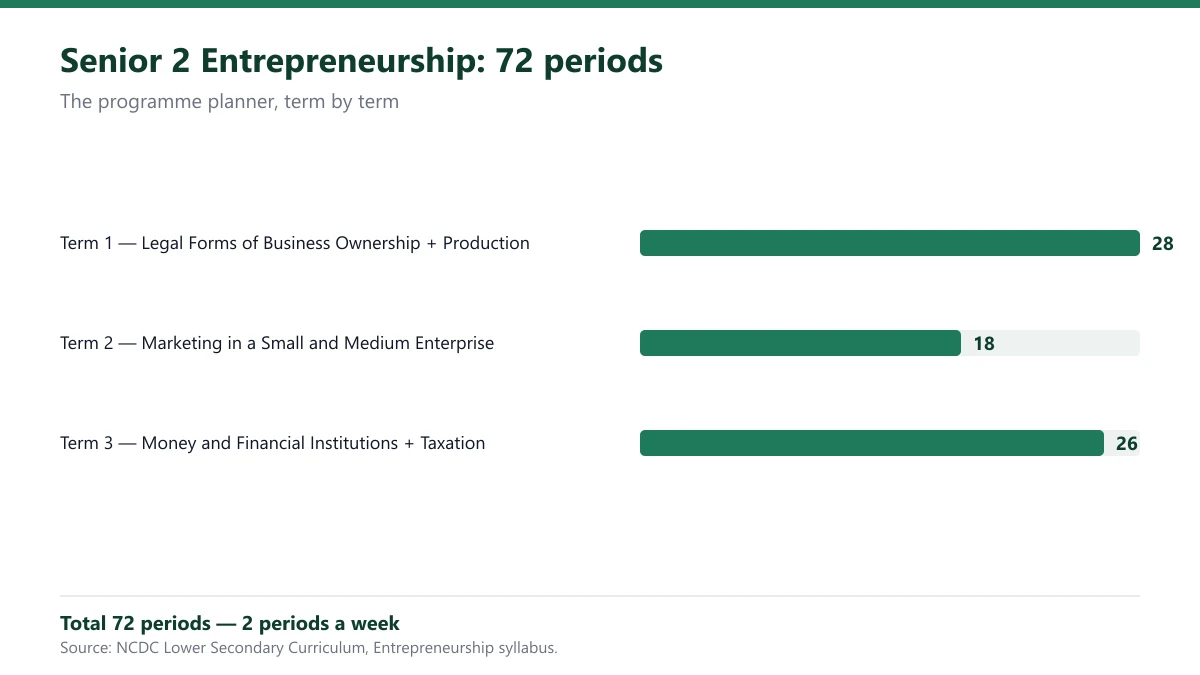
    Senior 2 Entrepreneurship topics span 72 periods across five topics, from Legal Forms of Business Ownership through Production in Business and Marketing to Money and Financial Institutions and Taxation. The year runs across three terms under two themes. Every sub-topic, period count and learning outcome below comes from the NCDC Entrepreneurship syllabus.

    • 72 periods total — 28 in Term 1, 18 in Term 2 and 26 in Term 3.
    • Five topics — from Legal Forms of Business Ownership to Taxation.
    • Two themes — Business Management (Terms 1 and 2) and Business Support (Term 3).
    • Topic 9 is the longest — Money and Financial Institutions takes 20 periods.
    • Topic 10 is the shortest — Taxation takes 6 periods.
    • Outcome codes (k), (u), (s), (v) and (gs) tag every learning outcome.

    What is Senior Two Entrepreneurship?

    Senior Two Entrepreneurship is the second-year lower secondary Entrepreneurship subject in Uganda’s O-level. It builds on Senior 1 by teaching learners how businesses are owned and formalised, how goods are produced, how products are marketed, and how money and financial institutions support trade before taxation closes the year. read more
  • Maximizing Profits in Banana Plantations on an Acre in Uganda: A Comprehensive Guide

    Maximizing Profits in Banana Plantations on an Acre in Uganda: A Comprehensive Guide

    Discover the profit potential of banana farming on one acre in Uganda. Detailed analysis of costs, yields, revenue, and best practices to maximize returns.

  • Sweet Potato Profits in Uganda: A Complete Guide for Farmers

    Sweet Potato Profits in Uganda: A Complete Guide for Farmers

    Discover how to maximize profits from sweet potato farming in Uganda. Learn costs, yields, market strategies, and success tips in this comprehensive guide.

  • Vihusishi na Njeo ya Wakati Uliopo

    Discover Prepositions and the Present Tense in Kiswahili and master all Kiswahili prepositions

    vihusishi) and the present tense (njeo ya wakati uliopo) with 50+ examples, simple explanations, and English translations for beginner students.

    Introduction

    Understanding vihusishi (prepositions) and njeo ya wakati uliopo (present tense) is essential for beginner Kiswahili learners. These two grammar areas help students construct clear sentences, describe actions happening now, and express relationships between words. read more

  • Complete Guide to Feeding Local Chickens: Nutrition, Feed Formulation, and Management

    Complete Guide to Feeding Local Chickens: Nutrition, Feed Formulation, and Management

    Comprehensive guide on feeding local chickens covering nutritional requirements, feed ingredients, ration formulation, feeding management, and common problems. Includes sample rations and FAQs.

  • Matunda na Vyakula kwa Wanafunzi wa Kiswahili (Na Tafsiri za Kiingereza)

    Learn about Fruits and Foods – A Complete Beginner’s Guide

    Katika kujifunza Kiswahili, kujua majina ya matunda (fruits) na vyakula (foods) ni muhimu sana. Hivi ni vitu tunavyokula kila siku, hivyo msamiati huu unawasaidia wanafunzi kuelewa mazungumzo ya nyumbani, masoko, hoteli, na masomo ya afya.

    Blog hii inatoa maelezo rahisi ya Kiingereza, mifano mingi, picha za maoni (illustrations), na zaidi ya mifano 50 ya matunda na vyakula ili kumsaidia mwanafunzi anayeanza.

    1. Matunda ni nini? (What are fruits?)

    Matunda ni sehemu ya mmea iliyoiva na kuliwa kama chakula.
    Fruits are edible plant parts that usually grow after a flower. read more

  • Growing Avocado in Uganda: A Complete Guide for Farmers

    A complete guide to growing avocado in Uganda, covering varieties, planting, care, pests, harvesting, and marketing for profitable farming.

  • Dairy Farming in Uganda: A Comprehensive Guide to Profitability and Disease Control

    Dairy farming in Uganda offers profitability but requires managing diseases and parasites. Learn practical tips on feeding, breeding, marketing, and control strategies for success.

  • Carrot Farming in Uganda: A Guide to Profitable Growth

    Carrot farming in Uganda can yield high profits with low costs. This guide covers everything from planting to marketing, with real success stories and practical tips for maximum returns.

  • Mimea na Mazao ya Mimea – Mwongozo

    Plants and Plant Products – A Complete Beginner’s Guide

    Mimea ni viumbe muhimu sana katika maisha ya binadamu, wanyama, na mazingira kwa ujumla. Katika lugha ya Kiswahili, kujua majina ya mimea na mazao yao husaidia wanafunzi kuelewa mada za chakula, kilimo, mazingira, na matumizi ya kila siku. Blog hii itakusaidia kujifunza kwa urahisi kwa kutumia mifano mingi, maelezo mafupi, na tafsiri za Kiingereza.

    1. Mimea ni nini? (What are plants?)

    Mimea ni viumbe hai vinavyoota ardhini na hutengeneza chakula chao kwa kutumia mwanga wa jua, maji, na hewa.
    Plants grow from the soil and make their own food using sunlight, water, and air. read more

  • Growing Mangoes for a Living: A Profitable Case Study

    A farmer in India turned mango growing into a profitable business. Learn how he overcame pests, diseases, and market challenges to earn $70,000 annually.

  • Growing Onions in Uganda: Expert Interview on Profitability, Varieties, and Best Practices

    Expert interview on growing onions in Uganda. Learn about profitable varieties, planting tips, and market insights for a successful onion farm.

  • World War I Explained: The Great War’s Meaning, Nations, and Global Reach

    A clear guide to WWI, exploring its global meaning, the nations that fought, and the often-overlooked East African campaign.

  • Rise of Nationalism in Kenya, Uganda & Tanzania: Causes Explained

    Discover the key reasons for the rise of nationalism in Kenya, Uganda, and Tanzania. A detailed East African history guide for students, teachers, and researchers.

    Introduction

    Nationalism in East Africa did not emerge overnight. It grew slowly out of shared suffering, resistance, hope, and identity among African communities under colonial rule. In countries like Kenya, Uganda, and Tanzania, nationalism became the powerful force that united diverse ethnic groups into a single political voice demanding freedom. read more

  • 🌟 Uses of Unreactive Metals Like Gold and Everyday Applications of Alloys

    Discover the unique uses of unreactive metals such as gold and learn how alloys like bronze, brass, and stainless steel impact daily life. Explore real-world examples in electronics, construction, and jewellery.

    🧭 Introduction

    Metals play an essential role in modern society, but not all metals are alike. Some are highly reactive, needing careful handling and extraction, while others are incredibly unreactive, remaining unchanged over centuries.

    Among these, gold stands out — not just for its beauty, but for its chemical stability. Meanwhile, alloys, which are mixtures of metals (or metals and non-metals), offer enhanced strength, resistance, and versatility. From kitchen utensils to skyscrapers, alloys shape our daily lives. read more

  • 🏗️ Extraction of Metals Based on Reactivity: From Ores to Pure Elements

    Learn how metals are extracted based on their reactivity series. Discover methods like electrolysis, reduction with carbon, and heating with air, all explained with examples and diagrams.

    🧭 Introduction: Why Does Metal Reactivity Matter in Extraction?

    Metals are among the most important materials on Earth — used in construction, electronics, transport, and tools. But most metals do not exist in their pure form; they are found as ores in the Earth’s crust.

    The method used to extract a metal from its ore depends on its position in the reactivity series. Highly reactive metals need more energy to extract, while less reactive ones require simpler methods. read more

  • ⚡ Reactivity of Metals with Water and Acids: A Complete Guide for Learners and Teachers

    Explore how different metals react with water and acids. Learn about the reactivity trends, balanced equations, and safety precautions in real-world applications and classroom experiments.

    🔍 Introduction: Why Study Metal Reactivity?

    Metals play a vital role in our daily lives — from the iron in bridges to the calcium in our bones. However, not all metals behave the same way, especially when they come in contact with water or acids.

    Some react explosively, while others don’t react at all. Understanding the reactivity of metals is essential for learners, scientists, and engineers. read more

  • 🔧 Properties of Alloys Compared to Pure Metals: Why Alloys Are Stronger, Smarter, and More Useful

    Discover the key differences between alloys and pure metals. Learn why alloys are stronger, more durable, and widely used in industries like construction, transportation, and medicine.

    🧲 Introduction: Pure Metals vs Alloys — What’s the Difference?

    In our daily lives, we encounter countless metal objects — from cooking pots to car bodies and electrical wires. But have you ever wondered why some metals are shiny and soft while others are hard and rust-resistant?

    The answer often lies in whether the metal is pure or an alloy.

    This blog explores the properties of alloys compared to pure metals, and explains why alloys are so important in modern life. read more

  • Traditional African Families vs. Modern Families in Uganda: Structure, Values, and Lessons for Today

    Explore the key differences between traditional African families and modern Ugandan families. Discover lessons from African family values like unity, respect, and communal support, and how they can strengthen modern homes.

    Introduction

    The family remains the foundational unit of any society. In African tradition, the family has historically been a pillar of unity, morality, and survival. However, with the rise of modernity, urbanization, and individualism, the traditional African family structure—once marked by communal living, extended kinship, and respect for elders—has gradually evolved. Today in Uganda, most families are nuclear, with values often shaped by religion, modern education, and Western influence. read more

  • 🔥 Variation in Chemical Reactivity Among Metals: Understanding the Reactivity Series

    Explore how different metals react with water, acids, and oxygen, and learn about the reactivity series of metals — a key concept in chemistry that influences extraction methods, corrosion, and everyday use.

    🧪 Introduction: Why Metal Reactivity Matters

    Metals are widely used in construction, electronics, utensils, transportation, and manufacturing. But not all metals behave the same way chemically. Some react violently with water or acid, while others remain unreactive even under extreme conditions.

    This difference in behavior is explained by the variation in chemical reactivity among metals, summarized in the reactivity series — a powerful tool in understanding and predicting chemical reactions. read more

×
Listen to Remedial Radio

Listen to Remedial Radio

Enjoy the rhythm of knowledge. where books sing!
Learn More
🚀 Stuck in School? Catch Up and Stand Out!

🚀 Stuck in School? Catch Up and Stand Out!

Don't let difficult topics hold you back. Our fast-track Remedial Courses are designed to bridge the gap and boost your confidence instantly.

What We Offer:

  • Speak Kiswahili From Day One: Master conversational Swahili with zero stress.

  • English for Locals: Perfect your grammar and speak English with absolute confidence.

  • Targeted Remedial Support: Easily catch up on core subjects you find challenging.

Stop struggling. Start mastering.


Learn More