Author: Akankwatsa Andrew Oba

  • Understanding particle theory: States of Matter and Changes of State

    Introduction

    Matter, the substance that makes up the universe, exists in various forms known as states of matter. These states—solid, liquid, gas, and plasma—are distinct phases that matter can undergo, each with unique properties. Understanding the changes of state, such as melting, freezing, evaporation, and condensation, is fundamental in the study of physics and chemistry. These transitions are driven by changes in temperature and pressure, influencing how molecules interact with each other. This article delves into the meaning of changes of state, provides examples, and explores the different transitions that matter can undergo.

    The Particle Theory of Matter

    The particle theory of matter is a scientific concept that explains the behavior and properties of matter based on the idea that all matter is composed of tiny particles. This theory provides a framework for understanding the microscopic nature of substances and how they behave at the atomic and molecular levels.

    Key principles of the particle theory of matter

    before we look at the key principals of matter, click on our virtual laboratory experiment on understanding particle theory, states of matter and changes of state.

    The key principles of the particle theory of matter include:

    1.         Particles in Constant Motion:

    •          Particles (atoms, molecules, or ions) that make up matter are in constant motion. The motion increases with temperature. In solids, particles vibrate in fixed positions, while in liquids and gases, particles move more freely.

    2.         Space Between Particles:

    •          There is space between particles in all forms of matter. The amount of space varies depending on the state of matter. In solids, particles are closely packed, in liquids, they are less closely packed, and in gases, they are widely spaced.

    3.         Forces of Attraction:

    •          There are attractive forces between particles. In solids, these forces are strong, holding particles in fixed positions. In liquids, the forces are weaker, allowing particles to move past each other. In gases, the forces are very weak.

    4.         Particle Size and Arrangement:

    •          Particles have a specific size, shape, and arrangement. The arrangement and spacing of particles determine the physical state of matter (solid, liquid, or gas).

    5.         Changes in State:

    •          Changes in the state of matter (melting, freezing, condensation, etc.) are explained by the behavior of particles. For example, melting occurs when particles gain enough energy to overcome the forces holding them in a fixed position in a solid.

    6.         Conservation of Mass:

    •          The particle theory supports the principle of the conservation of mass. During physical and chemical changes, particles are rearranged, but the total mass of the system remains constant.

    7.         Temperature and Particle Motion:

    •          Increasing the temperature of a substance increases the kinetic energy of its particles, causing them to move faster. Decreasing the temperature reduces particle motion.

    8.         Pressure and Particle Motion:

    •          Increasing pressure on a gas reduces the volume it occupies because the particles are forced closer together. Conversely, decreasing pressure allows the gas particles to move further apart.

    The particle theory of matter is crucial for understanding and predicting the behavior of substances under different conditions. It forms the basis for explaining concepts such as heat transfer, phase changes, and the macroscopic properties of matter observed in our daily experiences. This theory has been instrumental in advancing our understanding of the physical world at the molecular and atomic levels.

    Arrangement of Particles and Forces Between Them in Gas, Liquid, and Solid:

    **1. Gas:

    •          Arrangement of Particles:

    •          Gas particles are in constant, random motion and are spaced far apart from each other.

    •          There is no fixed arrangement, and gas particles fill the entire container they occupy.

    •          Forces Between Particles:

    •          Weak intermolecular forces or negligible forces.

    •          Particles move independently of each other and collide frequently.

    2. Liquid:

    •          Arrangement of Particles:

    •          Liquid particles are also in constant motion but are more closely packed compared to gas particles.

    •          They have a definite volume but no fixed shape, taking the shape of the container.

    •          Forces Between Particles:

    •          There are moderate intermolecular forces.

    •          Particles can move past each other, allowing liquids to flow.

    3. Solid:

    •          Arrangement of Particles:

    •          Solid particles are closely packed and vibrate in fixed positions.

    •          They have a definite shape and volume.

    •          Forces Between Particles:

    •          Strong intermolecular forces.

    •          Particles are held in a fixed, orderly arrangement, resulting in a rigid structure.

    Forces Between Particles

    1. Gas:

    •          Forces Between Particles:

    •          Negligible intermolecular forces.

    •          Gas particles experience minimal attraction or repulsion. They move freely and independently.

    2. Liquid:

    •          Forces Between Particles:

    •          Moderate intermolecular forces.

    •          Liquids have stronger forces than gases but weaker than solids. Particles can slide past each other.

    3. Solid:

    •          Forces Between Particles:

    •          Strong intermolecular forces.

    •          Solids have the strongest forces, with particles held tightly together. The forces resist motion, resulting in a fixed structure.

    In summary, the arrangement of particles and the forces between them significantly influence the physical properties and behavior of matter in different states. Gases have particles that are widely spaced and experience minimal forces, liquids have particles that are more closely packed with moderate forces allowing for flow, and solids have closely packed particles with strong forces, resulting in a rigid structure. Understanding these characteristics is fundamental to explaining the diverse properties of matter in everyday life and scientific contexts.

    observation about the theory of particles

    Let us make an observation that can be explained by the theory of particles: Investigate evidence of particles using balloon filled with air. we shall give other evidences of this theory.

    Observation

    When a balloon is filled with air, it expands and takes on a defined shape. Additionally, if the balloon is released, it moves in the opposite direction, demonstrating a change in position.

    Explanation Based on the Particle Theory

     The observation can be explained by the particle theory of matter. According to the theory:

    1.         Gas Particles in the Balloon:

    •          The air inside the balloon is composed of gas particles, which are in constant, random motion. They collide with the walls of the balloon, creating pressure and causing the balloon to expand.

    2.         Expansion of Gas:

    •          As the balloon is filled, the gas particles exert force on the interior walls of the balloon, pushing them outward. This results in the balloon expanding and taking on a specific shape.

    3.         Change in Position:

    •          When the filled balloon is released, the air particles inside it continue to move randomly. As they move, they create a net force that propels the balloon in the opposite direction. This change in position demonstrates the kinetic energy and motion of gas particles.

    Other Evidences of the Particle Theory:

    1.         Diffusion:

    •          The spreading of a gas throughout a space is explained by the random motion of gas particles. For example, the scent of perfume spreading across a room is a result of gas particles (molecules) moving randomly and mixing with the air.

    2.         Melting and Boiling Points:

    •          The melting and boiling points of substances can be explained by the arrangement and movement of particles. As a substance is heated, its particles gain energy and move more rapidly, causing a change in state.

    3.         Changes in Volume with Temperature:

    •          Gases exhibit changes in volume with temperature due to the increased or decreased kinetic energy of particles. Heating a gas causes its particles to move faster, leading to an increase in volume.

    4.         Pressure in a Closed Container:

    •          Gas particles exert pressure on the walls of a container. The pressure increases with an increase in the number of gas particles or an increase in their kinetic energy. This is evident in, for example, inflating a balloon.

    5.         States of Matter:

    •          The different states of matter (solid, liquid, gas) and their transitions are explained by the arrangement and behavior of particles. Solid particles are closely packed, liquid particles are more mobile, and gas particles are widely spaced.

    These evidences collectively support the particle theory of matter, providing a comprehensive explanation for the behavior and properties of substances at the microscopic level. The theory is fundamental to understanding various physical phenomena and is widely applied in physics and chemistry.

    Conclusion

     Understanding the states of matter and the changes of state is essential for comprehending the physical world around us. From the ice melting in your drink to the water vapor forming clouds in the sky, these transitions are constant and vital to numerous natural and industrial processes. Recognizing how temperature and pressure affect matter can lead to a deeper appreciation of both everyday phenomena and complex scientific concepts. As we continue to explore and manipulate particle theory of matter, and transitions, we gain greater control over materials and can innovate in fields ranging from environmental science to engineering.

    FAQs: Particle Theory of Matter

    Q1: What is the particle theory of matter?

    A: The particle theory of matter is a scientific concept that explains the behavior and properties of matter based on the idea that all matter is composed of tiny particles, such as atoms and molecules.

    Q2: What evidence supports the particle theory of matter?

    A: Experimental evidence, including the observation of Brownian motion, changes in states of matter, and the behavior of gases, supports the particle theory. Microscopic imaging technologies also provide visual confirmation of individual particles.

    Q3: How do particles behave in solids, liquids, and gases?

    A: In solids, particles are closely packed and vibrate in fixed positions. In liquids, particles are more loosely packed and can move past each other. Gases have widely spaced particles that move freely.

    Q4: Can particles be seen with the naked eye?

    A: No, particles are generally too small to be seen with the naked eye. They are typically on the scale of atoms and molecules, which are much smaller than the wavelengths of visible light.

    Q5: What is Brownian motion, and how does it support the particle theory?

    A: Brownian motion is the random motion of particles in a fluid (liquid or gas) due to collisions with other particles. This phenomenon, observed by Robert Brown, provides direct evidence of the existence of particles.

    Q6: How do particles change their arrangement during state changes?

    A: During state changes, such as melting or boiling, particles gain or lose energy, leading to changes in their arrangement. For example, in melting, particles gain energy and move from a fixed position in a solid to a more mobile arrangement in a liquid.

    Q7: How does the particle theory explain changes in volume and shape?

    A: In solids, particles are closely packed, resulting in a definite shape and volume. Liquids have a definite volume but no fixed shape, as particles can move past each other. Gases have neither a definite shape nor volume, taking the shape of their container.

    Q8: Why is the particle theory important in understanding matter?

    A: The particle theory is crucial in explaining a wide range of phenomena, from the behavior of substances in everyday life to complex scientific processes. It forms the foundation for understanding properties, changes, and interactions of matter.

    Q9: How does the particle theory relate to temperature and pressure?

    A: The particle theory explains that increasing temperature increases the kinetic energy of particles, leading to changes in states of matter. Pressure is related to the frequency and force of particle collisions, with higher pressure indicating more frequent and forceful collisions.

    Q10: Can the particle theory be applied to all types of matter?

    A: Yes, the particle theory is a fundamental concept applicable to all types of matter, including solids, liquids, and gases. It provides a consistent framework for understanding the behavior of matter at the microscopic level.

  • Fueling Your Entrepreneurial Journey: Understanding and Generating Business Ideas

    In the dynamic world of entrepreneurship, the foundation of any successful venture begins with a robust and innovative business idea. These ideas are the sparks that ignite entrepreneurial passion and drive, leading to the creation of new products, services, and businesses. But what exactly are business ideas, and where do they come from? More importantly, how can aspiring entrepreneurs consistently generate viable and profitable business ideas? In this blog, we will explore the essence of business ideas, identify various sources from which they can emerge, and provide practical strategies for generating your own groundbreaking business concepts. Whether you are an experienced entrepreneur or a newcomer to the business world, this guide will equip you with the knowledge and inspiration needed to embark on your next entrepreneurial venture.

    What are Business ideas?

    Business ideas are creative concepts or proposals that identify potential opportunities for starting or expanding a business. These ideas can encompass various aspects, including products, services, markets, and business models. Business ideas often arise from recognizing a need, problem, or opportunity in the market and formulating a plan to address or capitalize on it. They serve as the initial seeds of entrepreneurship and can be developed into viable business ventures. Successful business ideas are typically innovative, feasible, and have the potential for profitability.

    sources of Business ideas

    Business ideas can originate from various sources and inspiration can come from unexpected places. Here are common sources of business ideas:

    1.         Identifying Market Needs: Recognizing unmet needs or problems in the market can lead to innovative business ideas. Conducting market research and observing consumer behavior can help uncover opportunities.

    2.         Personal Passion and Hobbies: Your personal interests, hobbies, and passions can inspire business ideas. Creating a business related to something you love can be both fulfilling and profitable.

    3.         Industry Trends and Emerging Technologies: Keeping up with industry trends, technological advancements, and consumer preferences can reveal opportunities for businesses that leverage these changes.

    4.         Solving Your Own Problems: If you face a challenge or problem in your life, chances are others do too. Developing a solution for your own problem can lead to a business idea.

    5.         Networking and Collaborations: Conversations with others, including friends, colleagues, or mentors, can spark ideas or lead to collaborations that generate business opportunities.

    6.         Competitor Analysis: Analyzing competitors may reveal gaps in the market where you can offer better products, services, or solutions.

    7.         Franchise and Licensing Opportunities: Investigating franchise or licensing options can provide ready-made business ideas and established business models.

    8.         Travel and Cultural Experiences: Traveling and experiencing different cultures can expose you to unique business concepts that can be adapted for your market.

    9.         Education and Skillsets: Your education, expertise, or specialized skills may lead to business opportunities in your field of knowledge.

    10.       Social and Environmental Trends: Trends related to sustainability, wellness, and social responsibility can inspire businesses that align with these values.

    11.       Government and Industry Reports: Reports and publications from government agencies, industry associations, and research organizations can offer insights into emerging opportunities.

    12.       Online Communities and Forums: Engaging with online communities and forums related to your interests or industry can provide valuable insights and inspiration.

    13.       Observing Consumer Behavior: Pay attention to how people shop, consume, and interact with products and services. Behavior patterns can reveal unmet needs.

    14.       Adaptation and Improvement: Improving upon existing products or services to make them more efficient, convenient, or affordable can lead to successful business ideas.

    15.       Subscription Models: The subscription-based business model, which offers regular, recurring services or products, has become a popular source of business ideas.

    16.       Collaborative Economy: Opportunities for sharing, renting, or collaborative consumption can lead to innovative business models.

    17.       Aging Population: Demographic shifts, such as an aging population, can lead to business ideas related to senior care, healthcare, and lifestyle services.

    18.       Economic Changes: Economic trends, including economic downturns or upswings, can create new business opportunities or influence consumer behavior.

    19.       Legislation and Regulation: Changes in laws and regulations can open doors for businesses that help organizations or individuals comply with new requirements.

    20.       Local Market Gaps: Analyzing your local area or community for gaps in products or services can lead to small-scale, localized business ideas.

    It’s essential to evaluate the feasibility and market potential of your business ideas before pursuing them. Conduct thorough research, validate demand, and create a solid business plan to increase the likelihood of success.

    How to generate business ideas

    Generating business ideas is a creative process that involves brainstorming, exploration, and problem-solving. Here are some methods and approaches on how to generate business ideas:

    1.         Identify Market Needs: Start by looking for unmet needs or problems in the market. Consider what products, services, or solutions are missing, and how you can address those gaps.

    2.         Industry Research: Explore different industries and sectors to understand trends, emerging technologies, and areas with growth potential. Industry reports and publications can provide valuable insights.

    3.         Consumer Insights: Study consumer behavior and preferences. Surveys, focus groups, and market research can help you understand what customers want and need.

    4.         Personal Interests and Hobbies: Your own passions and hobbies can lead to business ideas. Think about how you can turn what you love into a profitable venture.

    5.         Networking and Collaboration: Engage with peers, mentors, and colleagues. Conversations and collaborations can spark new ideas and opportunities.

    6.         Problem-Solving: Think about the challenges and problems you or others face in daily life. Solutions to these problems can become the foundation of a business.

    7.         Trend Spotting: Stay updated on current trends in various fields, including technology, health, sustainability, and lifestyle. Look for ways to leverage these trends in your business.

    8.         Competitor Analysis: Analyze competitors to identify areas where you can offer a better or differentiated product or service.

    9.         Brainstorming Sessions: Host brainstorming sessions with a diverse group of people to generate a wide range of ideas. Encourage creativity and free thinking.

    10.       SWOT Analysis: Conduct a SWOT (Strengths, Weaknesses, Opportunities, Threats) analysis for potential business ideas. This can help you assess their viability.

    11.       Franchise and Licensing Opportunities: Investigate franchise or licensing options in established businesses or industries. These models can offer ready-made ideas.

    12.       Adaptation and Improvement: Consider how you can improve existing products or services to make them more efficient, cost-effective, or user-friendly.

    13.       Ecosystem Thinking: Look at the broader ecosystem of a particular industry or market. Identify gaps or connections that could lead to innovative ideas.

    14.       Sustainability and Social Responsibility: Explore opportunities to create businesses with a focus on sustainability, ethical practices, or social impact.

    15.       Online Communities and Forums: Participate in online communities and forums related to your interests or industry. Engaging in discussions can provide valuable insights.

    16.       Global Inspiration: Explore ideas from around the world. Concepts that work well in one location may have potential in your area with some adaptation.

    17.       Education and Skillsets: Consider how your education, expertise, or skills can be applied to create valuable products or services.

    18.       Future Projections: Predict future needs and trends in your industry. Anticipating changes can position your business ahead of the curve.

    19.       Customer Feedback: Listen to customer feedback and reviews. Customer insights can reveal areas for improvement or new product ideas.

    20.       Trial and Error: Don’t be afraid to experiment with different ideas. Some of the most successful businesses started with small experiments.

    Remember that generating business ideas is just the beginning. You’ll need to validate, refine, and develop these ideas into viable business plans, taking into account factors like market demand, competition, and financial feasibility. Additionally, persistence and adaptability are essential as you work on transforming your ideas into successful businesses.

    how to select a good business idea

    many people think selecting a business idea is hard. However, if you follow along with our blog, you will learn some of the  tips on how to select a good business idea. Selecting a good business idea is a crucial step in the entrepreneurial journey. Here are some steps and considerations to help you choose a viable and promising business idea:

    1.         Identify Your Passions and Interests: Start by considering what you’re passionate about and what interests you. A business idea that aligns with your interests is more likely to keep you motivated and engaged.

    2.         Assess Your Skills and Knowledge: Evaluate your skills, expertise, and knowledge. A good business idea should leverage your strengths and experience, increasing your chances of success.

    3.         Market Research: Conduct thorough market research to identify opportunities and demand. Analyze market trends, customer needs, and potential gaps in the market. Look for industries or niches that show promise.

    4.         Target Audience: Define your target audience and understand their preferences, pain points, and behaviors. A business idea should cater to a specific target audience’s needs.

    5.         Competition Analysis: Analyze the competition in your chosen industry or niche. Assess the strengths and weaknesses of existing businesses and identify areas where you can differentiate or offer a superior solution.

    6.         Profitability and Revenue Model: Consider the revenue model for your business idea. How will you generate income? Ensure that the idea has the potential for profitability and sustainability.

    7.         Feasibility: Assess the feasibility of your idea. Can you realistically execute it given your resources, budget, and available time? Consider the practical aspects of launching and running the business.

    8.         Scalability: Think about the scalability of the business. Can it grow over time, and can you expand it to meet increasing demand or serve a broader market?

    9.         Trends and Longevity: Consider the long-term viability of the idea. Is it based on a short-lived trend, or does it address a lasting need? Businesses with long-term potential are more likely to succeed.

    10.       Legal and Regulatory Considerations: Investigate the legal and regulatory requirements associated with your business idea. Ensure you understand and can comply with these requirements.

    11.       Resource Availability: Assess the resources you have at your disposal, including funding, time, and access to technology or equipment. Ensure you can obtain the necessary resources to launch and operate the business.

    12.       Risk Analysis: Identify potential risks associated with the business idea and develop strategies to mitigate them. A well-thought-out risk management plan is essential.

    13.       Value Proposition: Clearly define the unique value your business idea offers to customers. What sets it apart from the competition?

    14.       Business Plan: Create a comprehensive business plan that outlines your idea, market analysis, financial projections, and execution strategy. A well-structured business plan helps you visualize the path to success.

    15.       Feedback and Validation: Seek feedback from trusted advisors, mentors, or potential customers. Validation from external sources can confirm the viability of your idea.

    16.       Passion and Commitment: Ensure that you are passionate and committed to the idea. Entrepreneurship requires dedication, and your enthusiasm can be a driving force.

    17.       Adaptability: Be open to adapting and evolving your idea as you learn and grow. A good business idea should be flexible and capable of adjusting to changing circumstances.

    18.       Customer-Centric Approach: Focus on providing value to your customers. A customer-centric approach is essential for long-term success.

    19.       Proof of Concept: If possible, create a minimum viable product (MVP) or prototype to test your idea with real users or customers. A successful proof of concept can boost confidence in your idea.

    20.       Legal Protection: If your idea involves intellectual property, consider how to protect it through patents, trademarks, or copyrights.

    Selecting a good business idea requires careful thought, research, and analysis. While there’s no one-size-fits-all approach, considering these factors and conducting due diligence can help you make an informed decision and increase the likelihood of success in your entrepreneurial endeavor.

    Conclusion

     Generating innovative and viable business ideas is a critical skill for any aspiring entrepreneur. By understanding what constitutes a business idea and exploring diverse sources such as market needs, technological advancements, and personal experiences, you can uncover opportunities that align with your passions and market demands. Additionally, employing creative thinking techniques and leveraging feedback from potential customers can further refine and enhance your ideas. The journey from concept to successful business is paved with exploration, experimentation, and perseverance. Embrace these strategies to generate ideas that not only inspire but also stand the test of market dynamics. With the right approach and mindset, your next big business idea could be just around the corner, waiting to be discovered and transformed into a thriving enterprise.

  • Qualities of a Good Map: A Comprehensive Guide

    Maps have been essential tools for navigation, exploration, and understanding geographical spaces for centuries. However, not all maps are created equal. The qualities of a good map ensure it is useful, accurate, and easy to read. This blog will delve into the essential qualities that make a map effective, using examples from various types of maps to illustrate these points. By understanding these qualities, you can better appreciate the art and science of cartography and make informed choices when selecting or using maps.

    Introduction to Map Quality

    A map is more than just a visual representation of an area; it is a detailed, informative, and functional tool. The qualities of a good map are critical for conveying information accurately and efficiently. Whether for educational purposes, travel, or scientific research, a good map must meet certain criteria to be deemed effective. Below, we explore these essential qualities in detail.

    1. Accuracy

    Definition: Accuracy refers to the correctness of the information presented on the map.

    Importance: Accurate maps provide reliable data that users can depend on for navigation, planning, and analysis. Errors in location, distance, or scale can lead to significant misunderstandings and potentially hazardous situations.

    Example: Topographic maps, which show elevation and landforms, must be highly accurate to be useful for hikers and engineers. Inaccurate contour lines could mislead users about the steepness of terrain, leading to dangerous hikes or flawed engineering projects.

    2. Clarity

    Definition: Clarity involves the ease with which users can read and understand the map.

    Importance: A clear map avoids clutter and uses legible fonts and symbols, ensuring users can quickly and easily find the information they need. Overcrowded or poorly designed maps can confuse users.

    Example: City maps that highlight important locations such as hospitals, police stations, and tourist attractions should use clear symbols and avoid overcrowding to help residents and visitors navigate efficiently.

    3. Detail

    Definition: Detail refers to the amount of information provided on the map.

    Importance: A good map includes all necessary details without becoming cluttered. This balance ensures that users have comprehensive information without feeling overwhelmed.

    Example: Geological maps should show detailed information about rock types and fault lines but should balance this with a clean design to avoid overwhelming geologists with too much information at once.

    4. Scale Appropriateness

    Definition: Scale appropriateness means that the map’s scale is suitable for its intended use.

    Importance: The scale of a map determines the level of detail and the area covered. A good map uses a scale that provides sufficient detail for its purpose without covering an unnecessarily large area.

    Example: A road map for a city should use a large enough scale to show individual streets and landmarks, while a map of an entire country can use a smaller scale to provide an overview of major highways and cities.

    5. Legend

    Definition: A legend (or key) explains the symbols and colors used on the map.

    Importance: Without a legend, users might misinterpret the symbols, leading to confusion. A well-designed legend ensures that all symbols are clearly explained.

    Example: In a wildlife conservation area map, a legend might indicate different symbols for various species habitats, water sources, and walking trails. This allows visitors to understand the map fully and use it effectively.

    6. Orientation

    Definition: Orientation refers to the map’s ability to show direction, usually with a north arrow or compass rose.

    Importance: Proper orientation helps users understand directions and relate the map to the real world. This is crucial for navigation and geographic understanding.

    Example: Nautical charts used by sailors must be correctly oriented to ensure safe navigation. Misorientation could lead to navigational errors and potential hazards at sea.

    7. Aesthetic Appeal

    Definition: Aesthetic appeal means the map is visually pleasing.

    Importance: An aesthetically appealing map is more engaging and easier to use. Good design principles can help highlight important features and make the map enjoyable to look at.

    Example: Tourist maps often use bright colors and appealing designs to attract tourists and make navigation more enjoyable. These maps are not just functional but also enhance the tourist experience by being pleasant to use.

    8. Relevance

    Definition: Relevance means the map includes information that is pertinent to its intended use.

    Importance: Including relevant information ensures the map meets the needs of its users without overwhelming them with unnecessary details.

    Example: An evacuation map for a building should focus on exits, fire extinguisher locations, and assembly points, rather than unrelated details like the layout of offices or decorations.

    9. Up-to-Date Information

    Definition: Up-to-date information ensures the map reflects current conditions and data.

    Importance: A map with outdated information can mislead users, rendering it ineffective or even dangerous in some situations.

    Example: Road maps need regular updates to reflect new roads, changes in traffic patterns, and other relevant alterations. An outdated map could send drivers on routes that no longer exist or miss new, faster options.

    10. Integration of Technology

    Definition: Integration of technology refers to the use of modern tools to enhance the map’s functionality.

    Importance: Modern technology can provide additional layers of information and interactivity, making maps more useful and accessible.

    Example: Digital maps and GPS systems use real-time data to update routes, traffic conditions, and points of interest. Apps like Google Maps integrate user-generated content, live traffic updates, and satellite imagery to provide a comprehensive navigation tool.

    Examples of Maps Exhibiting Good Qualities

    1. Google Maps: This widely used digital map excels in accuracy, clarity, and up-to-date information. It integrates real-time traffic data, provides detailed street views, and includes a robust legend for symbols and landmarks.
    2. Ordnance Survey Maps: These detailed topographic maps of the UK are renowned for their accuracy and clarity, providing hikers, planners, and geographers with detailed and reliable information.
    3. National Geographic Maps: Known for their aesthetic appeal and detailed information, these maps are not only functional but also beautifully designed, making them a pleasure to use and study.

    Identifying Key Features on Maps with Ugandan Examples

    1. Hotels: Symbolized by a bed or “H” icon. Example: Serena Kampala Hotel.
    2. Botanical Gardens: Marked by a tree or leaf icon. Example: Entebbe Botanical Gardens.
    3. Markets: Represented by a shopping bag icon. Example: Owino Market, Kampala.
    4. Stadiums: Shown with a stadium or sports field icon. Example: Mandela National Stadium, Kampala.
    5. Railway Lines: Depicted as dashed lines. Example: Kampala to Mombasa Railway.
    6. Lakes: Illustrated with wavy blue areas. Example: Lake Victoria.
    7. Rocky Islands: Indicated by dark specks or irregular shapes. Example: Buvuma Islands.
    8. Ferry Terminals: Represented by a ferry icon. Example: Entebbe Ferry Terminal.

    Conclusion

  • Unit Conversions in Agriculture: Worked Examples for Ugandan Farms

    Unit Conversions in Agriculture: Worked Examples for Ugandan Farms

    Unit conversions in agriculture are the calculations a farmer uses to change a measurement from one unit to another without changing the amount itself. A Ugandan learner meets them when converting an acre to hectares, a fertiliser rate from kilograms per hectare to kilograms per acre, or a knapsack sprayer’s volume from litres to millilitres. Getting the number right decides how much seed, fertiliser or chemical reaches the crop.

    This guide sets out the conversion factors, the Ugandan land units, and four fully worked problems for revision.

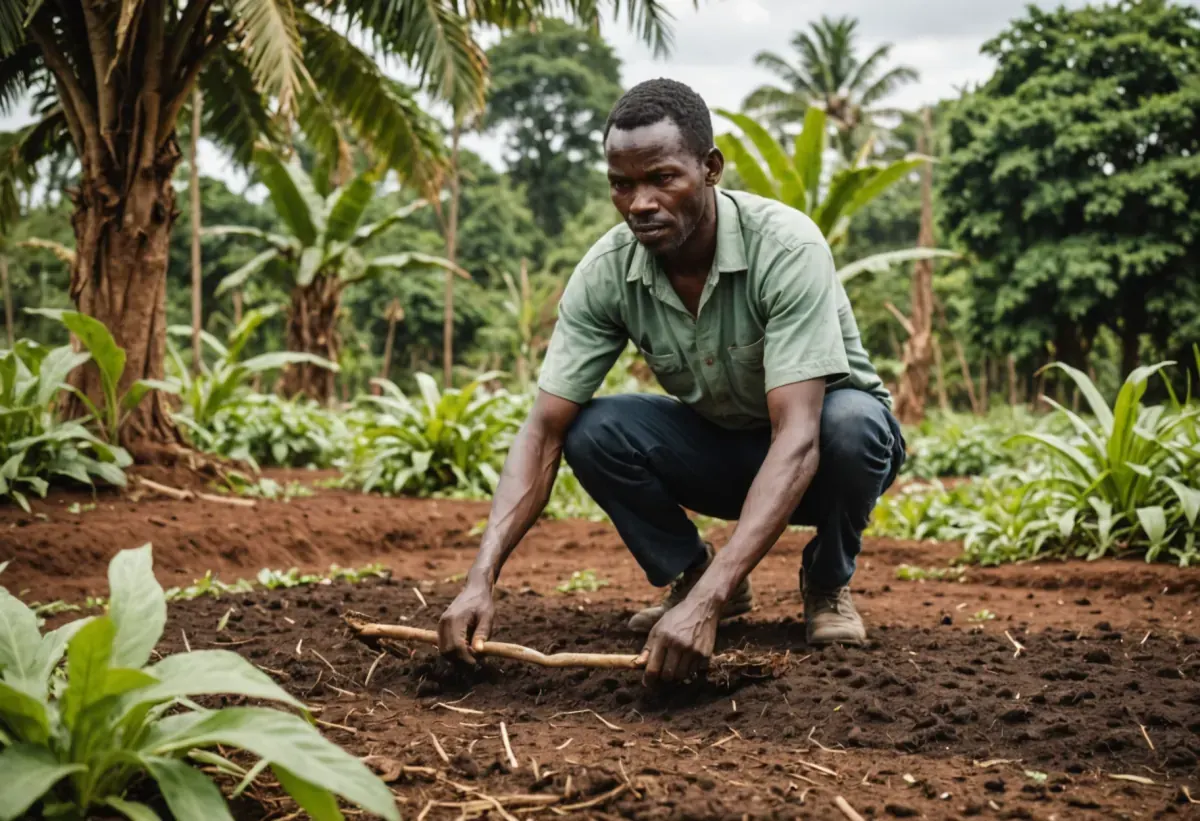
    Farmer measuring the length of a maize plot with a tape measure on a Ugandan smallholding
    A farmer measures the length of a maize plot with a measuring tape, the first step in converting the field’s area from square metres to acres or hectares.

    Why farmers convert units

    Unit conversions in agriculture exist so that readings taken in different systems can be compared, and the skill starts with precision measurements in agriculture. A seed packet may state a rate per acre while a soil test reports per hectare, and the two must be matched before money is spent. Converting keeps the amount of an input correct, which protects both the crop and the farm budget.

    • Consistent measurements. One field may be surveyed in metres while a neighbour’s is in acres, so conversion lets both farms compare their true sizes on one scale.
    • Correct input doses. A fertiliser label quoted per hectare must be changed to per acre before a smallholder applies it, otherwise the field is under-fed or over-fed.
    • Accurate land records. Land sales and crop estimates are recorded in acres or hectares, and a wrong conversion changes the area a farmer thinks they own.
    • Budgeting and costing. A farmer who knows the cost per kilogram must convert weights and areas to price a whole plot or a full season’s harvest.
    • Seed and planting rates. Seed rate is given per unit area, so converting between acres and hectares sets the correct amount of seed to buy for a field.
    • Chemical safety. A spray label states a dose per hectare, and converting to the knapsack’s litres prevents a mix too weak to control pests or strong enough to scorch crops.
    • Yield comparison. Yields are reported as tonnes per hectare or kilograms per acre, so conversion lets a farmer judge whether a crop performed well against district figures.
    • Trade and selling. Buyers quote prices per kilogram while a farmer sells by the bag or sack, so weight conversion settles a fair and clear price.
    • Following instructions. Government and extension advice often uses metric units, and a farmer must convert them into the units their own tools and tins measure.
    • Preventing waste and loss. Incorrect unit conversions lead to suboptimal farming practices and financial loss, because an error made once is repeated across every acre of the field.
    • Communicating with suppliers. When ordering fertiliser or fencing, stating the area in the supplier’s unit avoids buying far too much or far too little.
    • Exam and class work. The Senior 3 Agriculture notes syllabus expects “simple mathematical calculations”, so learners who convert units accurately earn the marks set for numerical work.
    • Plan irrigation and spacing. A syllabus drip-irrigation project uses a 5 m × 2 m garden, and converting that 10 m² helps plan the water and plants it needs.

    Common mistake: learners convert 1 acre to 0.4047 hectares but then multiply when they should divide. Always write the unit beside every number, then cancel the units like fractions.

    Metric conversions for length area and mass

    Unit conversions in agriculture rest on the metric system of metres, square metres, kilograms and litres, plus a short list of imperial units still used for land. Every conversion below is a fixed factor, so once a learner writes the factor down, the rest is careful multiplication or division. The table is the revision reference to memorise.

    CategoryConversion
    Length1 foot = 0.3048 metres
    Length1 metre = 3.2808 feet
    Length1 mile = 1.6093 kilometres
    Length1 kilometre = 0.6214 miles
    Length1 metre = 100 centimetres = 1,000 millimetres
    Length1 kilometre = 1,000 metres
    Area1 acre = 0.4047 hectares
    Area1 hectare = 2.4711 acres
    Area1 square foot = 0.0929 square metres
    Area1 square metre = 10.7639 square feet
    Area1 hectare = 10,000 square metres
    Area1 acre = 4,047 square metres
    Mass1 pound = 0.4536 kilograms
    Mass1 kilogram = 2.2046 pounds
    Mass1 short ton = 0.9072 tonnes
    Mass1 tonne = 1,000 kilograms
    Volume1 cubic foot = 0.0283 cubic metres
    Volume1 cubic metre = 35.3147 cubic feet
    Volume1 litre = 1,000 millilitres
    Volume1 cubic metre = 1,000 litres
    Volume1 bushel of wheat = 35.2391 litres (varies by crop)
    • Prefixes. The prefixes kilo, centi and milli mean 1,000, one hundredth and one thousandth, so a kilometre is 1,000 metres and a litre is 1,000 millilitres.
    • Temperature. To change Celsius to Fahrenheit use °F = (°C × 9/5) + 32; to change back use °C = (°F − 32) × 5/9.
    • Time. One hour is 60 minutes and one week is 7 days, conversions that appear in labour and watering schedules.

    Common mistake: dropping the units. Write the unit beside every number and cancel them; 0.4047 ha is not the same thing as 0.4047 acres.

    Converting area units for land measurement

    For unit conversions in agriculture, the two land units a Ugandan learner must master are the acre and the hectare. One acre equals 0.4047 hectares, and one hectare equals 2.4711 acres, so changing between them is a single multiplication either way. These are the units the NCDC syllabus uses when it counts the country’s farmland.

    Land unitMetric equivalentUse on a Ugandan farm
    Acre0.4047 hectares = 4,047 m²The unit in which the syllabus counts farmland, for example “40 million acres”.
    Hectare2.4711 acres = 10,000 m²The metric unit behind yield and fertiliser rates, such as tonnes per hectare.
    Square metre10.7639 square feetUsed for small plots, gardens and the 5 m × 2 m drip-irrigation bed.
    Square foot0.0929 square metresAppears on older plans and in some imported equipment manuals.
    • The acre–hectare link. One acre equals 0.4047 hectares and one hectare equals 2.4711 acres, so the two factors are simply reciprocals of each other.
    • Acres to hectares. To convert acres to hectares, multiply by 0.4047, because each acre is a little less than half a hectare.
    • Hectares to acres. To convert hectares to acres, multiply by 2.4711, because a hectare is about two and a half acres.
    • Check by reversing. Because 0.4047 and 2.4711 multiply to about one, an answer can be checked by converting straight back the other way.
    • Square metres in a hectare. One hectare is 10,000 square metres, which is a square measuring 100 m on each side.
    • Square metres in an acre. One acre is about 4,047 square metres, so a 4,000 m² field is very nearly one acre.
    • Small plots in square metres. The syllabus drip-irrigation project uses a 5 m × 2 m garden, whose area is 10 m², a reminder that small areas are measured in square metres.
    • Square feet and metres. One square metre is 10.7639 square feet and one square foot is 0.0929 square metres, used when an old plan must be matched to a metric tape.
    • Farmland in acres. The NCDC Agriculture syllabus states that Uganda has about 40 million acres under agricultural production, up from 8 million acres in 1997.
    • Acres to hectares at scale. Those 40 million acres convert to about 16.19 million hectares, because 40,000,000 × 0.4047 = 16,188,000.
    • The 1997 figure. The 8 million acres of 1997 convert to about 3.24 million hectares, showing how one national area is reported in either unit.
    • Arable land share. URA’s agricultural tax guide records that about 80 percent of Uganda’s land is arable but only 35 percent is being cultivated, figures a learner can quote with their source.
    • Area is length squared. Because area is length times length, a foot-to-metre change must be applied twice when converting square feet to square metres.

    Exam tip: when a question gives a plot in metres, first find its area in m², then divide by 10,000 to reach hectares. Never multiply the side lengths by the acre factor directly.

    Converting rates for fertiliser and spray application

    Rates are the hardest part of unit conversions in agriculture because a rate carries two units at once, such as kilograms per hectare or litres per hectare. Converting a rate means changing one of those units, and the common error is converting only half of it. The table below turns application rates into the units a Ugandan farmer’s tools actually measure.

    Rate conversionMultiply byWorked check
    kg/ha to kg/acre0.4047100 kg/ha = 40.47 kg/acre
    kg/acre to kg/ha2.471150 kg/acre = 123.56 kg/ha
    lb/acre to kg/ha1.1209100 lb/acre = 112.09 kg/ha
    kg/ha to lb/acre0.8922100 kg/ha = 89.22 lb/acre
    g/m² to kg/ha101 g/m² = 10 kg/ha
    kg/ha to g/m²0.11 kg/ha = 0.1 g/m²
    t/ha to kg/m²0.11 t/ha = 0.1 kg/m²
    kg/m² to t/ha101 kg/m² = 10 t/ha
    L/ha to mL/m²0.11 L/ha = 0.1 mL/m²
    mL/m² to L/ha101 mL/m² = 10 L/ha
    L/ha to L/acre0.4047200 L/ha = 80.94 L/acre
    tonne to kilogram1,0001 t = 1,000 kg
    litre to millilitre1,0001 L = 1,000 mL
    • Sprayer ownership. UBOS’s 2021 livestock census found only 11.3 percent of livestock-keeping households owned a spray pump, so converting the mix correctly matters when equipment is shared.
    • Knapsack volume. A typical knapsack sprayer holds 16 litres, and a rate quoted per hectare must be divided across however many knapsack loads cover that hectare.
    • Rate units. A rate such as 100 kg/ha means 100 kilograms spread over every hectare, not 100 kilograms for the whole farm, unless the farm is exactly one hectare.
    Farmer checking the volume marks on a knapsack sprayer before spraying beans
    A farmer checks the volume marks on a 16-litre knapsack sprayer before mixing a crop-protection spray at the correct rate.

    Common mistake: converting the area but forgetting the weight. When a label says pounds per acre, change the pounds to kilograms and the acre to hectares, or the dose is wrong by the size of one whole factor.

    Worked conversion problems for Ugandan farms

    This section works four exam-style unit conversions in agriculture from start to finish, showing the units at every single step. Each answer is checked by working it back the other way, because checking is how a learner catches the arithmetic slip that drops marks.

    1. Worked problem 1 — 6 acres to hectares. A farmer in Wakiso measures a maize garden as 6 acres and needs the area in hectares. Step 1: write the factor, 1 acre = 0.4047 hectares. Step 2: multiply, 6 × 0.4047 = 2.4282. Step 3: state the answer with units, 2.43 hectares. Check: 2.4282 × 2.4711 = 6.00 acres, which returns the starting value.
    2. Worked problem 2 — 150 kg/ha to kg/acre. A recommended fertiliser rate is 150 kilograms per hectare, and the farmer needs it per acre. Step 1: note 1 acre = 0.4047 hectares. Step 2: multiply, 150 kg/ha × 0.4047 ha/acre = 60.71 kg/acre, and the “ha” cancels. Step 3: answer 60.7 kg/acre. Check: 60.71 × 2.4711 = 150.0 kg/ha.
    3. Worked problem 3 — knapsack sprayer volume. A 16-litre knapsack must deliver a label rate of 200 litres per hectare. Step 1: convert the tank, 16 L × 1,000 = 16,000 mL. Step 2: find loads per hectare, 200 ÷ 16 = 12.5 loads. Step 3: if 2 litres of product cover a hectare, each load takes 2 ÷ 12.5 = 0.16 L = 160 mL. Check: 12.5 × 16 L = 200 L, and 12.5 × 160 mL = 2,000 mL = 2 L.
    4. Worked problem 4 — kilograms per plot to tonnes per hectare. A farmer harvests 600 kg of maize grain from a plot measuring 40 m by 25 m. Step 1: area = 40 × 25 = 1,000 m². Step 2: convert to hectares, 1,000 ÷ 10,000 = 0.1 ha. Step 3: convert mass, 600 kg = 0.6 t. Step 4: divide, 0.6 ÷ 0.1 = 6 t/ha. Check: 6 t/ha × 0.1 ha = 0.6 t = 600 kg.
    5. Bonus — forage yield per acre to per hectare. Boma Rhodes pasture records a dry-matter yield of 4,868 kg per acre. Step 1: 4,868 kg = 4.868 t. Step 2: multiply, 4.868 × 2.4711 = 12.0 t/ha, which sits inside the manual’s stated range of 10–18 t/ha per year.
    6. Reverse-check every answer. Convert the answer back to the starting unit; if the original value does not return, a step has slipped somewhere.
    7. Carry units at each step. Write the unit beside every number and cancel matching units, because the unit that is left tells you whether to multiply or divide.
    8. Convert mass and area separately. A rate like pounds per acre needs the pounds changed to kilograms and the acre changed to hectares, two conversions, not one.
    9. Estimate before calculating. Round the factor first, using 1 acre ≈ 0.4 ha, to see roughly what the answer should be, then compare it with the exact result.
    10. Mind the decimal place. A misplaced decimal in 0.4047 turns 6 acres into 24.282 instead of 2.4282 hectares, an error of ten times.
    11. Answer in the unit requested. If the question asks for tonnes per hectare, leave the answer in t/ha and do not convert it again into kilograms per acre.
    12. Practise on real Ugandan numbers. The syllabus’s 40-million-acre figure and the pasture yield per acre are free revision questions, because each tests both arithmetic and the conversion at once.
    13. Revise the linked calculations. Feed making uses the same arithmetic, so a learner who can convert rates is ready for formulating and blending compound feeds.
    Harvested maize grain weighed on a spring scale at a Ugandan farm
    Harvested maize grain is weighed on a spring scale, giving the kilograms that are later converted to tonnes per hectare.

    Frequently asked questions about unit conversions in agriculture

    How do I convert acres to hectares in agriculture?

    Multiply the number of acres by 0.4047. For example, 6 acres × 0.4047 gives 2.43 hectares. Check your answer by converting back, multiplying the hectares by 2.4711 to recover the original acres. Always write the units beside each number so you do not multiply when you should divide.

    What is the formula to change kilograms per hectare to kilograms per acre?

    Multiply the per-hectare rate by 0.4047, because one acre is 0.4047 hectares. A rate of 150 kilograms per hectare becomes 150 × 0.4047 = 60.7 kilograms per acre. Reverse the change by multiplying kilograms per acre by 2.4711, which restores the per-hectare figure.

    How many litres does a knapsack sprayer hold, and how do I use the volume?

    A typical knapsack sprayer holds 16 litres, which is 16,000 millilitres. To cover one hectare at a label rate of 200 litres per hectare, you need 200 ÷ 16 = 12.5 knapsack loads. Divide the amount of chemical needed per hectare by 12.5 to find the dose for each load.

    How do I turn a yield from kilograms per plot into tonnes per hectare?

    First find the plot’s area in hectares by dividing square metres by 10,000. Then change kilograms to tonnes by dividing by 1,000. Finally divide the tonnes by the hectares. A 600-kilogram harvest from 0.1 hectares is 0.6 ÷ 0.1 = 6 tonnes per hectare.

    Why does dropping the units cause wrong answers?

    Units show whether a step is a multiplication or a division. Writing 0.4047 ha beside the acres lets you cancel the units like fractions, leaving only the unit you want. Without units, a learner easily multiplies where division is needed and lands ten or a hundred times off.

    Which units do Ugandan farmers use for land?

    Ugandan farmers use acres and hectares, plus square metres for small plots and gardens. The NCDC syllabus counts the country’s farmland in acres, while yields and fertiliser rates use hectares. One acre equals 0.4047 hectares, and one hectare equals 2.4711 acres.

    Key terms and revision summary

    Glossary of key terms

    TermMeaning
    Unit conversionChanging a measurement into another unit of the same quantity without changing the amount.
    AcreAn imperial area unit equal to 0.4047 hectares or about 4,047 square metres.
    HectareA metric area unit equal to 10,000 square metres or 2.4711 acres.
    RateAn amount per unit, such as kilograms per hectare or litres per hectare.
    KilogramThe metric unit of mass, equal to 1,000 grams or about 2.2046 pounds.
    Tonne (metric)A metric mass of 1,000 kilograms.
    LitreThe metric unit of volume, equal to 1,000 millilitres, with 1,000 litres in a cubic metre.
    Knapsack sprayerA hand-pumped, backpack sprayer typically holding about 16 litres of mixture.
    YieldThe amount of crop harvested, expressed as kilograms per plot or tonnes per hectare.
    Conversion factorThe fixed number used to change one unit into another, such as 0.4047 for acres to hectares.

    Exam-style questions

    1. Convert 8 acres to hectares, showing your working. Answer outline: multiply 8 × 0.4047 = 3.2376 ha, so about 3.24 ha; check with 3.2376 × 2.4711 = 8.0 acres.
    2. A fertiliser is recommended at 120 kg/ha. What is the rate in kg/acre? Answer outline: multiply 120 × 0.4047 = 48.56 kg/acre, and keep the “per acre” unit on the answer.
    3. A farmer sprays 200 litres per hectare with a 16-litre knapsack, and the label asks for 3 litres of product per hectare. How many loads, and how much product per load? Answer outline: 200 ÷ 16 = 12.5 loads; then 3 ÷ 12.5 = 0.24 L = 240 mL per load.
    4. A plot 50 m × 40 m yields 1,200 kg of beans. Express the yield in tonnes per hectare. Answer outline: area = 2,000 m² = 0.2 ha; 1,200 kg = 1.2 t; 1.2 ÷ 0.2 = 6 t/ha.
  • Understanding Worship in African Traditional Societies: Forms, Objects, and Leadership Roles Compared to Christianity

    Christian rituals play a pivotal role in the religious life of millions around the globe, serving not only as acts of worship but also as profound symbols of faith and community. In this blog post, we will explore the importance of Christian rituals, delve into Christian teachings about rituals, and share examples of Christian celebrations. These insights aim to enrich your understanding and appreciation of these sacred practices.

    The Importance of Christian Rituals

    Christian rituals are essential for several reasons:

    1. Unity: They bring believers together, fostering a sense of community and shared identity.
    2. Remembrance: Many rituals are performed in remembrance of the life, death, and resurrection of Jesus Christ, keeping the central tenets of Christianity alive in the hearts and minds of the faithful.
    3. Spiritual Growth: Rituals often involve readings, prayers, and songs that encourage reflection and personal growth.
    4. Covenant: Rituals such as baptism and communion are seen as covenants between the believers and God, which reaffirm their commitment to their faith and moral conduct.

    to expand on the topic of The Importance of Christian Rituals:

    1. Moral Formation: Christian rituals often involve readings from scriptures, prayers, and teachings that reinforce moral values. These activities help shape the ethical framework of believers, guiding their actions and decisions according to Christian principles.
    2. Historical Connection: Engaging in rituals that have been practiced for centuries connects believers to the historical church. This continuity fosters a deep sense of heritage and belonging within the global Christian community.
    3. Spiritual Discipline: Regular participation in Christian rituals such as weekly worship, prayer, and fasting cultivates spiritual discipline. This discipline is crucial for maintaining a focused and devout life, allowing believers to grow closer to God.
    4. Emotional Support: Rituals provide emotional support during times of joy, sorrow, and transition. Services like funerals, weddings, and baptism ceremonies offer structured ways for communities to come together and support one another emotionally and spiritually.
    5. Identity Formation: For many, participation in Christian rituals is a key component of their personal and social identity. These practices help define who they are in the context of their faith community and the larger society.
    6. Physical and Mental Reflection: Certain rituals, such as the act of kneeling for prayer, fasting, or the physical journey of a pilgrimage, involve physical actions that reflect mental and spiritual states, creating a holistic form of worship that engages the entire being.
    7. Reaffirmation of Beliefs: Rituals frequently serve as opportunities for believers to reaffirm their faith and commitment to the core beliefs and tenets of Christianity, thereby strengthening their resolve to follow Christ.
    8. Education for the Youth: Rituals serve as practical frameworks within which the youth can learn about their faith through observation and participation, ensuring the transmission of religious practices and values from one generation to the next.
    9. Enforcement of Community Standards: By participating in rituals, members of the Christian community collectively uphold and enforce the moral and ethical standards of their faith, which in turn promotes social order and understanding within the community.
    10. Renewal of Commitment: Annual celebrations and observances, such as Easter and Christmas, provide

    Christian Teachings About Rituals

    Christianity teaches that rituals are not just ceremonial but are imbued with deep theological significance. For example:

    1. Sacramental Understanding: Christian teachings often emphasize that rituals are sacramental. They are outward signs instituted by Christ to give grace. This sacramental nature means that rituals are seen not just as symbolic, but as actual conduits of God’s grace and blessings.
    2. Scriptural Basis: Many Christian rituals have their roots in Biblical directives. For instance, the ritual of Communion is directly taken from Jesus’ instructions during the Last Supper as detailed in the Gospels. This scriptural basis is essential for understanding why certain rituals are observed.
    3. Unity with Christ: Christian teachings suggest that rituals such as baptism and the Eucharist are not merely formalities but are spiritual practices that unite believers with Christ. This unity is considered essential for spiritual growth and salvation.
    4. Remembrance: Rituals serve as a form of remembrance. They remind believers of the pivotal events in Christian history, such as the death and resurrection of Jesus Christ, and motivate them to live according to those truths.
    5. Communal Bonding: Teachings often highlight that rituals help in strengthening the bonds within the church community. By participating together, believers develop a deeper connection with each other, fostering a strong community of faith.
    6. Teaching and Catechism: Rituals are used as a means to teach fundamental Christian truths to believers, especially to new converts and children. They serve as practical demonstrations of faith’s principles and are integral to catechetical instruction.
    7. Anticipation of the Eschaton: Many rituals, especially those of the liturgical calendar, are anticipatory, reflecting the Christian hope in the final fulfillment of God’s promise and the coming of the Kingdom of Heaven.
    8. Transformation: Christian doctrine often teaches that rituals are transformative. They change the participant in a spiritual sense, drawing them closer to God and renewing their spirit.
    9. Obedience to Tradition: Christian teachings respect the traditions passed down through church history. Rituals are seen as a way to maintain continuity with the past and obedience to the ecclesiastical authority that has preserved these practices.
    10. Ethical Implications: Some rituals have ethical teachings embedded within them, instructing believers on moral living. For example, the washing of feet on Maundy Thursday teaches humility and service to others.
    1. Baptism: Seen as a sacrament of initiation into the faith, representing purification and rebirth. Romans 6:4 says, “We were therefore buried with him through baptism into death in order that, just as Christ was raised from the dead through the glory of the Father, we too may live a new life.”
    2. Eucharist (Communion): This ritual commemorates Jesus’ Last Supper with his disciples, reflecting on sacrifice and atonement. 1 Corinthians 11:24-25 recounts, “And when he had given thanks, he broke it and said, ‘This is my body, which is for you; do this in remembrance of me.’ In the same way, after supper he took the cup, saying, ‘This cup is the new covenant in my blood; do this, whenever you drink it, in remembrance of me.’”

    Examples of Christian Celebrations

    Christianity is rich with various rituals and celebrations, each carrying its own unique significance:

    1. Easter: Celebrating the resurrection of Jesus Christ, marking the triumph of life over death and sin. It is the cornerstone of Christian faith.
    2. Christmas: Commemorating the birth of Jesus Christ in Bethlehem, this celebration emphasizes themes of joy, giving, and the importance of Jesus as the Savior.
    3. Pentecost: This marks the day when the Holy Spirit descended upon the Apostles, which is often called the birthday of the Church.
    4. Lent: A period of 40 days before Easter involving fasting, prayer, and penitence to prepare for Easter. It begins with Ash Wednesday and is a time for reflection and spiritual cleansing.
    5. Feast of the Transfiguration: Celebrated on August 6th, this feast commemorates the transfiguration of Jesus on Mount Tabor, where he appeared radiant in divine glory to his disciples Peter, James, and John. It’s a major feast in the liturgical calendars of many Christian denominations.
    6. Candlemas: Also known as the Feast of the Presentation of Jesus at the Temple, Candlemas is celebrated on February 2nd. It marks the presentation of Jesus in the Temple and the purification of the Virgin Mary. Traditionally, candles are blessed on this day, symbolizing Christ as the light of the world.
    7. Feast of the Annunciation: This celebration occurs on March 25th and marks the angel Gabriel’s announcement to the Virgin Mary that she would be the mother of Jesus Christ. This day is significant across many Christian denominations.
    8. Feast of Corpus Christi: Celebrated on the Thursday after Trinity Sunday, this feast day commemorates the real presence of the body and blood of Jesus Christ in the Eucharist. It is often marked with Eucharistic processions and adoration.
    9. Feast of Christ the King: This feast is observed on the last Sunday of the liturgical year in many Christian denominations and celebrates the all-embracing authority of Christ as King and Lord of the cosmos.
    10. Saints’ Feast Days: Throughout the Christian liturgical year, numerous days are designated to honor the lives and martyrdoms of saints. Each saint’s feast day is an opportunity for devotees to celebrate their virtues and seek their intercessions.
    11. Epiphany (or Three Kings’ Day): Celebrated on January 6th, Epiphany commemorates the visit of the Magi to the Christ child. Traditions include blessing of homes, special masses, and in some cultures, exchanging gifts.
    12. Pentecost: Occurring 50 days after Easter, Pentecost celebrates the descent of the Holy Spirit upon the apostles and other followers of Jesus Christ while they were in Jerusalem celebrating the Feast of Weeks. It is often called the “birthday of the Church.”
    13. Advent: The season of Advent marks the beginning of the liturgical year in Western Christianity, encompassing the four Sundays leading up to Christmas. It is a time of preparation and anticipation for the celebration of the Nativity of Jesus.
    14. Holy Saturday (or the Great Vigil): This celebration marks the day Jesus lay in the tomb after his death. It is characterized by a vigil service that begins in darkness and is lit by the lighting of the Paschal candle, symbolizing the resurrection.

    Conclusion

  • Timelines of human  development : Stages of the evolution of man

    The timeline of human development, or the stages of the evolution of man, spans millions of years and is divided into several key periods. Here is an overview of the major stages in the evolution of our species:

    Pre-Hominid Ancestors (6-7 Million Years Ago):

    The earliest ancestors of humans diverged from the common ancestor we share with chimpanzees. These early hominids were likely bipedal, but their brains were small.

    Australopithecus (4-2 Million Years Ago):

    Australopithecus species, such as Australopithecus afarensis (famous for “Lucy”), exhibited a combination of ape-like and human-like features. They walked upright but had smaller brains than modern humans.

    Homo habilis (2-1.5 Million Years Ago):

    Homo habilis, often referred to as the “handy man,” had slightly larger brains and the ability to use tools, marking an important step in human evolution.

    Homo erectus (1.9 Million – 70,000 Years Ago):

    Homo erectus was the first hominid to migrate out of Africa. They had larger brains and more sophisticated tools and fire use. Their upright posture and adaptations for long-distance travel are significant developments.

    Archaic Homo sapiens (600,000 – 200,000 Years Ago):

    Archaic Homo sapiens, including Neanderthals, emerged with larger brains and more complex societies. They created advanced tools and demonstrated evidence of symbolic behavior.

    Anatomically Modern Homo sapiens (Around 200,000 Years Ago to Present):

    Modern Homo sapiens emerged in Africa and began to spread globally. They had the same brain capacity as present-day humans and exhibited advanced cognitive abilities. This period includes various cultural developments, such as art, language, and agriculture.

    Agricultural Revolution (Around 10,000 Years Ago):

    The transition from hunting and gathering to agriculture marked a significant shift in human development. It led to the growth of settled communities, the development of civilizations, and the rise of complex societies.

    Industrial Revolution (18th Century):

    The Industrial Revolution marked a major turning point in human history, with advances in technology, industry, and urbanization. It transformed economies and societies, leading to significant changes in living conditions and work.

    Information Age (20th Century to Present):

    The Information Age, characterized by the rapid development of computers, the internet, and digital technologies, has revolutionized communication, information sharing, and global interconnectedness.

    Contemporary Developments (Present Day):

    Today, humans continue to advance technologically and socially. We face complex challenges related to sustainability, climate change, and global cooperation.

    Throughout these stages, human development has been marked by physical, intellectual, cultural, and technological advancements. The journey from our early hominid ancestors to modern humans reflects the remarkable adaptability and innovation of our species.

    What differences are between Dryopithecus and Cro-Magnon.

    Dryopithecus and Cro-Magnon are two distinct species separated by millions of years of evolution, and they exhibit numerous differences in terms of their taxonomy, physical characteristics, and cultural aspects. Here are some key differences between Dryopithecus and Cro-Magnon:

    1. Taxonomy and Classification:

    Dryopithecus is an extinct genus of apes that lived approximately 9 to 12 million years ago during the Miocene epoch. It is considered a hominoid and is believed to be an ancestor to modern apes, including gibbons and orangutans.

    Cro-Magnon refers to a population of anatomically modern Homo sapiens who lived in Europe around 40,000 to 10,000 years ago during the Upper Paleolithic period. Cro-Magnons are early members of our own species.

    • Physical Characteristics:

    Dryopithecus is thought to have been a relatively small ape, approximately the size of modern gibbons. It had an apelike body structure with adaptations for tree-dwelling, such as long arms and a grasping big toe.

    Cro-Magnon individuals were anatomically similar to modern humans. They had a high forehead, rounded skull, and a fully bipedal, upright stance. They were well-adapted to both terrestrial and potentially aquatic environments.

    • Brain Size:

    Dryopithecus had a relatively small brain size compared to modern humans, indicating limited cognitive abilities.

    Cro-Magnons had brain sizes within the range of modern humans, suggesting advanced cognitive capacities for tool-making, art, and complex social behaviors.

    • Cultural and Technological Aspects:

    As an extinct ape, Dryopithecus did not exhibit cultural or technological behaviors. Its survival and adaptation relied on instinct and physical characteristics.

    Cro-Magnon humans are known for their advanced tool-making skills, including the creation of finely crafted stone tools and intricate artwork such as cave paintings. They had a well-developed culture and likely engaged in symbolic and social activities.

    • Time Period:

    Dryopithecus lived in the Miocene epoch, which occurred millions of years ago.

    Cro-Magnon: Cro-Magnon humans lived during the Upper Paleolithic period, which was relatively recent in geological terms, around 40,000 to 10,000 years ago.

    • Social Structure:

    Dryopithecus is believed to have had a relatively simple social structure typical of primates, likely living in small groups or communities.

    Cro-Magnon: Cro-Magnon humans are thought to have lived in more complex social groups with organized hunting strategies and the potential for larger communities.

    In summary, Dryopithecus and Cro-Magnon represent vastly different stages in the evolutionary history of life on Earth. Dryopithecus was an ancient ape ancestor with limited cognitive and cultural capabilities, whereas Cro-Magnon humans were anatomically modern Homo sapiens with advanced cognitive, cultural, and technological achievements.

    What makes man different from animals?

    The distinction between humans and animals is complex and multifaceted, and it has been a topic of philosophical, scientific, and ethical debate for centuries. While there is no single defining characteristic that unequivocally separates humans from animals, several attributes collectively contribute to this distinction:

    1. Complex Cognitive Abilities:

    Humans possess highly developed cognitive abilities, including advanced problem-solving, reasoning, memory, and abstract thinking. Our ability to create complex language and communicate through it sets us apart.

    Culture and Symbolic Thought:

    • Humans have the capacity for culture, which involves the transmission of knowledge, beliefs, and practices across generations. We create and understand symbols, enabling the development of art, literature, music, and rituals.

    Self-Awareness and Consciousness:

    • Humans are aware of their existence, possess self-consciousness, and can reflect on their own thoughts and emotions. This level of self-awareness is not definitively observed in other animals.

    Tool Use and Technology:

    • While some animals use tools, human tool use is distinguished by its complexity, diversity, and adaptability. Humans have created and continue to advance technology at an unprecedented rate.
    • Altruism and Moral Behavior:

    Humans often engage in altruistic behavior, empathy, and moral reasoning. We have complex ethical systems and the ability to make moral judgments, even beyond immediate survival or kin relationships.

    • Language and Communication:

    Human language is exceptionally complex and flexible. We use language not only for communication but also for sharing knowledge, conveying abstract concepts, and expressing creativity.

    • Societal Structures:

    Humans form complex societies with intricate social structures, hierarchies, and governance systems. Our communities are often based on shared norms, laws, and cultural values.

    • Religion and Spirituality:

    Humans exhibit a wide range of religious and spiritual beliefs. These beliefs often involve questions about the meaning of life, existence beyond the physical world, and morality.

    • Artistic and Creative Expression:

    Humans create art, music, literature, and other forms of creative expression that go beyond mere survival or functional purposes.

    1. Advanced Problem-Solving:

    Humans can tackle complex and abstract problems, inventing novel solutions. Our ability to engage in scientific inquiry and technological innovation is unparalleled.

    1. Capacity for Planning and Future Orientation:

    Humans can plan for the future, set long-term goals, and engage in activities with delayed gratification. This forward-thinking ability is less developed in animals.

    It’s important to note that the boundaries between humans and animals are not always clear-cut. Some animals exhibit impressive cognitive and social abilities, and the line between human and animal traits can be blurry. Additionally, our understanding of animal cognition and

    In conclusion Ultimately, the unique combination of advanced cognitive abilities, culture, self-awareness, language, and complex social structures distinguishes humans from other animals. However, these distinctions exist on a spectrum, and the degree to which each trait is expressed can vary among individuals and species.

    Note: it is important to remember that in the contemporary world, especially in psychology, we also look at the periods of human development. Therefore, avoid confusing the two concepts.  

    Timelines of human development

    Periods of Human Development

    • Prenatal Development.
    • Infancy and Toddlerhood.
    • Early Childhood.
    • Middle Childhood.
    • Adolescence.
    • Early Adulthood.
    • Middle Adulthood.
    • Late Adulthood.

    FAQs: Timelines and the Evolution of Man

    1. What are the major timelines in the evolution of man?

    • Ardipithecus (5-6 million years ago): One of the earliest known ancestors, showing both tree-climbing and bipedal characteristics.
    • Australopithecus (4-2 million years ago): Known for bipedalism, with famous fossils like “Lucy.”
    • Homo habilis (2.4-1.4 million years ago): The “handy man,” known for using simple tools.
    • Homo erectus (1.9 million – 110,000 years ago): The first to use fire and more advanced tools, and to migrate out of Africa.
    • Homo neanderthalensis (400,000 – 40,000 years ago): Lived in Europe and Asia, known for their robust build and cultural practices.
    • Homo sapiens (300,000 years ago – present): Modern humans, characterized by advanced tools, art, and complex societies.

    2. How did Homo sapiens evolve? Homo sapiens evolved in Africa around 300,000 years ago. Over time, they developed complex language, advanced tools, and cultural practices. Migration out of Africa led to the spread of Homo sapiens across the globe, where they encountered and sometimes interbred with other hominin species such as Neanderthals and Denisovans.

    3. What are the key differences between Homo habilis and Homo erectus?

    • Brain Size: Homo erectus had a larger brain size (about 900-1,100 cm³) compared to Homo habilis (about 500-700 cm³).
    • Tool Use: Homo habilis used more primitive stone tools, while Homo erectus developed more sophisticated tools and techniques.
    • Physical Build: Homo erectus had a more modern body structure suited for long-distance walking and running.
    • Behavior: Homo erectus showed evidence of using fire and possibly building shelters.

    4. How did the discovery of “Lucy” impact our understanding of human evolution? The discovery of “Lucy” in 1974, a 3.2-million-year-old Australopithecus afarensis skeleton, provided crucial evidence that bipedalism preceded large brain size in human evolution. Lucy’s well-preserved skeleton showed adaptations for walking upright, reshaping our understanding of early hominin locomotion.

    5. What are the significant evolutionary milestones in human history?

    • Bipedalism: Transition from tree-dwelling to walking upright on two legs.
    • Tool Use: Development and use of stone tools for hunting and gathering.
    • Control of Fire: Homo erectus used fire for cooking and protection.
    • Language: Development of complex language for communication.
    • Agriculture: Transition from nomadic lifestyles to settled farming communities.

    7. What are the seven stages of human evolution in order?

    • Sahelanthropus tchadensis: 7-6 million years ago
    • Orrorin tugenensis: 6.2-5.8 million years ago
    • Ardipithecus: 5.8-4.4 million years ago
    • Australopithecus: 4-2 million years ago
    • Homo habilis: 2.4-1.4 million years ago
    • Homo erectus: 1.9 million – 110,000 years ago
    • Homo sapiens: 300,000 years ago – present

    8. What is the chronological sequence of stages of human evolution?

    • Sahelanthropus tchadensis: 7-6 million years ago
    • Orrorin tugenensis: 6.2-5.8 million years ago
    • Ardipithecus: 5.8-4.4 million years ago
    • Australopithecus: 4-2 million years ago
    • Homo habilis: 2.4-1.4 million years ago
    • Homo erectus: 1.9 million – 110,000 years ago
    • Homo neanderthalensis: 400,000 – 40,000 years ago
    • Homo sapiens: 300,000 years ago – present

    9. What is the order of the stages in the development of human history?

    • Prehistoric Era: Includes the Paleolithic (Old Stone Age), Mesolithic (Middle Stone Age), and Neolithic (New Stone Age) periods.
    • Ancient Civilizations: Development of early societies such as Mesopotamia, Egypt, Indus Valley, and China.
    • Classical Antiquity: Greek and Roman civilizations.
    • Middle Ages: Feudal societies, the rise of Islam, and the Byzantine Empire.
    • Renaissance: Rebirth of art and learning in Europe.
    • Modern Era: Industrial Revolution, World Wars, and contemporary history.

    10. What is the timeline of human evolution? The timeline of human evolution includes:

    • 6-7 million years ago: Sahelanthropus tchadensis
    • 5-6 million years ago: Ardipithecus
    • 4-2 million years ago: Australopithecus
    • 2.4-1.4 million years ago: Homo habilis
    • 1.9 million – 110,000 years ago: Homo erectus
    • 400,000 – 40,000 years ago: Homo neanderthalensis
    • 300,000 years ago – present: Homo sapiens
  • States and Changes of Matter

    States of Matter

    As we learn on states and changes of matter, remember to click on an interactive science laboratory experiment for a deeper understanding on the topic.

    Matter exists in different physical states, each characterized by the arrangement and movement of particles. The three primary states of matter are:

    1.         Solid:

    •          Characteristics: Definite shape and volume, particles closely packed in a fixed arrangement, vibrate in place.

    •          Behavior: Solids maintain their shape and volume, and their particles have the least amount of kinetic energy.

    2.         Liquid:

    •          Characteristics: Definite volume but no definite shape, particles are close but not rigidly arranged, can flow and take the shape of their container.

    •          Behavior: Liquids can flow and are more fluid than solids. Their particles have more kinetic energy than those in solids.

    3.         Gas:

    •          Characteristics: No definite shape or volume, particles are widely spaced and move freely, filling the entire container.

    •          Behavior: Gases can expand to fill any available space and take the shape of their container. Their particles have the highest kinetic energy.

    Changes of States

    Matter can undergo changes in its state due to variations in temperature and pressure. The primary changes of state are:

    1.         Melting:

    •          Solid to Liquid:

    •          Description: The solid state changes to the liquid state as heat is added. The temperature at which melting occurs is the melting point.

    2.         Freezing:

    •          Liquid to Solid:

    •          Description: The liquid state changes to the solid state as heat is removed. The temperature at which freezing occurs is the freezing point.

    3.         Vaporization:

    •          Liquid to Gas:

    •          Description: Liquid turns into a gas through either boiling (at the boiling point) or evaporation (at any temperature, with a focus on the surface of the liquid).

    4.         Condensation:

    •          Gas to Liquid:

    •          Description: Gas changes into a liquid as it loses heat. This often occurs when a gas comes in contact with a cooler surface.

    5.         Sublimation:

    •          Solid to Gas (or vice versa):

    •          Description: Some substances can transition directly from the solid state to the gaseous state (sublimation) or from the gaseous state to the solid state (deposition) without passing through the liquid state.

    6.         Deposition:

    •          Gas to Solid:

    •          Description: The direct transition of a gas to a solid without passing through the liquid state. It is the reverse process of sublimation.

    Understanding the states and changes of states of matter is fundamental in explaining a wide range of physical phenomena, from everyday experiences like boiling water to complex scientific processes. The behavior of matter in different states and during state changes is governed by principles of physics and thermodynamics.

    What is Matter?

    Matter refers to anything that has mass and occupies space. It comprises the substance of the physical world and is composed of elementary particles such as atoms and molecules. Matter exists in various forms, including solids, liquids, and gases, each characterized by the arrangement and movement of its constituent particles.

    Key Concepts about matter

    1.         Particle Nature:

    •          Matter is composed of tiny particles, including atoms, ions, and molecules. These particles are in constant motion, and their behavior determines the physical properties of different forms of matter.

    2.         States of Matter:

    •          Matter exists in three primary states: solid, liquid, and gas. The state of matter depends on factors such as temperature and pressure. Solids have a definite shape and volume, liquids have a definite volume but no fixed shape, and gases have neither a definite shape nor volume.

    3.         Properties of Matter:

    •          Matter exhibits various properties, including physical and chemical properties. Physical properties are characteristics that can be observed or measured without changing the composition of the substance (e.g., color, density, melting point). Chemical properties describe the ability of a substance to undergo chemical reactions and form new substances.

    4.         Mass and Volume:

    •          Mass is the measure of the amount of matter in an object, and it is typically measured in grams or kilograms. Volume is the amount of space occupied by an object or substance, and it is often measured in liters or cubic meters.

    5.         Conservation of Mass:

    •          The principle of the conservation of mass states that the total mass of a closed system remains constant during physical and chemical changes. In other words, matter is neither created nor destroyed; it only undergoes transformations.

    6.         Energy-Matter Interaction:

    •          Matter and energy are interconnected through Einstein’s famous equation, E=mc², which expresses the equivalence of energy (E) and mass (m). This equation highlights that matter can be converted into energy and vice versa.

    7.         Classification of Matter:

    •          Matter can be classified into pure substances and mixtures. Pure substances are further divided into elements (composed of one type of atom) and compounds (composed of two or more types of atoms chemically bonded). Mixtures are combinations of different substances that retain their individual properties.

    Understanding the nature of matter is foundational to various scientific disciplines, including physics and chemistry. Endeavor to carryout a laboratory experiment on states and changes of matter so as to gain more insights in science. It allows scientists to investigate the properties, behavior, and interactions of substances, leading to advancements in technology, materials science, and our overall comprehension of the physical universe.

  • Unlocking Entrepreneurial Success: Benefits, Key Factors, and business failure Indicators

    Introduction

    Embarking on the entrepreneurial journey can be both exhilarating and challenging. For many, the dream of running a successful business is fueled by the potential benefits it brings. However, achieving this success requires understanding the critical factors and recognizing the indicators of progress and failure. In this blog, we will explore the multitude of benefits a successful business offers to an entrepreneur, delve into the essential factors that contribute to business success, and highlight the key indicators that signal a thriving enterprise. Whether you are a seasoned entrepreneur or just starting out, this comprehensive guide will provide valuable insights to help you navigate your path to success.before we look at failure in business, we have to look at the meaning of success, a thing that will enable any of us to build successful businesses.

    meaning of success

    Success in business can be defined in various ways, but it generally involves achieving specific objectives and goals while maintaining a profitable and sustainable operation.

    Success is a subjective and multifaceted concept that can be defined in various ways, depending on an individual’s or organization’s goals, values, and circumstances. Generally, success refers to the achievement of specific objectives, goals, or desired outcomes, often accompanied by a sense of accomplishment, satisfaction, or fulfillment. Success can take many forms and may encompass achievements in various aspects of life, including personal, professional, financial, and social domains.

    Some common elements associated with the meaning of success include:

    1.         Goal Attainment: Success often involves reaching or surpassing predetermined goals or targets. These goals can be related to career, education, personal development, relationships, or any other area of life.

    2.         Fulfillment: A sense of fulfillment and contentment is frequently associated with success. Achieving something that aligns with one’s values and aspirations can lead to a feeling of accomplishment.

    3.         Recognition and Appreciation: Success may involve receiving recognition, appreciation, or acknowledgment from others for one’s achievements, whether through awards, praise, or other forms of validation.

    4.         Progress and Growth: Success can be seen as a reflection of personal or professional growth and development. It often involves moving forward, overcoming obstacles, and learning from experiences.

    5.         Happiness and Well-being: Many people consider happiness and overall well-being as essential components of success. Achieving success should contribute positively to one’s happiness and life satisfaction.

    6.         Impact and Contribution: For some, success is tied to making a meaningful impact on the lives of others or contributing to the betterment of society.

    7.         Financial Prosperity: In a business context, success is often measured by financial indicators, such as profitability, revenue growth, and return on investment.

    8.         Legacy and Long-Term Influence: Success can extend beyond an individual’s lifetime, with a focus on leaving a lasting legacy or creating a positive influence on future generations.

    It’s important to note that success is highly subjective and can vary greatly from one person to another. What one person views as a significant success might not hold the same importance for someone else. Moreover, success is not always a linear or constant state; it may involve ups and downs, setbacks, and ongoing efforts to maintain or enhance one’s achievements.

    Ultimately, the meaning of success is deeply personal and can be defined by an individual’s values, aspirations, and the context in which they operate. It is a concept that continues to evolve throughout a person’s life and can be redefined as new goals and experiences emerge.

    indicators of success in business

    Factors for success in business

    Here are some key factors and strategies that contribute to success in business:

    1.         Clear Vision and Goals: A successful business typically begins with a clear vision and well-defined goals. Entrepreneurs and business leaders should have a compelling vision for what they want to achieve and set specific, measurable, achievable, relevant, and time-bound (SMART) goals.

    2.         Value Proposition: Providing value to customers is at the core of business success. Identify what makes your product or service unique and how it addresses customers’ needs or problems.

    3.         Effective Leadership: Strong leadership is essential. Effective leaders inspire, motivate, and guide their teams, fostering a positive and productive work environment.

    4.         Financial Management: Proper financial management, including budgeting, cost control, and financial planning, is critical. Understanding cash flow and managing resources wisely is key to long-term success.

    5.         Market Research: Conduct thorough market research to understand your target audience, competitors, and industry trends. This information helps in making informed decisions.

    6.         Marketing and Branding: Effective marketing and branding strategies create awareness and demand for your products or services. Building a strong brand can lead to customer loyalty.

    7.         Customer Focus: Prioritize customer satisfaction and provide excellent customer service. Happy customers are more likely to return and recommend your business to others.

    8.         Innovation and Adaptability: Businesses need to adapt to changing market conditions and embrace innovation. Staying current with technology and trends can provide a competitive edge.

    9.         Quality Products or Services: Consistently delivering high-quality products or services builds trust and a good reputation.

    10.       Operational Efficiency: Streamline your operations to reduce waste, cut costs, and improve productivity. Efficiency contributes to profitability.

    11.       Talent Management: Attract, retain, and develop skilled employees who are aligned with the company’s goals and values. A strong team is a valuable asset.

    12.       Risk Management: Identify, assess, and mitigate risks that can impact your business. This includes financial, operational, and external risks.

    13.       Networking and Partnerships: Building a strong network of contacts and forming strategic partnerships can open doors to new opportunities and resources.

    14.       Legal and Ethical Practices: Conduct business in an ethical and legal manner to maintain trust and credibility.

    15.       Customer Feedback: Listen to customer feedback and use it to improve your products, services, and processes.

    16.       Measuring and Analyzing Performance: Regularly assess and analyze key performance indicators (KPIs) to track progress and make informed decisions.

    17.       Persistence and Resilience: Be prepared to overcome challenges and setbacks. Persistence and resilience are essential traits for business success.

    18.       Continuous Learning: Stay up-to-date with industry knowledge and trends. Continuous learning and personal development are valuable for long-term success.

    Success in business is not static; it requires ongoing effort, adaptability, and a commitment to improvement. It’s important to define what success means for your specific business and work towards achieving it while continuously reassessing and adjusting your strategies as needed.

    Indicators of success in business are measurable factors or metrics that provide insights into the performance, growth, and overall health of a company. These indicators help business owners, managers, and stakeholders assess whether the business is achieving its objectives and goals. Here are some key indicators of success in business:

    1.         Revenue and Sales Growth: Steady revenue growth and increasing sales figures are fundamental indicators of business success. A growing customer base and expanding market share often contribute to revenue growth.

    2.         Profitability: Profit margins and net income are essential indicators. A profitable business generates more revenue than it incurs in expenses and costs.

    3.         Return on Investment (ROI): ROI measures the return on investment in a particular project, initiative, or asset. A positive ROI indicates a successful investment.

    4.         Customer Satisfaction: High levels of customer satisfaction and positive feedback are indicative of a successful business. Satisfied customers are more likely to become repeat buyers and brand advocates.

    5.         Customer Retention: A high rate of customer retention, reflected in a low churn rate, suggests that the business is successful in retaining existing customers and maintaining long-term relationships.

    6.         Market Share: Expanding market share indicates that the business is gaining a competitive edge in the industry.

    7.         Operational Efficiency: Efficiency indicators, such as cost per unit, production cycle time, and inventory turnover, reflect how efficiently the business operates.

    8.         Cash Flow: Positive cash flow is essential for business success. It ensures that the business can meet its financial obligations and invest in growth opportunities.

    9.         Debt Management: Maintaining a healthy debt-to-equity ratio and effectively managing debt obligations is a sign of financial stability.

    10.       Employee Satisfaction and Retention: High levels of employee satisfaction and low turnover rates can contribute to a successful business by fostering a positive work environment and retaining talent.

    11.       Innovation and Research and Development (R&D): Investing in R&D and introducing innovative products or services can lead to long-term success and competitive advantage.

    12.       Market Position: A strong market position, reflected in a unique value proposition and competitive advantage, can indicate business success.

    13.       Brand Recognition: A well-established and recognized brand is often a sign of success, as it can lead to customer trust and loyalty.

    14.       Strategic Partnerships: Building strategic partnerships and alliances can help expand market reach and access new resources.

    15.       Sustainability and Social Responsibility: Demonstrating commitment to sustainable practices and corporate social responsibility can enhance a business’s reputation and success.

    16.       Online Presence and Digital Engagement: For businesses with an online presence, indicators such as website traffic, social media engagement, and conversion rates can signal success.

    17.       Cost Control: Efficient cost control and expense management contribute to profitability and financial stability.

    18.       Legal and Regulatory Compliance: Adhering to relevant laws and regulations is crucial for business success, as it avoids legal issues and maintains a positive reputation.

    19.       Operational Resilience: The ability to adapt to challenges, disruptions, and crises without significant negative impact can indicate a resilient and successful business.

    These indicators may vary depending on the industry and business model. It’s essential for businesses to regularly monitor and analyze these indicators to assess their performance, make informed decisions, and make adjustments to ensure ongoing success.

    factors leading to success in business

    Success in business is the result of various factors and elements working together to achieve specific goals and objectives. While success can vary by industry and individual circumstances, several common factors contribute to achieving success in business:

    1.         Clear Vision and Goals: Having a well-defined vision and setting clear, achievable goals is fundamental to business success. A clear sense of direction provides focus and motivation.

    2.         Commitment and Determination: Success often requires unwavering commitment and determination. The willingness to persevere through challenges and setbacks is a critical factor.

    3.         Effective Leadership: Strong leadership that can inspire, guide, and motivate a team is essential. Effective leaders can set the tone for the entire organization.

    4.         Adaptability and Flexibility: The ability to adapt to changing market conditions, customer needs, and emerging trends is crucial for long-term success.

    5.         Market Research and Customer Understanding: Understanding the target market and customer preferences is key to delivering products or services that meet their needs.

    6.         Quality Products or Services: Consistently delivering high-quality products or services is essential for building trust and customer satisfaction.

    7.         Customer Focus: Prioritizing customer satisfaction and providing exceptional customer service can lead to loyal customers and positive word-of-mouth.

    8.         Innovation and Creativity: Embracing innovation and creative thinking can lead to the development of unique solutions and products that stand out in the market.

    9.         Effective Marketing and Branding: Effective marketing strategies and branding efforts can create awareness and demand for products or services.

    10.       Financial Management: Proper financial management, including budgeting, cash flow management, and cost control, is crucial for financial stability and success.

    11.       Operational Efficiency: Streamlining operations to reduce waste, improve productivity, and reduce costs is essential for profitability.

    12.       Talent Management: Attracting, retaining, and developing a skilled and motivated team is vital for business success.

    13.       Networking and Partnerships: Building a strong network of contacts and forming strategic partnerships can open doors to new opportunities and resources.

    14.       Legal and Ethical Practices: Conducting business ethically and in compliance with relevant laws and regulations maintains trust and credibility.

    15.       Data-Driven Decision-Making: Using data and analytics to inform decision-making can lead to more effective strategies and improvements.

    16.       Risk Management: Identifying, assessing, and mitigating risks that could impact the business is essential for long-term success.

    17.       Strategic Planning: Creating and following a well-thought-out business strategy can guide the business toward success.

    18.       Positive Company Culture: Fostering a positive and supportive work culture can lead to greater employee satisfaction and productivity.

    19.       Resilience: Being able to bounce back from failures and setbacks is a key factor in long-term success.

    20.       Continuous Learning and Adaptation: Staying informed about industry trends and adapting to changing circumstances is crucial for ongoing success.

    While these factors are important, their relative importance can vary depending on the nature of the business and its specific goals. Successful businesses often combine these factors in a unique way to create a winning formula for their success.

    benefits of a successful business to an entrepreneur

    A successful business can bring numerous benefits to an entrepreneur, both personally and professionally. Here are some of the key benefits of running a successful business:

    1.         Financial Rewards: A successful business can generate substantial profits and financial stability, providing the entrepreneur with a comfortable income, personal wealth, and the opportunity to reinvest in the business or pursue other investments.

    2.         Independence and Autonomy: Successful entrepreneurs often have more control over their work and decisions, allowing them to operate independently and set the direction of the business.

    3.         Job Satisfaction: Achieving success in business can lead to a sense of accomplishment and job satisfaction, knowing that one’s efforts have paid off.

    4.         Personal Growth: Building and managing a successful business can lead to personal growth and development, as entrepreneurs face and overcome challenges, learn new skills, and gain valuable experience.

    5.         Influence and Impact: Successful entrepreneurs can make a positive impact on their communities and industries, contributing to economic growth and job creation.

    6.         Recognition and Reputation: A successful business can lead to personal recognition and a positive reputation within the industry and the broader community.

    7.         Financial Security: Entrepreneurial success can provide financial security not only for the entrepreneur but also for their family, enabling them to meet various personal and family needs.

    8.         Freedom and Work-Life Balance: With success comes the potential for more freedom and improved work-life balance. Entrepreneurs can choose when and how they work, allowing for more time with family and personal pursuits.

    9.         Opportunities for Innovation: Success can provide the financial resources and credibility needed to invest in innovation and explore new business opportunities.

    10.       Networking and Connections: Successful entrepreneurs often have access to valuable networks and connections, which can lead to collaboration, partnerships, and further growth opportunities.

    11.       Legacy Building: A successful business can serve as a legacy for the entrepreneur, leaving a lasting impact for future generations.

    12.       Philanthropy and Giving Back: Success can enable entrepreneurs to give back to their communities, support charitable causes, and make a positive social impact.

    13.       Personal Fulfillment: Many entrepreneurs find personal fulfillment in building and running successful businesses, as they have the opportunity to pursue their passions and make a difference in their chosen field.

    14.       Continued Growth and Expansion: Success can lead to opportunities for business growth, expansion into new markets, and diversification of services or products.

    15.       Mentorship and Leadership: Successful entrepreneurs can become mentors and leaders in their industry, sharing their knowledge and expertise with others.

    It’s important to note that success in business is not guaranteed, and it often requires hard work, dedication, and the ability to navigate challenges and setbacks. However, the benefits of a successful business can be highly rewarding, not only for the entrepreneur but for their stakeholders and the broader community as well.

    factors that lead to business failure

    Business failure can result from a combination of factors, some of which are internal to the business and others that are external. Understanding these factors can help entrepreneurs and business owners take proactive measures to mitigate the risks. Here are some common factors that can lead to business failure:

    1.         Poor Financial Management: Inadequate financial planning, mismanagement of funds, or excessive debt can lead to financial instability and ultimately business failure.

    2.         Lack of Market Demand: If a business offers products or services for which there is insufficient demand, it may struggle to attract customers and generate revenue.

    3.         Ineffective Marketing and Sales: Inadequate marketing strategies, poor sales tactics, and an inability to reach the target audience can hinder business growth.

    4.         Competition: Intense competition and an inability to differentiate from competitors can lead to reduced market share and revenue.

    5.         Inadequate Business Planning: A lack of a clear business plan, including goals, strategies, and contingencies, can leave a business without a roadmap for success.

    6.         Insufficient Capital: Undercapitalization, or not having enough funds to support business operations and growth, can lead to cash flow problems and, ultimately, business failure.

    7.         Management Issues: Poor leadership, ineffective decision-making, and a lack of management skills can hinder business success.

    8.         Legal and Regulatory Problems: Failing to comply with relevant laws, regulations, and industry standards can result in legal issues, fines, and reputational damage.

    9.         Operational Inefficiencies: Inefficient operations, high production costs, and a failure to adapt to changing circumstances can erode profitability.

    10.       Economic Downturns: Economic recessions or downturns can negatively impact businesses by reducing consumer spending and demand.

    11.       Technological Disruption: Failing to adapt to new technologies or industry disruptions can leave a business obsolete and uncompetitive.

    12.       External Shocks: Unexpected events like natural disasters, global crises, or geopolitical instability can disrupt business operations and financial stability.

    13.       Poor Cash Flow Management: Inadequate cash flow management can lead to problems meeting financial obligations and paying bills on time.

    14.       High Employee Turnover: Frequent turnover of skilled employees can disrupt operations and hinder business growth.

    15.       Inadequate Risk Management: A failure to identify, assess, and mitigate risks can leave a business vulnerable to unexpected challenges.

    16.       Customer Dissatisfaction: Consistently dissatisfied customers can lead to reputational damage and declining sales.

    17.       Product or Service Quality Issues: Subpar product or service quality can lead to a loss of customer trust and loyalty.

    18.       Ineffective Cost Control: An inability to control costs and reduce unnecessary expenses can hurt profitability.

    19.       Inability to Adapt: A lack of flexibility and adaptability can make a business unable to respond to changing market conditions.

    20.       Owner’s Personal Issues: Personal challenges faced by the business owner, such as health problems or significant life events, can affect business operations.

    It’s important to recognize that business failure is not necessarily permanent. Many entrepreneurs learn from their failures and go on to start successful ventures. Additionally, early recognition of these factors and proactive measures to address them can help prevent business failure or mitigate its impact.

    Conclusion

    Success in business is not an overnight phenomenon but the result of strategic planning, continuous effort, and adaptability. For entrepreneurs, a successful business brings numerous benefits, from financial rewards and personal growth to contributing positively to the community. Understanding and leveraging the critical factors for success, such as effective leadership, market understanding, and innovation, can significantly enhance your chances of achieving your business goals. Recognizing the indicators of success, like increased profitability, customer satisfaction, and strong brand presence, helps you stay on track and make informed decisions. By integrating these insights into your entrepreneurial journey, you can build a resilient and prosperous business that stands the test of time. Keep pushing forward, stay committed to your vision, and let these guiding principles lead you to entrepreneurial success.

  • Understanding the Features on a Map: A Guide to Symbols and Their Meanings

    Maps are indispensable tools for navigating and understanding various geographical locations. By using standardized symbols, maps provide a clear and concise depiction of both natural and man-made features. In this guide, we’ll explore how various elements like hotels, botanical gardens, markets, stadiums, railway lines, lakes, rocky islands, and ferry terminals are represented on maps. This information is particularly useful for students, tourists, and professionals who rely on accurate maps for planning and navigation.

    Key Symbols and Their Representations on Maps

    Hotels

    1. Symbol: Commonly represented by a bed icon or an H within a square or circle.
    2. Example in Uganda: On the map of Kampala, look for bed icons along Yusuf Lule Road, indicating the presence of hotels like the Sheraton Kampala Hotel.

    Botanical Gardens

    1. Symbol: Often shown with a tree or flower icon.
    2. Example in Uganda: The Entebbe Botanical Gardens might be marked with a green tree icon on maps of Entebbe.

    Markets

    1. Symbol: Usually depicted by an icon of a stall or a shopping bag.
    2. Example in Uganda: On maps of central Kampala, the icon of a shopping bag can often be spotted, indicating popular markets such as Owino Market.

    Stadiums

    1. Symbol: Illustrated with a stadium icon, which can look like a horseshoe or a dome.
    2. The Mandela National Stadium (Namboole Stadium) near Kampala, Buhinga in Fort Portal and Kaceeka in Mbarara  might be marked with a dome icon on sports or city maps.
    • Railway Lines
    1. Symbol: Represented as long, thin lines with small dashes across them.
    2. Example in Uganda: The map of Kampala shows railway lines with dashed lines, indicating the route towards Jinja.

    Lakes

    1. Symbol: Illustrated with wavy blue lines or a solid blue area.
    2. Example in Uganda: Lake Victoria is often a prominent blue area on maps of Uganda, particularly visible on maps focusing on Kampala and Entebbe. Other lakes visible on the Ugandan map with  blue features include: Edward, George and Kyoga.
    • Rocky Islands
    1. Symbol: Small circles or irregular shapes, often in grey or black.
    2. Example in Uganda: The Ssese Islands in Lake Victoria might be marked with small grey shapes on a map, indicating their rocky nature.
    • Ferry Terminals
    1. Symbol: Shown with a part of a ship’s hull or a slipway.
  • Farm Tools and Implements in Uganda: What Each One Does

    Farm Tools and Implements in Uganda: What Each One Does

    Farm tools and implements are the manual and mechanical aids a Ugandan farmer uses to prepare land, plant, tend, harvest and store crops. A tool is a simple hand-held instrument such as a hoe; an implement is a working part hitched to a tractor or animal; equipment is the broad name for every machine, tool and structure a farm owns. This guide classifies and names each one so you can say what it does.

    The topic opens the four-year NCDC Agriculture syllabus (2019, ISBN 978-9970-00-120-0), which lists Farm tools, equipment and implements as a Senior 1 topic inside a 72-period year, studied in two periods a week alongside introduction to agriculture, soil science and vegetable growing. The skills it builds are then applied across the Senior 3 Agriculture notes, from cattle production to farm structures.

    This page is the introduction that classifies and names the tools. For how to hold, carry and use each item without injury, read the companion guide to safe and efficient use of farm tools and equipment.

    Hand farm tools including a hoe and panga resting beside a planted garden bed in Uganda
    Hand tools laid out beside a garden bed, ready for the day’s work on a Ugandan smallholding.

    Hand tools used in Ugandan farming

    Hand tools are the most common farm tools and implements on a Ugandan smallholding because they are cheap, portable and powered by muscle alone. The 2021 UBOS National Livestock Census found that 81.4% of livestock-keeping households own hand farm tools, far more than own any machine. Each hand tool does one clear job in the field, so a learner should be able to name the tool and its task.

    • Hand hoe — the workhorse of every garden. It digs, weeds and banks soil around crops, and it is the tool most Ugandan smallholders reach for first each morning.
    • Panga — a broad cutting blade used to slash bush, split wood and cut planting material, such as cassava stems, before they go back into the ground.
    • Slasher — a long-handled blade swung to cut grass and weeds close to the ground when clearing a new plot or trimming the path between beds.
    • Fork jembe — a digging fork with strong steel tines that breaks hard or stony soil, lifts root crops such as sweet potatoes, and turns in manure.
    • Hand fork — a smaller fork used for turning and aerating compost heaps and loosening soil around young seedlings without cutting their roots.
    • Rake — a toothed bar on a handle that levels and smooths a seedbed, gathers cut grass, and removes stones and debris from the plot.
    • Shovel — a broad, cupped blade for digging, lifting and moving soil, compost and manure from one part of the garden to another.
    • Spade — a flat-edged digging tool that cuts cleanly into soil and turf, ideal for opening planting holes and turning the edge of a bed.
    • Garden trowel — a small hand tool for digging tiny holes and transplanting seedlings into trays, pots and nursery beds without disturbing the neighbours.
    • Watering can — a container with a rose spout that waters nursery beds and young seedlings gently, so the stream does not wash away the soil.
    • Knapsack sprayer — a pump carried on the back that applies pesticide, fungicide or foliar feed as a fine mist, exactly as a farmer does on a tomato bed.
    • Secateurs — small, hand-held pruners that make clean precision cuts when pruning fruit trees, coffee bushes and passion fruit vines.
    • Pruners and shears — longer-bladed cutters for trimming hedges, shrubs and thicker branches that secateurs cannot manage.
    • Wheelbarrow — a single-wheeled carrier that moves soil, manure, harvest and water along garden paths, saving many trips by hand.

    What each hand tool does, and the crop it suits

    Hand toolWhat it doesCrop or task it suits
    Hand hoeDigs, weeds and banks soil around plantsWeeding a matooke garden and making sweet-potato mounds
    PangaSlashes bush and cuts planting materialClearing a cassava plot and cutting cassava stems
    SlasherCuts grass and weeds at ground levelClearing grass before planting maize or beans
    RakeLevels and smooths the seedbed, gathers debrisPreparing a fine seedbed for sowing vegetables
    Fork jembeBreaks soil and lifts root cropsDigging a sweet-potato or cassava harvest
    Watering canWaters seedlings gently through a roseWatering a tomato or cabbage nursery bed
    Knapsack sprayerSprays pesticide or fungicide as a fine mistTreating a tomato bed against blight
    SecateursMakes clean, precise pruning cutsPruning coffee bushes and passion fruit vines

    Exam tip: When a question asks you to “name the tool and its use,” always pair the two. “A hoe weeds the soil between crops” earns the mark; the single word “hoe” on its own does not.

    Equipment and implements used on a farm

    Equipment and implements are the larger, mechanical aids a farm uses once it moves beyond the hand hoe, and together with hand tools they make up the full set of farm tools and implements a farm needs. Equipment is the broad term for machines, structures and tools together, while an implement is a piece of machinery that attaches to a power source to do a field job.

    In Uganda most of these stay rare on smallholdings: the 2021 UBOS census found only 0.2% of livestock-keeping households own a tractor.

    • Tractor — the motorised power unit that pulls implements and hauls loads; in Uganda only 0.2% of livestock-keeping households own one (UBOS National Livestock Census 2021).
    • Plough — an implement attached to a tractor or oxen that breaks and turns the soil, the first step in opening a new field.
    • Harrow — a toothed implement dragged over ploughed land to smooth and level it before planting begins.
    • Cultivator — an implement that loosens and aerates soil between crop rows, often mounted on a tractor.
    • Seeder or planter — a machine that sows seeds or sets seedlings at even spacing, faster and more evenly than a human hand.
    • Seed drill — equipment that places each seed at a set depth and spacing, giving a precise and even plant stand.
    • Transplanter — a machine that plants seedlings into prepared rows, replacing slow hand transplanting on larger fields.
    • Combine harvester — a machine that harvests, threshes and cleans grain in one pass, used for crops such as wheat and rice.
    • Thresher — a machine that separates grain from the chaff and husks after the crop has been harvested.
    • Fruit picker — a tool designed to pick fruit efficiently from trees without bruising the produce.
    • Irrigation system — the pipes, sprinklers or drippers that carry water to crops; the syllabus covers sprinklers and low-cost drip kits.
    • Chainsaw — a powered saw for felling trees, trimming branches and cutting timber for farm structures.
    • Mower — a machine that cuts and maintains grass and forage on larger grazing or hay fields.
    • Tillage equipment — implements such as rototillers and disc harrows that prepare the seedbed before sowing.
    • Cattle crush — a strong containment device that holds one animal still so it can be handled, treated or vaccinated safely.
    • Milking machine — equipment that milks dairy animals mechanically, faster and more hygienically than hand milking on large farms.
    • Feeder and waterer (troughs) — troughs that hold feed and water for livestock; only 16.4% of livestock-keeping households owned feeding or watering troughs in 2021.
    • Livestock scale — a platform scale for weighing animals, used to track growth and to agree a fair sale price.
    • Silo or grain bin — a storage structure that keeps grain dry and safe from pests after harvest.
    • Grain auger — a screw conveyor that moves grain and other granular material from one container into another.
    • Conveyor — equipment for moving bulk materials such as grain or produce from one point to another.
    • Packing and sorting machine — equipment that sorts and packages produce by size and grade, ready for sale.

    Equipment grouped by the farm operation it serves

    Farm operationExample equipment or implementWhat it does
    Land preparationPlough, harrow, cultivatorBreaks, smooths and loosens soil before planting
    PlantingSeeder, seed drill, transplanterSows seed or sets seedlings at even spacing
    Crop careIrrigation system, mower, chainsawWaters crops and manages grass and trees
    HarvestingCombine harvester, thresherGathers grain and separates it from chaff
    LivestockCattle crush, milking machine, livestock scaleHandles, milks and weighs animals
    Storage and handlingSilo, grain auger, packing machineStores and moves produce safely

    Common mistake: Calling every machine a “tool.” A tractor is equipment and a plough is an implement; reserve the word “tool” for the small hand-held items such as a hoe or panga.

    Differences between tools, equipment and implements

    The three words are not interchangeable. Learning to separate farm tools and implements from equipment is a common exam task, so memorise one rule: a tool is worked by hand, an implement is hitched to a power source, and equipment is the whole collection. Then fix one clear example of each in your memory.

    • Tool — a simple instrument worked by hand, usually with no engine or moving parts, such as a hoe or a panga.
    • Implement — a working attachment that needs a power source, such as a plough pulled by a tractor or by oxen.
    • Equipment — the umbrella word for every machine, structure and tool a farm uses, from a watering can to a milking machine.
    • Power source — a tool uses human muscle; an implement borrows the tractor’s or animal’s power; equipment may carry its own engine.
    • Size and weight — tools are small and light enough to carry; implements are large and heavy; equipment ranges from a sprayer to a whole irrigation system.
    • Cost — a hoe costs little; an implement costs more; a tractor or combine harvester is the most expensive item a farm buys.
    • Complexity — a tool has few or no moving parts; an implement has hitches and blades; equipment such as a combine has many working parts.
    • Who uses it — a tool is used by one person’s hand; an implement needs an operator and a tractor; equipment may need trained operators.
    • Maintenance need — a tool needs cleaning and sharpening; an implement needs greasing and hitching; equipment needs servicing and spare parts.
    • Where it fits in Uganda — 81.4% of livestock-keeping households own hand tools but only 0.2% own a tractor (UBOS 2021), so tools dominate small plots.
    • A clear example chain — a hoe is a tool, a plough is an implement, and a tractor is equipment; naming one of each proves you know the difference.
    • Overlap in language — farmers often call a plough “equipment,” which is not wrong, because equipment is the broad class that includes implements.
    • Tax treatment — under Uganda’s VAT rules, hoes are zero-rated and machinery, tools and implements used only in agriculture are exempt, which keeps smallholder farm tools and implements affordable.
    • Exam precision — an examiner asks for the difference, so give the power-source rule first, then one example of each, in that order.

    Tool, implement and equipment side by side

    CategoryDefinitionExamplePowered by
    ToolA simple hand-held instrumentHoeHuman muscle
    ImplementA working part hitched to a power sourcePloughTractor or draught animal
    EquipmentThe whole collection of machines, tools and structuresTractor, or a full irrigation systemEngine, motor or gravity

    Exam tip: A three-column answer earns full marks. Write “tool — hand-powered — example hoe; implement — tractor-hitched — example plough; equipment — the whole collection — example tractor,” and you have answered the difference precisely.

    Choosing the right tool for each farm task

    Match the tool to the job, not the job to whatever tool is at hand. On a Ugandan smallholding, choosing the right farm tools and implements saves labour, protects the crop and gets the work done in fewer passes, so think about the task — digging, cutting, watering or spraying — before you pick anything up.

    1. Weeding a matooke garden — use a hand hoe to scrape weeds between the banana stools without cutting the shallow matooke roots.
    2. Cutting cassava stems — a panga makes clean cuts when preparing planting material and when harvesting cassava from the plot.
    3. Clearing new bush — a slasher or panga cuts grass and light bush before the first ploughing of a new garden.
    4. Breaking hard ground — a fork jembe breaks compacted or stony soil more easily than a hoe because the tines pierce and lift.
    5. Leveling a seedbed — a rake smooths and levels the soil and gathers stones, leaving a fine surface for small seeds.
    6. Watering a nursery — a watering can with a fine rose waters seedlings gently so the stream does not wash the seeds away.
    7. Spraying a tomato bed — a knapsack sprayer applies fungicide as a fine mist to control blight on the tomato leaves.
    8. Pruning a passion vine — secateurs make clean cuts that heal fast when pruning passion fruit, coffee or a citrus tree.
    9. Transplanting seedlings — a garden trowel digs a small hole the right size for a seedling without disturbing its neighbours.
    10. Moving manure — a wheelbarrow carries manure or soil in one trip where a basket would need several journeys.
    11. Digging sweet-potato mounds — a hand hoe banks soil into mounds that keep the tubers out of waterlogged ground.
    12. Sowing maize in rows — on a larger plot a seed drill places each seed at even depth and spacing; by hand, a hoe opens the furrow.
    13. Harvesting grain — a combine harvester reaps, threshes and cleans wheat or rice in one pass on big farms, while a smallholder threshes by hand.
    14. Milking dairy cows — a milking machine handles large herds hygienically, while a smallholder with one cow milks by hand into a clean bucket.
    15. Weighing cattle for sale — a livestock scale gives an accurate weight so a farmer is not cheated at the market.

    Task, tool and reason at a glance

    Farm taskBest tool or implementWhy it fits
    Weeding a matooke gardenHand hoeCuts weeds without harming shallow banana roots
    Cutting cassava stemsPangaBroad blade makes clean cuts on tough stems
    Spraying a tomato bedKnapsack sprayerFine mist coats the leaves evenly
    Leveling a seedbedRakeToothed bar smooths soil and clears stones
    Pruning fruit treesSecateursClean, precise cuts heal quickly
    Breaking new groundFork jembeTines pierce and lift hard soil

    Common mistake: Using a hoe where a fork jembe is needed on stony ground, which blunts the hoe and tires the worker. Choose the tool for the soil condition, not out of habit.

    A farmer weeding between banana stools with a hand hoe in a matooke garden
    A hand hoe works between banana stools in a matooke garden, the everyday weeding task.

    Caring for and storing farm tools

    A tool that is cleaned, dried and stored off the ground lasts for years, while one left in the field rusts and blunts within a single season. Caring for farm tools and implements means cleaning after use, sharpening cutting edges, oiling the metal and storing every item in a dry, lockable place. Each habit below prevents one specific failure.

    Maintenance or storage practiceWhat goes wrong if it is ignored
    Clean soil off blades after every useDamp soil holds moisture against the metal and rusts it
    Wash and dry the knapsack sprayer after sprayingDried chemical residue blocks the nozzle and corrodes the tank
    Sharpen hoes, pangas and secateursA blunt edge tears rather than cuts, wasting effort and harming plants
    Oil or grease moving and metal partsBare steel rusts and seizes, so joints stiffen and break
    Tighten loose handles and blade fittingsA loose hoe head flies off mid-swing and can injure the user
    Store tools off the ground on a rackContact with damp soil rusts blades and rots wooden handles
    Keep tools in a dry, lockable shedRain and theft ruin tools left out in the open overnight
    Hang tools by the handle, not the bladeBlades resting on the floor get chipped and blunted
    Wipe wooden handles with oilDry wood cracks and splinters, hurting the user’s hands
    Empty and rinse the watering canStanding water breeds algae and corrodes the metal
    Check the sprayer’s seals and nozzleLeaks waste chemical and spray it onto the operator’s skin
    Repair small faults at onceA small crack grows into a broken tool that must be replaced
    Keep a written tool list and check it inUnrecorded tools are easy to lose or have stolen without notice
    Separate sharp edges from other toolsBlades knocking together blunt each other’s edges

    A lockable tool shed is itself a small farm structure, and the same skills that keep tools safe are taught in the farm buildings and structures notes, where learners budget for and build a durable store. Treating farm tools and implements as assets worth protecting, rather than items to replace, is what keeps a plot running without sudden stops for repairs. Good storage is not an afterthought; it is part of the tool’s working life.

    A farmer spraying a tomato bed with a knapsack sprayer on a Ugandan farm
    A knapsack sprayer covers tomato leaves with a fine mist of pesticide on a Ugandan farm.

    Exam tip: For “state four ways of maintaining farm tools,” write a habit and its consequence as a pair — “sharpen the hoe so it cuts cleanly” — because a bare verb list earns only half the marks.

    Frequently asked questions about farm tools and implements

    What is the difference between a farm tool, equipment and an implement?

    A tool is a simple hand-held instrument powered by muscle, such as a hoe. An implement is a working part hitched to a tractor or draught animal, such as a plough. Equipment is the broad name for all the machines, tools and structures a farm uses, from a watering can to a milking machine.

    What are the common hand tools used in Ugandan farming?

    The most common are the hand hoe, panga, slasher, fork jembe, rake, watering can and knapsack sprayer. Each does one clear job: the hoe weeds and banks soil, the panga cuts planting material, and the sprayer applies pesticide to crops such as tomatoes.

    Why do most Ugandan smallholder farmers use hand tools instead of tractors?

    Hand tools are cheap, portable and need no fuel or spare parts, so they suit a small plot. The 2021 UBOS National Livestock Census found 81.4% of livestock-keeping households own hand farm tools but only 0.2% own a tractor.

    What is a panga used for in farming?

    A panga is a broad cutting blade used to slash bush, split wood and cut planting material such as cassava stems. In a cassava plot it cuts stems for planting and helps lift the tubers at harvest time without damaging them.

    How should I store farm tools so they last longer?

    Clean soil off the blades, dry the metal, sharpen the edges and oil or grease moving parts, then store everything off the ground in a dry, lockable shed. Hanging tools by the handle stops the blades from chipping on the floor.

    Which tool do I use to spray a tomato bed?

    A knapsack sprayer, carried on the back and pumped by hand, applies pesticide or fungicide as a fine mist that coats the leaves evenly. Rinse and dry it after use so dried chemical does not block the nozzle.

    Key terms and revision summary

    Glossary

    TermMeaning
    ToolA simple hand-held instrument powered by muscle, such as a hoe
    ImplementA working part hitched to a tractor or animal, such as a plough
    EquipmentThe broad class of machines, tools and structures a farm uses
    Hand hoeA tool for digging, weeding and banking soil around crops
    PangaA broad cutting blade for slashing bush and cutting planting material
    Fork jembeA digging fork whose steel tines break and lift soil and root crops
    Knapsack sprayerA back-carried pump that sprays pesticide or fungicide as a fine mist
    SecateursSmall hand pruners that make clean, precise cuts on stems and vines
    Seed drillEquipment that places each seed at a set depth and spacing
    Combine harvesterA machine that harvests, threshes and cleans grain in one pass
    Cattle crushA containment device that holds one animal still for safe handling
    SiloA storage structure that keeps grain dry and safe from pests

    Exam-style questions

    1. Distinguish between a farm tool, an implement and equipment.

    Answer outline: state the power-source rule — a tool is hand-powered, an implement is hitched to a tractor or animal, and equipment is the broad class that includes both. Then give one example of each: hoe, plough and tractor.

    2. State four hand tools and the job each does on a Ugandan farm.

    Answer outline: any four, each paired with its job — a hoe weeds, a panga cuts planting material, a rake levels the seedbed, and a watering can waters seedlings.

    3. Explain why a farmer should clean and store a knapsack sprayer after use.

    Answer outline: dried chemical residue blocks the nozzle and corrodes the tank; rinsing and storing it dry keeps it working and stops the next spray from being contaminated.

    4. Give the Ugandan ownership figures that show hand tools dominate small farms.

    Answer outline: 81.4% of livestock-keeping households own hand farm tools and only 0.2% own a tractor, from the UBOS National Livestock Census 2021; always name the source.

    5. Which tool would you choose to weed a matooke garden, and why?

    Answer outline: a hand hoe, because it scrapes weeds from between the banana stools without cutting the shallow matooke roots.

  • Modern Worship Practices: The Rising Popularity of Night Worship and Its Impact

    In the fast-paced rhythm of contemporary life, traditional worship practices are evolving, adapting to the needs and constraints of modern believers. Among these practices, night worship has gained significant traction, drawing interest for its unique approach and benefits. This blog post explores why night worship is becoming increasingly popular today, how it benefits individuals, and addresses some of the problems associated with night prayers.

    Why is Night Worship Becoming Popular Today?

    1. Increased Privacy: Night worship allows individuals a greater degree of privacy, which can be appealing for those who wish to express their faith more personally or intimately without the self-consciousness they might feel in larger, daytime gatherings.
    2. Alignment with Spiritual Traditions: Many religions have historical or scriptural traditions that emphasize the spiritual significance of the night, such as the biblical story of Jacob wrestling with the angel until daybreak or the Islamic practice of Tahajjud (late-night prayers).
    3. Enhanced Atmosphere for Worship: The atmospheric conditions at night, such as cooler temperatures and quieter surroundings, can enhance the sensory experience of worship, making it more profound and emotionally impactful.
    4. Greater Accessibility for Shift Workers: With the increase in 24-hour industries and shift work, night worship services provide an important spiritual resource for those whose work schedules preclude attending traditional daytime or evening services.
    5. Youth Engagement: Nighttime activities often appeal more to younger demographics, who may be more likely to be awake and active during these hours. Organizing worship at night can engage a younger crowd that churches and religious organizations might not otherwise reach.
    6. Opportunity for Intense Devotion: The night offers a time when devotees can engage in longer, uninterrupted sessions of prayer or meditation, which can lead to deeper spiritual experiences due to the lack of time constraints typically present during the day.
    7. Catering to a Global Audience: For religious communities with international ties, night worship can coincide with daytime in other parts of the world, facilitating real-time participation in global prayer chains or virtual worship services.
    8. Therapeutic Benefits: Engaging in worship at night can have therapeutic benefits, particularly for those who suffer from insomnia or anxiety. The tranquil and serene environment can help in calming the mind and promoting better sleep afterward.
    9. Cultural Resonance: In some cultures, there are specific nights marked by religious significance (such as the Night of Power in Islam or Christmas Eve in Christianity), which can amplify the appeal of night worship as a special, culturally resonant practice.
    10. Spiritual Renewal: For many, the end of the day is a time to reflect on the day’s events and seek spiritual renewal. Night worship allows for this reflection and offers a means of surrendering daily troubles and renewing faith before sleep.
    1. Flexibility in Scheduling: One of the primary reasons for the rise in popularity of night worship is the flexibility it offers. Many people find it challenging to commit to daytime worship due to work or personal responsibilities. Night worship fits into the quieter moments of the day when other responsibilities do not take precedence.
    2. Emotional and Spiritual Solitude: Nighttime inherently provides a more secluded and introspective atmosphere. For many worshippers, the quiet of the night offers a perfect backdrop for deep spiritual reflection and connection with the divine, away from the day’s hustle and bustle.
    3. Community and Fellowship Opportunities: Night worship often attracts a community of like-minded individuals who may feel isolated or unable to participate in other forms of worship due to time constraints. This creates a strong sense of fellowship and support among night worshippers, fostering a vibrant community spirit.

    How Does Night Worship Benefit an Individual?

    1. Deepened Spiritual Focus: Nighttime often brings fewer distractions compared to the daytime, enabling individuals to focus more deeply on their spiritual practices and personal connection with their faith.
    2. Fostering a Sense of Community: Attending night worship can create a unique sense of community among attendees, as the act of gathering under unusual hours adds a sense of shared purpose and camaraderie.
    3. Enhanced Emotional Relief: Night worship provides a safe space for emotional expression. Individuals may find it easier to release their emotions and find comfort in their faith during these quiet hours.
    4. Spiritual Accountability: Regular participation in night worship can help individuals maintain a consistent spiritual routine, fostering discipline and accountability in their religious practices.
    5. Encouragement and Upliftment: For those who may be struggling with personal issues, night worship can offer messages of hope and encouragement that are particularly poignant during the solitude of the night.
    6. Reflection and Introspection: The quiet of the night provides an ideal time for reflection and introspection, allowing worshippers to ponder life’s big questions and their personal spiritual journey in a serene setting.
    7. Access to Spiritual Guidance: Night worship often involves sermons or teachings that can provide crucial spiritual guidance and insight, helping individuals navigate their lives according to their faith.
    8. Promotes Mental Clarity: Engaging in prayer or meditation during night worship can clear the mind, reduce stress, and promote mental clarity, preparing individuals for the following day with renewed perspective.
    9. Connection with the Divine: Many believe that the spiritual veil is thinner during night hours, making it an optimal time for divine connection and receiving spiritual messages or revelations.
    10. Personal Growth and Development: Regularly participating in night worship can challenge individuals to grow and develop spiritually, intellectually, and emotionally as they dedicate time to their beliefs and values.
    1. Enhanced Focus and Concentration: With fewer distractions and the calm of the evening, night worship allows individuals to concentrate better on their spiritual practices. This can lead to more profound experiences and stronger personal connections with their faith.
    2. Stress Relief and Peace: Engaging in night worship can be a significant stress reliever. After a long day, participating in prayer, meditation, or song can help soothe the mind and lead to greater peace and relaxation.
    3. Spiritual Growth and Insight: The introspective nature of night worship can accelerate personal and spiritual growth. The silence of the night often encourages deeper reflection and insight, which can be transformative for many worshippers.

    Problems Associated with Night Prayers

    1. Sleep Disruption: Regular participation in night worship can disrupt normal sleep patterns, potentially leading to sleep deprivation if individuals do not compensate with additional rest at other times.
    2. Safety Concerns: Depending on the location, traveling to and from places of worship late at night might pose safety risks due to reduced visibility and potentially higher crime rates during these hours.
    3. Family Conflicts: If family members are not all on the same page regarding night worship practices, it can lead to conflicts or misunderstandings about time spent away from home during the night.
    4. Physical Exhaustion: Staying up late for night prayers and then engaging in day-time activities without adequate rest can lead to physical exhaustion and reduced productivity.
    5. Impact on Professional Life: Regularly attending night prayers might affect an individual’s performance at work due to tiredness or lack of adequate sleep, especially in professions demanding early morning presence or high alertness.
    6. Social Isolation: Those who spend significant time in night worship might miss out on social activities typically held in the evenings, potentially leading to feelings of isolation or disconnection from their social circles.
    7. Decreased Participation in Other Religious Activities: If night prayers take a toll on one’s energy and time, individuals might find themselves less able to participate in other religious or community activities that occur during more conventional hours.
    8. Health Issues: Over time, the lack of regular, restful sleep can lead to more serious health problems including cardiovascular issues, impaired immune function, and increased stress levels.
    9. Difficulty in Maintaining Routine: For individuals with rigid work schedules or family responsibilities, consistently integrating night prayers into their routine can be challenging and stressful.
    10. Weather and Seasonal Affects: During certain times of the year, particularly in colder or inclement weather conditions, traveling to and participating in night prayers can be more daunting and uncomfortable.
    1. Safety Concerns: Depending on the location, conducting worship activities at night might raise safety concerns. Dimly lit areas and late hours can increase the risk of accidents or unwanted incidents.
    2. Health Implications: Regular late-night activities can disrupt natural sleep patterns, potentially leading to sleep disorders or general fatigue, which can affect physical health and daytime productivity.
    3. Potential for Social Isolation: While night worship can be a community-building practice, it can also lead to social isolation from family or friends who do not participate in or understand the nature of these activities.
    4. Noise Complaints: In urban environments, night worship activities might cause disturbances leading to conflicts with neighbors or local authorities, especially if held in residential areas.

    Conclusion

    Night worship stands as a testament to the adaptability of spiritual practices in modern society. It offers numerous benefits that cater to the unique needs of contemporary worshippers but also comes with its set of challenges. As this practice continues to grow, it will be essential for communities and leaders to address these issues thoughtfully to maintain the delicate balance between spiritual fulfillment and communal harmony.

    By understanding both the compelling attractions and potential drawbacks of night worship, individuals can make more informed decisions about integrating these practices into their spiritual lives, ensuring they reap the benefits while mitigating the risks.

  • Exploring the Levels of Cellular Organization and groups of cells

    Distinguish the Levels of Cellular Organization

    Cellular organization refers to the hierarchical structure within living organisms, ranging from molecules to complete organisms. Understanding the levels of cellular organization is essential for comprehending the complexity and functionality of life. The progression of these levels reflects an increase in complexity, crucial for biological studies and educational purposes.

    1. Molecular Level:
    1. Description: This is the fundamental level consisting of essential biological molecules—lipids, proteins, nucleic acids, and carbohydrates.
    2. Example: DNA molecules, enzymes, glucose.
    • Organelle Level:
    1. Description: Comprises specialized structures within cells, each enclosed by membranes and performing specific functions.
    2. Examples: Mitochondria for energy production, the nucleus for genetic control, endoplasmic reticulum for protein and lipid synthesis.
    • Cellular Level:
    1. Description: Represents the basic unit of life, encompassing the cell membrane, cytoplasm, and all organelles within.
    2. Example: Typical examples include animal cells and plant cells, each adapted to their specific life processes.
    • Tissue Level:
    1. Description: Involves groups of similar cells working together to perform a shared function.
    2. Examples: Muscle tissue for movement, epithelial tissue for protection, connective tissue for support and structure.
    • Organ Level:
    1. Description: Entails multiple types of tissues collaborating to execute specific organ functions.
    2. Examples: Organs such as the heart for pumping blood, the liver for metabolism, and the lungs for gas exchange.
    • Organ System Level:
    1. Description: Multiple organs working in coordination to perform complex physiological tasks.
    2. Examples: The circulatory system, nervous system, and digestive system, each essential for maintaining homeostasis and overall health.
    • Organism Level:
    1. Description: The most complex level, representing the whole living entity made up of interconnected systems.
    2. Example: An individual organism such as a human, a plant, or an animal.

    Relating the Structure of Specialized Cells to Their Function

    The structure of specialized cells is intricately designed to fulfill specific roles within an organism, a concept often summarized as “form follows function.” Here’s how the unique structures of various specialized cells are adapted to their functions:

    1. Red Blood Cells (Erythrocytes):
    1. Structure: Biconcave and anucleate to increase surface area.
    2. Function: Optimizes oxygen and carbon dioxide transport within the bloodstream.
    • Neurons:
    1. Structure: Composed of dendrites, an axon, and axon terminals.
    2. Function: Facilitates rapid communication across the nervous system through electrical impulses.
    • Muscle Cells (Myocytes):
    1. Structure: Contains elongated fibers packed with myofibrils.
    2. Function: Enables contraction and movement, crucial for mobility and vital organ functions.
    • Epithelial Cells:
    1. Structure: Arranged in tight layers, often equipped with cilia or microvilli.
    2. Function: Protects and lines organs, regulating material transfer in and out of tissues.
    • Adipocytes (Fat Cells):
    1. Structure: Large cells dominated by a single lipid droplet.
    2. Function: Stores energy, insulates and cushions the body.

    The relationship between the structure and function of these cells is key to their efficiency and the overall health of the organism. Each cell type is adapted to its role, ensuring optimal performance and contributing to the organism’s survival and functionality. This foundational knowledge is not only pivotal in biology but also has applications in medical, environmental, and biotechnological fields.

    Groups of cells (levels of organization)

    The organization of cells into groups is a hierarchical process that contributes to the complexity and specialization observed in multicellular organisms. These groups of cells are organized into distinct levels, each with specific functions and interactions. Here are the main groups of cells at different levels of organization:

    1.         Cellular Level:

    •          Description: Individual cells, each with a specific structure and function.

    •          Example: Animal cells, plant cells.

    2.         Tissue Level:

    •          Description: Groups of cells with similar structures and functions working together.

    •          Examples:

    •          Epithelial Tissue: Covers and protects surfaces (e.g., skin).

    •          Connective Tissue: Supports and connects tissues and organs (e.g., blood, bone).

    •          Muscle Tissue: Enables movement (e.g., skeletal muscle).

    •          Nervous Tissue: Facilitates communication through electrical impulses (e.g., neurons).

    3.         Organ Level:

    •          Description: Multiple tissues working together to perform specific functions.

    •          Examples:

    •          Heart: Composed of muscle tissue, connective tissue, and nervous tissue to pump blood.

    •          Liver: Contains tissues for metabolic functions and blood filtration.

    4.         Organ System Level:

    •          Description: Multiple organs working together to perform complex physiological processes.

    •          Examples:

    •          Circulatory System: Involves the heart, blood vessels, and blood for the transport of nutrients and gases.

    •          Nervous System: Includes the brain, spinal cord, and nerves for communication and control.

    5.         Organism Level:

    •          Description: The entire living individual composed of various organ systems.

    •          Examples:

    •          Human: An individual with integrated systems for growth, reproduction, and response to the environment.

    •          Oak Tree: A living organism with specialized cells, tissues, and organs for survival and reproduction.

    Understanding these levels of cellular organization is essential for comprehending the complexity and integration of structures and functions within living organisms. Each level contributes to the overall functioning and homeostasis of the organism, allowing it to adapt to its environment and carry out life processes.

  • Darwin’s theory: advantage, disadvantage of scientific theory, and  the origin of  man

    The Scientific theory is a well-substantiated explanation of some aspect of the natural world,that narrates the origin and evolution of man.  It is based on empirical evidence, experimentation, and extensive observations. It is a fundamental concept in the scientific method and represents the highest level of scientific understanding and confidence. One of the most influential scientific theories about the evolution of man is Charles Darwin’s theory of evolution by natural selection.

    Darwin’s theory about the evolution of man

    Darwin’s theory of evolution, introduced in his groundbreaking work “On the Origin of Species” published in 1859, proposed a naturalistic explanation for the diversity of life on Earth, including the origin of man. It posits that all species, including humans, share common ancestry and have evolved over long periods of time through a process of gradual, incremental change.

    Key elements of Darwin’s theory about the evolution of man

    Key elements of scientific or Darwin’s theory about the origin of man include:

    Common Descent: Darwin proposed that all species, including humans, share a common ancestor. This idea challenged the prevailing belief in special creation.

    Natural Selection: Darwin suggested that individuals within a population vary in traits, and some of these variations are heritable. Those individuals with traits that provide an advantage in their environment are more likely to survive and reproduce, passing on their advantageous traits to the next generation.

    Adaptation: Over time, the accumulation of advantageous traits results in populations becoming better adapted to their specific environments. This adaptation is a driving force behind the evolution of species.

    Gradualism: Darwin argued that evolution occurs gradually over long periods of time, rather than through sudden, dramatic changes. This concept challenged the idea of abrupt, miraculous creation.

    Darwin’s theory of evolution has been supported by extensive evidence from various scientific fields, including paleontology, comparative anatomy, genetics, and embryology. It has provided a comprehensive and compelling explanation for the origin of man and all species on Earth.

    While Darwin’s theory has faced criticism and refinement over the years, it remains one of the foundational principles of modern biology. It has not only deepened our understanding of human origins but also revolutionized our perspective on the interconnectedness of all life forms and the processes that have shaped the biological diversity on our planet.

    The advantages of the scientific theory on the origin and evolution of man

    The scientific theory of human evolution, including Charles Darwin’s theory of evolution by natural selection, offers numerous advantages and benefits for our understanding of the origin of man and the broader field of biology. Here are some of the advantages of the scientific theory on the origin of man:

    1. Empirical Evidence: Scientific theories, including the theory of evolution, are based on empirical evidence gathered through extensive research, observation, and experimentation. This evidence provides a solid foundation for our understanding of human origins.
    • Consistency with Fossil Record: The theory of human evolution is consistent with the fossil record, which documents a progression of hominin species over millions of years. Fossil discoveries have provided valuable insights into our ancestors and their evolutionary history.
    • Biological Continuity: The theory of evolution emphasizes the continuity of life forms, highlighting that humans are part of the natural world and share a common ancestry with other species. This perspective promotes a deeper appreciation for the interconnectedness of life.
    • Predictive Power: Scientific theories make testable predictions. In the case of human evolution, these predictions have often been confirmed through new discoveries, further strengthening the theory’s validity.
    • Medical Advancements: Understanding human evolution has practical applications in fields such as medicine. Knowledge of our evolutionary history helps in the study of diseases, genetics, and the development of medical treatments.
    • Educational Value: The theory of evolution provides a comprehensive framework for teaching biology and anthropology. It helps students develop critical thinking skills and fosters a deeper understanding of the natural world.
    • Cultural and Philosophical Insights: The theory of human evolution has profound cultural and philosophical implications. It challenges traditional creation myths and encourages a more evidence-based approach to understanding our place in the cosmos.
    • Environmental Awareness: Evolutionary theory underscores the importance of adaptation and change in response to environmental challenges. This perspective is relevant to discussions of environmental conservation and sustainability.
    • Global Scientific Consensus: Human evolution is widely accepted and supported by the global scientific community. This consensus helps foster international collaboration and advances in our understanding of human origins.
    1. Interdisciplinary Research: The study of human evolution involves collaboration across various scientific disciplines, including biology, paleontology, anthropology, genetics, and geology. This interdisciplinary approach enriches our understanding of our past.
    1. Challenges Pseudoscience: The scientific theory of human evolution counters pseudoscientific claims and unsupported beliefs about human origins. It promotes critical thinking and evidence-based reasoning.

    In summary, the scientific theory of human evolution offers a robust, evidence-based framework for understanding the origin of man. It has far-reaching implications for various fields of science, education, and our broader understanding of humanity’s place in the natural world.

    The disadvantages of the scientific theory on the origin and evolution of  man

    While the scientific theory of human evolution has provided significant insights into our origins and has broad acceptance in the scientific community, it is important to acknowledge that there are also challenges and criticisms associated with this theory. Here are some of the disadvantages and limitations of the scientific theory on the origin of man:

    1. Incompleteness of Fossil Record: The fossil record, while rich and informative, is incomplete. Gaps in the fossil record can make it difficult to establish precise evolutionary timelines or identify all transitional forms.
    • Complexity of Speciation: The process of speciation and the emergence of new species can be complex and challenging to study. It may not always follow a straightforward pattern, making it difficult to draw definitive conclusions.
    • Interpretation of Evidence: The interpretation of fossil evidence, genetic data, and other forms of evidence can sometimes be subject to debate and differing viewpoints within the scientific community. This can lead to ongoing discussions and revisions of theories.
    • Limited Historical Data: Human evolution spans millions of years, and much of this history is lost to time. Scientists rely on indirect evidence and models to reconstruct our evolutionary past.
    • Ethical and Moral Concerns: The theory of human evolution has at times been misused to justify unethical or discriminatory practices, such as eugenics or social Darwinism. These applications are not reflective of the theory itself but have raised moral and ethical concerns.
    • Resistance Due to Religious or Cultural Beliefs: Some individuals or groups resist the theory of human evolution due to religious or cultural beliefs that conflict with it. This can lead to social and political controversies.
    • Misconceptions and Misrepresentations: Misconceptions and misrepresentations of the theory can lead to confusion and misinformation. Public understanding of the theory may be influenced by inaccurate portrayals.
    • Societal Implications: Understanding human evolution can raise challenging questions about human nature, behavior, and ethics. It can be unsettling for some individuals and may have societal implications.
    • Limitations in Studying Ancient DNA: While advances have been made in the study of ancient DNA, the preservation of genetic material over long periods is still a challenge, limiting our ability to study early hominin genomes.
    1. Ongoing Research and Revision: Scientific understanding is dynamic and subject to change as new evidence emerges. While this is a strength of the scientific method, it can also lead to public confusion when theories are revised or updated.

    It is important to note that these disadvantages do not undermine the overall validity of the scientific theory of human evolution. Instead, they highlight the complexities and ongoing debates within the field of evolutionary biology. Scientific theories evolve and adapt as new evidence emerges, and they continue to be refined and tested through rigorous research and inquiry.

    FAQ: Theories of Human Origin and the evolution of man

    1. What are the advantages of Darwinian theory? Darwinian theory, or the theory of evolution by natural selection, offers several advantages:

    • Scientific Basis: It is grounded in extensive scientific research and evidence.
    • Explanation of Biodiversity: It explains the diversity of life on Earth through gradual changes over time.
    • Adaptation Insight: Provides understanding of how species adapt to their environments.
    • Predictive Power: Helps predict evolutionary changes based on environmental pressures.

    2. What are the advantages of the scientific theory of evolution of man? The scientific theory of evolution of man has numerous advantages:

    • Evidence-Based: Supported by fossil records, genetic data, and comparative anatomy.
    • Comprehensive Framework: Offers a cohesive framework for understanding human origins and development.
    • Interdisciplinary: Integrates knowledge from paleontology, genetics, anthropology, and other fields.
    • Human Variation: Explains the genetic diversity and adaptations seen in human populations.

    3. What are the disadvantages of Darwin’s theory? Despite its strengths, Darwin’s theory has some disadvantages:

    • Complexity: The theory can be complex and difficult for non-scientists to fully understand.
    • Incomplete Fossil Record: Some gaps in the fossil record can lead to debates and misunderstandings.
    • Misinterpretations: Can be misinterpreted or misused to justify social and political agendas.

    4. What was Charles Darwin’s theory about the origin of man? Charles Darwin’s theory posited that humans evolved from ape-like ancestors through a process of natural selection. He suggested that all species, including humans, descended from common ancestors and that the variations which offer advantages in survival and reproduction become more common in populations over generations.

    5. What is the African traditional theory of the origin of man? The African traditional theory of the origin of man includes various myths and legends that explain human origins. These narratives often involve creation by gods or ancestors and are deeply intertwined with cultural beliefs and practices.

    6. What are the advantages and disadvantages of the traditional theory of the origin of man? Advantages:

    • Cultural Significance: Rich in cultural meaning and helps preserve traditions.
    • Moral Framework: Provides moral and ethical guidelines for communities. Disadvantages:
    • Lack of Scientific Evidence: Not supported by empirical scientific evidence.
    • Varied Interpretations: Different cultures have different versions, leading to inconsistencies.

    7. What are the advantages of the religious theory of the origin of man?

    • Spiritual Guidance: Provides spiritual meaning and purpose.
    • Moral and Ethical Framework: Offers guidelines for moral behavior and ethics.
    • Community and Identity: Strengthens community bonds and cultural identity.

    8. What are the disadvantages of the traditional theory of man?

    • Non-Scientific: Lacks empirical support and scientific validation.
    • Conflict with Science: May conflict with scientific explanations and evidence.
    • Rigid Beliefs: Can lead to rigid belief systems that resist change and new information.

    9. What are the limitations of the theory of evolution?

    • Gaps in Fossil Record: Not all transitional forms have been discovered.
    • Complexity: The mechanisms of evolution can be complex and multifaceted.
    • Misuse: Can be misinterpreted or misused to support non-scientific agendas.

    10. What are the advantages and disadvantages of evolution? Advantages:

    • Scientific Basis: Strongly supported by evidence across various scientific disciplines.
    • Understanding Biodiversity: Explains the diversity and adaptation of life forms.
    • Predictive: Can predict evolutionary trends and changes. Disadvantages:
    • Complexity: Can be difficult for non-scientists to understand.
    • Incomplete Data: Some gaps in evidence can lead to debates.
    • Ethical Misuse: Sometimes misused to justify unethical behaviors or policies.

    11. How do cultural and traditional theories about the origin of humanity differ?

    • Cultural Theories: Focus on societal beliefs, practices, and myths unique to specific cultures.
    • Traditional Theories: Often refer to long-standing cultural narratives that explain origins based on spiritual or religious beliefs.
    • Distinction: Cultural theories may evolve and incorporate new ideas, while traditional theories tend to remain fixed and are passed down through generations.

    Conclusion

    Understanding the various theories about the origin of humanity—whether Darwinian, scientific, traditional, or religious—provides a comprehensive view of how different cultures and scientific communities interpret our beginnings. Each theory offers unique insights and has its own set of advantages and disadvantages. By exploring these theories, we can appreciate the diverse perspectives that contribute to our understanding of human origin and evolution.

  • Purification of Mixtures: Effective Methods for Component Separation

    Let us describe how a mixture can be purified, given the composition of its components.

    Mixture purification involves separating the components of a mixture to obtain individual substances in a more refined or concentrated form. The specific method used depends on the nature of the mixture and the properties of its components. Here are several common methods for purifying mixtures:

    Methods used in Purification of Mixtures

    1.         Filtration:

    Filtration is effective for separating solid particles from a liquid. It is commonly used when one component of the mixture is insoluble in the solvent.

    The mixture is passed through a filter, and the solid particles are trapped while the liquid (filtrate) passes through. The collected solid can be further purified if necessary.

    2.         Distillation:

    Distillation is suitable for separating components of a liquid mixture based on differences in their boiling points.

    The mixture is heated to vaporize the component with the lower boiling point. The vapor is then condensed back into a liquid, and the purified component is collected.

    3.         Crystallization:

    Crystallization is employed when one component of the mixture is more soluble in the solvent at high temperatures and less soluble at lower temperatures.

    The mixture is dissolved in a hot solvent, and as the solution cools, the less soluble component crystallizes out. The crystals are then separated from the remaining liquid.

    4.         Chromatography:

    Chromatography is used to separate components based on their different affinities for a stationary phase.

    The mixture is dissolved in a solvent and applied to a chromatography paper or column. As the solvent moves through the paper or column, different components are carried at different rates, resulting in separation.

    5.         Centrifugation:

    Centrifugation is employed to separate components based on differences in density.

    The mixture is spun at high speeds in a centrifuge. Heavier components move towards the bottom, forming a pellet, while lighter components remain in the supernatant.

    6.         Decantation:

    Decantation is useful for separating components with different densities or solubilities.

    The mixture is allowed to settle, and the clear liquid (supernatant) is carefully poured off, leaving behind the sediment or denser component.

    7.         Magnetic Separation:

    Magnetic separation is suitable for separating components with different magnetic properties.

    One component of the mixture is magnetic, and a magnet is used to attract and separate it from the non-magnetic components.

    8.         Evaporation:

    Evaporation is employed to separate a solute from a solvent, often when the solvent is volatile.

    The mixture is heated, and the solvent evaporates, leaving the solute behind. The vapor can be condensed and collected if a pure solvent is desired.

    The choice of purification method depends on factors such as the physical state of the components, their chemical properties, and the desired purity level. Often, a combination of these methods may be used to achieve the desired level of purification for each component in a mixture.

    FAQs: Purification of Mixtures

    What is mixture purification? Mixture purification involves separating and isolating the components of a mixture to obtain individual substances in a purer form. This process is critical in scientific research, manufacturing, and quality control across various industries.

    Why is filtration used in mixture purification? Filtration is used to separate solid substances from liquids. It is particularly effective when the solid component of a mixture does not dissolve in the liquid. The mixture is passed through a filter that traps the solid particles, allowing the liquid to pass through.

    How does distillation separate mixture components? Distillation separates components by exploiting differences in their boiling points. The mixture is heated to vaporize the component with the lower boiling point. The vapor is then cooled and condenses into a liquid, which is collected separately from the rest of the mixture.

    What is the purpose of crystallization in purifying mixtures? Crystallization is used to purify a component that has different solubility levels at various temperatures. By dissolving the mixture in a hot solvent and then cooling it, the component with lower solubility crystallizes. These crystals can be collected and separated from the solvent.

    How does chromatography work to purify components? Chromatography separates components based on their different affinities for a stationary phase. The mixture is dissolved in a solvent and passed through a medium like chromatography paper or a column. As the solvent moves, it carries components at varying speeds, effectively separating them based on their interaction with the stationary phase.

    When is centrifugation suitable for purifying mixtures? Centrifugation is suitable for separating components of a mixture based on their densities. By spinning the mixture at high speeds, denser components settle at the bottom, forming a pellet, while lighter components remain in the liquid (supernatant).

    What is magnetic separation, and when is it used? Magnetic separation is used to separate magnetic components from non-magnetic ones within a mixture. A magnet is introduced to the mixture, attracting magnetic substances and thus enabling their separation.

    How does evaporation contribute to the purification process? Evaporation helps separate a solute from its solvent, particularly when the solvent is volatile. The mixture is heated so that the solvent evaporates, leaving the solute behind. If needed, the solvent vapor can be condensed back into a liquid to collect it in a pure form.

    By utilizing these purification methods, industries can achieve the desired purity levels for various applications, ensuring efficiency and safety in product development and environmental management.

  • Business Terrain in Uganda: retail and wholesale, challenges and opportunities explained

    Uganda, a country with a rich cultural heritage and a rapidly growing economy, offers a fertile ground for both local entrepreneurs and international investors looking to dive into the business world. With its strategic location in East Africa, Uganda serves as a pivotal economic hub, facilitating trade and commerce across the region. This comprehensive guide aims to unpack the essence of business operations within Uganda, emphasizing the retail and wholesale sectors that play significant roles in bolstering the nation’s economic framework. We shall then critique the challenges and opportunities plus the impact of businesses in Uganda.

    Understanding Business in Uganda

    The concept of business in Uganda encompasses a broad spectrum of activities aimed at generating profits through the creation, exchange, sale, or provision of goods and services. From bustling markets in Kampala to agricultural enterprises in the countryside, the business landscape in Uganda is as diverse as it is dynamic. Businesses in Uganda vary widely in scope and scale, ranging from individual artisans and small-scale farmers to large corporations and multinational companies. The common thread binding these various forms of business is their contribution to the country’s economic growth and development.

    The Backbone of Uganda’s Economy: Retail and Wholesale Sectors

    Retail Business: The Consumer Connection

    Retail businesses in Uganda serve as the final link between the production chain and consumers, offering a wide array of products and services tailored to meet the diverse needs of the population. These businesses range from traditional brick-and-mortar shops and markets to modern online platforms, all geared towards providing consumers with convenient access to goods and services.

    The retail sector in Uganda thrives on understanding consumer preferences and adapting to market trends. Successful retail businesses invest in quality inventory management systems, competitive pricing strategies, and innovative marketing techniques to attract and retain customers. Additionally, excellent customer service and an engaging shopping environment are crucial for encouraging repeat business and word-of-mouth referrals.

    In the digital age, e-commerce has also seen a surge in Uganda, with more consumers appreciating the convenience of online shopping. This has prompted traditional retailers to adopt omnichannel approaches, combining physical presence with online platforms to enhance customer reach and satisfaction.

    Understanding Retail Business: Key Aspects and Strategies

    1. Customer Experience Management

    • Retail businesses thrive by creating exceptional customer experiences. From personalized service to seamless online and offline integration, ensuring customer satisfaction is paramount. Innovative retailers use technology, such as AI and VR, to enhance the shopping experience, making it more engaging and convenient.

    2. Inventory Management

    • Effective inventory management is crucial for retail success. It involves balancing stock levels to meet demand without overstocking. Techniques like just-in-time (JIT) inventory can minimize costs and reduce waste, while robust inventory systems track stock levels in real-time, ensuring optimal product availability.

    3. Omnichannel Retailing

    • Integrating online and offline sales channels to provide a cohesive customer experience is at the heart of omnichannel retailing. This approach allows customers to interact with the brand across multiple platforms seamlessly, enhancing convenience and fostering loyalty.

    4. Pricing Strategies

    • Competitive pricing strategies are essential in attracting and retaining customers. Retailers often use psychological pricing, discount strategies, and dynamic pricing models to optimize sales and profits. Understanding the market and customer behavior is key to effective pricing.

    5. Marketing and Branding

    • Strong marketing and branding efforts help retail businesses stand out in a crowded market. Digital marketing, social media engagement, and content marketing are vital tools for building brand awareness and driving traffic. Tailored marketing strategies can attract specific customer segments and create a loyal customer base.

    6. Sustainability Practices

    • With increasing consumer awareness of environmental and social issues, sustainability has become a critical aspect of retail. Adopting eco-friendly practices, such as reducing packaging, sourcing products ethically, and minimizing waste, can enhance brand image and attract conscious consumers.

    7. Technology and Innovation

    • Leveraging technology for better inventory management, customer relationship management (CRM), and data analytics is indispensable. Innovations like augmented reality (AR) for virtual try-ons, mobile payments, and blockchain for supply chain transparency are shaping the future of retail.

    8. Workforce Management

    • Motivated and well-trained staff are the backbone of any retail operation. Effective workforce management, including training, scheduling, and performance incentives, ensures high-quality customer service and operational efficiency.

    9. Regulatory Compliance

    • Navigating the regulatory landscape is essential for retail businesses. Compliance with health and safety standards, labor laws, and consumer protection regulations is non-negotiable to ensure business continuity and reputation.

    10. Adaptability and Resilience

    • The retail sector is highly dynamic, with consumer preferences and market conditions constantly evolving. Retailers must remain adaptable, continuously analyzing market trends and being ready to pivot strategies to stay competitive and relevant.
    Wholesale Business: The Supply Chain Catalyst

    Contrary to the direct-to-consumer model of retail, wholesale businesses in Uganda operate on a business-to-business (B2B) basis, dealing primarily with the bulk distribution of goods to retailers, other wholesalers, or large-scale consumers such as schools and hospitals. Wholesalers act as vital intermediaries, ensuring that products from manufacturers and farmers reach the market efficiently and cost-effectively.

    A key aspect of the wholesale sector is its focus on volume sales, which allows for the purchase of goods at lower prices and the passing of savings on to retailers. This bulk purchasing model benefits the entire supply chain, from producers who secure large orders to retailers who access a broader range of products at competitive prices.

    Wholesalers in Uganda face the challenge of managing complex logistics, from warehousing to transportation and distribution. Successful wholesale businesses leverage advanced inventory and logistics management technologies to streamline operations, reduce costs, and improve service delivery to their retail partners.

    Key characteristics of wholesale businesses include:

    1.         Bulk Purchases: Wholesale businesses buy products in large quantities from manufacturers or producers at lower prices per unit.

    2.         Reselling: They then sell these products to retailers, other wholesalers, or businesses that need large quantities of the items for their operations.

    3.         B2B Focus: Wholesale transactions are typically business-to-business (B2B) rather than business-to-consumer (B2C).

    4.         Distribution: Wholesalers play a critical role in the supply chain, ensuring that products reach retailers and other businesses in a timely and cost-effective manner.

    5.         Diverse Product Range: Wholesale businesses often deal with a wide variety of products, including consumer goods, industrial equipment, raw materials, and more.

    6.         Pricing and Negotiation: Wholesalers negotiate with manufacturers and retailers to establish pricing, terms, and conditions of sale.

    7.         Storage and Logistics: Wholesalers manage warehousing and logistics, handling the storage, transportation, and distribution of products.

    8.         Relationships: Building strong relationships with manufacturers and retailers is crucial for success in the wholesale business.

    The Economic Impact of Business in Uganda

    The symbiotic relationship between the retail and wholesale sectors significantly contributes to Uganda’s economic vitality. These sectors not only provide employment opportunities for a substantial portion of the population but also stimulate production and innovation across various industries. By facilitating the efficient movement of goods from producers to consumers, retail and wholesale businesses help to stabilize prices, ensure product availability, and promote consumer satisfaction.

    Furthermore, the growth of business in Uganda attracts foreign investment, leading to technology transfer, infrastructure development, and enhanced international trade. The government of Uganda recognizes the importance of a thriving business sector and has implemented policies aimed at improving the business climate, such as tax incentives, investment in infrastructure, and support for small and medium-sized enterprises (SMEs).

    Challenges and Opportunities

    While the business landscape in Uganda offers numerous opportunities, it is not without its challenges. Entrepreneurs and businesses face issues related to access to finance, regulatory hurdles, and infrastructural constraints. Moreover, the competitive global market demands constant innovation and adaptation to changing consumer behaviors and technological advancements.

    Some of the key challenges of doing business in Uganda include the following:

    1. Access to Financing: Many businesses, especially SMEs, face difficulties in accessing the capital needed to start or expand their operations. High-interest rates and stringent lending criteria by financial institutions pose significant barriers.
    2. Regulatory and Bureaucratic Hurdles: Navigating the complex web of regulations, licenses, and permits can be time-consuming and costly for businesses. Inconsistencies and red tape in government procedures can also impede business growth and operations.
    3. Infrastructure Deficits: While there has been progress, inadequate infrastructure, such as roads, electricity, and internet connectivity, particularly in rural areas, continues to hinder operational efficiency and access to markets.
    4. Skill Gaps: Finding employees with the right skills and qualifications remains a challenge for many businesses in Uganda. The education system does not always align with the skill demands of the job market, affecting productivity and innovation.
    5. Market Access and Competition: Small businesses often struggle to compete with larger, established companies and foreign entities with more resources. Additionally, accessing larger markets outside Uganda remains a challenge due to trade barriers and the cost of compliance with international standards.
    6. Political and Economic Stability: Although Uganda has seen relative stability in recent years, political uncertainties and fluctuating economic policies can affect business confidence and investment decisions.
    7. Corruption: Corruption remains a pervasive issue, affecting all levels of business operations. It distorts market dynamics and increases the cost of doing business in Uganda.
    8. Supply Chain Disruptions: Businesses frequently face supply chain disruptions due to logistical challenges, affecting the timely delivery of goods and services. This issue has been exacerbated by global events such as the COVID-19 pandemic.
    9. Environmental and Climate Challenges: Uganda’s economy, heavily reliant on agriculture, is vulnerable to climate change and environmental degradation. Unpredictable weather patterns can disrupt business operations and supply chains.
    10. Cybersecurity Threats: With the rise of digital business operations, cybersecurity has become a critical concern. Many businesses are ill-prepared to handle cyber-attacks, which can lead to significant financial and reputational damage.

    However, these challenges also present opportunities for growth and development. For instance, the digital revolution opens new avenues for businesses to reach customers, optimize operations, and create value. Additionally, Uganda’s strategic location and abundant natural resources provide a competitive advantage in sectors such as agriculture, tourism, and manufacturing.

    Conclusion

    The business environment in Uganda is a dynamic and integral component of the country’s economic landscape, offering a wealth of opportunities for growth, innovation, and development. The retail and wholesale sectors, in particular, play crucial roles in connecting producers with consumers, facilitating trade, and driving economic progress. By navigating the challenges and leveraging the opportunities presented, businesses in Uganda can contribute significantly to the nation’s prosperity and development.

    As Uganda continues to develop and integrate into the global economy, the importance of fostering a robust, inclusive, and sustainable business sector cannot be overstated. Entrepreneurs, investors, and policymakers must work together to create a conducive environment for business growth, ultimately contributing to a brighter economic future for Uganda and its people.

    Frequently Asked Questions (FAQs) about Business in Uganda

    Q1: What types of business structures are commonly found in Uganda? A1: In Uganda, businesses commonly operate as sole proprietorships, partnerships, corporations (limited companies), and cooperatives. The choice of structure depends on factors like the scale of operations, capital requirements, and the level of liability the owners are willing to assume.

    Q2: How significant is the retail sector to Uganda’s economy? A2: The retail sector plays a crucial role in Uganda’s economy by creating employment, fostering consumer spending, and acting as an intermediary between producers and consumers. It contributes significantly to the country’s GDP and serves as a barometer for economic health.

    Q3: What challenges do retailers face in Uganda? A3: Retailers in Uganda face several challenges, including high rental costs, competition from informal markets, supply chain disruptions, and changing consumer preferences. Additionally, access to financing and dealing with bureaucratic hurdles can be significant obstacles.

    Q4: How is the wholesale business sector structured in Uganda? A4: The wholesale business sector in Uganda is structured around serving as a bridge between manufacturers or large-scale producers and the retail market. Wholesalers typically operate in specific industries, providing bulk goods to retailers, other wholesalers, and sometimes directly to large consumers.

    Q5: What are the key success factors for wholesale businesses in Uganda? A5: Key success factors include establishing strong relationships with both suppliers and retailers, efficient inventory and logistics management, competitive pricing strategies, and the ability to adapt to market changes. Understanding the needs of the retail market and maintaining reliable supply chains are also crucial.

    Q6: Can foreign investors own and operate businesses in Uganda? A6: Yes, foreign investors can own and operate businesses in Uganda. The country encourages foreign investment by providing incentives and ensuring a relatively straightforward process for business registration. However, certain sectors may have restrictions or require local partnerships.

    Q7: What are some emerging trends in Uganda’s business landscape? A7: Emerging trends include the growth of e-commerce, increased focus on sustainability and social entrepreneurship, and greater adoption of digital technologies across sectors. There’s also a rising interest in agribusiness and renewable energy as key areas for investment.

    Q8: How does the government support small and medium enterprises (SMEs) in Uganda? A8: The Ugandan government supports SMEs through various initiatives, including access to financing programs, business development services, tax incentives, and training on entrepreneurship and management. Additionally, several government agencies provide guidance and support to help SMEs navigate regulatory requirements.

    Q9: What impact does the informal sector have on Uganda’s economy? A9: The informal sector has a significant impact on Uganda’s economy, contributing to employment and income generation for many Ugandans. While it poses challenges in terms of tax collection and regulation, it also offers flexibility and opportunities for grassroots economic activities.

    Q10: How can businesses in Uganda stay competitive in a global market? A10: Ugandan businesses can stay competitive by focusing on quality improvement, innovation, understanding international market trends, investing in technology, and building capacity for export. Forming strategic partnerships and participating in trade promotions can also open up new market opportunities.

  • Understanding Cartography: Exploring the Distinctive Features and Utility of Maps

    In an era where digital navigation is at our fingertips, it’s easy to overlook the art and science of traditional maps. But what exactly is a map? Unlike simple photographs, maps are complex representations of our environment crafted to convey detailed information about geographical spaces. This post dives into the core of what maps are, how they differ from mere pictures, the kinds of features they can illustrate, and how photographs contribute to the creation of accurate maps.

    What is a Map?

    A map is more than just a drawing or a visual tool; it is a symbolic depiction highlighting relationships between elements of space, such as objects, regions, and themes. In other terms, a map is something seen and drawn from above. Historically, maps have been pivotal in exploration, property delineation, and strategy games. Today, they are integral in fields like urban planning, disaster management, and environmental conservation.

    Difference Between a Map and a Picture

    While both maps and pictures represent physical spaces, their purposes are fundamentally different. A picture captures a visual moment in time, emphasizing aesthetics and details as seen by the eye or lens. A map, however, abstracts reality to provide a strategic, informative view of an area. Key differences include:

    • Purpose: Maps are designed to offer navigational or thematic information about a space. Pictures capture the appearance of a space at a specific moment.
    • Representation: Maps use symbols and scales to represent physical and abstract features. Pictures present a naturalistic view.
    • Scale and Orientation: Maps are scaled and oriented to geographic directions; pictures are not necessarily aligned with such precision.

    Features Shown on Maps

    Maps can display a vast range of features, both physical and abstract:

    • Physical Features: Landforms like mountains and rivers, infrastructure like roads and bridges.
    • Human-Made Features: Political boundaries, urban developments.
    • Abstract Features: Statistical data like population density, weather patterns.

    Maps can be specialized, such as topographic maps showing natural and man-made features with an emphasis on elevation, or thematic maps highlighting specific data types such as climate trends or demographic information.

    Using Photographs for Constructing Maps

    The integration of photography, especially aerial and satellite imagery, has revolutionized map-making. These photographs are vital for creating accurate representations of the Earth’s surface. Techniques such as photogrammetry allow cartographers to extract precise measurements from photographs, enhancing the accuracy and utility of maps. Google Earth, for example, combines satellite imagery and map data to provide detailed, scalable views of the globe.

    Applications and Future Directions

    The practical applications of maps are nearly limitless. They are crucial for:

    • Navigation: Both in everyday use (GPS) and in specialized settings (maritime navigation).
    • Urban and Regional Planning: Designing layouts for cities, optimizing traffic flows, zoning decisions.
    • Environmental Management: Tracking changes in land use, planning conservation areas, managing natural resources.

    The future of mapping is driven by advances in technology, such as Geographic Information Systems (GIS), drones for aerial data collection, and enhanced satellite imagery. These tools are making maps more accurate, detailed, and accessible than ever before.

    Conclusion

    From aiding ancient empires in territorial expansions to helping modern scientists track climate change, maps are a fundamental tool in human advancement. As technology progresses, the ways we create and use maps may change, but their importance remains undiminished. Whether you’re a professional cartographer, a student, or simply someone interested in the world around you, understanding maps is an invaluable skill in our interconnected world.

    FAQ: Understanding Maps and Their Creation

    What is the primary purpose of a map?

    The primary purpose of a map is to depict geographical information in a simplified, visual format to aid navigation, understanding of spatial relationships, planning, and decision-making.

    How do maps differ from photographs?

    Maps are designed to provide structured spatial information with symbols, scales, and labels, making them ideal for navigation and planning. Photographs capture a realistic visual representation of a scene at a particular moment, focusing on visual details rather than spatial metrics or data.

    What kind of features can maps display?

    Maps can display a variety of features, including:

    • Physical features such as mountains, rivers, and lakes.
    • Man-made features like roads, buildings, and cities.
    • Abstract data such as climate zones, political boundaries, and demographic statistics.

    How are photographs used in map-making?

    Photographs, especially aerial and satellite images, are used in map-making to provide accurate real-world data that can be analyzed to create detailed and precise maps. Techniques like photogrammetry are used to derive measurements from these images, facilitating the drafting of maps with real dimensions and layouts.

    What technologies are advancing map-making today?

    Technologies such as Geographic Information Systems (GIS), drones, and high-resolution satellite imagery are at the forefront of modern cartography. These technologies provide detailed data and high flexibility in map creation and updating, leading to more precise and functional maps.

    Can anyone make a map?

    Yes, with today’s resources and technology, anyone can make a map. Online tools and apps allow users to create custom maps for personal use, educational purposes, or to share information about specific locations or events.

    What is GIS and why is it important in map-making?

    Geographic Information Systems (GIS) are frameworks for gathering, managing, and analyzing spatial and geographic data. GIS is crucial in map-making because it integrates various types of data layers to create complex, interactive, and functional maps that are invaluable in planning, research, and data visualization.

    How can I learn more about maps and cartography?

    To learn more about maps and cartography, consider enrolling in geography or cartography courses, attending workshops, or using online platforms that offer tutorials and insights into map-making. Libraries and online resources also provide access to a wealth of information on this subject.

  • Sustainable Agriculture in Uganda: Challenges and Solutions

    Sustainable Agriculture in Uganda: Challenges and Solutions

    Sustainable agriculture in Uganda means farming in a way that keeps soil, water, forests and wetlands healthy while still producing food and income today and in the future. It answers one question: how can Uganda’s farmers keep the same land productive year after year instead of wearing it out?

    The National Curriculum Development Centre records that more than 70% of Ugandans are directly involved in agricultural production, and that agriculture contributes over 25% of gross domestic product.

    Because so many livelihoods rest on the land, protecting it is a national matter rather than an optional extra. This post defines the idea plainly, sets out the challenges and walks through practices a learner can demonstrate in a school garden. It follows the Senior 3 Agriculture notes on the NCDC syllabus.

    Terraced Ugandan hillside farm with banana plants and mulched crop rows
    A hillside farm kept productive with terracing, mulching and banana cover.

    Meaning and principles of sustainable agriculture

    Sustainable agriculture in Uganda rests on a set of principles that protect the resource base while production continues. These principles guide every choice a farmer makes, from how to till the soil to where to plant trees.

    1. Protect the soil means keeping the fertile top layer in place. Bare, loose soil washes or blows away, so a sustainable farm keeps the ground covered and its structure intact.
    2. Conserve water by holding rainwater where it falls. Captured water supports crops through dry spells and stops valuable moisture from running off the surface.
    3. Maintain organic matter by returning crop residues and manure to the soil. Decaying organic matter feeds soil life and acts like a sponge for water.
    4. Keep ground cover so the soil is never left bare. Living plants and mulch shield the surface from raindrop force and the midday sun.
    5. Diversify crops and animals instead of growing one crop alone. A varied farm spreads risk, breaks pest cycles and uses nutrients in different ways.
    6. Use inputs wisely rather than dumping chemicals. Seed, fertiliser and pesticide are chosen for what the crop needs, not applied by habit.
    7. Recycle nutrients on the farm. Manure, compost and crop residues go back into the soil instead of being burned or thrown away.
    8. Manage pests gently through integrated methods. Cultural, biological and mechanical controls come first, with chemicals saved for a last resort.
    9. Integrate trees into cropland and pasture. Trees anchor soil, provide shade and litter, and supply fodder, fuel and fruit.
    10. Match land use to capability by planting crops and grazing animals only where the land can support them without degrading.
    11. Plan for the long term rather than only the next harvest. A sustainable farm asks what the soil will look like in ten years, not just next season.
    12. Respect wetlands and natural areas by leaving them to store and filter water instead of draining or clearing them.
    13. Work with the local climate by choosing crops and timings that suit Uganda’s rainfall rather than fighting it.
    14. Keep records and learn from what the farm shows. Measured yields and observations guide better decisions each season.
    PrincipleWhat it means on a Ugandan farm
    Protect the soilKeep hillside plots terraced and mulched
    Conserve waterHarvest roof and runoff water for the dry season
    Maintain organic matterCompost kitchen and crop waste into humus
    Diversify cropsIntercrop maize with beans and bananas
    Integrate treesPlant calliandra hedges along the boundary
    Recycle nutrientsReturn animal manure to the vegetable plot

    Exam tip: When you define sustainable agriculture, do not stop at “farming without chemicals”. Examiners want the three strands named together — protecting soil and water, producing enough food, and remaining viable for the future.

    Challenges facing sustainable agriculture in Uganda

    The challenges facing sustainable agriculture in Uganda are the pressures that wear the land down faster than it can recover. Most of them remove cover, exhaust nutrients or depend on rain that no longer arrives on time. Each one below has a direct cause and a practical answer.

    1. Soil erosion strips away the fertile top layer on bare or sloping land. Heavy rain loosens the soil, and runoff carries it downhill, leaving stony, less productive ground behind.
    2. Fertility decline follows continuous cropping without returning nutrients. Harvest after harvest removes nitrogen and organic matter, so yields fall even when rainfall is good.
    3. Deforestation removes trees for charcoal, timber and new farmland. The NCDC syllabus records land under agricultural production growing from 8 million acres in 1997 to 40 million acres, and clearing for that expansion exposes hillsides.
    4. Wetland encroachment drains swamps for rice and vegetables. The drained wetland stops storing and filtering water, so floods rise and dry-season flow shrinks.
    5. Overgrazing keeps more animals than the pasture can feed. Grass is eaten faster than it regrows, leaving bare, compacted soil that erodes easily.
    6. Dependence on rain-fed production leaves crops at the mercy of the seasons. When rain arrives late or ends early, planted fields fail and harvests shrink.
    7. Low use of improved inputs holds yields down. URA notes 80% of Uganda’s land is arable yet only 35% is cultivated, while FinScope Uganda 2023 found only 5% of adults had borrowed to buy improved seed and livestock varieties.
    8. Climate variability brings unpredictable rainfall and longer dry spells. FinScope Uganda 2023 recorded crop failure, livestock death or drought as the negative event for 22% of adults.
    9. Pests and diseases attack crops and animals and are costly to control. Insect pests and plant diseases cut yields and push farmers toward repeated chemical sprays.
    10. Post-harvest losses waste food after it is harvested. Poor storage and processing let grain and produce spoil before it reaches a market or a plate.
    11. Land fragmentation subdivides family land into small, uneconomical plots. As plots shrink through inheritance, farmers struggle to reach any economy of scale.
    12. Limited access to credit stops farmers investing in better seed and tools. Many smallholders cannot borrow affordably, so they keep using low-yielding methods.
    13. Weak extension and research slows the spread of better practice. With few extension workers and little adaptation research, good techniques reach farms slowly.
    14. Poor rural infrastructure raises the cost of moving produce. Bad roads and missing storage increase spoilage and cut the farmer’s final income.
    ChallengeMechanismConsequence
    Soil erosionRunoff carries topsoil from bare slopesThinner, less fertile topsoil
    Fertility declineContinuous cropping without returning nutrientsFalling yields
    DeforestationTrees cleared for charcoal and farmlandHillsides lose cover and anchor
    Wetland encroachmentSwamps drained for cropsLess water stored and filtered
    OvergrazingGrass eaten faster than it regrowsBare, compacted, eroding soil
    Rain-fed dependenceCrops rely on seasonal rainfallFailure when rains fail
    Low improved inputsFew farmers buy improved seed or fertiliserYields stay low
    Climate variabilityUnpredictable rain and longer dry spellsCrop and livestock losses

    Common mistake: Learners often write climate change as the only challenge and stop there. A complete answer names the human pressures too — deforestation, wetland encroachment and overgrazing — because these are the causes a farmer can actually change.

    Farmer spreading mulch over young crops on a Ugandan garden plot
    Mulching a garden plot to protect the soil and hold in moisture.

    Sustainable farming practices for Ugandan soils

    Sustainable farming practices for Ugandan soils are the hands-on techniques that rebuild fertility, hold water and keep the ground covered. Together they form the practical core of sustainable agriculture in Uganda, and most cost labour rather than money. Every practice below can be demonstrated on a school plot.

    1. Mulching spreads crop residues, grass or leaves over the soil. The cover breaks raindrop force, keeps the soil cool and stops moisture evaporating, then rots into organic matter.
    2. Composting heaps plant and kitchen waste until it rots into dark humus. The finished compost feeds soil organisms and slowly releases plant nutrients.
    3. Adding organic matter returns manure, compost and residues to the plot. Organic matter acts like a sponge and feeds the microbes that keep soil fertile, as explained in the notes on soil fertility and microbes.
    4. Crop rotation changes the crop on a plot each season. Rotating breaks pest and disease cycles and balances nutrients, because different crops take and give different things.
    5. Intercropping grows two or more crops on the same plot at once. FinScope Uganda 2023 found 78% of adults already practise mixed cropping, yet only 4% had borrowed to fund it.
    6. Cover crops keep a living plant on the soil between main seasons. The cover shields the surface and its roots hold the soil, so the plot never sits bare.
    7. Green manure ploughs young legume plants back into the soil. The buried plants decay and release nitrogen, feeding the next crop without bought fertiliser.
    8. Agroforestry plants trees and shrubs among crops and pasture. Species such as calliandra, leucaena, gliricidia and sesbania anchor soil, add leaf litter and supply fodder.
    9. Terracing and contour farming build level steps or rows across a slope. Working along the contour slows water and stops furrows turning into downhill channels, as covered in the notes on soil erosion control and moisture conservation.
    10. Trash lines and grass strips place crop residues or grass bands across the slope. These barriers trap soil and let water soak in instead of running away.
    11. Integrated pest management combines cultural, biological and mechanical controls. Traps, resistant varieties and natural enemies cut pest numbers before chemicals are needed.
    12. Water harvesting captures rainwater from roofs and runoff. Stored water carries crops and animals through dry spells instead of relying on rain alone.
    13. Bucket drip irrigation delivers water slowly to plant roots. The NCDC syllabus has learners build one for a 5 m × 2 m garden from a bucket, pipe and used bottles, following the low-cost drip irrigation for forage production notes.
    14. Retention ditches and bunds slow and store runoff in the field. Water held behind a bank or in a trench seeps sideways into the soil beside it.
    PracticeWhat it doesUgandan example
    MulchingCovers soil and slows evaporationCrop residues and napier grass cuttings
    CompostingTurns waste into humusA heap of kitchen and garden waste
    Crop rotationBreaks pest cycles and balances nutrientsMaize, then beans, then groundnuts
    IntercroppingUses light and nutrients differentlyMaize with beans; desmodium with napier
    Cover cropsShields soil between seasonsLablab and mucuna as ground cover
    Green manureAdds nitrogen when buriedYoung lablab ploughed back in
    AgroforestryAnchors soil, adds litter and fodderCalliandra and gliricidia hedges
    Water harvestingStores rain for dry spellsRoof gutters and storage tanks

    Exam tip: Tie each practice to the problem it solves. Writing “mulching reduces evaporation and raindrop impact” scores more marks than a bare list of practice names.

    Contour grass strips and a water-harvesting trench on sloping farmland
    Grass strips and a retention trench slowing water on a sloping field.

    Role of government and organisations in sustainable agriculture

    Government and organisations make sustainable agriculture possible where an individual farmer cannot act alone. They write the curriculum, run research, make inputs affordable and provide the credit and advice that smallholders lack. Their work turns scattered good practice into a national effort.

    1. Setting the curriculum is the National Curriculum Development Centre’s job. The NCDC Agriculture Syllabus (2019) teaches Senior 3 learners the causes of soil erosion and how to conserve soil moisture.
    2. Demonstration sites show farmers new techniques in practice. The Makerere University Agricultural Research Institute (MUARIK) at Kabanyolo hosts demonstrations of agricultural technologies that youth and farmers can learn from, as the Ministry of Agriculture, Animal Industry and Fisheries reports.
    3. Agricultural research develops better crop and pasture varieties. NARO breeds forage species and is the sole supplier of the foundation seed used in production.
    4. Introducing drought-tolerant forages comes through research bodies. NaLIRRI and Makerere University introduced lablab, Setaria sphacelata and Brachiaria mulato to overcome forage scarcity.
    5. Making inputs affordable happens through the tax system. URA zero-rates the supply of seeds, fertilisers, pesticides and hoes, and lists crop extension services, irrigation works and sprinklers among VAT-exempt supplies.
    6. Providing affordable credit helps farmers invest in better practice. The Agricultural Credit Facility lends at up to 12% fixed per year through participating banks.
    7. Offering insurance cushions farmers against crop and livestock loss. The Uganda Agricultural Insurance Scheme subsidises premiums so smallholders can insure crops and animals.
    8. Extension services carry advice to the farm gate. Extension workers train farmers in techniques such as mulching, composting and integrated pest management.
    9. Conserving genetic resources protects Uganda’s animal and plant heritage. NAGRC&DB conserves indigenous animal genetics and spearheads livestock breeding.
    10. Community finance groups such as SACCOs and VSLAs pool savings locally. FinScope Uganda 2023 recorded access to SACCOs rising from 4.3% in 2018 to 12.2% in 2023.
    11. Setting land policy gives farmers secure rights over their plots. Secure tenure encourages the long-term investment that soil and water conservation needs.
    12. Building rural infrastructure such as roads and storage cuts losses. Better infrastructure lets produce reach market quickly, reducing post-harvest waste.
    13. Supporting farmer organisations strengthens cooperatives and self-help groups. Group action helps smallholders share tools, seed and marketing power.
    14. Partnerships join government, NGOs, the private sector and farmers. Working together, these actors tailor solutions to the conditions of each region of Uganda.
    OrganisationWhat it does for sustainable agriculture
    NCDCWrites the Agriculture Syllabus, including soil erosion and moisture conservation
    MAAIFPromotes agricultural technologies and demonstration sites
    NARO and NaLIRRIBreed and distribute forage and crop varieties
    URAZero-rates seeds, fertilisers, pesticides and hoes
    Bank of UgandaAdministers the Agricultural Credit Facility
    NAGRC&DBConserves indigenous animal genetic resources
    SACCOs and VSLAsProvide local savings and credit to members

    Exam tip: A question on the role of government scores best when you name a specific body and its exact function. Writing “NCDC sets the syllabus” earns more than “the government helps farmers”.

    Benefits of sustainable agriculture to communities

    The benefits of sustainable agriculture to communities show up as steadier harvests, cleaner water and more secure incomes. These gains explain why sustainable agriculture in Uganda matters far beyond any single farm. The benefits compound over seasons.

    1. Higher long-term yields come from soil that keeps its fertility. Healthy, covered soil produces dependable harvests for many seasons instead of declining after a few.
    2. More stable incomes follow from diversified farms. A farmer with several crops and animals is not wiped out when one enterprise fails.
    3. Greater food security means households eat through the year. Steadier production reduces the hungry gap between harvests and keeps food on the table.
    4. Cheaper production over time results from recycled nutrients. Compost and manure replace some bought fertiliser, cutting the cash a farmer must find each season.
    5. Cleaner water flows when wetlands and river banks are protected. Vegetation filters runoff, so communities draw cleaner water and suffer less siltation.
    6. Reduced flood and drought risk comes from ground cover and trees. Covered land soaks up rain, so floods fall and springs keep flowing longer into the dry season.
    7. Local jobs and enterprises grow around sustainable practices. Compost making, tree nurseries, beekeeping and seed multiplication all create village work.
    8. Healthier soils support the microbes that recycle nutrients. Rich soil life improves structure and fertility, the heart of the soil fertility and microbes topic.
    9. Climate resilience comes from systems that tolerate variability. Mulch, trees and water harvesting keep farms producing when rain arrives late or short.
    10. More biodiversity thrives where crops, trees and natural areas mix. Diverse farms support pollinators, birds and the beneficial insects that control pests.
    11. Stronger community ties build around shared resources and group projects. Communal tree planting and water schemes teach cooperation and shared management.
    12. Reduced post-harvest losses follow from better storage and processing. Less spoilage means more of the harvest reaches the family and the market.
    13. A future for young people rests on land that remains productive. Fertile, profitable farms give rural youth a reason to stay and farm rather than migrate.
    14. Safer food and water result from fewer agrochemicals. Integrated pest management reduces chemical residues, protecting both consumers and farm families.
    BenefitWhat the community gains
    Steadier harvestsFood available through more of the year
    Cleaner waterSafer drinking water and less silt in streams
    More jobsIncome from compost, nurseries and beekeeping
    Lower input costsLess cash spent on bought fertiliser
    Climate resilienceFarms survive late or short rains
    BiodiversityPollinators and pest-controlling insects
    Youth opportunityProductive land worth staying to farm

    Common mistake: Learners sometimes write that sustainable agriculture produces less. The opposite is true over time — lower input costs and steadier long-term yields are the whole point, even when the first season looks the same.

    Frequently asked questions about sustainable agriculture in Uganda

    These are the questions learners ask most, answered in the short form you can lift straight into a revision card.

    What is sustainable agriculture in simple terms?

    Sustainable agriculture is farming that produces food and income today without wearing out the soil, water, forests and wetlands that future generations will need. In Uganda it means keeping the land fertile, the ground covered and the water stored, so the same plot keeps producing year after year instead of declining after a few seasons.

    Why is soil erosion a serious problem for Ugandan farmers?

    Soil erosion washes away the fertile top layer where crops grow and where nutrients concentrate. Once topsoil is gone, what remains is poorer, stonier ground that yields less, so a farmer must use more fertiliser or clear more land. On slopes, erosion also cuts gullies that make fields harder to work.

    How does mulching improve the soil?

    Mulching covers the soil with crop residues, grass or leaves. The cover breaks the force of raindrops, stops evaporation and keeps the soil cool, then slowly rots into organic matter. Over time this adds nutrients and feeds soil life, which improves structure and water-holding.

    What is the difference between crop rotation and intercropping?

    Crop rotation grows different crops on the same plot in different seasons, one after another, to break pest cycles and balance nutrients. Intercropping grows two or more crops on the same plot at the same time, so a legume and a cereal use light and nutrients differently. Both add diversity to the farm.

    Why should farmers stop encroaching on wetlands?

    Wetlands store and slowly release water, filter runoff and support a rich web of life. When a swamp is drained for crops, it stops holding water, so floods rise in the rains and streams shrink in the dry season. Protecting wetlands keeps water available all year and buffers communities against drought.

    How can a learner practise sustainable agriculture at school?

    Start a school garden using the syllabus practical: mulch a small plot, make compost from kitchen waste, intercrop beans with maize, and build a bucket drip system for a 5 m by 2 m bed. Record what you do and observe the soil, water and yields each term.

    What does the government do to support sustainable farming in Uganda?

    Government writes the curriculum through NCDC, runs research through NARO and NaLIRRI, makes inputs cheaper through URA tax relief, and provides credit through the Agricultural Credit Facility and insurance through the Uganda Agricultural Insurance Scheme. Extension workers then carry the resulting advice to farmers.

    Key terms and revision summary

    This summary ties the meaning, challenges, practices and benefits together, then gives you exam-style questions to practise. Learn the glossary first, then test yourself on the questions below.

    TermMeaning
    Sustainable agricultureFarming that meets today’s needs without damaging soil, water and biodiversity for the future.
    Soil erosionThe removal of topsoil by water or wind.
    Fertility declineThe gradual loss of soil nutrients when crops are grown without returning them.
    MulchingCovering the soil with crop residues, grass or leaves.
    CompostingRotting plant and animal waste into humus for the soil.
    Crop rotationGrowing different crops on the same plot in successive seasons.
    IntercroppingGrowing two or more crops on the same plot at the same time.
    Green manurePloughing young legume plants into the soil to add nitrogen.
    AgroforestryGrowing trees and shrubs together with crops or pasture.
    Integrated pest managementControlling pests with cultural, biological and mechanical methods before chemicals.
    Water harvestingCapturing and storing rainwater for later use.
    OvergrazingGrazing more animals than the pasture can feed, leaving bare soil.

    Exam-style questions

    1. Define sustainable agriculture and state three of its principles. (4 marks) — Define it as farming that meets today’s food needs while protecting soil, water and biodiversity for the future. Principles (any three): protect the soil; conserve water; maintain organic matter; keep ground cover; diversify crops; integrate trees; recycle nutrients.
    2. Explain four challenges facing sustainable agriculture in Uganda. (8 marks) — Any four: soil erosion; fertility decline; deforestation; wetland encroachment; overgrazing; dependence on rain-fed production; low use of improved inputs; climate variability. For each, name the cause and its effect on the land.
    3. Describe how mulching and composting improve soil fertility. (6 marks) — Mulching covers the soil, breaks raindrop force, reduces evaporation and rots into organic matter; composting turns waste into humus that feeds soil organisms and slowly releases nutrients.
    4. Outline the role of government and organisations in promoting sustainable agriculture. (6 marks) — NCDC sets the curriculum; NARO and NaLIRRI breed and distribute varieties; URA zero-rates inputs; the Agricultural Credit Facility lends; extension workers train; SACCOs provide local finance.
    5. Distinguish between crop rotation and intercropping, giving one example of each. (4 marks) — Rotation changes the crop each season, such as maize then beans; intercropping grows two crops together at once, such as maize with beans or desmodium with napier.
  • A Dramatic Summary of the Passion Narrative from the Gospel of Mark

    The Passion narrative from the Gospel of Mark, steeped in emotion and theological significance, captures the last days of Jesus Christ, providing profound insights into his suffering, death, and its implications for the Christian faith. This account begins with Jesus’ prediction of betrayal and leads through to his crucifixion, burial, and the events following. As we explore this narrative, we will incorporate specific verses from the Gospel of Mark to provide a clearer understanding of this pivotal period in Christian theology.

    The Foretelling of Betrayal

    Jesus, aware of the impending betrayal and the trials he would face, gathers his disciples at the Mount of Olives. Here, he forewarns them, stating, “You will all fall away, for it is written, ‘I will strike the shepherd, and the sheep will be scattered.’” (Mark 14:27). This prediction foreshadows the scattering of his closest followers in his most critical hours.

    The Last Supper

    Before his arrest, Jesus shares the Last Supper with his disciples, during which he establishes the communion ritual, breaking bread and sharing wine as symbols of his body and blood, destined for sacrifice. “Take it; this is my body.” He said, and taking the cup, giving thanks, he gave it to them, and they all drank from it. “This is my blood of the covenant, which is poured out for many,” he explained (Mark 14:22-24). This moment is crucial as it institutes a new covenant between God and humanity, central to Christian faith.

    The Betrayal and Arrest of Jesus

    In one of the most poignant scenes, Judas Iscariot, one of the twelve disciples, leads a mob to Jesus under the cover of night. The betrayal is marked by a kiss, a gesture of feigned affection that serves as the signal for the arresting soldiers. “The betrayer had given them a sign, saying, ‘The one I will kiss is the man; seize him and lead him away under guard.’” (Mark 14:44). This act of betrayal by Judas sets the entire Passion into motion.

    Jesus Before the Sanhedrin

    The narrative intensifies as Jesus is brought before the Sanhedrin, where he faces accusations and false testimony. Yet, the turning point comes when the high priest asks him directly if he is the Messiah. Jesus’ response, “I am, and you will see the Son of Man sitting at the right hand of the Mighty One and coming on the clouds of heaven” (Mark 14:62), seals his fate, affirming his divine identity and mission.

    Peter’s Denial

    Simultaneously, Peter faces his own ordeal as he denies knowing Jesus three times before the rooster crows twice, fulfilling Jesus’ prediction of his denial. “Before the rooster crows twice you will disown me three times.” (Mark 14:30). This moment highlights human frailty and fear, contrasting with Jesus’ steadfast faith in his path.

    The Trial Before Pilate

    Brought before Pontius Pilate, Jesus finds himself amidst a political and moral dilemma. Pilate, unconvinced of Jesus’ guilt, yet pressured by the crowd, finally succumbs, handing Jesus over to be crucified after a symbolic washing of his hands, signaling his attempt to distance himself from the decision. “Wanting to satisfy the crowd, Pilate released Barabbas to them. He had Jesus flogged, and handed him over to be crucified.” (Mark 15:15).

    The Crucifixion

    The crucifixion of Jesus is depicted with stark realism. Mark describes how Jesus, after being mocked and beaten, is crucified at Golgotha. The narrative does not shy away from the brutality of the crucifixion or the scorn he faced from bystanders. “Those who passed by hurled insults at him, shaking their heads and saying, ‘So! You who are going to destroy the temple and build it in three days, come down from the cross and save yourself!’” (Mark 15:29-30). In his final moments, Jesus cries out, “Eloi, Eloi, lema sabachthani?” which means, “My God, my God, why have you forsaken me?” (Mark 15:34).

    The Burial

    After his death, Jesus is taken down from the cross and buried by Joseph of Arimathea in a tomb, which is sealed with a large stone. The burial is witnessed by Mary Magdalene and Mary the mother of James, who later return to the tomb to anoint Jesus’ body. “So Joseph bought some linen cloth, took down the body, wrapped it in the linen, and placed it in a tomb cut out of rock. Then he rolled a stone against the entrance of the tomb.” (Mark 15:46).

    Conclusion

    Mark’s Passion narrative offers an unflinching depiction of the last days of Jesus. Through betrayal, suffering, and death, it underscores themes of sacrifice and redemption that are central to Christian theology. The Gospel of Mark not only invites believers to reflect on the magnitude of Jesus’ sacrifice but also challenges them to consider the depth of their own faith in the face of adversity. This dramatic summary seeks to bring clarity and insight into the Passion as presented by Mark, providing a foundation for deeper reflection and understanding.

  • Specialized Cells: Essential Units of Life in Multicellular Organisms

    Specialized cells, or differentiated cells, are the foundation of complex life forms. Each cell type is uniquely tailored to perform specific functions necessary for the survival and optimal functioning of multicellular organisms. These cells vary widely in their structure and capabilities, reflecting an exquisite level of adaptation that allows them to meet specific physiological demands. Below, we delve into the functions of several key types of specialized cells and explore how their unique features contribute to the health and operation of an organism.

    Functions of Key Specialized Cells

    1. Red Blood Cells (Erythrocytes):
    1. Function: Primarily responsible for the transport of oxygen from the lungs to body tissues and facilitating the return of carbon dioxide from the tissues to the lungs for exhalation.
    • Neurons:
    1. Function: Essential for processing and transmitting information throughout the body via electrical and chemical signals, enabling complex behaviors, reflexes, and thoughts.
    • Muscle Cells (Myocytes):
    1. Function: Specialized in contraction, these cells enable not just movement and locomotion but also play critical roles in the function of the heart and other vital organs.
    • Epithelial Cells:
    1. Function: Form the linings of organs and body cavities, providing protection from pathogens, facilitating absorption, and creating a barrier to fluid loss.
    • Adipocytes (Fat Cells):
    1. Function: Store energy in the form of fat, which can be mobilized when needed; they also play roles in insulation and protection of organs against physical shocks.
    • Osteocytes:
    1. Function: Key regulators of bone strength and density; these cells are crucial for maintaining the structural integrity of bones and mineral balance within the body.
    • Sperm Cells:
    1. Function: Designed to deliver genetic material to an egg cell during fertilization, ensuring the propagation of genetic information to the next generation.
    • Egg Cells (Ova):
    1. Function: Provide not only the genetic blueprint for a new organism but also the initial nutrients required for the early stages of development.
    • Phagocytes (White Blood Cells):
    1. Function: Act as the first line of defense in the immune system by identifying, engulfing, and destroying pathogens and debris.
    1. Pancreatic Beta Cells:
    1. Function: Play a critical role in metabolic regulation by producing and secreting insulin, which helps control blood glucose levels.
    1. Guard Cells:
    1. Function: Involved in the regulation of gas exchange and water evaporation in plants by controlling the size of the stomatal openings on leaf surfaces.
    1. Palisade Cells:
    1. Function: Positioned in the upper part of leaves to maximize light absorption and efficiency in photosynthesis, critical for plant growth and energy production.

    These specialized cells collectively contribute to the complex structure, functionality, and coordination of multicellular organisms, ensuring seamless execution of physiological processes. The diversity and specialization of these cell types highlight the evolutionary adaptability and complexity that characterize living organisms, enabling them to thrive in varied environments and conditions. Their intricate interactions and specialized functions underscore the marvel of biological systems, showcasing the delicate balance of life at the cellular level.

    Frequently Asked Questions About Specialized Cells

    What are specialized cells? Specialized cells, also known as differentiated cells, are cells in multicellular organisms that have developed specific structures and functions to perform particular tasks within the body. This differentiation allows for more efficient and targeted biological processes, contributing to the overall health and functionality of the organism.

    Why do cells become specialized? Cells become specialized through a process called differentiation, which occurs during development. This process allows cells to take on unique roles that support various functions necessary for survival, growth, and reproduction of the organism. Differentiation is driven by genetic signals that dictate how a cell should behave and interact within its environment.

    How do specialized cells work together in an organism? Specialized cells work together by forming tissues and organs, each dedicated to specific functions. For example, muscle cells group together to form muscle tissue, which works with other tissues like nerves and connective tissue to enable movement. This collaboration is coordinated through chemical signals and physical structures that ensure all cells and tissues function harmoniously.

    Can specialized cells change their function? Typically, once a cell has differentiated into a specialized type, it does not change its function. However, certain conditions, such as disease or severe injury, can cause cells to undergo a process called metaplasia, where they change type to adapt to new conditions. This is relatively rare and usually occurs as a response to abnormal situations.

    What are some examples of specialized cells in humans? Humans have many types of specialized cells, including:

    • Neurons: Transmit electrical signals throughout the nervous system.
    • Muscle cells: Contract to enable movement.
    • Red blood cells: Carry oxygen to tissues and remove carbon dioxide.
    • White blood cells: Fight infections and provide immunity.
    • Epithelial cells: Create barriers and protect underlying tissues.

    What is the role of specialized cells in plants? In plants, specialized cells perform functions critical to survival and reproduction, such as:

    • Guard cells: Regulate the opening and closing of stomata for gas exchange.
    • Xylem cells: Transport water and nutrients from the roots to other parts of the plant.
    • Phloem cells: Distribute sugars and other metabolic products throughout the plant.
    • Palisade cells: Conduct photosynthesis to convert solar energy into usable chemical energy.

    How do specialized cells impact medical research? Specialized cells are central to medical research because they help scientists understand how different parts of the body function and how various diseases affect these functions. Studying these cells also aids in the development of targeted treatments, such as regenerative medicine, where specific cell types are used to replace damaged tissues.

    Are specialized cells found in all living organisms? While all multicellular organisms have specialized cells, single-celled organisms do not exhibit cellular specialization in the same way. However, single-celled organisms can still perform a variety of functions within one cell, demonstrating a different kind of complexity.

    This section aims to clarify common questions about the role and nature of specialized cells in multicellular organisms, emphasizing their importance in the complexity and adaptability of life forms.

  • EXPLORING ARCHAEOLOGY SOURCES, ADVANTAGES, AND LIMITATIONS

    Let’s Embark on a captivating journey through the world of archaeology. Through this  blog, you’ll discover sources of archeology, delve into advantages of archeology, and explore limitations of archeology.

    Archeology

    Archaeology is the scientific study of human history and prehistory through the excavation and analysis of material remains, including artifacts, structures, fossils, and other physical evidence. It is a multidisciplinary field that combines elements of anthropology, history, geology, and various natural sciences to understand the past and human cultures. Archaeologists aim to reconstruct and interpret the lives, societies, and activities of people who lived in the past by examining the physical and cultural remnants they left behind.

    SOURCES OF ARCHEOLOGY

    Archaeology is the study of past human societies and cultures through the analysis of material remains, including artifacts, structures, and environmental data. Archaeologists use various sources and methods to reconstruct and understand the past. Here are some of the key sources of information in archaeology:

    1. Artifacts: These are physical objects made or used by past cultures. They can include tools, pottery, weapons, clothing, jewelry, and more. Artifacts provide direct evidence of past human activities and can reveal information about technology, trade, and daily life.
    2. Structures and Architecture: The study of buildings, monuments, and other architectural features can provide insights into the organization, technology, and beliefs of ancient societies. Excavations of ancient cities, temples, and dwellings yield valuable data.
    3. Eco facts: These are organic remains such as plant and animal remain, shells, and other biological materials. Eco facts help archaeologists understand the diet, environment, and economy of past societies. For example, pollen and seeds can provide information about ancient agriculture and diet.
    4. Features: Archaeologists often identify and study non-portable archaeological elements such as hearths, kilns, wells, and burial sites. Features provide context for artifacts and can reveal information about settlement patterns, rituals, and technology.
    5. Written Records: While not always available, written documents, inscriptions, and manuscripts from the past can be valuable sources of information. These texts can provide direct insights into the beliefs, practices, and historical events of ancient societies.
    6. Maps and Surveys: Modern and historical maps, as well as aerial and geophysical surveys, help archaeologists locate potential sites and features. They can also aid in understanding the layout of ancient landscapes and settlements.
    7. Radiocarbon Dating: This scientific method allows archaeologists to determine the age of organic materials like wood, bone, and charcoal, enabling the establishment of chronological sequences for archaeological sites.
    8. Stratigraphy: The study of the layers (strata) in an archaeological site can provide a relative dating method. Older layers are usually found deeper in the ground, and changes in soil composition can indicate different time periods.
    9. Geophysical Techniques: Tools like ground-penetrating radar, magnetometry, and LiDAR (Light Detection and Ranging) can help archaeologists discover and map buried features without excavation.
    10. Oral History: In some cases, oral traditions and interviews with local communities can provide insights into the history and cultural practices of a region. This is particularly valuable when studying cultures with no written records.
    11. Laboratory Analysis: Modern scientific techniques, such as DNA analysis, isotope analysis, and chemical analysis, can provide additional information about artifacts, Eco facts, and human remains.
    12. Experimental Archaeology: Researchers use experiments to recreate and test ancient techniques and technologies, providing insights into how they may have been used in the past.
    13. Comparative and Ethnographic Studies: Comparing archaeological findings with existing or historical cultures can help archaeologists make inferences about the behaviors and practices of ancient societies.

    Archaeologists use a combination of these sources and methods to piece together a comprehensive picture of the past, allowing us to better understand the history and development of human societies and cultures.

    ADVANTAGES OF ARCHEOLOGY

    Archaeology offers several advantages as a source of history:

    1. Material Evidence: Archaeology provides tangible, material evidence of past human activities, including artifacts, structures, tools, and art. These physical remains can offer insights into aspects of life that may not be documented in written records.
    2. Unbiased Insights: Archaeological evidence is often less subject to biases and prejudices that can affect written historical accounts. It offers a more direct and unfiltered view of the past, potentially revealing aspects of history that were overlooked or misrepresented in texts.
    3. Filling Gaps in Historical Records: Archaeology can fill gaps in historical records. Many societies left little or no written history, but their material remains can still be studied, allowing us to reconstruct their stories.
    4. Complementary to Written Records: Archaeology complements written records and can provide a more comprehensive view of the past. By comparing archaeological findings with historical texts, a more accurate and nuanced understanding of history can emerge.
    5. Study of Prehistoric Periods: Archaeology is indispensable for understanding prehistoric periods when no written records exist. It provides vital information about early human societies, from the Stone Age to the Iron Age.
    6. Cultural Insights: Archaeology helps us understand the culture and daily lives of ancient civilizations. It reveals aspects such as art, religion, technology, trade, diet, and social organization.
    7. Longitudinal Studies: Archaeological excavations often uncover evidence spanning centuries or even millennia. This longitudinal perspective allows historians to track changes and developments over time.
    8. Environmental and Ecological Data: Archaeological studies can provide data on past environments and ecosystems, offering insights into how human activities have impacted and adapted to their surroundings.
    9. Multidisciplinary Approach: Archaeology is inherently multidisciplinary, involving fields such as anthropology, geology, chemistry, and biology. This interdisciplinary approach allows for a comprehensive understanding of the past.
    10. Public Engagement: Archaeology engages the public and fosters a sense of connection to history. Excavations and archaeological museums often draw public interest and encourage learning about the past.
    11. Cultural Heritage Preservation: By uncovering and preserving historical sites and artifacts, archaeology plays a crucial role in cultural heritage conservation, helping protect the legacy of past civilizations for future generations.
    12. Historical Accuracy: Archaeology can help correct inaccuracies or misconceptions in historical accounts. It allows historians to verify or challenge the accuracy of written records.
    13. Comparative Studies: Archaeological evidence can be used for comparative studies, allowing researchers to analyze and contrast different cultures and time periods, which can yield valuable insights into human development and societal evolution.

    Despite its advantages, archaeology also has limitations, such as the potential for misinterpretation and the fact that it can only provide indirect insights into the past. However, when used in conjunction with other historical sources, it significantly enhances our understanding of human history.

    Limitations of archeology

    Archaeology, while a valuable source of historical information, has several limitations and challenges:

    1. Incomplete Record: The archaeological record is incomplete, as not all artifacts, structures, or sites have survived over time. Many have been destroyed by natural processes, development, or human activities.
    2. Bias in Preservation: The preservation of archaeological sites and artifacts is often biased toward materials that survive well in certain environmental conditions, such as stone or pottery. Organic materials, like wood and textiles, tend to decay quickly and may be underrepresented.
    3. Interpretive Nature: Archaeology involves interpretation, and different archaeologists may interpret the same evidence differently. This subjectivity can lead to varying conclusions about the past.
    4. Site Disturbance: The process of excavation itself can disturb archaeological sites, making it difficult to recover information in its original context. Excavation is often destructive, and once something is removed, it can’t be put back.
    5. Taphonomy: Taphonomy is the study of how organisms and environmental processes affect the remains of ancient organisms. It’s important in understanding how and why archaeological materials are preserved or altered, but it adds complexity to interpretation.
    6. Chronological Uncertainty: Dating archaeological remains can be challenging. While there are various dating techniques, they are not always precise, and there can be uncertainties in establishing chronological sequences.
    7. Sample Size: Archaeological evidence is often based on a limited sample of what has survived. This limited data can lead to generalizations that may not be representative of the entire population or culture.
    8. Preservation of Context: The context of archaeological finds is critical for interpretation. If an artifact is removed from its original context without proper documentation, valuable information may be lost.
    9. Biased Perspectives: Archaeological research can be influenced by the biases of the researchers themselves. The questions asked and the sites chosen for excavation can be shaped by personal or cultural biases.
    10. Ethical Concerns: Archaeological work can sometimes raise ethical issues, particularly when it involves the excavation of culturally sensitive sites or the handling of human remains. Respect for indigenous and descendant communities is a significant concern.
    11. Limited Accessibility: Not all archaeological sites are accessible, either due to their location (e.g., deep underwater or in remote areas) or due to political, legal, or ethical constraints.
    12. Costs and Resources: Archaeological research is often costly and resource-intensive. Excavations, lab work, and analysis can be expensive, limiting the extent of research that can be undertaken.
    13. Destructive Nature: Archaeological excavations are inherently destructive, and once a site is excavated, it cannot be re-excavated in the same way. This makes it essential to document and analyze findings thoroughly during the initial excavation.

    Despite these limitations, archaeology remains a valuable and essential tool for understanding our human history and cultural heritage. Archaeologists continually refine their methods and collaborate with other disciplines to mitigate these challenges and improve our knowledge of the past.

×
🚀 Stuck in School? Catch Up and Stand Out!

🚀 Stuck in School? Catch Up and Stand Out!

Don't let difficult topics hold you back. Our fast-track Remedial Courses are designed to bridge the gap and boost your confidence instantly.

What We Offer:

  • Speak Kiswahili From Day One: Master conversational Swahili with zero stress.

  • English for Locals: Perfect your grammar and speak English with absolute confidence.

  • Targeted Remedial Support: Easily catch up on core subjects you find challenging.

Stop struggling. Start mastering.


Learn More
Listen to Remedial Radio

Listen to Remedial Radio

Enjoy the rhythm of knowledge. where books sing!
Learn More