
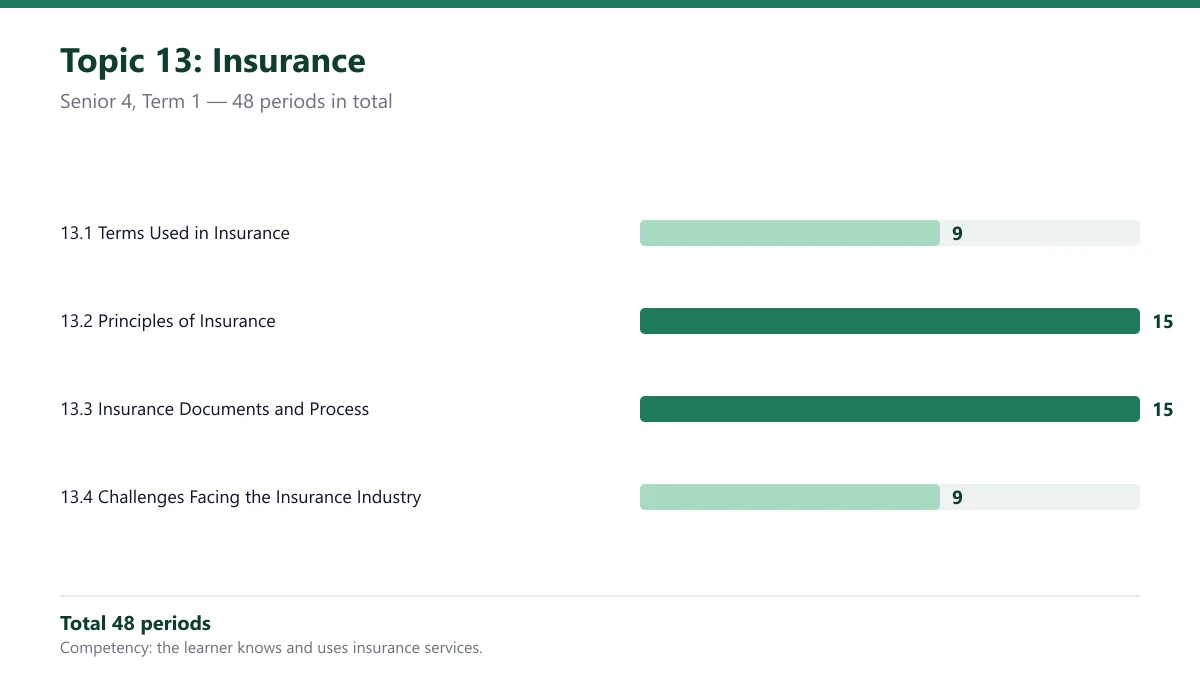
Insurance in Senior 4 Entrepreneurship is Topic 13, a 48-period unit taught in Term 1 under the theme Business Support. The topic’s competency states that “the learner knows and uses insurance services.” The four sub-topics below carry a teacher through terms, principles, documents and process, and industry challenges.
- 48 periods — Topic 13 fills the whole of Term 1 in Senior 4.
- Theme: Business Support, with the competency “The learner knows and uses insurance services.”
- Four sub-topics: 13.1 Terms Used in Insurance (9), 13.2 Principles of Insurance (15), 13.3 Insurance Documents and Process (15), 13.4 Challenges Facing the Insurance Industry (9).
- Outcome codes (u), (k), (v) and (gs) tag every learning outcome.
What is Insurance in Senior 4 Entrepreneurship?
Insurance in Senior 4 Entrepreneurship is the Term 1 topic that teaches learners how insurance works, why it matters, and how to take out and use a policy. It sits under the theme Business Support and carries 48 periods. Its competency is: “The learner knows and uses insurance services.”
This unit sits inside Uganda’s competency-based lower secondary curriculum published by the National Curriculum Development Centre (NCDC). It follows Senior 3, where learners plan a business and record its finances, and it adds the layer of protecting those assets against risk.
After this unit, Senior 4 continues with International Trade in Term 2 and Tax Compliance with Basic Tax Computations in Term 3. The table below shows where the 48-period Insurance unit sits across the whole Senior 4 year.
| Term | Topic | Periods |
|---|---|---|
| Term 1 | Insurance | 48 |
| Term 2 | International Trade | 48 |
| Term 3 | Tax Compliance | 20 |
| Term 3 | Basic Tax Computations | 20 |
| Total | 136 |
This guide is published by Remedial Corner, a Ugandan inclusive-education and revision platform. The period counts and competency below follow the NCDC Curriculum Framework. If you are coming from the previous year, start with the Senior 3 Entrepreneurship syllabus breakdown.
How is the Topic 13 Insurance unit structured?
Topic 13 Insurance is split into four sub-topics totalling 48 periods. Terms Used in Insurance takes 9 periods, Principles of Insurance takes 15, Insurance Documents and Process takes 15, and Challenges Facing the Insurance Industry takes 9. The two middle sub-topics carry the largest share.
| Sub-topic | Title | Periods |
|---|---|---|
| 13.1 | Terms Used in Insurance | 9 |
| 13.2 | Principles of Insurance | 15 |
| 13.3 | Insurance Documents and Process | 15 |
| 13.4 | Challenges Facing the Insurance Industry | 9 |
| Total | 48 |

The two 15-period sub-topics are the heart of the unit. Principles of Insurance gives learners the rules that govern every policy, while Insurance Documents and Process gives them the practical workflow of taking out a policy and settling a claim. The two 9-period sub-topics frame that core: terms at the start, and challenges at the end.
13.1 Terms Used in Insurance (9 periods)
Sub-topic 13.1 opens the unit by making sure every learner speaks the language of insurance. In nine periods it moves from a shared definition of insurance to the basic terms used in insurance and the difference between types of insurance.
What are the learning outcomes for 13.1?
Sub-topic 13.1 has two understanding outcomes, both tagged (u). The learner must understand the meaning and importance of insurance, and must understand the basic terms used in insurance and the difference between types of insurance. Both outcomes are about comprehension rather than recall.
What learning activities teach insurance terms?
The activities begin as a whole class, where learners discuss and agree a definition of insurance. They then work in pairs to explain why insurance is important and what they would insure in their own lives and why. A final activity takes learners out into their local community.
- As a class, discuss and agree what is meant by the term insurance.
- In pairs, tell each other why insurance is important and what they would insure in their own lives and why.
- Discuss examples of where a lack of insurance has led to considerable financial difficulty, and where the need to pay insurance has been a financial burden.
How is 13.1 assessed?
The sample assessment strategy sends learners into their local community. Each learner identifies any two businesses and finds out the importance of insurance to those businesses. This turns the classroom definition into a real-world check that the learner can explain why a business insures itself.
The three activities move in difficulty: a whole-class discussion builds a shared meaning, the pair work makes it personal, and the community task makes it real. By the end of 13.1, a learner can define insurance, explain why it matters, and name the difference between types of insurance.
13.2 Principles of Insurance (15 periods)
Sub-topic 13.2 is the first of the two 15-period blocks and the conceptual core of the unit. Across fifteen periods learners move from appreciating the principles of insurance to understanding its types and classes.
What are the learning outcomes for 13.2?
Sub-topic 13.2 has two outcomes. The first, tagged (u, gs), is to appreciate the principles of insurance. The second, tagged (k), is to understand the types and classes of insurance. The (gs) tag signals that generic skills are built into the outcome.
What activities teach the principles of insurance?
Learners research and discuss the principles of insurance in groups, with guidance from the teacher. They then work in pairs to define each principle with examples. Finally, small groups think critically about how these principles affect the way people live.
- In groups, research and discuss the principles of insurance with guidance from the teacher.
- In pairs, define each principle with examples.
- In small groups, think critically about the effects of these insurance principles on the way people live.
How is 13.2 assessed?
The sample assessment strategy is an individual assignment on the principles of insurance. Each learner is asked to write the assignment, which lets the teacher check that every learner — not just the group — can articulate the principles and their meaning independently.
The (gs) tag matters here: working in groups and pairs builds the generic skills of collaboration and critical thinking while learners master the principles. Because outcome (b) is tagged (k), the types and classes of insurance are checked as knowledge rather than as deep understanding.
13.3 Insurance Documents and Process (15 periods)
Sub-topic 13.3 is the practical half of the unit’s core. Across fifteen periods learners move from knowing the documents used in insurance to walking through the full process of taking out a policy and settling a claim.
What are the learning outcomes for 13.3?
Sub-topic 13.3 has three outcomes. The learner must know the documents used in insurance (k, u), understand the steps to take up an insurance policy (k), and know the steps taken to settle a claim (k, v). The (v) tag brings values into the claims process.
What activities teach the documents and process?
Learners work in groups to research the documents that hold the key features of the insurance process, consider an insurance they would need to take out, and list the steps and documents involved. They then present the process to the class, including the claim steps.
- In groups, research a series of documents that contain the key features for understanding the insurance process.
- In groups, consider an insurance they would need to take out.
- In groups, list the steps needed and the documents that would need to be created.
- Present the process to the class and explain the steps that would need to be taken if a claim was made.
How is 13.3 assessed?
Each learner writes an instruction guide explaining the process someone must follow when taking up an insurance policy and settling a claim. The guide checks both outcomes at once: the documents used in insurance and the steps for taking out and settling a policy.
Working in groups on documents mirrors how insurance is actually arranged, then the class presentation makes the process visible to everyone. The instruction-guide assessment pushes each learner to hold the whole sequence in their own words, from application to claim.
13.4 Challenges Facing the Insurance Industry (9 periods)
Sub-topic 13.4 closes the unit in nine periods. It shifts the lens from the individual policyholder to the whole industry, asking learners to appreciate the challenges facing insurance and to propose possible solutions.
What are the learning outcomes for 13.4?
Sub-topic 13.4 has two outcomes. The learner must appreciate the challenges facing the insurance industry (u, gs) and know the possible solutions to those challenges (u, s). The (s) tag signals a skills outcome, because solutions must be devised, not just named.
What activities explore the industry challenges?
The key activity is an interview: learners interview an insurance broker and ask key questions to identify the challenges facing the industry and suggest possible solutions. Learners then prepare a summary of learning about insurance that outlines those possible solutions.
- Interview an insurance broker and ask key questions to identify the challenges facing the insurance industry and suggest possible solutions.
- Prepare a summary of learning about insurance, outlining possible solutions to the challenges the insurance industry faces.
How is 13.4 assessed?
Assessment is observation-based. The teacher observes how well learners write an assignment that incorporates the key features of the challenges facing the insurance industry, and how convincingly they connect those challenges to possible solutions. This checks both outcomes in one written product.
The broker interview brings a real practitioner into the lesson, which is exactly what a Business Support theme intends. Learners leave 13.4 able to name the challenges facing insurance and to suggest solutions, satisfying both outcomes in one short block.
How do the four sub-topics build across the 48 periods?
The four sub-topics form a single learning arc across 48 periods. Terms in 13.1 give learners the language, Principles in 13.2 give the rules, Documents and Process in 13.3 give the workflow, and Challenges in 13.4 give the critical view. Each stage assumes the one before it.
- 13.1 Terms Used in Insurance (9 periods) — define insurance and learn its language.
- 13.2 Principles of Insurance (15 periods) — learn the principles and the types and classes.
- 13.3 Insurance Documents and Process (15 periods) — learn the documents, the policy steps and the claim steps.
- 13.4 Challenges Facing the Insurance Industry (9 periods) — critique the industry and propose solutions.
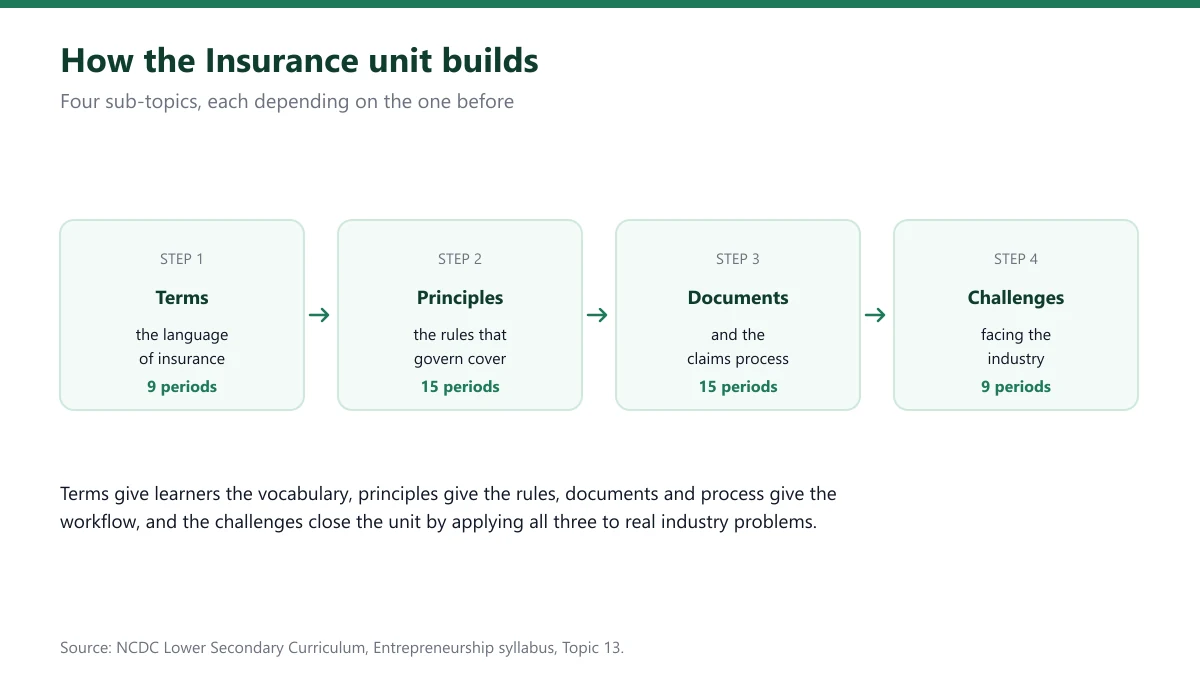
This sequence mirrors the competency itself. “The learner knows and uses insurance services” requires knowledge first (terms and principles), then use (documents and process), then judgement (challenges and solutions). The period split reflects that: knowing and using take the two 15-period blocks, while framing takes the two 9-period blocks.
How should a teacher plan the whole Insurance unit?
Teachers should base lesson plans on the learning outcomes, using the suggested learning activities only as a guide. The syllabus says these are not the only possible activities, and teachers are encouraged to extend them and devise their own that suit the needs of their class.
Teachers should base their lesson plans on the Learning Outcomes using the Suggested Learning Activities as a guide. These are not the only possible learning activities, teachers are encouraged to extend these and devise their own that are appropriate to the needs of their class.
The syllabus sets out each sub-topic in three columns: Learning Outcomes, Suggested Learning Activities, and Sample Assessment Strategy. The Learning Outcomes are the objectives, the activities are ideas for the lesson body, and the assessment strategy shows how to check understanding. For 13.3, the outcomes name documents and steps, the activities build the documents in groups, and the assessment is the written instruction guide.
- Write objectives from the Learning Outcomes column.
- Choose or adapt activities from the Suggested Learning Activities column.
- Select a check from the Sample Assessment Strategy column.
- Match assessment to outcome so the three columns stay aligned.
Because the activities are guidance rather than a fixed script, a teacher can adapt them for mixed abilities. A pair discussion on why insurance matters works for learners who struggle with writing, and an oral question-and-answer can replace a written test without changing the learning outcome.
| Code | Meaning | What it tells a teacher |
|---|---|---|
| (k) | Knowledge — the retention of information | Check with a written question or naming task |
| (u) | Understanding — putting knowledge into a framework of meaning | Ask learners to explain, compare or outline |
| (s) | Skills — the ability to perform a mental or physical operation | Observe the skill or look at its product |
| (v) | Values — behaviours or actions that form character | Observe over time rather than mark |
| (gs) | Generic skills — skills deployed in all subjects | Assess within the subject work itself |
In Topic 13 the codes spread across all four sub-topics: 13.1 is entirely (u), 13.2 mixes (u, gs) and (k), 13.3 mixes (k, u), (k) and (k, v), and 13.4 mixes (u, gs) and (u, s). Reading the codes therefore tells a teacher exactly how to assess each outcome.
Two wider rules frame all this planning. The final examination at the end of Senior 4 focuses on a learner’s ability to apply learning in new situations rather than recall information, and the summative teacher assessment contributes 20% to the final School Leaving Certificate grade.
For worked classroom material on the insurance process, the O-Level Entrepreneurship Education textbook expands on this content alongside the syllabus.
Frequently asked questions about Senior 4 Insurance
Teachers and parents planning the Topic 13 unit most often ask these questions. Each answer below is self-contained, so you can read any one on its own.
“The learner knows and uses insurance services.” — the Topic 13 competency that every sub-topic below works towards.
Is Insurance a Senior 4 or Senior 3 topic?
Insurance is a Senior 4 topic. It is Topic 13 in the Senior 4 Entrepreneurship syllabus, taught in Term 1 under the theme Business Support. Senior 3 covers Business Planning and Introduction to Principles of Accounting instead, so insurance begins in Senior 4.
How many periods is Insurance in Senior 4 Entrepreneurship?
Insurance in Senior 4 Entrepreneurship is allocated 48 periods in Term 1. The four sub-topics split those periods as 9 for Terms Used in Insurance, 15 for Principles of Insurance, 15 for Insurance Documents and Process, and 9 for Challenges Facing the Insurance Industry.
What is the competency for Senior 4 Insurance?
The Topic 13 competency is: “The learner knows and uses insurance services.” It frames all four sub-topics, because a learner must first know insurance terms, principles, documents and process, and then be able to use an insurance service such as taking out a policy.
What are the four sub-topics of Senior 4 Insurance?
The four sub-topics are Terms Used in Insurance (9 periods), Principles of Insurance (15 periods), Insurance Documents and Process (15 periods), and Challenges Facing the Insurance Industry (9 periods). Together they total the 48 periods that make up Topic 13 in Term 1.
What topics follow Insurance in Senior 4?
After Insurance, Senior 4 continues with International Trade (48 periods) in Term 2, then Tax Compliance (20 periods) and Basic Tax Computations (20 periods) in Term 3. The full Senior 4 year therefore totals 136 periods across the three terms.
For more subject breakdowns, browse the Remedial Corner blog, and read about Remedial Corner to meet the team behind these guides.
Sources and further reading
The sources behind this article, and where to read further.
- NCDC Curriculum Framework (ncdc.go.ug)
- O-Level Entrepreneurship Education textbook (ura.go.ug)



Leave a Reply