

The top special needs schools in Uganda include St. Helen’s Primary School in Mbarara, Hornby High School in Kabale, Saad Memorial Secondary School in Kasese, Kampala School for the Physically Handicapped, Wakiso School for the Deaf, and St. Francis School for the Blind Madera in Soroti. This page lists all 16 institutions by region and disability focus.
The author, Akankwatsa Andrew OBA, is a former pupil of St. Helen’s Primary School and now works in special needs education. The list below draws on his first-hand knowledge of Uganda’s inclusive schools and the educators who built them.
- 16 schools profiled across Kampala/Central, Western, Northern, Eastern and West Nile regions.
- Five school types: visually impaired, deaf and hard of hearing, physical disabilities, inclusive, and vocational.
- Four educators acknowledged for building these units: TR. Muzammil Ali, MR. Owinyi Keneth, Francis Kinubi and TR. Ayoli Moses.
- Details change — confirm current programmes, fees and admission directly with each school or the Ministry of Education.
The 16 special needs schools compared at a glance
The table below gathers all 16 schools into one scannable view, showing the location, type and primary disability focus of each. Use it to shortlist schools before reading the fuller profiles further down.
| School | Location / region | Type | Primary disability focus |
|---|---|---|---|
| St. Helen’s Primary School | Mbarara City (Western) | Inclusive girls’ boarding | Visual impairment |
| Hornby High School | Rugarama Hill, Kabale District (Western) | Inclusive secondary | Visual impairment |
| Hornby High School Junior | Western Uganda (about 150 km from Hornby High School) | Girls’ school with braille section | Visual impairment |
| St. Peter’s Secondary School | Not stated in source | Inclusive secondary | Visual impairment |
| Saad Memorial Secondary School | Kasese District (Western) | All-inclusive secondary | Multiple disabilities |
| Iganga Girls Secondary School | Iganga District (Eastern) | Inclusive girls’ secondary | Visual impairment |
| Sir Apollo Kagwa Secondary School | Mukono (Central) | Secondary, low-budget option | Not stated in source |
| Mvara Secondary School | Arua City (West Nile) | Mixed boarding and day | Visual impairment |
| Gulu High School | Gulu City (Northern) | Mixed boarding | Visual impairment |
| Kampala School for the Physically Handicapped | Kampala (Central) | Special school with vocational training | Physical disability |
| Wakiso School for the Deaf | Wakiso District (Central) | Special school | Deaf and hard of hearing |
| Salama School for the Blind | Mukono District (Central) | Special school | Visual impairment |
| St. Francis School for the Blind Madera | Soroti (Eastern) | Special school with vocational training | Visual impairment |
| Ngora School for the Deaf | Ngora District (Eastern) | Special school | Deaf and hard of hearing |
| Mulago School for the Deaf | Kampala (Central) | Special school | Deaf and hard of hearing |
| Butabika School of Psychiatric Nursing | Kampala (Central) | Nursing school with support initiatives | Psychiatric conditions |
School details change over time. Confirm current programmes, fees, admission and transport directly with the school, or with the Ministry of Education, before making decisions.
Special needs schools in Uganda by region
A parent’s first question is usually what is near home. The grouping below sorts the 16 schools by the region the source places them in, so you can start with the schools closest to you.
Central / Kampala — 6 schools
- Kampala School for the Physically Handicapped — Kampala
- Mulago School for the Deaf — Kampala
- Butabika School of Psychiatric Nursing — Kampala
- Salama School for the Blind — Mukono District
- Sir Apollo Kagwa Secondary School — Mukono
- Wakiso School for the Deaf — Wakiso District
Western — 4 schools
- St. Helen’s Primary School — Mbarara City
- Hornby High School — Rugarama Hill, Kabale District
- Hornby High School Junior — Western Uganda, about 150 km from the senior school
- Saad Memorial Secondary School — Kasese District
Eastern — 3 schools
- Iganga Girls Secondary School — Iganga District
- St. Francis School for the Blind Madera — Soroti
- Ngora School for the Deaf — Ngora District
Northern — 1 school
- Gulu High School — Gulu City
West Nile — 1 school
- Mvara Secondary School — Arua City
Location not stated — 1 school
- St. Peter’s Secondary School — provides inclusive education for learners with visual impairments
A closer look at each special needs school
The profiles below keep each school’s name, town and region exactly as recorded. Where a view is an assessment rather than a verified fact, it is written as such — for example, “widely regarded as”.
St. Helen’s Primary School
Located in Mbarara City, St. Helen’s Primary School has pioneered inclusive primary education since 1976. This girls’ boarding school excels at supporting visually impaired learners, and its alumni include Andrew Akankwatsa, founder of Remedial Corner, and Boas, a former boss at Open Society in East Africa.
Hornby High School
Situated at Rugarama Hill in Kabale District, Hornby High School has educated visually impaired and non-visually impaired students side by side since 1981. Its graduates include Andrew Akankwatsa of Remedial Corner and Ninsiima Magret of Standard Chartered Bank.
Hornby High School Junior
Hornby High School Junior lies about 150 km from its senior counterpart and was established in 1923 by Constance Hornby to promote girls’ education. A braille section followed in 1969, thanks to the Late David Tindyeebwa. Alumni include counsellor Bright Nkwasibwe and literature teacher Arinaitwe Catherine.
St. Peter’s Secondary School
St. Peter’s Secondary School provides inclusive education for learners with visual impairments. Its notable alumni include teacher Patrick Ssekyondwa, Muwonge Alex and Didas Tumuhimbise, and though the school is relatively new, its annex is growing rapidly in prominence.
Saad Memorial Secondary School
Along the Mpondwe–Fort Portal Road at Kiburara Trading Centre in Kasese District, Saad Memorial Secondary School is widely regarded as one of Uganda’s best all-inclusive secondary schools. Established in 2011, it traces its history to 1974 as the first secondary school in Kasese District, and it is the only special needs school with a Muslim foundation.
Iganga Girls Secondary School
Found in Iganga District in eastern Uganda, Iganga Girls Secondary School was founded by the Church of Uganda and provides inclusive education for visually impaired students. Its blind unit is hailed for producing countless notable visually impaired personalities, including TR. Ronald Kamusiime and lawyer Alex Lukwago, and it inspired other units across eastern Uganda.
Sir Apollo Kagwa Secondary School
Located in Mukono, on the outskirts of Kampala, Sir Apollo Kagwa Secondary School offers a conducive learning environment suited to families on a low budget. Its specific disability focus is not stated, so parents should confirm the current arrangements directly with the school.
Mvara Secondary School
Mvara Secondary School in Arua City is a West Nile mixed boarding and day school for visually impaired students, and one of the region’s traditional schools. Its unit is developing rapidly, credit to TR. Muzammil Ali.
Gulu High School
Situated in Gulu City, Gulu High School is a mixed boarding school for visually impaired students, widely regarded as the best in Northern Uganda. It is renowned for its rapid advancement in assistive technology, thanks in large part to MR. Owinyi Keneth.
Kampala School for the Physically Handicapped
This Kampala school is specifically designed for students with physical disabilities and provides both academic and vocational training, helping learners build practical skills alongside their studies.
Wakiso School for the Deaf
Located in Wakiso District, Wakiso School for the Deaf serves deaf and hard-of-hearing students, focusing on both sign language and written communication.
Salama School for the Blind
Situated in Mukono District, Salama School for the Blind caters to visually impaired students with specialised education tailored to their needs. It was established by Francis Kinubi, one of Uganda’s best blind educators.
St. Francis School for the Blind Madera
Located in Soroti, St. Francis School for the Blind Madera provides education and vocational training that equips visually impaired learners with skills to lead independent lives. It is the earliest special school started in Uganda, and the author’s own view, as a former pupil, is that it is arguably the best school for visually impaired children in the country. Prominent old students include TR. Ayoli Moses.
Ngora School for the Deaf
Ngora School for the Deaf in Ngora District offers comprehensive programmes for deaf and hard-of-hearing students, promoting both academic achievement and vocational skills.
Mulago School for the Deaf
Based in Kampala, Mulago School for the Deaf is dedicated to educating deaf children, focusing on communication skills and vocational training.
Butabika School of Psychiatric Nursing
Primarily a nursing school in Kampala, Butabika School of Psychiatric Nursing offers programmes and initiatives aimed at supporting children with psychiatric conditions and raising awareness about mental health in education.
The five types of special needs schools in Uganda
Uganda’s special needs provision falls into five broad types. The chart below shows them, and the list matches each type to schools named on this page.

- Schools for the visually impaired use braille as the main medium of instruction, with tactile maps, audio books and specialised software. Examples: Salama School for the Blind, St. Francis School for the Blind Madera.
- Schools for the deaf and hard of hearing teach through sign language and written communication. Examples: Wakiso School for the Deaf, Ngora School for the Deaf, Mulago School for the Deaf.
- Schools for students with physical disabilities provide accessible facilities, therapy and adaptive education. Example: Kampala School for the Physically Handicapped.
- Inclusive schools integrate learners with and without disabilities in one classroom — the model behind how inclusive education empowers all students. Examples: Hornby High School, St. Peter’s Secondary School, Saad Memorial Secondary School.
- Vocational and technical schools teach practical skills such as tailoring, carpentry, computer skills and agriculture for employability. Examples: St. Francis School for the Blind Madera, Kampala School for the Physically Handicapped.
How the 16 schools distribute across Uganda’s regions
Of the 16 institutions listed here, six sit in the Central/Kampala area, four in the Western region, three in the Eastern region, one in the Northern region and one in West Nile. One school’s location is not stated in the source, so it is shown separately below.
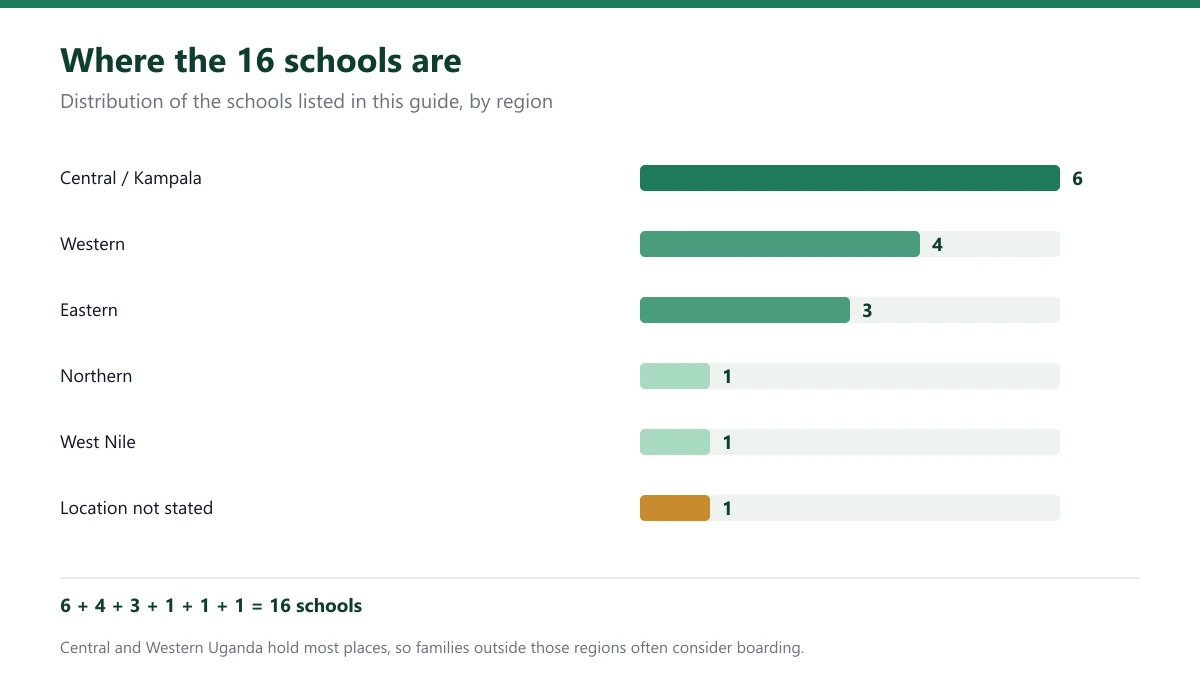
- Central / Kampala — 6 schools
- Western — 4 schools
- Eastern — 3 schools
- Northern — 1 school
- West Nile — 1 school
- Location not stated — 1 school
Why special needs schools matter
Special needs schools in Uganda matter because they give learners with disabilities the support a mainstream classroom often cannot. If you are new to the subject, start with our guide to what inclusive education means in Uganda, then consider the seven contributions below.
- Tailored education — teaching, materials and curricula adapted to each learner’s needs.
- An inclusive environment — learners with and without disabilities study together, reducing stigma.
- Specialised support — speech and language therapy, occupational therapy, counselling and mobility training.
- Independence and life skills — vocational training and daily-living skills for independent futures.
- Advocacy and awareness — speaking up for disability rights and reshaping public attitudes.
- Parental support — involving families so learning continues at home.
- Bridging education gaps — reaching children who might otherwise miss out on school.
How to choose a special needs school in Uganda
Choosing among the special needs schools in Uganda is a decision you make in stages, not a single leap. The flow below turns the choice into steps, and the checklist and questions that follow give you a practical way to compare schools on a visit.
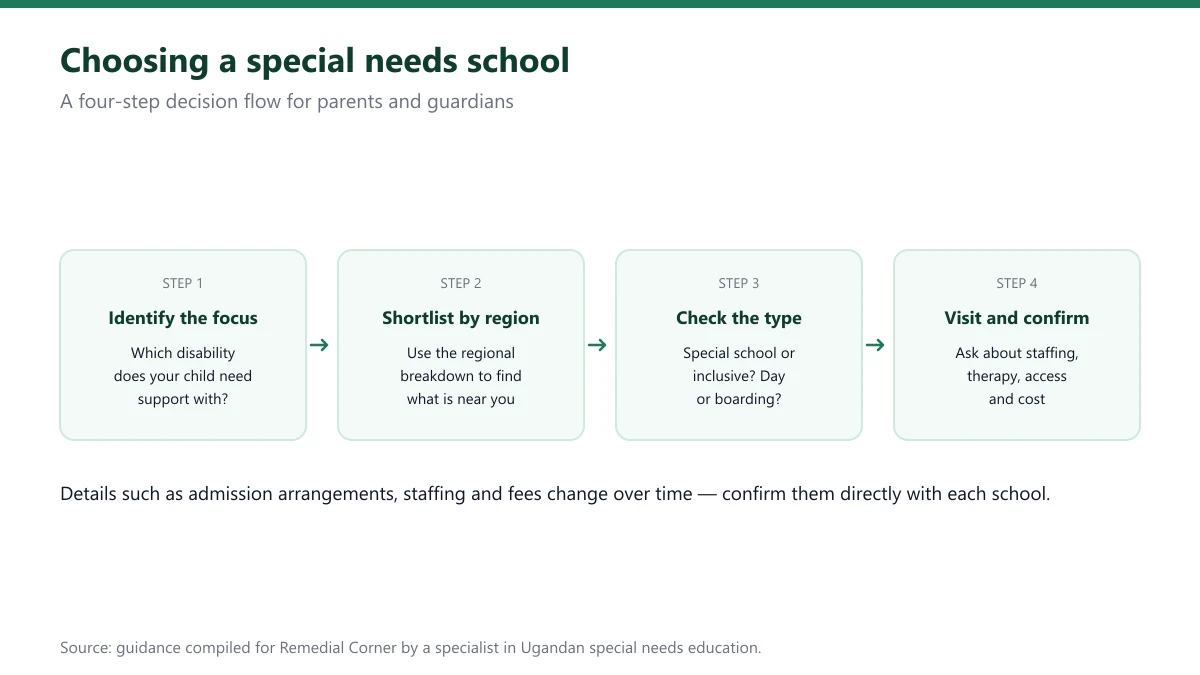
- Identify the disability focus your child needs, using the five types above.
- Shortlist schools near you using the regional breakdown.
- Check whether the school’s type and focus still match your need — details change.
- Decide between day and boarding, especially if distance is a factor.
- Visit the school and observe a lesson, the facilities and how staff interact with learners.
- Ask the questions below and write down the answers.
- Confirm fees, admission requirements and transport directly with the school.
- Cross-check with the Ministry of Education if anything is unclear.
Questions to ask on a visit:
- How are learners assessed and placed?
- What special needs training do the teachers hold?
- Which support services are available — speech therapy, mobility training or counselling?
- How does the school involve parents in each child’s learning plan?
- What vocational or transition skills are taught for life after school?
While you weigh the answers, look for what makes a teacher effective in an inclusive classroom, and ask what the school is doing about promoting teacher training for inclusive education. Also remember the role of parents in a child’s education — a school that welcomes you is a school that will support your child.
Uganda’s policy commitment to inclusive education
Uganda is committed to inclusive education as a national goal, so that children with disabilities learn alongside their peers with the right support. The Ministry of Education and Sports oversees the system, while the National Curriculum Development Centre shapes the curriculum these schools deliver.
Provision is still uneven, and the common challenges facing inclusive education remain real for many families. International guidance, such as UNESCO’s work on inclusion in education, frames the same goal Uganda is working toward.
Inclusive education means every child learns with the right support, in the least restrictive setting available — a goal Uganda pursues through these schools and its national curriculum.
What to do if the nearest school is far away
Distance is one of the biggest barriers a family faces. Several schools on this list are boarding — including St. Helen’s Primary School, Hornby High School, Mvara Secondary School and Gulu High School — which removes the daily journey. Where boarding is not an option, consider the alternatives below.
- Choose a boarding school so your child stays near support during the term.
- Ask about a special needs unit in a nearby mainstream school — many host them.
- Coordinate transport with other families travelling the same route.
- Ask the Ministry of Education about the nearest unit or outreach programme.
Families who live far from a specialist school can also lean on local support networks. Read about strengthening community involvement in inclusive education to see how neighbours, teachers and parents can share the load.
Frequently asked questions about special needs education in Uganda
Always confirm the current position with the school or the Ministry of Education, because programmes, fees and admission arrangements change over time.
What are the top special needs schools in Uganda?
Uganda’s leading institutions include St. Helen’s Primary School in Mbarara, Hornby High School in Kabale, Saad Memorial Secondary School in Kasese, Kampala School for the Physically Handicapped, Wakiso School for the Deaf, and St. Francis School for the Blind Madera in Soroti. All sixteen appear above, grouped by region.
What types of special needs schools are available in Uganda?
Uganda has five main types: schools for the visually impaired, schools for the deaf and hard of hearing, schools for students with physical disabilities, inclusive schools, and vocational and technical schools. Several institutions combine more than one of these roles, such as education plus vocational training.
How do schools for the visually impaired support their students?
Schools for the visually impaired use braille as the primary medium of instruction and provide tactile maps, audio books and specialised computer software. They also teach orientation and mobility skills so learners can move independently, supporting both academic progress and everyday life.
Are there schools in Uganda for deaf and hard-of-hearing students?
Yes. Wakiso School for the Deaf, Ngora School for the Deaf and Mulago School for the Deaf all serve deaf and hard-of-hearing learners. They teach sign language and written communication, and several combine this with vocational skills so learners leave with both academic and practical abilities.
How can I find a special needs school in Uganda?
Contact the Uganda Ministry of Education and Sports or reach out directly to the schools listed on this page. Because programmes, fees and admission arrangements change, always confirm the current position with the school or the Ministry before making travel or enrolment decisions.
Why are special needs schools important?
Special needs schools provide tailored education, an inclusive environment and specialised support such as speech therapy and mobility training. They teach life skills and independence, involve parents, and bridge gaps so children with disabilities can learn, grow and contribute like every other learner.
Where to go next
This list is part of Remedial Corner’s coverage of inclusive education in Uganda. To go deeper, look ahead with our guide to the future of inclusive education in Uganda.
Browse the Remedial Corner blog for more, or read about Remedial Corner and its founder, Akankwatsa Andrew OBA.
Sources and further reading
The sources behind this article, and where to read further.
- Ministry of Education and Sports (education.go.ug)
- National Curriculum Development Centre (ncdc.go.ug)
- UNESCO’s work on inclusion in education (unesco.org)





Leave a Reply