
A farming system is the way a farmer combines land, labour, capital and crops or livestock to produce food or income. Uganda runs several farming systems side by side, from small subsistence plots to large commercial estates and cattle ranches. This post classifies the main farming systems in Uganda, compares their characteristics, and shows how to choose the right one for a Ugandan farm.
The NCDC Agriculture Syllabus (2019) records that more than 70% of Uganda’s population is directly involved in agricultural production, with over half of these people in the subsistence sector, and that farming contributes over 25% of gross domestic product (GDP). Uganda’s tax authority adds that farming is practised on either a commercial or a subsistence basis (URA, A Guide to Taxation of the Agricultural Sector, FY 2025/26).
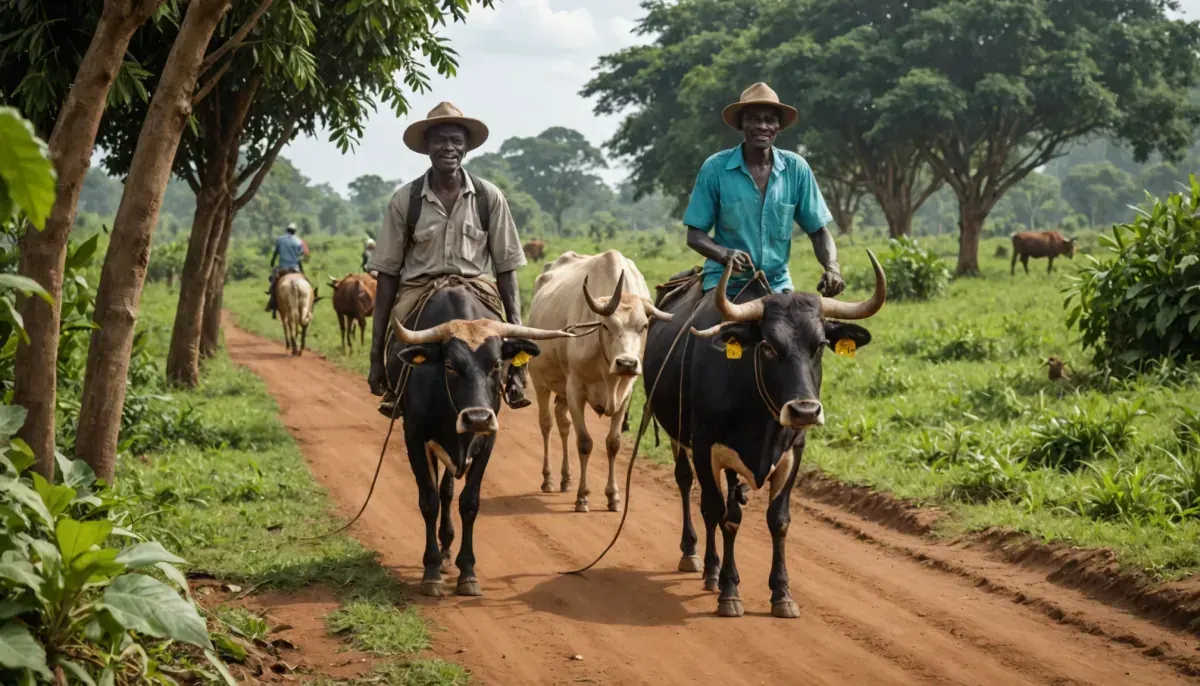
Meaning of a farming system
A farming system is the organised way a farmer uses land, labour, capital, water and knowledge to produce crops, livestock, or both. It is not just a list of crops; it is the whole pattern of inputs, activities and outputs on a holding. The same district in Uganda can host several different farming systems at once.
- Definition — A farming system is the combination of land, labour, capital, crops, livestock and management that a farmer uses to produce food and income.
- System, not a single practice — The term describes the whole farm pattern, covering what is grown, what is reared, and how labour and tools are organised.
- Land is the base — Every farming system starts from land, and its size, slope, soil and rainfall shape which system will actually work.
- Labour is the engine — Family labour powers most subsistence farming, while hired workers power commercial and plantation systems.
- Capital changes the system — Money for seed, fertiliser, machinery and irrigation is the main thing that separates commercial farming from subsistence farming.
- Crops or livestock — A system can be crop-based (arable), livestock-based (pastoral), or a blend of the two, which is mixed farming.
- Why classification matters — Classifying a farming system helps a farmer pick suitable techniques, plan the right inputs and compare expected output.
- The examiner’s angle — The NCDC syllabus expects a learner to describe each system and link it to the resources the farmer has.
- Subsistence is the majority — Most Ugandan households farm mainly to feed their own families before selling any surplus they may have.
- Commercial aims at profit — A commercial system produces for the market and is planned around buyers, prices and profit rather than household need.
- One farm, one dominant system — In an exam, describe the dominant system on a farm even if the household mixes in a little of another.
- Systems can shift — A farmer can move from subsistence toward commercial by adding capital, better seed and reliable market access.
- Climate sets the limits — Rainfall and temperature decide whether a region suits crops, livestock, or both, before any other factor.
- Meaning versus type — “Farming system” describes how production is organised, while “type” such as subsistence or commercial is the label given to that organisation.
Exam tip: When asked to define a farming system, give the definition first, then name the resources it combines (land, labour, capital, management), and finish with one Ugandan example.
Types of farming systems in Uganda
Uganda’s farming systems fall into six main types: subsistence, commercial, mixed, plantation, pastoral and organic. Each type is defined by its main aim — feeding the family or selling for profit — and by what it produces. The table below summarises what each system is and where it is common in Uganda.
| Farming system | What defines it | Where it is common in Uganda |
|---|---|---|
| Subsistence farming | Small plots farmed mainly to feed the family, using hand tools and family labour, with surplus sold only when it exists. | Widespread across rural Uganda, where most households grow bananas, beans and maize. |
| Commercial farming | Larger farms that grow crops or rear animals mainly for sale, using improved seed, inputs and machinery. | Near markets and towns, and in high-rainfall crop belts producing tea, coffee and sugar cane. |
| Mixed farming | One farm combines crop growing with livestock rearing, so manure fertilises crops and crop residues feed animals. | Common across central and western Uganda where households keep cattle alongside their crops. |
| Plantation farming | Large estates growing a single cash crop, usually for processing or export, with hired labour and central management. | Tea and sugar cane estates, concentrated where rainfall and processing factories support them. |
| Pastoral farming | Rearing cattle, goats and sheep on natural pasture, often moving with the seasons for water and grass. | The semi-arid cattle corridor, especially Karamoja, which holds the country’s largest cattle population. |
| Organic farming | Growing crops and animals using natural inputs and methods, without synthetic pesticides or fertilisers. | A growing trend among Ugandan farmers aiming for sustainable, premium-priced produce. |
| Arable farming | Growing crops only, with no livestock, on tilled or planted land. | High-rainfall crop regions producing maize, beans, bananas and vegetables. |
- Subsistence farming — Grows food mainly for the family table; common crops are bananas, beans and maize, and any surplus is sold locally.
- Commercial farming — Produces for sale on a larger scale; key Ugandan products are tea, coffee and sugar cane, often using machinery and improved techniques.
- Mixed farming — Joins crops and livestock on one holding so income is diversified and household food security improves.
- Plantation farming — Is commercial farming taken to estate scale, where one cash crop such as tea or sugar cane is grown for processing or export.
- Pastoral farming — Rears cattle, goats and sheep, mainly in semi-arid regions, and is the dominant system in the cattle corridor; herd management is covered under cattle management systems.
- Organic farming — Relies on natural inputs and methods and is a growing trend among farmers targeting sustainable agriculture.
- Arable farming — Means crops only, with no livestock, and suits districts with reliable rain and good crop markets.
- Karamoja’s pastoralism — UBOS’s 2021 National Livestock Census recorded 14.5 million cattle nationally, with Karamoja holding the most at about 2.4 million (16.7%).
- The cattle corridor — A belt across Uganda’s drier districts where pastoral and agropastoral systems concentrate because rainfall is too low for reliable crops.
- Sedentary versus nomadic — Pastoral systems can be sedentary (settled) or transhumant, where herders move in drier months to find water and pasture (MAAIF, 2025).
- Intensive versus extensive — Systems also differ by the scale of inputs: intensive farming draws high output from small land, while extensive farming spreads low inputs over large land.
- Distinguish, do not merge — In an exam keep “commercial” (aiming at sale) separate from “plantation” (a single cash crop on an estate), because the two are not identical.
- One family, several systems — A single Ugandan household may run a subsistence food plot beside a commercial cash crop, so an answer should name the dominant system.

Exam tip: List all six systems in order, then give each one a Ugandan crop or animal and one region. Marks follow the pattern: name, define, example.
Characteristics of subsistence and commercial farming
Subsistence and commercial farming sit at opposite ends of the same scale: the first aims at feeding the household, the second at selling for profit. These are the two most widespread farming systems in Uganda, and their characteristics differ in almost every way. The table sets them side by side.
| Characteristic | Subsistence farming | Commercial farming |
|---|---|---|
| Main aim | Feed the family | Sell for profit |
| Plot size | Small, often only a few acres | Large fields or estates |
| Labour | Family labour | Hired workers |
| Tools | Hand tools such as the hoe and panga | Machinery and improved tools |
| Inputs | Little or no fertiliser, local seed | Improved seed, fertiliser and agrochemicals |
| Capital | Low | High |
| Output | Small and mostly consumed at home | Large and mostly marketed |
| Crops and animals | Bananas, beans, maize and a few animals | Tea, coffee, sugar cane, dairy or beef herds |
| Record keeping | Little or none | Detailed production and financial records |
| Risk | Low financial risk, higher food risk | Higher financial risk, higher potential return |
| Surplus | Sold only if it exists | The whole point of production |
- Aim decides the system — Subsistence farming is planned around the family’s food needs, while commercial farming is planned around market demand and price.
- Scale of land — Subsistence plots are small and often fragmented, whereas commercial farms are large, consolidated fields or whole estates.
- Source of labour — Family members, including children after school, do most subsistence work, while commercial farms hire and pay workers.
- Capital intensity — Commercial farming needs capital for seed, fertiliser, machinery and irrigation, but subsistence farming runs on very little money.
- Level of technology — Subsistence farms rely on the hand hoe and simple tools, while commercial farms use tractors, improved seed and irrigation.
- Crop mix — Subsistence farms grow several food crops together to spread risk, while commercial farms often specialise in one or two cash crops.
- Purpose of surplus — In subsistence farming the surplus is incidental, but in commercial farming producing a marketable surplus is the entire goal.
- Record keeping — Commercial farms keep production and financial records to guide decisions, while subsistence farms rarely keep written records.
- Output per farm — Total output is far higher on a commercial farm, although output per hectare can be higher on a small, well-tended subsistence plot.
- Risk profile — Commercial farmers risk more capital but earn more in good seasons; subsistence farmers risk less money but face food insecurity in bad seasons.
- Response to price — Commercial farmers plant what the market pays for, while subsistence farmers plant what the family will eat, whatever the price.
- Market access — A commercial system only works where a farmer can reach buyers, transport produce and secure a fair price.
- Scale in Uganda — NCDC notes that more than half of the Ugandans involved in agriculture work in the subsistence sector, so subsistence is the most widespread system.
Advantages and disadvantages of each farming system
Every farming system trades something off. Subsistence farming gives food security at low cost but little cash; commercial farming earns money but risks far more capital. The table below sets subsistence against commercial farming, and the points then extend the comparison to the other systems.
| Aspect | Subsistence farming | Commercial farming |
|---|---|---|
| Advantage — food | Grows the family’s own food, cutting the cost of buying it. | Produces large quantities that widen the national food supply. |
| Advantage — income | Needs very little cash to run. | Generates cash income and foreign exchange from exports. |
| Advantage — employment | Puts family labour to productive use. | Creates paid jobs for many workers. |
| Advantage — inputs | Needs few costly purchased inputs. | Uses improved seed and technology for high yields. |
| Advantage — risk | Low financial risk if a crop fails. | Scale and diversification can spread losses across the farm. |
| Disadvantage — income | Little or no cash surplus for the family. | Needs large capital to start and to run. |
| Disadvantage — market | Little access to markets and better prices. | Depends on markets and can suffer sharp price falls. |
| Disadvantage — scale | Small output limits the chance to grow. | Demands large land and a large labour force. |
| Disadvantage — inputs | Low use of improved seed limits yields. | High input costs for fertiliser and chemicals. |
| Disadvantage — environment | Repeated cropping can degrade the soil. | Monoculture can exhaust soil and spread pests. |
- Subsistence — advantage — Guarantees the family’s daily food, so the household keeps eating even when it earns no money at all.
- Subsistence — disadvantage — Produces little surplus to sell, leaving little cash for school fees, medicine or improving the farm.
- Commercial — advantage — Brings cash income and, for export crops such as coffee and tea, earns foreign exchange for the country.
- Commercial — disadvantage — Needs large capital for land, seed, fertiliser and labour, which most small farmers simply do not have.
- Mixed — advantage — Livestock manure fertilises crops and crop residues feed animals, so the farm recycles its own nutrients.
- Mixed — disadvantage — Splitting land, labour and attention between crops and animals can lower the output of each one.
- Plantation — advantage — Large-scale production and processing create steady jobs and reliable output for factories and export.
- Plantation — disadvantage — A single crop means one disease outbreak or one price slump can hit the whole estate at once.
- Pastoral — advantage — Turns semi-arid grassland that cannot grow crops into meat, milk, hides and income.
- Pastoral — disadvantage — Drought, disease and long movement between water points cause heavy livestock losses.
- Organic — advantage — Natural inputs protect soil and water, and can earn premium prices from health-conscious buyers.
- Organic — disadvantage — Lower yields and higher labour make organic produce more costly to grow in the early years.
- Exam framing — Always pair each system with one advantage and one disadvantage in the same answer, because examiners award both sides of the argument.
Common mistake: Calling commercial farming “better” than subsistence farming. Each system suits a different level of capital and land, so examiners want balanced advantages and disadvantages, not a verdict.
Choosing a farming system for a Ugandan farm
Choosing among the farming systems in Uganda means matching what a farm has — land, capital, labour and markets — to what each system needs. Six factors decide the choice: land size, capital, labour, market access, climate and risk. The table summarises how each factor points toward a system.
| Factor | What it decides | Which system it favours |
|---|---|---|
| Land size | How much area can actually be farmed. | Small plots favour subsistence or intensive growing; large tracts favour commercial, plantation or extensive pastoral systems. |
| Capital | Money for seed, tools, inputs and machinery. | Low capital favours subsistence; high capital favours commercial or plantation farming. |
| Labour | Who does the work and how many workers there are. | Family labour favours subsistence or mixed; hired labour favours commercial or plantation farming. |
| Market access | Distance to buyers and the prices they offer. | Poor access favours subsistence; good access favours commercial or horticulture. |
| Climate | Rainfall, temperature and the length of dry seasons. | Reliable rain favours crops; semi-arid conditions favour pastoral or agropastoral systems. |
| Risk | Exposure to drought, pests, disease and price swings. | Low capital and risk-averse farmers favour subsistence or mixed; those able to absorb loss favour commercial. |
- Land size first — A family with less than an acre cannot run a commercial maize farm, so it chooses subsistence or intensive market gardening.
- Capital follows land — Without money for improved seed and fertiliser, even a large plot stays a low-yielding subsistence farm.
- Labour supply — A system that needs many hands, such as vegetable growing or dairying, only works where workers are available and affordable.
- Market access decides profit — A farmer near a town or tarmac road can sell fresh produce, while a remote farmer grows only what survives the journey to market.
- Climate is the gatekeeper — In the semi-arid cattle corridor rainfall is too low for reliable crops, so pastoralism dominates the landscape.
- Risk tolerance — A subsistence farmer avoids debt because one drought would be ruinous, while a commercial farmer borrows and insures against loss.
- Match crop to climate — Moisture-loving crops such as bananas suit wetter districts, while drier districts turn to livestock, so climate narrows the realistic choices.
- Start small, then grow — A common Ugandan path is to begin with subsistence farming, then add a cash crop as capital and market access improve.
- Mixed as a middle path — Where rainfall is adequate and land is moderate, mixed farming spreads risk between crops and animals.
- Follow the syllabus — The Senior 3 Agriculture notes link cattle production, feed making, pasture, hydroponics and farm economics, and each topic influences the system you choose.
- Test against a real farm — Before choosing, list the farm’s land, capital, labour and market, then match them to one system in the types table.
- Price and demand — A farmer should check what buyers actually want — maize, milk, vegetables or beef — before committing land to a system.
- Revisit the choice — As capital, roads and buyers change, the best system changes too, so the decision is made each season, not once.
Exam tip: For a “choose a system” question, name the system, then support it with at least two factors (land size, capital, market or climate) and one Ugandan example.
Frequently asked questions about farming systems in Uganda
- What are the main farming systems in Uganda? Uganda’s main farming systems are subsistence, commercial, mixed, plantation, pastoral and organic farming. Subsistence farming is the most widespread, with households growing food for their own families, while commercial and plantation systems grow cash crops such as tea, coffee and sugar cane for sale.
- What is the most common farming system in Uganda? Subsistence farming is the most common system in Uganda. Most households grow crops and rear a few animals mainly for their own consumption, selling only a small surplus. NCDC notes that over half of the Ugandans involved in agriculture work in the subsistence sector.
- How does subsistence farming differ from commercial farming? Subsistence farming grows food for the family on small plots using hand tools, family labour and little capital. Commercial farming produces for sale on large fields using hired labour, improved seed, machinery and inputs, and it is planned around profit and market demand.
- Where is pastoral farming most common in Uganda? Pastoral farming is most common in the semi-arid cattle corridor, especially Karamoja. UBOS’s 2021 National Livestock Census recorded 14.5 million cattle nationally, with Karamoja holding about 2.4 million, the largest share at 16.7%. Herders rear cattle, goats and sheep on natural pasture.
- What are the advantages of commercial farming in Uganda? Commercial farming creates paid jobs, produces large quantities of food for the market, and earns cash income and foreign exchange from exports such as coffee and tea. Its main disadvantages are the large capital it needs and its exposure to market price changes.
- How do I choose the right farming system for my farm? Match the farm’s resources to the system. Check land size, available capital, labour, market access, climate and risk. Small plots with little money suit subsistence or intensive growing; large land and capital suit commercial or plantation systems; semi-arid land suits pastoralism.
Key terms and revision summary
This revision summary ties the farming systems in Uganda together so you can revise fast. Learn the glossary, then attempt the exam-style questions below and check your answers against the outlines.
| Term | Definition |
|---|---|
| Farming system | The organised way land, labour, capital and knowledge are combined to produce crops or livestock. |
| Subsistence farming | Growing food mainly for the family’s own consumption, with little surplus for sale. |
| Commercial farming | Producing crops or livestock mainly for sale and profit, using hired labour and improved inputs. |
| Mixed farming | Combining crop growing with livestock rearing on the same farm. |
| Plantation farming | Growing a single cash crop on a large estate, usually for processing or export. |
| Pastoral farming | Rearing cattle, goats and sheep on natural pasture, often in semi-arid regions. |
| Organic farming | Producing using natural inputs and methods, without synthetic pesticides or fertilisers. |
| Arable farming | Growing crops only, with no livestock. |
| Cattle corridor | Uganda’s drier belt where pastoral and agropastoral systems concentrate. |
| Transhumance | Seasonal movement of livestock to find water and pasture in drier months. |
Test your understanding with these exam-style questions, then check the answer outlines.
- State four differences between subsistence and commercial farming. Outline: aim (family food versus sale), plot size (small versus large), labour (family versus hired), inputs and capital (low versus high), and output (consumed versus marketed) — any four earn full marks.
- Describe the types of farming systems practised in Uganda. Outline: name subsistence, commercial, mixed, plantation, pastoral and organic, and give one crop or one region for each.
- Explain the factors a farmer considers when choosing a farming system. Outline: land size, capital, labour, market access, climate and risk, each linked to the system it favours.
- Why is pastoral farming common in Karamoja? Outline: Karamoja is semi-arid with low rainfall, so crops fail often while cattle, goats and sheep survive on natural pasture; UBOS records it as holding the country’s largest cattle population.
For further practice, attempt the Agriculture past papers and the Agriculture quiz, then return to the revision courses to close any gaps.



Leave a Reply