
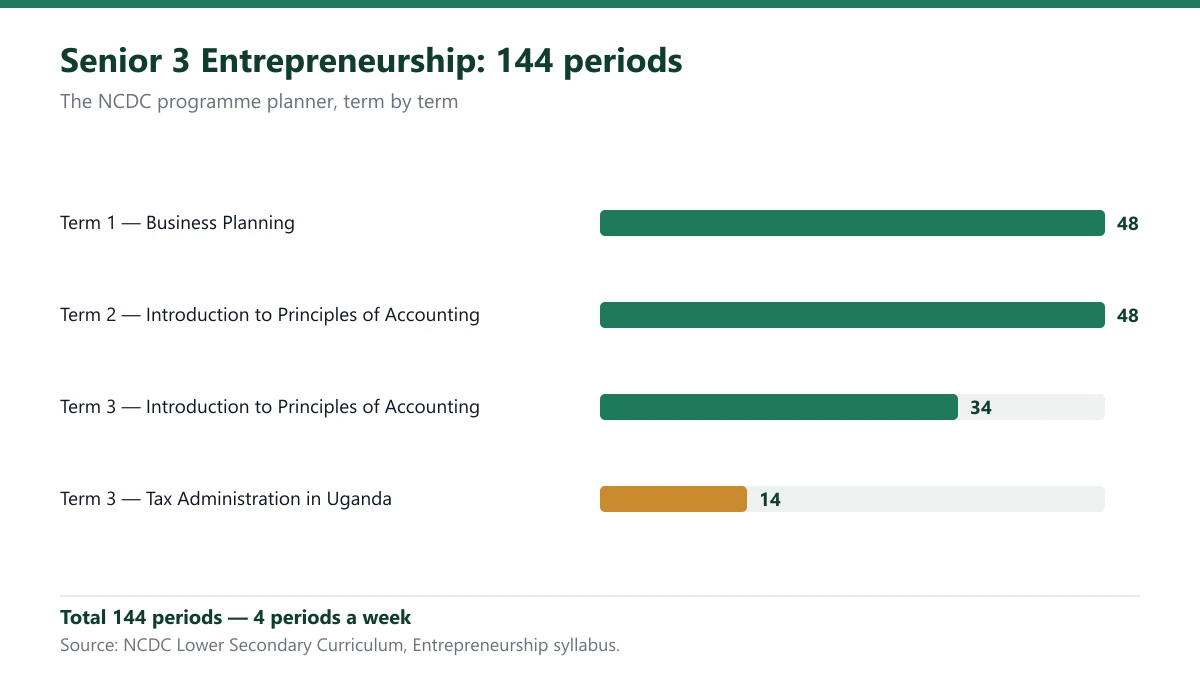
The Senior 3 Entrepreneurship syllabus covers two topics across 144 periods: Business Planning in Term 1, and Introduction to Principles of Accounting across Terms 2 and 3. Tax Administration closes the year as a 14-period unit. The breakdown below covers every sub-topic, its period allocation and its learning outcomes.
- 144 periods total — 48 in Term 1 and 96 across Terms 2 and 3.
- Two topics — Business Planning, then Introduction to Principles of Accounting.
- Four periods a week in Senior 3 and Senior 4.
- Elective in S3–S4, compulsory in S1–S2.
- Outcome codes (k), (u), (s), (v) and (gs) tag every learning outcome.
What is Senior Three Entrepreneurship?
Senior Three Entrepreneurship is the lower secondary Entrepreneurship subject taken in the third year of Uganda’s O-level. It builds on the S1 and S2 topics by teaching learners to plan a business and then to record and report its finances through basic accounting.
The subject sits in Uganda’s competency-based lower secondary curriculum, published by the National Curriculum Development Centre (NCDC). It is an experiential course aimed at deeper understanding: learners develop business ideas, plan a specific enterprise, and then learn the bookkeeping and financial statements a real business needs.
The rationale ties the subject to Uganda’s Vision 2040 and the National Development Plan, building the ability to use emerging and traditional technologies and to extract value from them. The teacher’s role is to build on learners’ existing knowledge and experience, then extend it by posing problems. Learners are expected to think for themselves and become critical thinkers.
Senior 2 leads into this with Legal Forms of Business Ownership, Production in Business, Marketing in an SME, Money and Financial Institutions, and Taxation, so learners arrive in Senior 3 already familiar with business basics.
This guide is published by Remedial Corner, a Ugandan inclusive-education and revision platform. The period counts and competencies below follow the NCDC Curriculum Framework, the official source for the lower secondary curriculum.
How many periods is Senior 3 Entrepreneurship?
Senior 3 Entrepreneurship is allocated 144 periods in total. The planner splits these as 48 periods for Business Planning in Term 1, 48 and 34 periods for Introduction to Principles of Accounting across Terms 2 and 3, and 14 periods for Tax Administration in Term 3.
The Senior 3 Entrepreneurship programme planner sets out the year in four rows. Term 1 belongs entirely to Business Planning, while Terms 2 and 3 carry Accounting and then Tax Administration. The table below shows the exact split.
| Term | Topic | Periods |
|---|---|---|
| Term 1 | Business Planning | 48 |
| Term 2 | Introduction to Principles of Accounting | 48 |
| Term 3 | Introduction to Principles of Accounting | 34 |
| Term 3 | Tax Administration in Uganda | 14 |
| Total | 144 |
At four periods a week, the year divides naturally across the three terms. The subject doubles its weekly load compared with Senior 1 and Senior 2, which allocate two periods a week.
What topics are taught in Senior 3 Entrepreneurship?
Senior 3 Entrepreneurship teaches two topics: Topic 11, Business Planning, in Term 1, and Topic 12, Introduction to Principles of Accounting, in Terms 2 and 3. A shorter Tax Administration unit closes Term 3, but it sits inside Topic 12 as sub-topic 12.8.
The subject moves in one clean arc: first the learner plans a business, then the learner learns to keep its books. Everything in Terms 2 and 3 depends on the planning work done in Term 1, which is why the Senior 3 Entrepreneurship syllabus sequences them in that order.

Topic 11: Business Planning (Term 1)
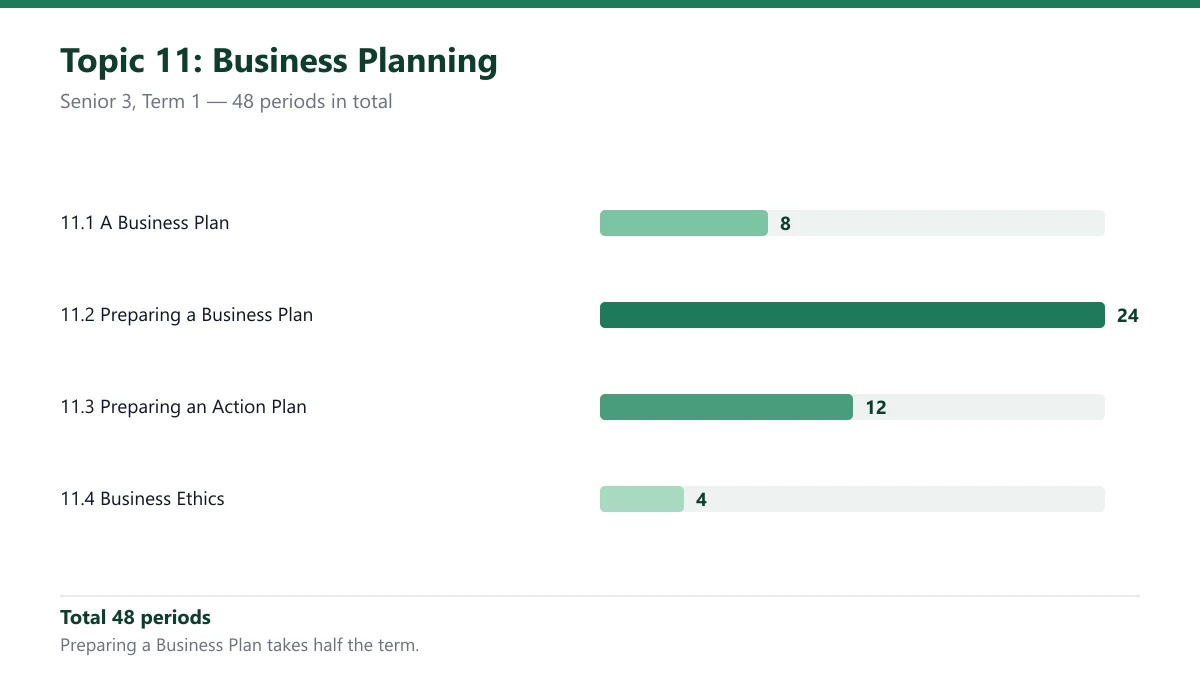
Topic 11 runs for 48 periods across Term 1, under the theme Business Planning. Its competency is: “The learner prepares a business plan for a selected business.” That single statement frames all four sub-topics that follow.
What are the sub-topics of Business Planning?
Business Planning has four sub-topics: 11.1 A Business Plan (8 periods), 11.2 Preparing a Business Plan (24 periods), 11.3 Preparing an Action Plan (12 periods), and 11.4 Business Ethics (4 periods). Together they total 48 periods, which is the whole of Term 1.
| Sub-topic | Title | Periods |
|---|---|---|
| 11.1 | A Business Plan | 8 |
| 11.2 | Preparing a Business Plan | 24 |
| 11.3 | Preparing an Action Plan | 12 |
| 11.4 | Business Ethics | 4 |
| Total | 48 |
11.1 A Business Plan (8 periods)
Learners here understand the purpose of a business plan and use one to plan a business and share it with different stakeholders. They also use the Internet purposefully to browse information about business plans.
Activities include reviewing business plans in groups to identify what makes an effective plan, discussing the term stakeholder, and identifying which stakeholder each plan was written for. Learners also research networking opportunities in Uganda from local to national and formal to informal, and discuss networking etiquette.
11.2 Preparing a Business Plan (24 periods)
This is the largest single sub-topic in the Senior 3 Entrepreneurship syllabus. Learners understand the steps in preparing a business plan and the importance of cash flow in processing and manufacturing.
Learners evaluate each step and relate it to cash flow, research a business that suffered from cash-flow problems, and identify when it should have sought support. They compare two business opportunities with a simple SWOT (Strengths, Weaknesses, Opportunities, Threats) analysis. Assessment has learners prepare a business plan for a selected opportunity.
11.3 Preparing an Action Plan (12 periods)
Learners appreciate the importance of an action plan and its relation to a business plan, and they prepare an action plan of their own. They also practise making presentations with objects and animation.
Activities include studying a sample action plan, discussing the importance of clear targets and aims, and producing an action plan for one key aim. Learners present their business plan to an audience using relevant technology, with animation and objects.
11.4 Business Ethics (4 periods)
Learners appreciate the principles of good business ethics and understand acceptable business behaviour towards customers, employees, society and government. They also cover customer attraction, customer care and customer retention.
Activities include reviewing case studies of ethical and unethical practice and producing an ethics charter for a local business. Role play illustrates good and bad behaviour towards customers, and learners agree acceptable behaviour towards employees, society and government.
Topic 12: Introduction to Principles of Accounting (Terms 2–3)
Topic 12 carries the second half of the Senior 3 Entrepreneurship syllabus across Terms 2 and 3, under the theme Business Management. Its competency is: “The learner uses relevant books of original entry to process financial information gathered from source documents.”
What are the sub-topics of Introduction to Principles of Accounting?
Introduction to Principles of Accounting has eight sub-topics: Bookkeeping (5), Source Documents (5), Books of Original Entry (13), The Ledger (15), Trial Balance (14), Statement of Profit or Loss and Other Comprehensive Income (15), Statement of Financial Position (15), and Tax Administration in Uganda (14).
| Sub-topic | Title | Periods |
|---|---|---|
| 12.1 | Bookkeeping | 5 |
| 12.2 | Source Documents | 5 |
| 12.3 | Books of Original Entry | 13 |
| 12.4 | The Ledger | 15 |
| 12.5 | Trial Balance | 14 |
| 12.6 | Statement of Profit or Loss and Other Comprehensive Income | 15 |
| 12.7 | Statement of Financial Position | 15 |
| 12.8 | Tax Administration in Uganda | 14 |
| Total | 96 |
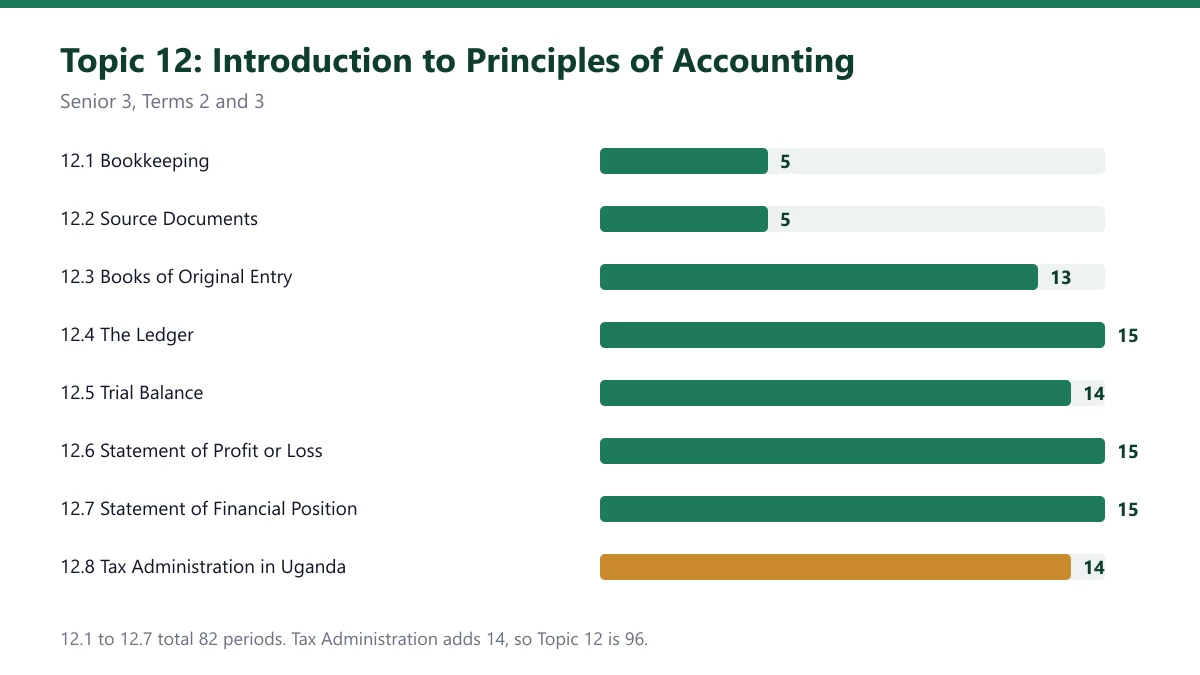
The accounting sub-topics 12.1 to 12.7 add up to 82 periods, and Tax Administration adds 14 more for a full-topic total of 96. The planner splits Accounting itself as 48 periods in Term 2 and 34 in Term 3, which matches the 82.
Bookkeeping and Source Documents
12.1 Bookkeeping (5 periods) has learners understand bookkeeping and related accounts, appreciate its importance, and demonstrate cost accounting using spreadsheets. They record a company’s transactions, produce their own ledger, and build a spreadsheet of “a day in the life of a local store”.
12.2 Source Documents (5 periods) has learners know and prepare the source documents used in bookkeeping. They contrast examples from familiar businesses, practise preparing documents for a range of business types, and sort documents into groups by agreed criteria.
Books of Original Entry and the Ledger
12.3 Books of Original Entry (13 periods) has learners know and prepare the books of original entry. They examine a range of accounting journals, discuss how transactions are recorded, and design books of original entry in pairs.
12.4 The Ledger (15 periods) has learners know a ledger, appreciate the different types of ledgers, and prepare ledger accounts. They post journal entries to a ledger using the double entry system and explain the posting process to a partner.
Trial Balance
12.5 Trial Balance (14 periods) has learners know a trial balance, understand its uses, and prepare one. They also identify and correct errors. Activities include preparing an accurate and an inaccurate trial balance and challenging each other to spot which is which.
Statement of Profit or Loss and Other Comprehensive Income
12.6 Statement of Profit or Loss and Other Comprehensive Income (15 periods) has learners know and prepare the statement. Using their trial balances, they discuss at what point profit should lead to further investment and prepare solutions for when a loss appears.
Statement of Financial Position
12.7 Statement of Financial Position (15 periods), also called the Balance Sheet, has learners understand its key components and how spreadsheets support them. They learn the accounting equation, list the assets and liabilities of their school, and prepare a balance sheet using spreadsheets and a calculator.
Tax Administration in Uganda
Tax Administration in Uganda is sub-topic 12.8, allocated 14 periods in Term 3. On its detail page the syllabus misprints the sub-topic number as “12.1” rather than 12.8.
Learners know tax administration and appreciate the role of the Uganda Revenue Authority (URA) in tax administration. They learn the taxes URA collects, the taxes and duties collected by Local Government Authorities, and the non-tax revenue collected by other government agencies.
Activities include preparing questions for a guest speaker on URA’s role and preparing an information report on tax administration in Uganda. Learners examine how URA is organised and create a list of non-tax revenue types. The O-Level Entrepreneurship Education textbook expands on this content.
What do the learning-outcome codes (k), (u), (s), (v) and (gs) mean?
The codes tag each learning outcome by type: (k) knowledge, (u) understanding, (s) skills, (v) values, and (gs) generic skills. They appear in parentheses after outcomes so teachers can see at a glance whether an outcome targets knowing, doing or valuing.
| Code | Meaning |
|---|---|
| (k) | Knowledge |
| (u) | Understanding |
| (s) | Skills |
| (v) | Values |
| (gs) | Generic skills |
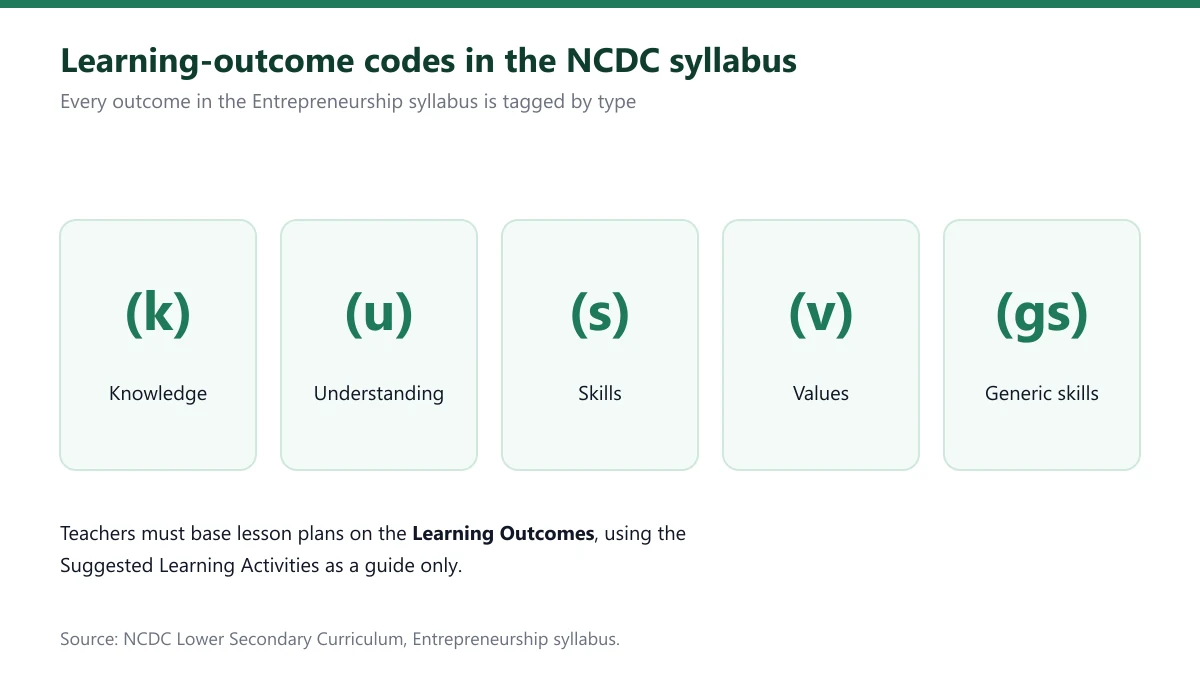
Because a single outcome can be tagged with more than one code, the letters tell a teacher how to assess it. A knowledge outcome is tested differently from a skills outcome, and a values outcome is observed rather than marked.
Which cross-cutting issues run through the S3 syllabus?
Six cross-cutting issues run through the lower secondary Entrepreneurship syllabus: environmental awareness, health awareness, mixed abilities and involvement, life skills, socio-economic challenges, and citizenship and patriotism. The Senior 3 topics embed these in activities such as ethics charters and tax discussions.
- Environmental awareness
- Health awareness
- Mixed abilities and involvement
- Life skills
- Socio-economic challenges
- Citizenship and patriotism
The mixed abilities and involvement issue matters most to inclusive-education platforms like Remedial Corner: it asks teachers to plan activities every learner can join, including learners with special needs.
Teachers fold these issues into a lesson without adding new periods. A tax lesson on URA doubles as a citizenship and patriotism discussion, while a business-ethics role play doubles as a life-skills exercise on customer care.
How should teachers plan lessons from the three-column layout?
The syllabus presents each topic in three columns: Learning Outcomes, Suggested Learning Activities, and Sample Assessment Strategy. Teachers must base lesson plans on the Learning Outcomes and treat the activities as guidance only, because the syllabus says they are not the only possible activities.
The three columns map cleanly onto a lesson: the Learning Outcomes are the objectives, the Suggested Learning Activities are ideas for the lesson body, and the Sample Assessment Strategy shows how to check understanding. Teachers are encouraged to extend the activities and devise their own.
The suggested learning activities are not the only possible learning activities; teachers are encouraged to extend these and devise their own.
In practice, this means a teacher planning Topic 11.2 should write objectives from its learning outcomes first, then choose or adapt activities such as the SWOT comparison, and finally pick an assessment from the sample strategy column.
The Sample Assessment Strategy column shows how the syllabus suggests checking each outcome. For 11.2 the sample strategy is a prepared business plan, while for 12.5 it is a corrected trial balance. Matching assessment to outcome keeps the three columns aligned.
Because the activities are a guide, a teacher in an inclusive classroom can adapt each one to mixed abilities. A role play on customer care works for learners who struggle with writing, and a spoken question-and-answer can replace a written test without changing the Learning Outcome.
Why does Topic 12 say 92 periods when the sub-topics total 82?
The Topic 12 header prints 92 periods, but the seven accounting sub-topics (12.1 to 12.7) sum to 82, while the programme planner splits Accounting as 48 plus 34, which also gives 82. The 144 total reconciles as 48 + 82 + 14, so the printed 92 is a typo.
This is a genuine print error in the syllabus, and it is easy to trip over. The accounting sub-topics 12.1 through 12.7 sum to 82, and Tax Administration adds 14, giving a true Topic 12 total of 96. The header’s “92” matches neither figure.
| Component | Periods |
|---|---|
| Topic 11 Business Planning | 48 |
| Topic 12 accounting sub-topics (12.1–12.7) | 82 |
| Tax Administration in Uganda (12.8) | 14 |
| Full-year total | 144 |
Because the planner’s own split (48 + 34 = 82 for Accounting, plus 14 for tax) matches the sub-topic sums, the 144 total is consistent. Only the printed “92” on the Topic 12 header is out of step.
What is the term-by-term sequence for Senior 3?
Term 1 covers Topic 11, Business Planning, across 48 periods. Term 2 opens Topic 12 with 48 periods of Introduction to Principles of Accounting. Term 3 finishes Topic 12 with 34 periods of Accounting, then closes with 14 periods of Tax Administration in Uganda, for 144 periods overall.
The sequence is deliberately cumulative. A learner who can plan a business in Term 1 is ready to record its transactions in Term 2, and to finish its financial statements and tax obligations in Term 3.
After Senior 3, the subject continues into Senior 4 with Topic 13 Insurance (48 periods in Term 1), Topic 14 International Trade (48 periods in Term 2) and Topic 15 Tax Compliance (40 periods in Term 3). These build directly on the planning and accounting foundations set in the Senior 3 Entrepreneurship syllabus.
Whether you are a teacher writing termly schemes or a parent checking what your learner covers, the Senior 3 Entrepreneurship syllabus is compact enough to hold in one view: two topics, twelve sub-topics, and 144 periods. Bookmark this breakdown as your quick reference.
Frequently asked questions about the S3 syllabus
Is Entrepreneurship compulsory in Senior 3?
No. Entrepreneurship is compulsory in Senior 1 and Senior 2, and it becomes an elective in Senior 3 and Senior 4. A learner in Senior 3 studies it for four periods a week, but only if they choose the subject as one of their electives.
How many periods a week is Entrepreneurship taught in Senior 3?
Entrepreneurship is taught for four periods a week in Senior 3 and Senior 4. By comparison, Senior 1 and Senior 2 allocate two periods a week. Across the full year, the Senior 3 timetable totals 144 periods for the subject.
What is the Business Planning competency in Senior 3?
The Topic 11 competency is: “The learner prepares a business plan for a selected business.” This single statement frames all four sub-topics, from understanding the purpose of a business plan through preparing it, preparing an action plan, and applying business ethics.
What is the Introduction to Principles of Accounting competency in Senior 3?
The Topic 12 competency is: “The learner uses relevant books of original entry to process financial information gathered from source documents.” It links the source documents that record transactions to the journals, ledger, trial balance and financial statements that follow.
Does the Senior 3 syllabus include Tax Administration?
Yes. Tax Administration in Uganda is sub-topic 12.8 in the Entrepreneurship syllabus for Senior 3, allocated 14 periods in Term 3. It covers the role of the Uganda Revenue Authority, the taxes URA and local government collect, and non-tax revenue.
What topics follow Senior 3 Entrepreneurship in Senior 4?
Senior 4 continues with three topics: Topic 13 Insurance (48 periods in Term 1), Topic 14 International Trade (48 periods in Term 2), and Topic 15 Tax Compliance (40 periods in Term 3). These build directly on the planning and accounting foundations set in Senior 3.
Where can I read the official Senior 3 Entrepreneurship syllabus?
Uganda’s National Curriculum Development Centre (NCDC) publishes the lower secondary Entrepreneurship syllabus that sets this structure. This page summarises its Senior 3 content in one place — every sub-topic, its exact period count and its learning-outcome codes — alongside the NCDC Curriculum Framework that governs the subject’s status and period allocation.
For more subject breakdowns, browse the Remedial Corner blog, and read about Remedial Corner to meet the team behind these guides.
Sources and further reading
The sources behind this article, and where to read further.
- NCDC Curriculum Framework (ncdc.go.ug)
- O-Level Entrepreneurship Education textbook (ura.go.ug)



Leave a Reply