
Routine cattle husbandry practices are the regular, scheduled tasks a farmer performs on every animal to keep the herd identifiable, safe, productive and healthy. Three of them — identification, dehorning and castration — are taught together in the NCDC Senior 3 Agriculture syllabus because they follow one rule: do each one at the right age, with the right tools, and by a competent person.
These notes explain each practice with numbered steps, comparison tables and exam guidance. They also cover the animal register and low-stress handling, because identification and safe restraint are what turn a good practice into a safe, welfare-friendly one.
This article follows the NCDC Agriculture Syllabus (2019, ISBN 978-9970-00-120-0), Senior 3, Term 1, Topic “Cattle production” under the theme “Animal Production”, allocated 48 periods. Its competency states that the learner “selects desirable cattle for production and breeding and carries out all processes involved in their rearing.”
Outcome (m) requires learners to “carry out identification, dehorning, and castration in cattle”, outcome (l) covers record keeping, and outcome (o) covers handling cattle products. These are part of our wider Senior 3 Agriculture notes on cattle production and the full Senior 3 Agriculture notes.
Put simply, identification tells one animal from another, dehorning removes the horns, castration removes the testicles of a male, record keeping writes these events down, and handling moves and restrains cattle safely. These five routine cattle husbandry practices make up the practical half of cattle production.
Every one of the three surgical practices is welfare-sensitive, which means it must be done at the correct age by a competent person — animal welfare matters as much as productivity.
Cattle identification methods including tagging and microchips
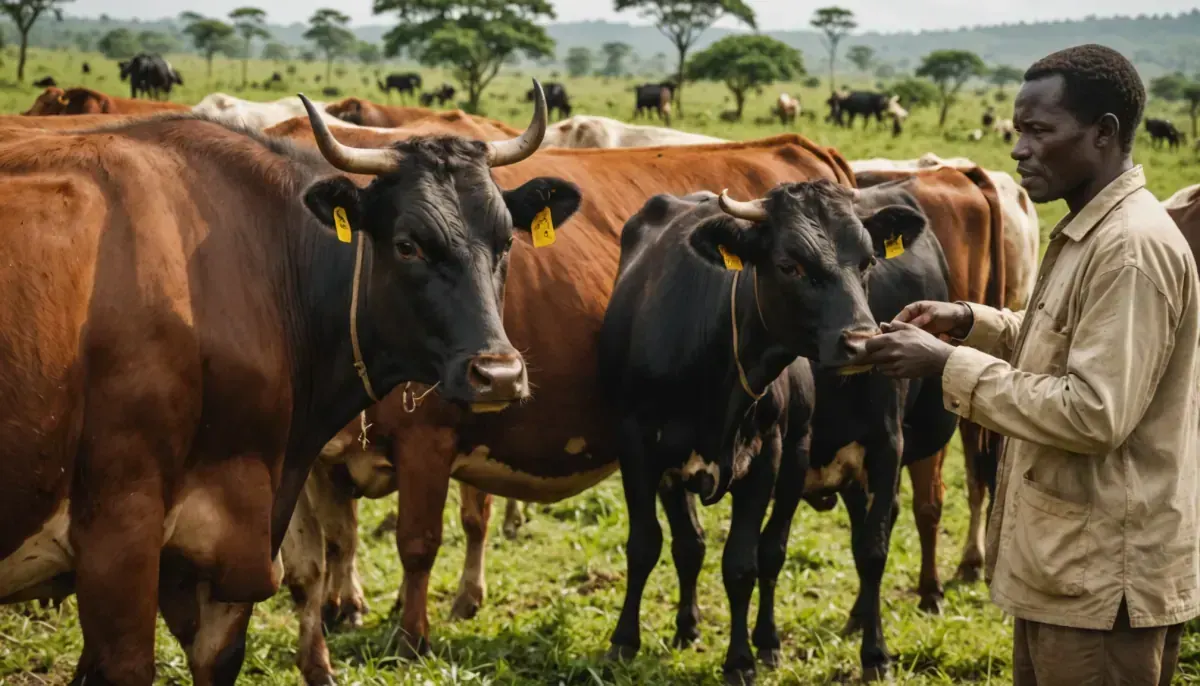
Cattle identification is the practice of marking each animal so it can be recognised, counted and traced through its whole life. In the Senior 3 syllabus it includes ear tags, ear notching, branding, tattoos and microchips, all tied back to the farm register. Identification is the first of the routine cattle husbandry practices to get right, because every other record hangs off the animal’s number.
- Permanent identification means the mark lasts for the animal’s whole life, so a cow can be recognised from birth through to culling or sale.
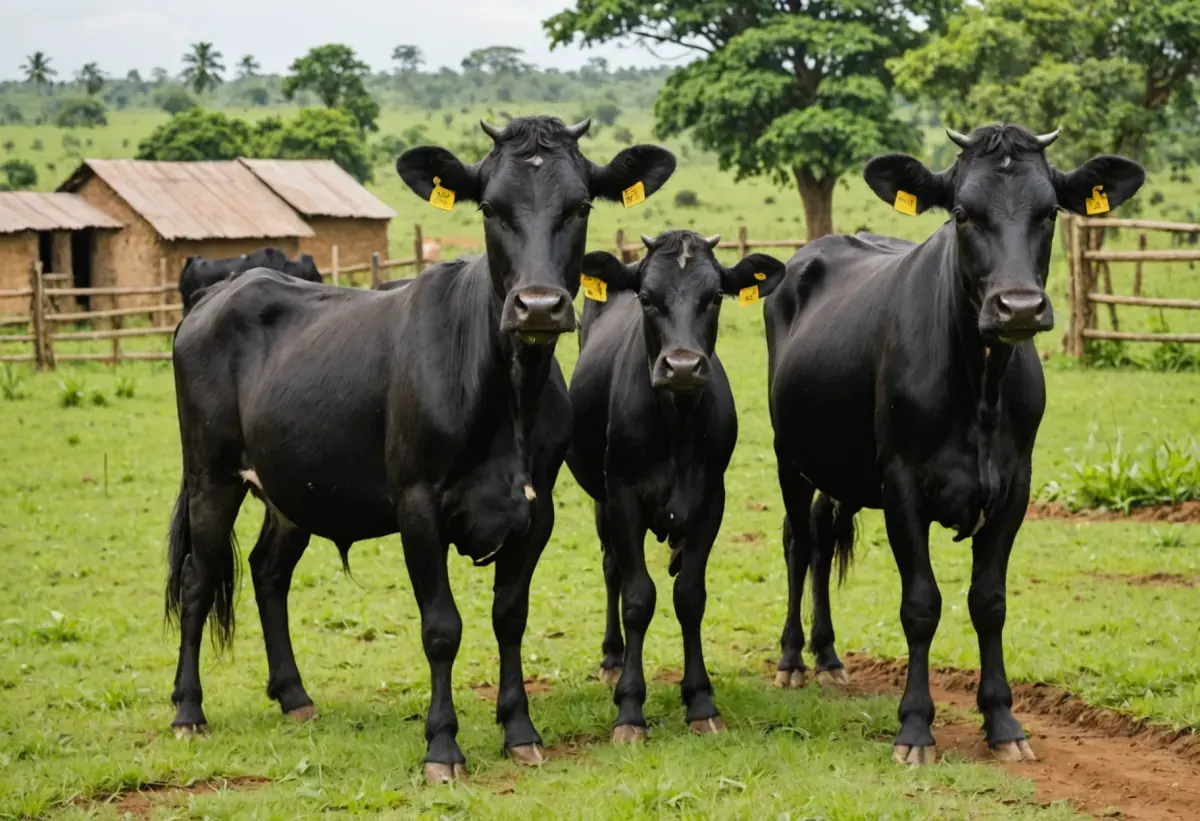
- Ear tags are numbered plastic or metal tags fixed through the ear; the number on the tag is the same number written in the farm register.
- Ear notching cuts small V-shaped notches into the edge of the ear in a coded pattern, so the animal can be identified even if a tag is lost.
- Hot-iron branding burns a number or symbol into the skin, leaving a permanent scar that is readable from a distance without catching the animal.
- Freeze branding uses very cold irons to kill the pigment cells, so pale hair grows back in the shape of the brand.
- Tattooing pierces the inside of the ear with ink numbers; the mark is permanent but must be read close up by an inspector.
- Microchips are tiny electronic devices injected under the skin that carry a unique number read with a scanner and stored using ICT.
- The farm register ties them together because every tag, notch, brand, tattoo or chip number is recorded against the animal’s name and history.
- Tags suit zero-grazing units where animals are handled daily and the number is read during milking, treatment or feeding.
- Brands suit large, extensively grazed herds because the mark cannot fall off and is seen even when the animal is far away on a communal grazing area.
- Notching is low-cost and permanent, which suits a smallholder farmer who cannot afford tags or microchips for every single animal.
- Microchips suit registered breeding stock because the electronic number cannot be copied and links to pedigree and production records.
- Cost and durability are traded off: tags and microchips cost more but are quick to read, while brands and notches cost less and last for life.
- The syllabus treats identification as a skill, with its record-keeping activity naming “tagging, identification marks, plus chips; using ICT where applicable”.
| Method | Durability | Relative cost | Typical use in Uganda |
|---|---|---|---|
| Ear tag | Lost unless applied well | Moderate | Standard on zero-grazing dairy units; the number links to the register |
| Ear notching | Permanent | Low | Smallholder herds; survives even when a tag is lost |
| Hot-iron branding | Permanent | Low | Large extensively grazed and communal herds; readable at a distance |
| Freeze branding | Permanent | Moderate | Registered herds wanting a clear mark with less tissue damage |
| Tattoo | Permanent but can fade | Low | Breeding herds where an inspector reads the ear close up |
| Microchip | Long-lasting device | High | Registered pedigree and breeding stock kept with ICT records |
Exam tip: when a question asks for methods of identifying cattle, name the method and then one reason you would choose it. For example, “ear tags — because the number links the animal to the farm register.”
Before you mark an animal, you need to be able to describe its breed and build, so start from our notes on breeds and physical selection of production cattle.
Practical steps for dehorning cattle
Dehorning is the removal of a calf’s horn buds, or a grown animal’s horns, to protect handlers and other cattle from injury. Dehorning is one of the routine cattle husbandry practices that must be done early, while the horn bud is still free under the skin and before it fuses to the skull. The NCDC syllabus lists dehorning as a skill learners must carry out safely and humanely.
Cattle with horns injure each other at the feed trough and injure the people who milk, treat and move them. Horned animals also need more space in a crush or zero-grazing unit, and they can bruise or gore valuable animals. Removing horns early makes handling calmer and safer for the animal and the farmer alike.
| Step | Action | Safety or welfare point |
|---|---|---|
| 1 | Check the age | Confirm the calf is within its first few weeks of life while the horn bud is still free under the skin; doing it at the right age causes less pain and avoids a bigger operation later. |
| 2 | Prepare the tools | Clean and ready the disbudding iron or caustic paste, plus antiseptic and clean water; a hot iron must reach working temperature before use. |
| 3 | Restrain the calf | Hold the calf in a calf crush or have a second person hold it firmly but calmly; correct restraint protects both the calf and the handler from sudden movement. |
| 4 | Give pain relief | Apply local anaesthetic or sedation as a veterinarian advises; pain relief is a welfare requirement, not an optional extra. |
| 5 | Locate the bud | Feel for the small round horn bud under the skin; take care not to burn or paste surrounding skin or the eyes. |
| 6 | Apply the iron or paste | Place the hot iron over the bud, or apply caustic paste only to the bud itself; over-application damages skin and delays healing. |
| 7 | Remove the bud | If the iron is used, lift the bud ring off cleanly; a clean removal reduces the chance of horn regrowth. |
| 8 | Protect the wound | Apply antiseptic and, if needed, a fly repellent; flies carry infection and an open wound invites them. |
| 9 | Release and watch | Let the calf back to its pen and observe it for signs of distress; early spotting of a problem prevents serious illness. |
| 10 | Keep the wound clean | Check the site daily and clean any discharge; a clean wound heals in days while a dirty one becomes a swelling. |
| 11 | Watch for infection | Look for heat, swelling, pus or loss of appetite; infection or fly strike needs treatment straight away. |
| 12 | Record the procedure | Write the date and method in the animal register or treatment record; the record proves the calf was done and shows when. |
| 13 | Never dehorn an adult without care | Grown horns need a veterinarian, sedation and sterile cutting; removing mature horn is a surgical act and must not be improvised. |
Animal welfare has legal backing in Uganda through the Animals (Prevention of Cruelty) Act, Cap. 39, which the Ministry of Agriculture inspection procedures list alongside the disease laws. A calf dehorned gently, at the right age and with pain relief, recovers fast and keeps growing. A calf done roughly, with dirty tools or no restraint, suffers pain and infection and may even die of the wound.
Common mistake: writing that dehorning is only about human safety. It also protects other cattle and makes management easier. In an exam, give at least two reasons — safety of handlers, and prevention of injuries between animals.
Methods and safety in cattle castration
Castration is the removal or destruction of a male animal’s testicles so it cannot breed. It is done to control breeding, to make male cattle calmer and easier to manage, and to improve the quality of meat. Of all routine cattle husbandry practices, castration carries the highest welfare stakes, because an open wound in a warm climate can become infected or fly-struck very quickly.
- The Burdizzo (bloodless) method crushes the spermatic cord with a clamp, cutting off the blood supply so the testicles shrink inside the scrotum.
- Rubber ring castration stretches a tight rubber ring over the scrotum of a very young calf, so the testicles wither and drop off.
- Surgical (open) castration cuts open the scrotum with a clean blade and removes the testicles, and needs sterile tools and pain relief.
- Age matters for each method: the rubber ring suits calves in their first week or two of life, the Burdizzo suits young bulls of a few months, and surgery suits older bulls.
- The Burdizzo is bloodless because it leaves the skin intact, which lowers the risk of bleeding and fly strike compared with an open wound.
- The rubber ring is simple but must be used early, because older animals feel more pain and the ring may not cut off the blood supply cleanly.
- Surgery must be done by a competent person under clean conditions, with a sharp sterile knife and proper restraint, or infection and bleeding can kill the animal.
- Pain relief and anaesthesia are welfare essentials for every method, and especially for surgical castration and for older animals.
- Tetanus protection matters where the skin is cut or the wound is open, so the risk of tetanus infection is considered around the procedure.
- Fly strike is a real risk in Uganda’s warm climate, so open wounds are treated and watched closely until they heal.
- Restraint comes first because a struggling animal can injure itself or the operator; use a crush or a firm helper.
- Sterile technique prevents infection, so every blade, clamp and the operator’s hands are cleaned before the procedure begins.
- Castration changes behaviour and growth, making males calmer, easier to keep with females and better for beef finishing.
- The animal register records the event — date, method and any treatment — so the farm can show the animal was managed correctly.
| Step | Action | Safety or welfare point |
|---|---|---|
| 1 | Choose the method by age | Rubber ring for very young calves, Burdizzo for young bulls, surgery for older animals; using the wrong method for the age causes unnecessary pain and risk. |
| 2 | Assemble clean tools | Sterilise the Burdizzo, ring applicator or scalpel and have antiseptic ready; sterile tools are the first defence against infection and tetanus. |
| 3 | Restrain the animal | Hold it in a crush or cradle so the rear legs cannot kick the operator; restraint protects the animal and the person doing the job. |
| 4 | Give pain relief | Use anaesthetic or sedation as a veterinarian advises; pain relief is a welfare duty, not an afterthought. |
| 5 | Clean the scrotum | Wash and disinfect the area before any cutting or clamping; a dirty site pushes bacteria into the wound. |
| 6 | Burdizzo: clamp each cord | Clamp each spermatic cord in turn for the correct time; clamping one cord at a time is safer than clamping both at once. |
| 7 | Rubber ring: seat the ring | Stretch the ring over the scrotum above both testicles; both testicles must sit below the ring or the job is incomplete. |
| 8 | Surgical: open and remove | Make a clean cut and remove each testicle with sterile handling; torn tissue bleeds more and heals slowly. |
| 9 | Control bleeding | Apply pressure or a clean dressing if bleeding continues; uncontrolled bleeding is an emergency. |
| 10 | Apply antiseptic | Dress the wound and apply fly repellent where the skin is open; flies and dirt cause infection in warm weather. |
| 11 | Release and observe | Watch the animal for swelling, bleeding or distress in the following hours; early care prevents most complications. |
| 12 | Check daily until healed | Inspect for heat, swelling, discharge or maggots; fly strike on a fresh wound can be fatal if missed. |
| 13 | Record the castration | Write date, method and aftercare in the treatment record; the record proves correct management and guides future care. |
| Method | How it works | Typical age | Bloodless? | Main safety / welfare point |
|---|---|---|---|---|
| Burdizzo | Crushes the spermatic cords with a clamp | Young bulls, a few months old | Yes | No open wound, so less bleeding and fly risk; needs correct clamp technique |
| Rubber ring | Tight ring cuts off blood to the scrotum | Calves in their first week or two | Yes | Simple but only for very young calves; place both testicles below the ring |
| Surgical (open) | Incision removes the testicles | Older bulls | No | Full pain relief and sterile technique are essential; done by a competent person |
Exam tip: name the method, the age it suits, and one safety point in the same sentence. For example, “the rubber ring is used on calves in their first week or two of life, and the operator must make sure both testicles sit below the ring.”
Keeping animal registers and production record cards
Record keeping is writing down the identification, breeding, production and treatment details of every animal on the farm. The NCDC syllabus names the animal register, record cards and record sheets, and expects these to be linked to tagging and identification marks, with ICT used where available. Record keeping turns the other routine cattle husbandry practices into decisions, because a written record, not memory, shows which animal is productive, sick or due to calve.
- The animal register is the master book of every animal, with its number, breed, sex, date of birth, parentage and movement on and off the farm.
- The production record card tracks the output of each animal — milk yield, growth, weight and other production data over time.
- Breeding records show service dates, the sire used, pregnancy checks and calving dates so the farmer can plan matings.
- Treatment records list every disease, vaccination, deworming, dehorning and castration, with the date and the medicine used.
- Milk production records record daily or weekly yield per cow, which shows which animals pay for their feed and which do not.
- Feed records link what each animal eats to what it produces, so the farmer can judge whether a ration is worth its cost.
- Identification links every record, because the tag, notch, brand or chip number is the same number written on every card for that animal.
- Records use ICT where available, with spreadsheets or farm apps replacing paper cards and reducing arithmetic errors.
- Record sheets are the day-to-day working pages, such as a milking sheet or a vaccination list, later summarised into the register.
- Accuracy is everything, because a wrong date or number makes the whole record useless for decisions.
- Records support profit decisions by showing which cows to keep, cull, breed or treat rather than guessing.
- Records support traceability, so an animal’s history can be shown to a buyer or a veterinary officer when asked.
- The syllabus requires records under outcome (l), “keep records of breeding, management, and production”.
- Common mistake: keeping records in the memory. Memory fails; the register and cards do not.
| Record type | Fields each record must carry |
|---|---|
| Animal register | Animal number, tag/notch/brand/chip number, breed, sex, date of birth, parentage, date of entry, date of exit or death |
| Production record card | Animal number, milk yield or weight per period, feed given, production trends |
| Breeding record | Dam and sire, service date, sire used, pregnancy check, expected and actual calving date |
| Treatment record | Animal number, date, disease or procedure, medicine or method, dose, name of person treating, outcome |
| Milk production record | Cow number, date, morning and evening yield, total, notes on milk quality |
| Feed record | Date, animal or group, feed type, quantity, cost, and the production that resulted |
Exam tip: when asked “what is an animal register?”, write its purpose and two of its fields. For example, “the animal register is the master record of every animal; it carries the animal number and its breed, sex and date of birth.”
A treatment record is where husbandry meets health, so it sits naturally beside our notes on the prevention and control of cattle diseases.
Practical livestock handling techniques
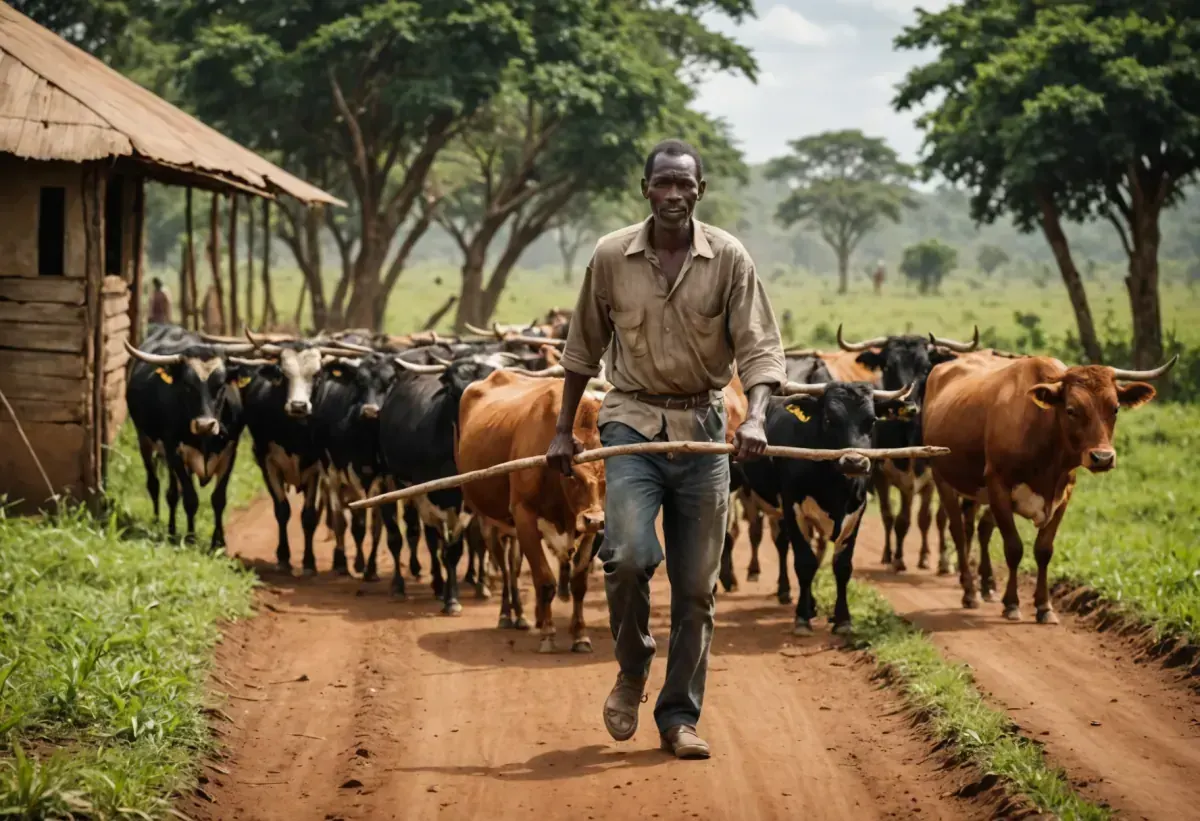
Livestock handling is the way a farmer moves, restrains and works with cattle so that neither the animal nor the person is hurt. The two ideas that make it work are the crush or race, which holds the animal safely, and the flight zone, which tells you how close you can get before the animal moves away.
Of all the routine cattle husbandry practices, safe handling is the one that protects every other task on this page.
- A crush (or race) is a narrow pen that holds one animal still for treatment, tagging, dehorning or castration, with walls that stop it from turning.
- A crush pen is part of the Ugandan zero-grazing unit, with a floor of well-firmed murram soil mixture and walls of wooden poles, according to the ILRI/NDDP specification.
- The flight zone is the invisible space around an animal; step inside it and the animal moves away, stay outside it and it stays calm.
- The point of balance sits at the animal’s shoulder; stand behind it and the animal moves forward, stand in front and it stops or backs up.
- Low-stress movement uses the flight zone and point of balance to ask the animal to move, instead of shouting, hitting or chasing.
- Calm cattle are safer cattle, because a frightened animal kicks, charges and hurts itself or the handler.
- Move slowly and quietly, avoiding sudden noise, because cattle see and hear far better than many learners expect.
- Use visual barriers such as solid sides on a race, because cattle balk at shadows, gaps and movement they can see.
- Never rush a cow into a crush; give it time to look and step in, because forcing it causes a fight that wastes time.
- Approach from the side, not directly behind, because the blind spot behind an animal is where a kick is most dangerous.
- A firm but calm helper is safer than a crowd; one person at the head and one at the gate is usually enough.
- The crush is where the earlier practices happen, because tagging, dehorning, castration and treatment all need a still, safely held animal.
- Handling is a syllabus skill, listed under outcome (o), “show skills in handling cattle products and bi-products”.
- Common mistake: thinking speed is skill. Skilled handling is quiet and slow, and it finishes the job sooner.
Exam tip: describe a crush by its purpose and one design feature. For example, “a crush is a narrow pen that holds one animal still for safe treatment; its solid sides keep the animal calm by blocking what it can see.”
Calm, clean handling flows straight into hygienic milking techniques and quality cattle handling, because a stressed cow gives less milk and is harder to milk safely.
Frequently asked questions about routine husbandry practices
Why do farmers identify their cattle?
Identification lets a farmer tell each animal apart, count the herd, and link every record to the right cow. The NCDC Senior 3 syllabus includes ear tags, ear notching, branding, tattoos and microchips for this. In Uganda, identification also helps prove ownership and trace an animal from birth to sale.
At what age should a calf be dehorned?
A calf should be dehorned, or disbudded, in its first few weeks of life while the horn bud is still free under the skin and before it fuses to the skull. Doing it early is quicker, less painful and safer than cutting a grown horn, which is a surgical job for a veterinarian.
What is the difference between the Burdizzo method and surgical castration?
The Burdizzo is a bloodless method that crushes each spermatic cord with a clamp, leaving the skin unopened, so there is less bleeding and fly risk. Surgical castration cuts the scrotum open and removes the testicles, so it needs full pain relief, sterile tools and a competent operator.
What is a flight zone in cattle handling?
The flight zone is the invisible space around a cow. When a person steps inside it, the animal moves away; when the person stays outside it, the animal stays calm. Skilled handlers use the flight zone and the point of balance to move cattle quietly instead of chasing them.
What records must a cattle farmer keep?
The NCDC syllabus names the animal register, record cards and record sheets. A good farm also keeps production, breeding, treatment, milk and feed records, all linked by the animal’s tag or identification number. These records show which animals are productive, which are sick and which are due to calve.
Why are identification, dehorning and castration called welfare-sensitive practices?
All three are routine cattle husbandry practices carried out on a live animal, and each can cause pain or infection if done at the wrong age, with dirty tools or by an unskilled person. Uganda’s Animals (Prevention of Cruelty) Act, Cap. 39, backs animal welfare. Doing each practice humanely protects the animal and keeps it productive.
Key terms and revision summary
Glossary
| Term | Meaning |
|---|---|
| Animal register | The master record of every animal on the farm, carrying its number, breed, sex and dates of entry and exit. |
| Ear tag | A numbered plastic or metal tag fixed through the ear, linking the animal to its register entry. |
| Ear notching | Cutting coded V-shaped notches in the ear edge to identify an animal permanently. |
| Microchip | A tiny electronic device injected under the skin, carrying a unique number read with a scanner. |
| Disbudding | Removing the horn bud of a young calf before the horn grows and fuses to the skull. |
| Dehorning | Removing a grown horn, a surgical procedure done by a competent person with pain relief. |
| Castration | Removing or destroying the testicles so a male animal cannot breed. |
| Burdizzo | A bloodless clamp that crushes the spermatic cords without opening the skin. |
| Rubber ring | A tight ring placed over the scrotum of a very young calf so the testicles wither and drop. |
| Flight zone | The space around an animal that, when entered, makes it move away. |
| Crush | A narrow pen that holds one animal still for safe treatment and handling. |
| Production record card | A card tracking the output of one animal, such as milk yield or weight, over time. |
Exam-style questions
- Outline four methods of identifying cattle and state one reason for choosing each. Answer outline: ear tag (links to the register); ear notching (permanent and low cost); branding (readable at a distance); microchip (electronic, for registered stock).
- Describe the steps you would follow to dehorn a young calf safely. Answer outline: check the age; prepare clean tools; restrain; give pain relief; locate the bud; apply the iron or paste; protect the wound; observe and record.
- Compare the Burdizzo method and the rubber ring as methods of castrating cattle. Answer outline: Burdizzo is a bloodless clamp for young bulls that crushes the cords; the rubber ring is a tight ring for calves in their first week or two that cuts off blood; both avoid an open wound.
- Explain why records are kept on a cattle farm. Answer outline: to identify productive animals; to plan breeding; to track treatment; to support profit and traceability.
- What is a flight zone and how is it used in low-stress cattle handling? Answer outline: it is the invisible space around an animal that makes it move away when entered; a handler uses it with the point of balance at the shoulder, moving slowly and quietly.
Revising these routine cattle husbandry practices is fastest when you can name each practice, its purpose and one safety point in a single sentence.



Leave a Reply