
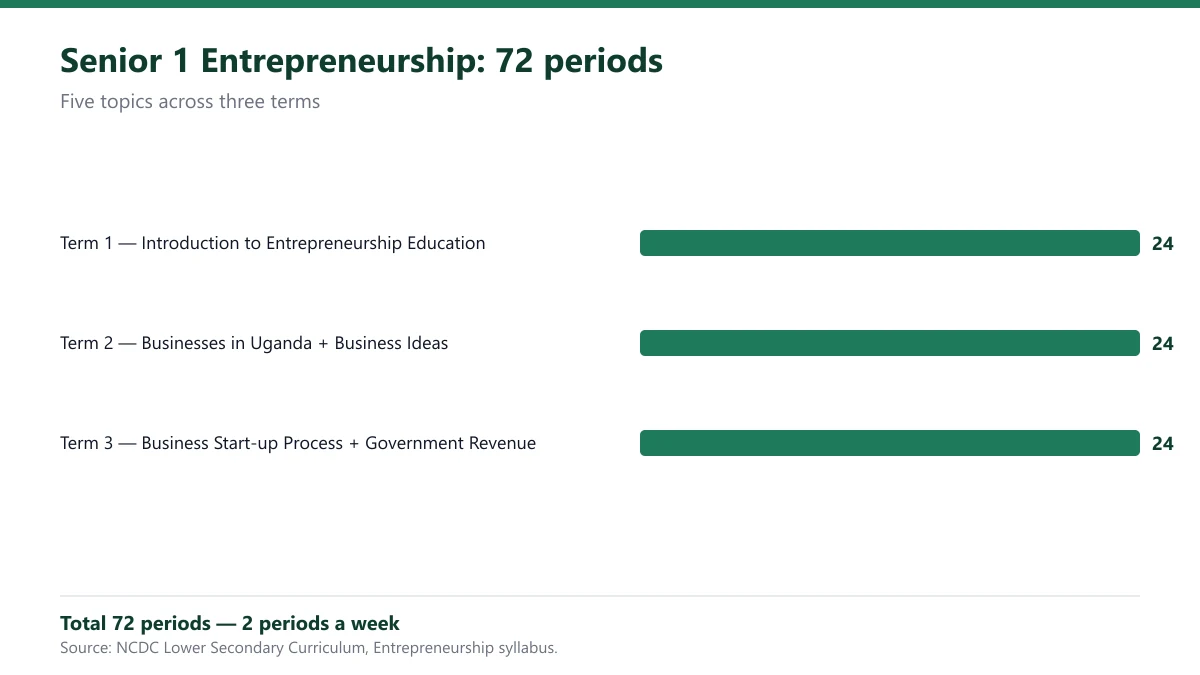
Senior 1 Entrepreneurship topics cover five units across 72 periods: Introduction to Entrepreneurship Education, Businesses in Uganda, Business Ideas and Opportunities, Business Start-up Process, and Introduction to Government Revenue. The year opens by building entrepreneurial awareness, then moves to scanning the environment and finally to the start-up process. This guide lists every sub-topic, its exact period count and its learning outcomes.
- 72 periods total — 24 in Term 1 and 24 in each of Terms 2 and 3.
- Five topics — from Introduction to Entrepreneurship Education to Introduction to Government Revenue.
- Two periods a week — compulsory in Senior 1 and Senior 2.
- Three themes — Creating an Entrepreneurial Awareness, Scanning the Environment, and the Start-up Process.
- 13 numbered sub-topics — each with its own period allocation.
- Outcome codes — (k), (u), (s), (v) and (gs) tag every learning outcome.
What is Senior 1 Entrepreneurship?
Senior 1 Entrepreneurship topics make up the first-year lower secondary Entrepreneurship course in Uganda’s O-level. They introduce learners to entrepreneurial thinking before they scan the business environment and learn the start-up process. The subject is compulsory in Senior 1 and Senior 2 and is taught for two periods a week.
The subject sits in Uganda’s competency-based lower secondary curriculum, published by the National Curriculum Development Centre (NCDC). It is an experiential course built around doing rather than only reading about business.
- Discuss ideas and definitions in their own words.
- Make and evaluate products from local resources.
- Interview successful entrepreneurs in the community.
- Run simple market surveys in the nearby trading centre.
This guide is published by Remedial Corner, a Ugandan inclusive-education and revision platform. The period counts and competencies below follow the NCDC Curriculum Framework, the official source for the lower secondary curriculum.
How many periods is Senior 1 Entrepreneurship?
Senior 1 Entrepreneurship is allocated 72 periods across the full year. The programme planner splits these evenly: 24 periods in Term 1, 24 periods in Term 2, and 24 periods in Term 3. At two periods a week, the 72 periods carry five topics over the three terms.
| Term | Theme | Topic | Periods |
|---|---|---|---|
| Term 1 | Creating an Entrepreneurial Awareness | Introduction to Entrepreneurship Education | 24 |
| Term 2 | Scanning the Environment | Businesses in Uganda | 12 |
| Term 2 | Scanning the Environment | Business Ideas and Opportunities | 12 |
| Term 3 | Start-up Process | Business Start-up Process | 18 |
| Term 3 | Start-up Process | Introduction to Government Revenue | 6 |
| Total | 72 |
Term 1 holds one topic, Terms 2 and 3 hold two apiece, so the Senior 1 Entrepreneurship topics total exactly 72 periods.
What themes organise the Senior 1 Entrepreneurship syllabus?
Three themes organise the Senior 1 syllabus: Creating an Entrepreneurial Awareness (Term 1), Scanning the Environment (Term 2), and the Start-up Process (Term 3). Each theme groups the topics learners meet that term, so the year reads as one progression from awareness to action.
- Creating an Entrepreneurial Awareness — Term 1, the mindset that opens the year.
- Scanning the Environment — Term 2, reading the market and opportunities around the learner.
- Start-up Process — Term 3, turning an idea into a business.
Every one of the Senior 1 Entrepreneurship topics sits under one of the three themes, so Term 1 builds attitude, Term 2 builds observation, and Term 3 builds action.
What topics are taught in Senior 1 Entrepreneurship?
The Senior 1 Entrepreneurship topics are five: Introduction to Entrepreneurship Education (24 periods), Businesses in Uganda (12), Business Ideas and Opportunities (12), Business Start-up Process (18), and Introduction to Government Revenue (6). Together they total 72 periods across the three terms.
| # | Topic | Theme | Periods |
|---|---|---|---|
| 1 | Introduction to Entrepreneurship Education | Creating an Entrepreneurial Awareness | 24 |
| 2 | Businesses in Uganda | Scanning the Environment | 12 |
| 3 | Business Ideas and Opportunities | Scanning the Environment | 12 |
| 4 | Business Start-up Process | Start-up Process | 18 |
| 5 | Introduction to Government Revenue | Start-up Process | 6 |
| Total | 72 |

The topics are cumulative: awareness first, then reading the environment, then starting up and government revenue.
Topic 1: Introduction to Entrepreneurship Education (Term 1, 24 periods)
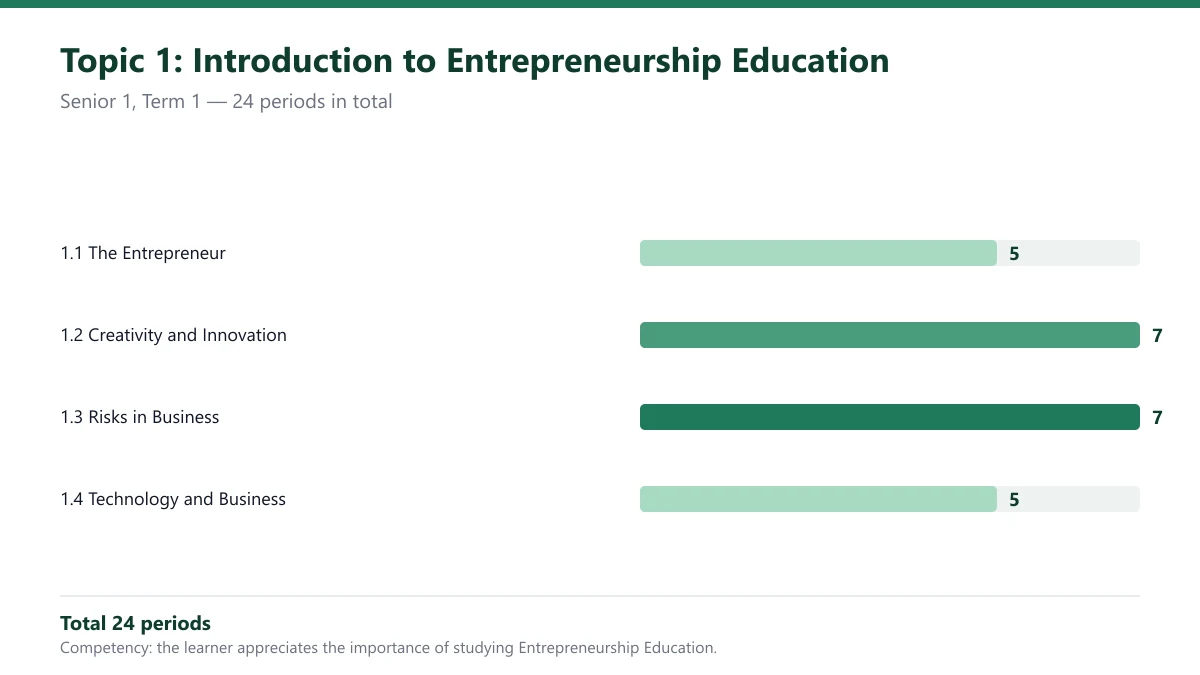
Topic 1 runs for 24 periods across Term 1, under the theme Creating an Entrepreneurial Awareness. Its competency is: “The learner appreciates the importance of studying Entrepreneurship Education and demonstrates characteristics of an Entrepreneur.” That one statement frames the four sub-topics that follow.
| Sub-topic | Title | Periods |
|---|---|---|
| 1.1 | The Entrepreneur | 5 |
| 1.2 | Creativity and Innovation | 7 |
| 1.3 | Risks in Business | 7 |
| 1.4 | Technology and Business | 5 |
| Total | 24 |
1.1 The Entrepreneur (5 periods)
Learners understand the purpose of Entrepreneurship Education, identify the key characteristics of an entrepreneur, and assess the benefits of an entrepreneur. Activities include a mind-map of the subject’s purpose, a poster advertising why students should study it, and a list of key characteristics. Learners then identify entrepreneurs in their community, and the teacher invites successful male and female entrepreneurs to class for questioning.
1.2 Creativity and Innovation (7 periods)
Learners understand creativity and innovation, then design, make and evaluate a product. They generate ideas for a product, such as a bridge-making simulation game using locally available resources, and plan the actions they will take. They then communicate design ideas in different ways and demonstrate how to make products to the class.
1.3 Risks in Business (7 periods)
Learners know risks in business and assess risks in business. They study case studies illustrating different risks, listen to accounts from business people, and identify the risks in each study, agreeing explanations and ways of minimising them. They present findings using ICT and play risk-taking simulation games to distinguish types of risk.
1.4 Technology and Business (5 periods)
Learners understand the role of technology in businesses. They consider the statement “Technology in business is a necessity”, think through the benefits and challenges of e-business, and identify examples of businesses in Uganda that use technology. Assessment weighs contrasting examples of technology in large businesses across Africa.
Topic 2: Businesses in Uganda (Term 2, 12 periods)
Topic 2 runs for 12 periods in Term 2, under the theme Scanning the Environment. Its competency is: “The learner participates in business operations in Uganda.” Two sub-topics follow, each with six periods.
| Sub-topic | Title | Periods |
|---|---|---|
| 2.1 | Types of Businesses | 6 |
| 2.2 | Success in Business | 6 |
| Total | 12 |
2.1 Types of Businesses (6 periods)
Learners understand the various types of businesses in Uganda and appreciate the importance of businesses to the community. Each group chooses a different business and records its type, key characteristics and the benefits it provides to the country, then shares its recording with another group. Learners also list the key features of a local business they know.
2.2 Success in Business (6 periods)
Learners know what makes a business successful, evaluate what causes a business to fail, and understand ways of reviving a failing business. They study successful and unsuccessful businesses, identify indicators of success and causes of failure, and role-play reviving an unsuccessful business.
Topic 3: Business Ideas and Opportunities (Term 2, 12 periods)
Topic 3 also runs in Term 2 for 12 periods, under Scanning the Environment. Its competency is: “The learner selects a business opportunity from the environment and conducts a market survey.” Three sub-topics of four periods each follow.
| Sub-topic | Title | Periods |
|---|---|---|
| 3.1 | Business Ideas | 4 |
| 3.2 | Business Opportunities | 4 |
| 3.3 | Market Survey | 4 |
| Total | 12 |
3.1 Business Ideas (4 periods)
Learners demonstrate how to generate a business idea from the environment, generate an idea, and select a good business idea. They brainstorm sources of ideas, walk to a nearby trading centre to observe the environment, and discuss the factors that make a good idea. They also build a decision tree from a dilemma or probing question.
3.2 Business Opportunities (4 periods)
Learners understand the difference between a business idea and a business opportunity, and appreciate the characteristics of a good business opportunity. They differentiate the two, think of an example of each, and role-play conversations between business people as an opportunity was first explored.
3.3 Market Survey (4 periods)
Learners understand the importance of a market survey and carry one out. They study a good example of an effective survey, learn the steps to follow, and plan and conduct a simple market survey in the nearby community, considering customers, price, raw materials, location and competition.
Topic 4: Business Start-up Process (Term 3, 18 periods)
Topic 4 runs for 18 periods in Term 3, under the theme Start-up Process. Its competency is: “The learner follows the steps involved in starting a business, saves money and invests in a profitable venture.” Four sub-topics follow.
| Sub-topic | Title | Periods |
|---|---|---|
| 4.1 | Steps in Starting a Business | 4 |
| 4.2 | Sources of Business Finance | 5 |
| 4.3 | Savings and Investments | 5 |
| 4.4 | Location of a Business | 4 |
| Total | 18 |
One print slip is worth flagging: the detail pages for sub-topics 4.3 and 4.4 are each headed “Topic 5: Business Start-up Process”, when their sub-topic numbers (4.3, 4.4) show they belong to Topic 4.
4.1 Steps in Starting a Business (4 periods)
Learners know the factors that enable an individual to start a business, including basic principles of effective record keeping, follow the correct steps, and prepare a budget. They brainstorm factors that enhance start-ups, listen to a prominent entrepreneur from the community, and practise preparing a budget.
4.2 Sources of Business Finance (5 periods)
Learners know the different sources of business finance and assess the benefits and challenges of each source. They discuss the sources, read case studies on their benefits and challenges, and identify the benefit and challenge of each source.
4.3 Savings and Investments (5 periods)
Learners know the factors that determine saving and investment, appreciate the reasons for and forms of saving, and prepare a savings plan using spreadsheets, books and calculators. They agree definitions, form a savings group or SACCO and start saving, and agree one investment plan.
4.4 Location of a Business (4 periods)
Learners know the factors considered when locating a business. They discuss the factors that influence location, examine contrasting locations, and design a guide for entrepreneurs choosing a location.
Topic 5: Introduction to Government Revenue (Term 3, 6 periods)
Topic 5 closes the year with six periods in Term 3, under the Start-up Process theme. Unlike Topics 1 to 4, it has no numbered sub-topics: the whole six periods sit under the one heading, Introduction to Government Revenue.
Learners understand government revenue and why the government needs revenue, and they know the sources of government revenue. They begin by discussing “Where does the government get its money from?”, thinking of local, national and international examples.
- Compare two sources of government revenue in detail using a diagram.
- Discuss why governments need revenue and how it is distributed, comparing Uganda with neighbouring countries.
- Debate an example where government revenue has or has not benefited the community.
- Field study: identify facilities the government has provided around the school.
- Write a letter to local government outlining funds needed to improve the community.
The detail page for Topic 5 lists its learning outcomes without the competency line that Topics 1 to 4 carry. The O-Level Entrepreneurship Education textbook expands on this content.
Do the Senior 1 planner totals match the detail pages?
Yes. The planner and the detail pages reconcile exactly: Topic 1’s four sub-topics sum to 24 periods, Topic 2’s two sub-topics sum to 12, Topic 3’s three sum to 12, Topic 4’s four sum to 18, and Topic 5 adds 6 — a 72-period total.
- Planner totals reconcile: 24 + 12 + 12 + 18 + 6 = 72 periods.
- Sub-topics 4.3 and 4.4 are misprinted as “Topic 5” on their detail pages.
- Topic 5’s detail page omits the competency line that Topics 1 to 4 include.
What do the learning-outcome codes (k), (u), (s), (v) and (gs) mean?
The codes tag each learning outcome by type: (k) knowledge, (u) understanding, (s) skills, (v) values, and (gs) generic skills. They sit in parentheses after outcomes so a teacher can see at a glance whether an outcome targets knowing, doing or valuing.
| Code | Meaning |
|---|---|
| (k) | Knowledge |
| (u) | Understanding |
| (s) | Skills |
| (v) | Values |
| (gs) | Generic skills |
Many outcomes carry more than one code. For example, the purpose outcome in sub-topic 1.1 is tagged (u, v) — understanding plus values — while the risk assessment in 1.3 is tagged (s, gs) — skills plus generic skills.
How should teachers plan lessons from the three-column layout?
The syllabus sets each topic out in three columns: Learning Outcomes, Suggested Learning Activities, and Sample Assessment Strategy. Teachers base lesson plans on the Learning Outcomes and treat the activities as a guide, because the syllabus says they are not the only possible activities.
These are not the only possible learning activities; teachers are encouraged to extend these and devise their own that are appropriate to the needs of their class.
The three columns map onto a lesson: outcomes are the objectives, activities are the lesson body, and the assessment strategy shows how to check understanding. In an inclusive classroom, a teacher can adapt any activity to mixed abilities without changing the learning outcome.
What is the term-by-term sequence for Senior 1?
Term 1 covers Topic 1, Introduction to Entrepreneurship Education, across 24 periods. Term 2 covers Businesses in Uganda and Business Ideas and Opportunities, 12 periods each. Term 3 covers Business Start-up Process (18 periods) and Introduction to Government Revenue (6), for 72 periods overall.
After Senior 1, the subject continues into Senior 2 with five more topics, listed below. These build directly on the Senior 1 Entrepreneurship topics covered here.
- Legal Forms of Business Ownership — 14 periods.
- Production in Business — 14 periods.
- Marketing in a Small Business Enterprise — 18 periods.
- Money and Financial Institutions — 20 periods.
- Taxation — 6 periods.
For the accounting-heavy later years, see the Senior 3 Entrepreneurship syllabus breakdown.
Frequently asked questions about the S1 topics
Is Entrepreneurship compulsory in Senior 1?
Yes. Entrepreneurship is compulsory in Senior 1 and Senior 2, where it is studied for two periods a week, and it becomes an elective in Senior 3 and Senior 4. A Senior 1 learner covers the full 72-period syllabus across the three terms.
How many periods a week is Entrepreneurship taught in Senior 1?
Entrepreneurship is taught for two periods a week in Senior 1 and Senior 2. By comparison, Senior 3 and Senior 4 allocate four periods a week. Across the full year, the Senior 1 timetable totals 72 periods for the subject.
How many topics are in Senior 1 Entrepreneurship?
Senior 1 Entrepreneurship has five topics: Introduction to Entrepreneurship Education (24 periods), Businesses in Uganda (12), Business Ideas and Opportunities (12), Business Start-up Process (18), and Introduction to Government Revenue (6). Together these five topics total 72 periods across the year.
What is the Introduction to Entrepreneurship Education competency?
The Topic 1 competency is: “The learner appreciates the importance of studying Entrepreneurship Education and demonstrates characteristics of an Entrepreneur.” This one statement frames all four sub-topics — the entrepreneur, creativity and innovation, risks in business, and technology and business.
Does Senior 1 Entrepreneurship include Government Revenue?
Yes. Introduction to Government Revenue is Topic 5 in Senior 1, allocated 6 periods in Term 3 under the Start-up Process theme. It covers what government revenue is, why the government needs revenue, and the sources of government revenue in Uganda.
What topics follow Senior 1 Entrepreneurship in Senior 2?
Senior 2 continues with five topics: Legal Forms of Business Ownership (14 periods), Production in Business (14), Marketing in a Small Business Enterprise (18), Money and Financial Institutions (20), and Taxation (6). These five topics total 72 periods across the Senior 2 year.
Where can I read the official Senior 1 Entrepreneurship syllabus?
Uganda’s National Curriculum Development Centre (NCDC) publishes the lower secondary Entrepreneurship syllabus that sets this structure. This page summarises the Senior 1 Entrepreneurship topics in one place — every sub-topic, its exact period count and its learning-outcome codes — alongside the NCDC Curriculum Framework.
Remember the arithmetic: 24 + 12 + 12 + 18 + 6 equals 72 periods — the whole of Senior 1 Entrepreneurship.
For more subject breakdowns, browse the Remedial Corner blog, and read about Remedial Corner to meet the team behind these guides.
Sources and further reading
The sources behind this article, and where to read further.
- NCDC Curriculum Framework (ncdc.go.ug)
- O-Level Entrepreneurship Education textbook (ura.go.ug)



Leave a Reply