
Business Planning in Senior 3 is Topic 11 of Uganda’s O-level Entrepreneurship syllabus, taught over 48 periods in Term 1. Its competency is that the learner prepares a business plan for a selected business. This guide covers every sub-topic and learning outcome, then works a full 12-month cash flow for a Ugandan juice business you can check step by step.
- 48 periods in Term 1, split across four sub-topics: 8, 24, 12 and 4.
- Competency: the learner prepares a business plan for a selected business.
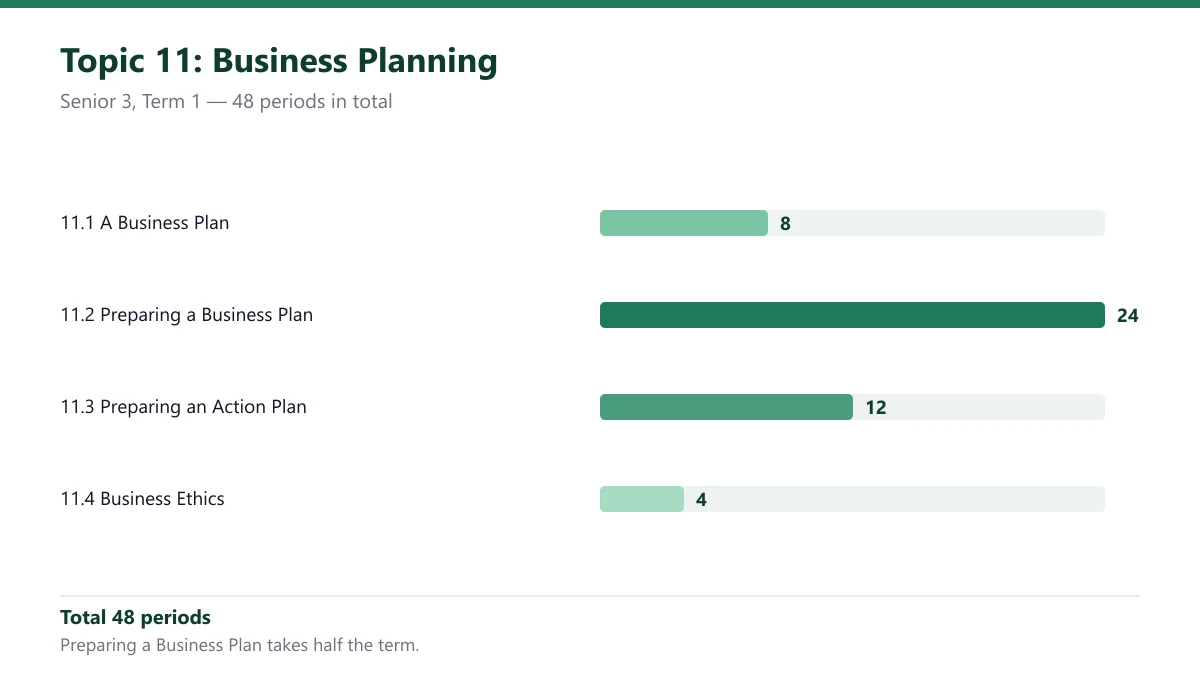
- 11.2 Preparing a Business Plan takes 24 periods — half of Term 1.
- Assessment: prepare a business plan for a selected business opportunity.
- Worked example below closes at UGX 4,360,000 after 12 months, verifiable line by line.
What is Business Planning in Senior 3?
Senior 3 Business Planning is the first of the two Senior 3 topics in Uganda’s O-level Entrepreneurship syllabus. It runs for 48 periods in Term 1 and teaches a learner to plan a real business, from understanding a business plan, through preparing it, to converting it into an action plan and applying business ethics.
The topic opens the year deliberately. A learner who can plan a business in Term 1 is ready, in Terms 2 and 3, to record and report its finances through Introduction to Principles of Accounting. The two topics are sequenced so planning comes before bookkeeping, which is why this one deserves a guide of its own.
The learner prepares a business plan for a selected business.
That single competency statement frames all four sub-topics that follow. Everything from the purpose of a business plan to the ethics charter a learner writes at the end serves one goal: planning a specific, selected business.
The full Senior 3 structure sits inside the National Curriculum Development Centre’s competency-based lower secondary curriculum. Read the complete Senior 3 Entrepreneurship syllabus breakdown for the year’s other topic, and consult the official O-Level Entrepreneurship syllabus PDF for the source text.
How many periods is Business Planning in Senior 3?
Business Planning in Senior 3 is allocated 48 periods, the whole of Term 1. The periods divide across four sub-topics: 8 for A Business Plan, 24 for Preparing a Business Plan, 12 for Preparing an Action Plan, and 4 for Business Ethics.
At four periods a week in Senior 3, the 48 periods spread across Term 1. The heaviest load falls on sub-topic 11.2, which alone takes half the term.
| Sub-topic | Title | Periods |
|---|---|---|
| 11.1 | A Business Plan | 8 |
| 11.2 | Preparing a Business Plan | 24 |
| 11.3 | Preparing an Action Plan | 12 |
| 11.4 | Business Ethics | 4 |
| Total | 48 |

The uneven split is the point. The syllabus gives the learner three times as long to prepare a plan as it gives to understanding what a plan is, because writing the plan is where the learning happens.
What does 11.1 A Business Plan cover?
Sub-topic 11.1 covers the purpose of a business plan and how to share it with stakeholders. Learners understand why a business plan matters, use one to plan a business and present it to different stakeholders, and use the Internet purposefully to browse information about business plans.
The learning outcomes target understanding (the purpose of a business plan) and skills (using the plan, sharing it, and researching online). The suggested learning activities show how teachers bring that to life.
- Review a series of business plans in groups and identify what makes an effective plan.
- Discuss the term stakeholder, then identify which stakeholder each plan was written for.
- Research networking opportunities in Uganda, from local to national and from formal to informal.
- Discuss the benefits of networking and networking etiquette.
- Produce a leaflet a bank might distribute on the importance of a business plan.
- Research two contrasting approaches to writing a business plan.
The stakeholder and networking threads run through the whole sub-topic. A plan written for a bank loan looks different from one written for a business partner, and learners see that difference by comparing real plans. For a plain-language view of why a plan matters before launch, read this guide on writing a business plan before you start.
What does 11.2 Preparing a Business Plan cover?
Sub-topic 11.2 is the largest section, taking 24 periods — half of Term 1. Learners understand the steps in preparing a business plan and the importance of cash flow in processing and manufacturing. The sample assessment here is a full business plan for a selected business opportunity.
Two learning outcomes anchor the sub-topic. The first is understanding the steps in preparing a business plan; the second is understanding why cash flow matters specifically in processing and manufacturing businesses.
What are the suggested learning activities for 11.2?
The suggested activities move from discussion to comparison to full writing. Learners discuss the steps of writing a plan, evaluate each step’s importance and tie it to cash flow, highlight the effective steps in a flow chart, compare two opportunities with a SWOT analysis, and finally prepare a business plan.
- Hold a guided discussion on the steps to follow when writing a business plan.
- Evaluate the importance of each step and relate it to cash flow in processing and manufacturing.
- Research a business that suffered cash-flow problems and identify when it should have sought support.
- Highlight the effective steps in a flow chart.
- Compare two contrasting business opportunities with a simple SWOT analysis.
Assessment then asks each learner to prepare a business plan for a selected business opportunity. That is the competency in action — the whole term points to this written plan.
What is the SWOT exercise in 11.2?
The SWOT exercise asks learners to compare two contrasting business opportunities using a simple SWOT analysis — Strengths, Weaknesses, Opportunities and Threats. They list each idea’s internal strengths and weaknesses and its external opportunities and threats, then use the comparison to decide which opportunity is worth developing.
SWOT works because it forces a decision between two ideas rather than describing one. A learner weighing a juice business against, say, a second-hand clothes stall must put evidence against evidence. See a simple guide to SWOT analysis for testing business ideas for the method in full.
What is the cash-flow failure research activity?
This activity asks learners to research a business that suffered cash-flow problems and identify the exact point at which it should have sought business support. It ties the abstract idea of cash flow to a real case, so learners see that running out of cash is usually foreseeable.
Cash flow is the movement of money in and out, and it is most dangerous in processing and manufacturing, where a business buys raw materials and pays for production before it sells anything. Read why processing and manufacturing businesses fail on cash flow for a deeper treatment of that risk.
Worked example: a 12-month cash flow for a Ugandan juice business
Here is a worked, exam-style example. Choose a plausible Ugandan small business — a passion-fruit juice processor in Kasese that buys fresh fruit, bottles juice and sells to local shops. The figures are illustrative, but the arithmetic is exact and checkable.

A full business plan for this business follows a standard outline. Different schools and banks may order the sections differently, but the list below covers the parts a Senior 3 learner is expected to include.
- Executive summary — a one-page overview of the product, the market and the money needed.
- Business description — what the juice business is, its legal form and where it operates.
- Market analysis — who buys the juice, what competitors charge and what price to set.
- Marketing plan — how the business will attract and keep customers.
- Operations plan — sourcing fruit, processing, bottling and delivering to shops.
- Organisation plan — the owner’s role and any staff, helpers or family support.
- Financial plan — start-up costs, pricing and the 12-month cash flow below.
- Action plan — the first eight weeks of tasks that get the business trading.
The SWOT below is the same exercise 11.2 requires, completed for the juice business so you can see a finished version. Read this guide on choosing the right business plan structure if your school uses a different order.
| Category | Examples for the juice business |
|---|---|
| Strengths | Low start-up cost; passion fruit is cheap in season; simple processing. |
| Weaknesses | Limited capital; fruit spoils fast; no cold storage. |
| Opportunities | Growing demand for fresh juice; school and shop contracts; market days. |
| Threats | New competitors; fruit price rises in the dry season; power cuts slow bottling. |
Now the cash-flow forecast, the financial heart of the plan. The rule is simple: closing balance = opening balance + inflows − outflows. Opening balance is the money the business starts with; inflows are sales; outflows are costs.
| Month | Opening balance (UGX) | Inflows (UGX) | Outflows (UGX) | Closing balance (UGX) |
|---|---|---|---|---|
| 1 | 1,200,000 | 820,000 | 760,000 | 1,260,000 |
| 2 | 1,260,000 | 850,000 | 770,000 | 1,340,000 |
| 3 | 1,340,000 | 900,000 | 780,000 | 1,460,000 |
| 4 | 1,460,000 | 950,000 | 790,000 | 1,620,000 |
| 5 | 1,620,000 | 1,000,000 | 800,000 | 1,820,000 |
| 6 | 1,820,000 | 1,050,000 | 810,000 | 2,060,000 |
| 7 | 2,060,000 | 1,100,000 | 820,000 | 2,340,000 |
| 8 | 2,340,000 | 1,150,000 | 830,000 | 2,660,000 |
| 9 | 2,660,000 | 1,200,000 | 840,000 | 3,020,000 |
| 10 | 3,020,000 | 1,250,000 | 850,000 | 3,420,000 |
| 11 | 3,420,000 | 1,300,000 | 860,000 | 3,860,000 |
| 12 | 3,860,000 | 1,400,000 | 900,000 | 4,360,000 |
The learner starts with an opening balance of UGX 1,200,000. In Month 1, juice sales bring in UGX 820,000 and costs take out UGX 760,000, so the closing balance is 1,200,000 + 820,000 − 760,000 = UGX 1,260,000.
That figure carries forward. Month 2 opens at UGX 1,260,000, adds UGX 850,000 in sales and spends UGX 770,000, closing at 1,260,000 + 850,000 − 770,000 = UGX 1,340,000.
Across the full year, total inflows are UGX 12,970,000 and total outflows are UGX 9,810,000. Check the whole chain: opening balance 1,200,000 + 12,970,000 − 9,810,000 = UGX 4,360,000, which is exactly the Month 12 closing balance.
Because every line closes above the opening balance, the business stays solvent all year. That is the habit the syllabus builds: a learner who checks each month’s closing balance can spot a cash shortage before it happens.
What does 11.3 Preparing an Action Plan cover?
Sub-topic 11.3 covers the action plan and its relation to the business plan across 12 periods. Learners appreciate why an action plan matters, prepare one for their own developed plan, and practise the skill of making presentations with objects and animation.
An action plan converts the business plan’s aims into dated tasks. The suggested activities centre on that conversion, and on presenting the finished plan to an audience.
- Study a sample action plan, then prepare your own for the developed business plan.
- Discuss the importance of clear targets and aims.
- Produce an action plan for one key aim.
- Present the business plan to an audience using relevant technology.
- Present using animation and objects.
Here is a worked action plan for the juice business, built around one key aim: launch and reach the first 50 sales in eight weeks.
| Task | By when | Responsibility |
|---|---|---|
| Register the business name and get a URA TIN | Week 1 | Owner |
| Buy equipment and bottles | Week 2 | Owner |
| Agree a fruit supply with a local farmer | Week 3 | Owner |
| Make a test batch and sample it to 10 people | Week 4 | Owner |
| Label bottles and set the price | Week 5 | Owner |
| Open a stall and list with two local shops | Week 6 | Owner |
| Reach the first 50 sales | Week 8 | Owner |
Each task has a deadline and a person, which is what turns an aim into action. The presentation activities then let a learner defend the plan in front of others, using technology, objects and animation rather than reading from notes.
What does 11.4 Business Ethics cover?
Sub-topic 11.4 closes Topic 11 with business ethics in four periods. Learners appreciate the principles of good business ethics, understand acceptable behaviour towards customers, employees, society and government, and know customer attraction, customer care and customer retention across a business.
This short section turns the plan into principles. A business that plans well but treats people badly will not last, so the syllabus ends the topic on behaviour.
| Stakeholder | Example of acceptable behaviour |
|---|---|
| Customers | Fair prices, honest labels and courteous service. |
| Employees | Fair pay, safe working conditions and respect. |
| Society | Avoiding pollution and supporting community causes. |
| Government | Paying taxes on time and following trading rules. |
These examples are illustrative, but they follow the four groups the syllabus names. Learners then write their own for a local business.
- Review case studies of ethical and unethical business practices.
- Produce an ethics charter for a local business.
- Consider what customer attraction, care and retention look like and role-play them.
- Agree acceptable behaviour towards employees, society and government.
- Role-play good and bad behaviour towards customers.
Customer attraction, care and retention sit together because they are one cycle: attract a customer, serve them well, and keep them coming back. Role play makes the difference between good and bad behaviour visible in a way a written definition cannot.
Frequently asked questions about Senior 3 Business Planning
These are the questions learners and teachers ask most about the topic, answered briefly.
Is Business Planning compulsory in Senior 3?
Entrepreneurship is compulsory in Senior 1 and Senior 2, but it becomes an elective in Senior 3 and Senior 4. So Business Planning in Senior 3 is studied only by learners who choose Entrepreneurship as an elective, for four periods a week during Term 1.
What is the Business Planning competency in Senior 3?
The Topic 11 competency is: “The learner prepares a business plan for a selected business.” That one statement frames all four sub-topics, from understanding the purpose of a business plan, through preparing it and an action plan, to applying business ethics.
How many periods is each Business Planning sub-topic?
Topic 11 totals 48 periods in Term 1. A Business Plan (11.1) takes 8 periods, Preparing a Business Plan (11.2) takes 24, Preparing an Action Plan (11.3) takes 12, and Business Ethics (11.4) takes 4. The four sub-topics add up to 48.
What is a cash flow statement in a business plan?
A cash flow statement shows money coming in and going out over a period, usually month by month. In Senior 3 it matters most for processing and manufacturing, where a business pays for materials before it sells anything, so the learner must see when cash runs low.
What does the SWOT exercise ask learners to do?
Learners compare two contrasting business opportunities using a simple SWOT analysis — Strengths, Weaknesses, Opportunities and Threats. For each idea they list internal strengths and weaknesses and external opportunities and threats, then use the comparison to choose the opportunity worth developing into a full plan.
How is Business Planning assessed in Senior 3?
The sample assessment strategy asks the learner to prepare a business plan for a selected business opportunity. This runs mainly through sub-topic 11.2, the 24-period section, where learners move from the steps of planning to a complete written plan for the opportunity they chose.
Remedial Corner publishes these breakdowns so every learner can follow the syllabus without a teacher beside them. Remedial Corner keeps every guide source-grounded and exam-focused.
- Read the full Senior 3 Entrepreneurship syllabus breakdown for the year’s other topic.
- See the Senior 1 Entrepreneurship topics that build into this one.
- Read how to write a business plan before you launch.
- Browse the Remedial Corner blog for more O-level guides.
- Meet Remedial Corner on the about page.
The Business Planning topic works best when you read the NCDC Curriculum Framework alongside these sub-topic notes, so you can see where each period allocation and competency fits the wider lower secondary curriculum.
Sources and further reading
The sources behind this article, and where to read further.
- O-Level Entrepreneurship syllabus PDF (ura.go.ug)
- NCDC Curriculum Framework (ncdc.go.ug)
Leave a Reply