
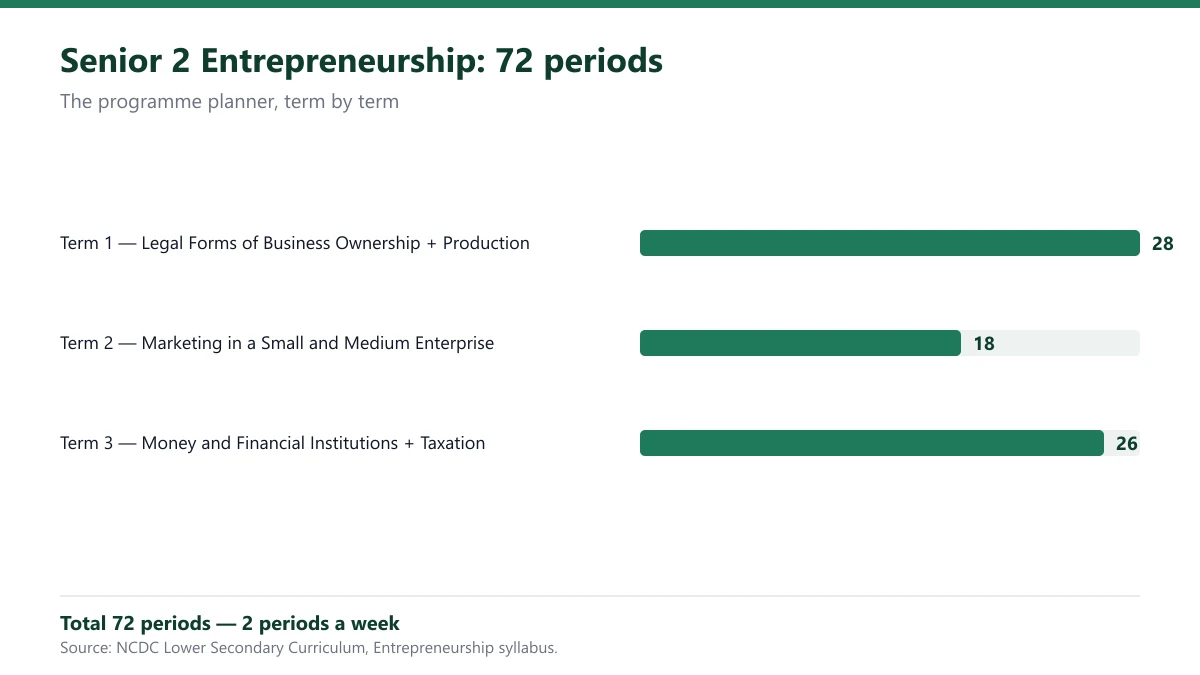
Senior 2 Entrepreneurship topics span 72 periods across five topics, from Legal Forms of Business Ownership through Production in Business and Marketing to Money and Financial Institutions and Taxation. The year runs across three terms under two themes. Every sub-topic, period count and learning outcome below comes from the NCDC Entrepreneurship syllabus.
- 72 periods total — 28 in Term 1, 18 in Term 2 and 26 in Term 3.
- Five topics — from Legal Forms of Business Ownership to Taxation.
- Two themes — Business Management (Terms 1 and 2) and Business Support (Term 3).
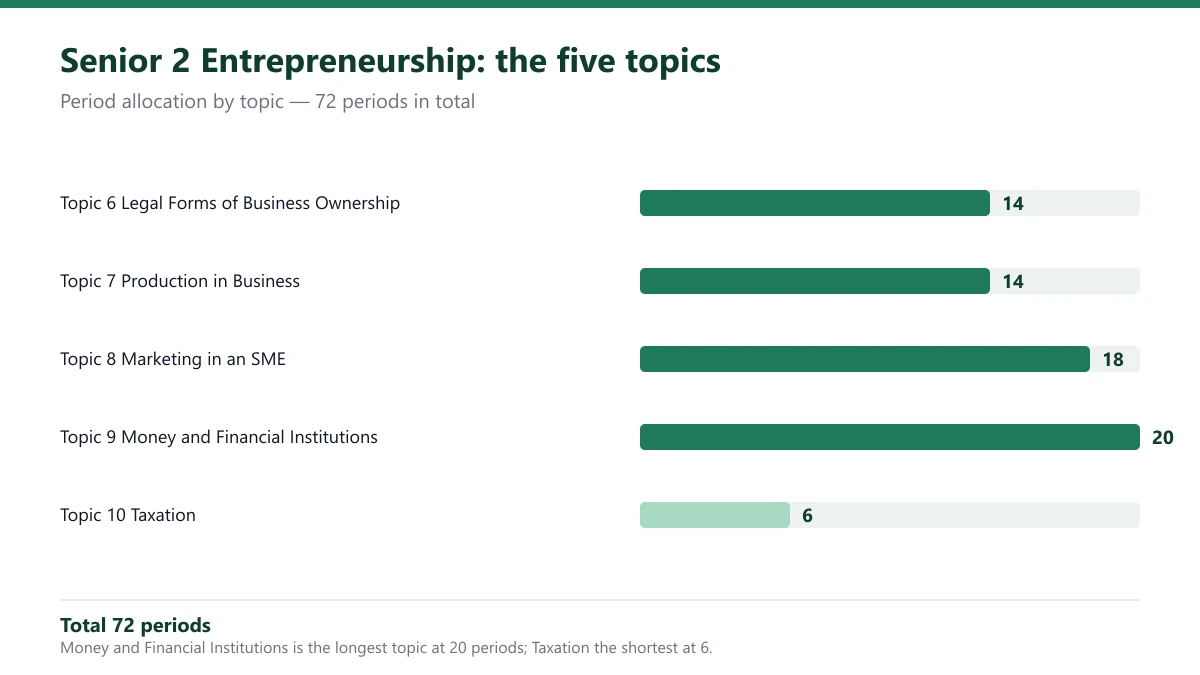
- Topic 9 is the longest — Money and Financial Institutions takes 20 periods.
- Topic 10 is the shortest — Taxation takes 6 periods.
- Outcome codes (k), (u), (s), (v) and (gs) tag every learning outcome.
What is Senior Two Entrepreneurship?
Senior Two Entrepreneurship is the second-year lower secondary Entrepreneurship subject in Uganda’s O-level. It builds on Senior 1 by teaching learners how businesses are owned and formalised, how goods are produced, how products are marketed, and how money and financial institutions support trade before taxation closes the year.
It is a hands-on course: learners study case studies, listen to guest speakers, run field visits and produce real marketing plans and products.
Learners should be responsible for their own learning, think for themselves, and become critical thinkers ready to face new challenges.
This guide is published by Remedial Corner, a Ugandan inclusive-education and revision platform, and follows the NCDC Curriculum Framework, the official source for the lower secondary curriculum.
How many periods is Senior 2 Entrepreneurship?
Senior 2 Entrepreneurship is allocated 72 periods across the school year. The programme planner splits these as 28 periods in Term 1, 18 periods in Term 2 and 26 periods in Term 3, which adds up to the full-year total of 72.
| Term | Theme | Periods |
|---|---|---|
| Term 1 | Business Management | 28 |
| Term 2 | Business Management | 18 |
| Term 3 | Business Support | 26 |
| Total | 72 |
What topics are taught in Senior 2 Entrepreneurship?
The Senior 2 Entrepreneurship topics are five: Legal Forms of Business Ownership, Production in Business, Marketing in a Small and Medium Business Enterprise, Money and Financial Institutions, and Taxation. Term 1 holds the first two, Term 2 the third, and Term 3 the last two.
| Topic | Title | Theme | Term | Periods |
|---|---|---|---|---|
| 6 | Legal Forms of Business Ownership | Business Management | 1 | 14 |
| 7 | Production in Business | Business Management | 1 | 14 |
| 8 | Marketing in a Small and Medium Business Enterprise | Business Management | 2 | 18 |
| 9 | Money and Financial Institutions | Business Support | 3 | 20 |
| 10 | Taxation | Business Support | 3 | 6 |
| Total | 72 |

Topic 6: Legal Forms of Business Ownership (Term 1)
Topic 6 runs 14 periods in Term 1 under Business Management. Its competency is: “The learner compares the forms of business ownership and selects a suitable one.” Four sub-topics follow.
| Sub-topic | Title | Periods |
|---|---|---|
| 6.1 | Forms of Business Ownership | 3 |
| 6.2 | Formalising a Business | 4 |
| 6.3 | Cooperatives in Uganda | 4 |
| 6.4 | Savings Credit and Cooperative Societies (SACCOs) | 3 |
| Total | 14 |
6.1 Forms of Business Ownership (3 periods)
Learners know the legal forms of business ownership, the types of limited companies, and the characteristics, advantages and disadvantages of each form. Groups study case studies and present the forms, while a guest speaker covers limited companies by single or multiple directorship, each by guarantee or shares.
6.2 Formalising a Business (4 periods)
Learners understand the process, benefits and indicators of a formalised business, plus the requirements, steps and limitations of registering, deregistering and re-registering one. They listen to a business owner, compose questions, build a guide for a new owner, and draw a registration flow chart.
6.3 Cooperatives in Uganda (4 periods)
Learners understand the meaning and history of cooperatives in Uganda, their principles and benefits, the types of cooperatives, and how one is formed. Groups produce a history timeline, agree a definition, and plan a report covering history, registration, principles, types, challenges and solutions.
6.4 Savings Credit and Cooperative Societies (SACCOs) (3 periods)
Learners understand financial cooperatives (SACCOs), how they operate, their benefits, and the challenges they face in Uganda with possible solutions. Groups investigate a SACCO case study, list benefits, outline solutions for debate, and visit a nearby SACCO to report on membership, savings, credit, benefits and challenges.
Topic 7: Production in Business (Term 1)
Topic 7 continues Term 1 under Business Management for 14 periods. Its competency is: “The learner produces quality products for sale.” Five sub-topics move from human wants to the machinery that turns raw materials into goods.
| Sub-topic | Title | Periods |
|---|---|---|
| 7.1 | Human Wants | 2 |
| 7.2 | Factors of Production | 3 |
| 7.3 | Specialisation, Division of Labour and Diversification in Production | 3 |
| 7.4 | Raw Materials for Production | 3 |
| 7.5 | Machinery, Equipment and Tools Used in Production | 3 |
| Total | 14 |
7.1 Human Wants (2 periods)
Learners distinguish between human wants and needs, understand the types of human wants, and appreciate their characteristics. Groups discuss wants and needs, build a table of types and characteristics, and link needs and wants to human rights and the 2030 sustainable development goals.
7.2 Factors of Production (3 periods)
Learners understand production, its types and stages, the benefits of record keeping, and the factors of production and their benefits. They make a simple production plan with a budget using spreadsheets, books and calculators, and produce an infographic or poster.
7.3 Specialisation, Division of Labour and Diversification in Production (3 periods)
Learners understand the difference between specialisation and division of labour, the types of specialisation, and the advantages and disadvantages of specialisation, division of labour and diversification. Groups count the specialist roles in making a product such as a car, then write about these concepts in their school.
7.4 Raw Materials for Production (3 periods)
Learners know the raw materials for a given product, the factors considered when selecting them, and how to use raw materials in production. Groups select a product, agree its raw materials and selection factors, produce it where possible, and build a table of raw products and their uses.
7.5 Machinery, Equipment and Tools Used in Production (3 periods)
Learners understand the factors considered when selecting machinery, equipment and tools for production, and they select and use the appropriate ones. A field visit identifies them in the community, learners argue for and against their use, and research how machines and tools have changed.
Topic 8: Marketing in a Small and Medium Business Enterprise (Term 2)
Topic 8 fills Term 2 under Business Management with 18 periods. Its competency is: “The learner markets and sells products.” Five sub-topics run from marketing through research, distribution, promotion and consumer protection.
| Sub-topic | Title | Periods |
|---|---|---|
| 8.1 | Introduction to Marketing | 3 |
| 8.2 | Market Research | 4 |
| 8.3 | Channels of Distribution | 4 |
| 8.4 | Advertisement and Sales Promotion | 4 |
| 8.5 | Consumer Protection | 3 |
| Total | 18 |
8.1 Introduction to Marketing (3 periods)
Learners understand the differences between marketing and selling, create a simple marketing plan, appreciate the importance of marketing, and understand its challenges. The class discusses recent purchases, then groups plan, market and sell a product at a local fete and evaluate the challenges.
8.2 Market Research (4 periods)
Learners understand the importance of market research, design a market survey tool for a selected product, carry out research, and write a market research report. Pairs review research documents, groups design and run a survey, and present a summary report to the class.
8.3 Channels of Distribution (4 periods)
Learners understand the channels of distribution, the factors considered when selecting one, and how to select the most appropriate channel for a product. Pairs identify channels in their community, share findings on Uganda and Eastern Africa, and write a field-study report.
8.4 Advertisement and Sales Promotion (4 periods)
Learners understand the importance of advertising and sales promotion, use the correct methods for both, and promote different products. Groups study advertisements, list and rank methods, role play sales promotion, and design a poster to advertise a given product.
8.5 Consumer Protection (3 periods)
Learners understand the importance of consumer protection, the methods of protecting consumers, the agents involved, and the challenges of enforcing it in Uganda and other countries. Groups study case studies, hear a guest speaker, and write a report on the main challenges.
Topic 9: Money and Financial Institutions (Term 3)
Topic 9 opens Term 3 under Business Support and runs for 20 periods. Its competency is: “The learner appreciates the importance of money and financial institutions in conducting business.” Six sub-topics run from money to electronic banking.
| Sub-topic | Title | Periods |
|---|---|---|
| 9.1 | Money | 3 |
| 9.2 | The Central Bank | 4 |
| 9.3 | Commercial Banks | 4 |
| 9.4 | Types of Bank Accounts | 3 |
| 9.5 | Microfinance Institutions | 3 |
| 9.6 | Electronic Banking | 3 |
| Total | 20 |
9.1 Money (3 periods)
Learners understand the evolution of money, the advantages and disadvantages of barter exchange, the meaning, forms and functions of money, and saving to develop a banking culture. A banking visitor explains money’s origins, learners role play barter scenarios, and they explore forms of money in Africa.
9.2 The Central Bank (4 periods)
Learners understand the meaning of a central bank and its functions. Groups read a text on the central bank, compare its role to local banks and community saving schemes, investigate its origins, and produce a diagram of its key functions.
9.3 Commercial Banks (4 periods)
Learners know commercial banks and understand their role. Groups describe the banks they know and what makes them commercial, compare them to other banks, and research how the role is the same and different across Uganda and Africa.
9.4 Types of Bank Accounts (3 periods)
Learners distinguish between the types of bank accounts, their features and the difference between investment and savings, and they use a cheque for cash deposit and withdrawal and know how to open an account. Groups demonstrate a cheque and slips, and produce a leaflet encouraging a family to open an account.
9.5 Microfinance Institutions (3 periods)
Learners understand the meaning of microfinance institutions and their types. Groups discuss their role to small businesses, list types with examples from across Uganda, and write about how microfinance gives opportunities that larger banks cannot offer.
9.6 Electronic Banking (3 periods)
Learners understand electronic banking, identify electronic banking products, and know the benefits and challenges of e-banking. A guest speaker describes modern banking trends, groups present a case for e-banking, list products, and produce a poster or infographic.
Topic 10: Taxation (Term 3)
Topic 10 closes the year with six periods under Business Support. It is printed as a single block with six learning outcomes and no numbered sub-topics, and the detail page prints no competency statement for it.
- understand what taxation is and its origin (v, u)
- distinguish key terms used in taxation (u)
- know the types of taxes (k)
- know the advantages and disadvantages of direct and indirect taxes (u, s)
- know the rights of a taxpayer (u, gs)
- understand the obligations of a taxpayer (k)
Learners read a text on the origin of taxation, for example in the Bible, the Quran and the historical background in Uganda, then debate how taxation has changed over time. Groups study articles on the types of taxes, discuss the advantages and disadvantages of direct and indirect taxes, and research the rights and obligations of a taxpayer.
Assessment includes a short paragraph on how taxes work in the community and interview questions for taxpayers in local businesses. The O-Level Entrepreneurship Education textbook expands on this content.
What do the learning-outcome codes (k), (u), (s), (v) and (gs) mean?
The codes tag each learning outcome by type: (k) knowledge, (u) understanding, (s) skills, (v) values and (gs) generic skills. They appear in parentheses after outcomes so teachers can see at a glance whether an outcome targets knowing, doing or valuing, and how to assess it.
| Code | Meaning |
|---|---|
| (k) | Knowledge |
| (u) | Understanding |
| (s) | Skills |
| (v) | Values |
| (gs) | Generic skills |
A knowledge outcome is tested differently from a skills outcome, and a values outcome is observed rather than marked.
Why does 9.1 Money carry an unnumbered banks-and-banking block?
The syllabus prints a block of banks-and-banking outcomes and activities between 9.1 Money and 9.2 The Central Bank, but it carries no sub-topic number. It cannot be a seventh sub-topic, because the six numbered sub-topics already total 20 periods, so it appears to be a print artefact rather than extra content.
The block lists outcomes on banks and banking, types of banks, challenges faced by banks in Uganda, solutions and customer rights. Sitting inside the 9.1 Money pages without a number, it reads as supporting material, not a separate sub-topic.
| Sub-topic | Periods |
|---|---|
| 9.1 Money | 3 |
| 9.2 The Central Bank | 4 |
| 9.3 Commercial Banks | 4 |
| 9.4 Types of Bank Accounts | 3 |
| 9.5 Microfinance Institutions | 3 |
| 9.6 Electronic Banking | 3 |
| Total | 20 |
The planner’s 20 periods for Money and Financial Institutions match this total, confirming the block is not an extra sub-topic.
What is the term-by-term sequence for Senior 2?
The Senior 2 Entrepreneurship topics run term by term as follows. Term 1 covers Legal Forms of Business Ownership and Production in Business across 28 periods, Term 2 covers Marketing in a Small and Medium Business Enterprise across 18 periods, and Term 3 covers Money and Financial Institutions and Taxation across 26 periods.
- Term 1 — Business Management: Topic 6 (14 periods) and Topic 7 (14 periods) = 28 periods.
- Term 2 — Business Management: Topic 8 Marketing (18 periods) = 18 periods.
- Term 3 — Business Support: Topic 9 (20 periods) and Topic 10 (6 periods) = 26 periods.
The sequence is cumulative: ownership first, then production, then marketing, then money, financial institutions and taxation. After Senior 2, the subject continues into Senior 3 with Business Planning and Introduction to Principles of Accounting — read our Senior 3 Entrepreneurship syllabus breakdown to see what follows.
Whether you are a teacher writing termly schemes or a parent checking what your learner covers, the Senior 2 Entrepreneurship topics are compact enough to hold in one view: five topics, twenty sub-topics and 72 periods.
Frequently asked questions about Senior 2 Entrepreneurship
Teachers should base their lesson plans on the Learning Outcomes, using the Suggested Learning Activities as a guide.
How many Senior 2 Entrepreneurship topics are there?
Senior 2 Entrepreneurship has five topics: Legal Forms of Business Ownership, Production in Business, Marketing in a Small and Medium Business Enterprise, Money and Financial Institutions, and Taxation. Together these five topics total 72 periods across the three terms, with two in Term 1, one in Term 2 and two in Term 3.
What is the longest topic in Senior 2 Entrepreneurship?
Money and Financial Institutions is the longest topic, at 20 periods in Term 3. Marketing in a Small and Medium Business Enterprise is second at 18 periods, while Legal Forms of Business Ownership and Production in Business take 14 periods each and Taxation takes 6.
What is the Legal Forms of Business Ownership competency?
The Topic 6 competency is: “The learner compares the forms of business ownership and selects a suitable one.” It frames the four sub-topics, from knowing the legal forms and limited companies through formalising a business, cooperatives in Uganda and SACCOs.
What is the Marketing competency in Senior 2?
The Topic 8 competency is: “The learner markets and sells products.” It runs through all five marketing sub-topics, from the difference between marketing and selling through market research, distribution channels, advertising and sales promotion, and consumer protection, across 18 periods in Term 2.
What is the Money and Financial Institutions competency?
The Topic 9 competency is: “The learner appreciates the importance of money and financial institutions in conducting business.” It covers money, the central bank, commercial banks, bank accounts, microfinance institutions and electronic banking across 20 periods, the longest topic of the Senior 2 year.
Which Senior 2 Entrepreneurship topics fall under Business Support?
Money and Financial Institutions and Taxation fall under Business Support, both in Term 3. The other three topics — Legal Forms of Business Ownership, Production in Business and Marketing in a Small and Medium Business Enterprise — sit under Business Management in Terms 1 and 2.
Where can I read the official Senior 2 Entrepreneurship topics?
Uganda’s National Curriculum Development Centre (NCDC) publishes the lower secondary Entrepreneurship syllabus that sets this structure. This page summarises its Senior 2 content — every sub-topic, its exact period count and its learning-outcome codes — alongside the NCDC Curriculum Framework.
For more subject breakdowns, browse the Remedial Corner blog, and read about Remedial Corner to meet the team behind these guides.
Sources and further reading
The sources behind this article, and where to read further.
- NCDC Curriculum Framework (ncdc.go.ug)
- O-Level Entrepreneurship Education textbook (ura.go.ug)



Leave a Reply