
Introduction
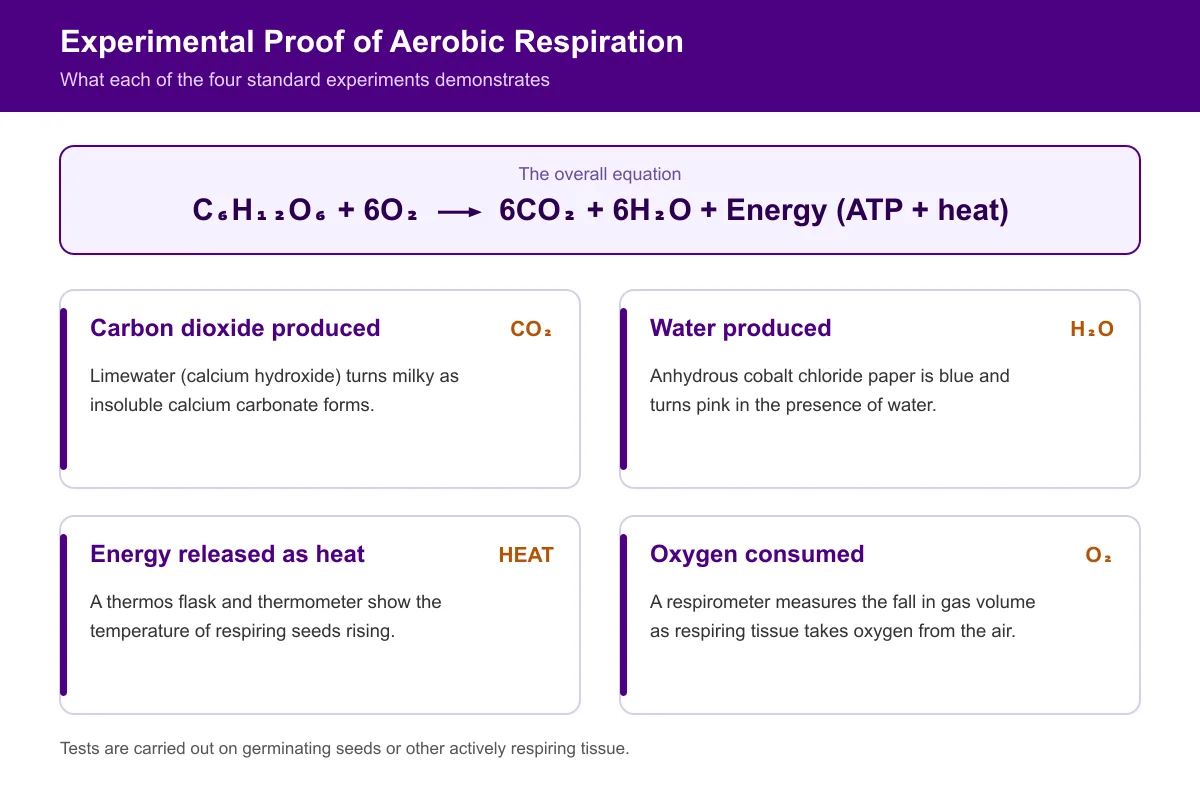
Aerobic respiration is a fundamental metabolic process in which cells break down glucose in the presence of oxygen to produce energy, carbon dioxide, and water. The overall equation is: C₆H₁₂O₆ + 6O₂ → 6CO₂ + 6H₂O + Energy (ATP + heat). Experimental proof of these products is essential for understanding cellular metabolism. This article provides detailed experimental evidence for each product, including the release of energy, production of carbon dioxide and water, and the use of oxygen during aerobic respiration. Each section includes step-by-step procedures, observations, and conclusions to support academic study.
The Release of Energy
Energy release during aerobic respiration is primarily in the form of ATP (adenosine triphosphate) and heat. Experimental demonstration involves measuring heat production or ATP synthesis in respiring tissues.
Experiment 1: Heat Production in Germinating Seeds
Principle: Actively respiring seeds release heat as a byproduct of respiration. This heat can be measured using a thermos flask and thermometer.
Procedure:
- Soak pea seeds in water for 24 hours to initiate germination.
- Place the germinating seeds in a thermos flask (to minimize heat loss).
- Insert a thermometer through a cork into the flask, ensuring it is in contact with the seeds.
- Seal the flask to prevent air exchange (optional: use a control flask with boiled, dead seeds).
- Record the temperature every 15 minutes for several hours.
Observation: The temperature in the flask with germinating seeds rises steadily, while the control (dead seeds) shows no significant change.
Conclusion: The rise in temperature indicates that respiration is an exothermic reaction, releasing heat energy. This proves that energy is released during aerobic respiration.
Experiment 2: ATP Measurement Using Luciferase Assay
Principle: The enzyme luciferase catalyzes a light-emitting reaction in the presence of ATP. The amount of light produced is proportional to ATP concentration.
Procedure:
- Prepare a cell extract from respiring yeast or muscle tissue.
- Add luciferase and luciferin (substrate) to the extract.
- Measure light emission using a luminometer.
- Compare with ATP standards to quantify ATP levels.
Observation: High light emission indicates high ATP content in respiring cells. When oxygen is supplied, ATP levels increase compared to anaerobic conditions.
Conclusion: Aerobic respiration produces significant ATP, confirming the release of energy in a usable form.
Key Points on Energy Release
- Energy is released as ATP (chemical energy) and heat.
- ATP is the primary energy currency for cellular processes.
- Heat production can be measured using calorimetry.
- The amount of energy released per glucose molecule is approximately 2870 kJ, with about 40% captured as ATP.
Production of Carbon Dioxide and Water
Carbon dioxide and water are the end products of aerobic respiration. Experimental detection relies on chemical reactions that produce visible changes.
Experiment 1: Detection of CO₂ Using Limewater
Principle: Carbon dioxide turns limewater (calcium hydroxide solution) milky due to the formation of insoluble calcium carbonate.
Procedure:
- Set up an apparatus with a conical flask containing germinating seeds (or a respiring organism like a snail).
- Connect a delivery tube from the flask to a test tube containing limewater.
- Seal the flask and allow respiration to occur for 1-2 hours.
- Observe the limewater for any change.
Observation: The limewater turns milky, indicating the presence of CO₂.
Conclusion: Respiration produces carbon dioxide, which reacts with limewater to form a precipitate.
Experiment 2: Detection of Water Using Cobalt Chloride Paper
Principle: Anhydrous cobalt chloride paper is blue in color and turns pink in the presence of water.
Procedure:
- Place a respiring organism (e.g., a germinating seed) in a sealed glass jar.
- Attach a strip of blue cobalt chloride paper to the inside of the lid, ensuring it doesn’t touch the organism.
- Observe the color change over time.
Observation: The blue paper turns pink, confirming the release of water vapor.
Conclusion: Water is a product of aerobic respiration.
Table: Comparison of CO₂ and Water Detection Methods
| Product | Test | Reagent | Positive Result |
|---|---|---|---|
| CO₂ | Limewater test | Calcium hydroxide (Ca(OH)₂) | Milky white precipitate |
| H₂O | Cobalt chloride test | Anhydrous CoCl₂ paper | Blue to pink |
Key Points on CO₂ and Water Production
- CO₂ is produced in the Krebs cycle and is exhaled by animals.
- Water is formed in the electron transport chain when oxygen accepts electrons and combines with protons.
- For every glucose molecule, 6 CO₂ and 6 H₂O are produced.
- Both products are essential for maintaining cellular pH and hydration.
Use of Oxygen During Aerobic Respiration
Oxygen is the final electron acceptor in the electron transport chain. Its consumption can be measured using respirometers.
Experiment 1: Oxygen Consumption Using a Respirometer
Principle: A respirometer measures the volume of oxygen consumed by respiring organisms. CO₂ produced is absorbed by potassium hydroxide (KOH), so the change in gas volume is due to O₂ consumption.
Procedure:
- Place germinating seeds in a respirometer chamber.
- Add a small vial of KOH to absorb CO₂.
- Seal the chamber and connect it to a graduated capillary tube containing colored water.
- Record the movement of the water droplet over time.
Observation: The water droplet moves towards the chamber, indicating a decrease in gas volume due to O₂ consumption.
Conclusion: Oxygen is used up during aerobic respiration. The rate of O₂ consumption can be calculated from the distance moved by the droplet.
Experiment 2: Oxygen Requirement for Germination
Principle: Seeds need oxygen for aerobic respiration during germination. This can be demonstrated by comparing germination in aerobic vs. anaerobic conditions.
Procedure:
- Place equal numbers of soaked pea seeds in two flasks.
- In Flask A, keep normal air (aerobic). In Flask B, replace air with nitrogen gas (anaerobic).
- Observe germination over 3-5 days.
Observation: Seeds in Flask A germinate and show growth, while seeds in Flask B fail to germinate.
Conclusion: Oxygen is essential for aerobic respiration and subsequent energy production needed for germination.
Key Points on Oxygen Use
- Oxygen acts as the final electron acceptor in the electron transport chain.
- Without oxygen, the electron transport chain halts, and ATP production is severely reduced.
- Oxygen consumption is directly proportional to the rate of aerobic respiration.
- Respirometry is a standard method to measure metabolic rates.
Integrated Experiments: Simultaneous Detection of All Products
To fully demonstrate the products of aerobic respiration, an integrated setup can be used. This involves measuring oxygen consumption, carbon dioxide production, and heat generation simultaneously.
Setup Description
A sealed chamber containing germinating seeds is connected to:
- A manometer to measure gas volume changes (with KOH to absorb CO₂).
- A thermometer to measure temperature.
- A port to sample gas for CO₂ detection using limewater.
This setup allows real-time monitoring of all three products.
Observations and Data
| Time (min) | O₂ Consumed (mL) | CO₂ Produced (mL) | Temperature (°C) |
|---|---|---|---|
| 0 | 0 | 0 | 25.0 |
| 30 | 5.2 | 5.2 | 25.8 |
| 60 | 10.5 | 10.5 | 26.5 |
Note that the volume of O₂ consumed equals the volume of CO₂ produced, indicating a respiratory quotient (RQ) of 1, consistent with carbohydrate respiration.
Conclusion from Integrated Experiment
The simultaneous detection confirms that for each molecule of oxygen consumed, one molecule of carbon dioxide is produced, and heat is released. This aligns with the overall equation of aerobic respiration.
Advanced Techniques for Product Analysis
Gas Chromatography for CO₂ and O₂
Gas chromatography can separate and quantify gases in a sample. This provides precise measurements of oxygen consumption and carbon dioxide production in real time. The technique involves injecting a gas sample into a column where different gases are separated based on their affinity for the stationary phase. A detector (e.g., thermal conductivity detector) quantifies each gas. This method is highly sensitive and can detect minute changes in gas concentrations, making it ideal for studying respiration in small organisms or tissues.
Mass Spectrometry for Water Isotopes
Using isotopically labeled oxygen (¹⁸O₂), researchers can trace the incorporation of oxygen into water molecules, proving that water is formed from molecular oxygen. In this experiment, cells are exposed to ¹⁸O₂, and the water produced is analyzed by mass spectrometry. The presence of H₂¹⁸O confirms that oxygen from the gas phase is incorporated into water during respiration. This provides direct evidence that water is a product of aerobic respiration and that oxygen is the source of the oxygen atom in water.
Calorimetry for Energy Measurement
Bomb calorimeters measure the total heat released by combusting organic material. For respiring tissues, microcalorimeters can detect minute heat changes. In a typical microcalorimetry experiment, a small sample of respiring cells or mitochondria is placed in a calorimeter cell, and the heat flow is measured over time. The heat output is directly proportional to the rate of respiration. This method allows quantification of energy release in real time and can be used to study the effects of inhibitors or uncouplers on respiration.
Common Misconceptions and Clarifications
- Misconception: CO₂ is produced only in the Krebs cycle. Fact: CO₂ is also produced during pyruvate decarboxylation (link reaction) before the Krebs cycle.
- Misconception: Water is a byproduct with no function. Fact: Water is essential for cellular hydration, acts as a solvent for biochemical reactions, and is involved in hydrolysis reactions.
- Misconception: Oxygen is used only in the electron transport chain. Fact: Oxygen is also involved in other oxidative reactions, such as in the synthesis of certain amino acids and in detoxification processes, but its primary role in respiration is in the ETC.
- Misconception: Energy release is only in the form of ATP. Fact: Energy is also released as heat, which helps maintain body temperature in warm-blooded animals.
Detailed Analysis of Each Stage of Aerobic Respiration
Glycolysis
Glycolysis occurs in the cytoplasm and doesn’t require oxygen. It breaks down one glucose molecule (6C) into two pyruvate molecules (3C each). The net energy yield is 2 ATP and 2 NADH. No CO₂ or H₂O is produced at this stage. but, the NADH produced will later be used in the electron transport chain to generate more ATP, indirectly contributing to oxygen consumption and water formation.
Pyruvate Decarboxylation (Link Reaction)
Each pyruvate is transported into the mitochondrial matrix, where it is decarboxylated (loses a CO₂ molecule) and combined with coenzyme A to form acetyl-CoA. This reaction also produces 1 NADH per pyruvate. Thus, for one glucose, 2 CO₂ molecules are released here. This is the first site of CO₂ production in aerobic respiration.
Krebs Cycle (Citric Acid Cycle)
Acetyl-CoA (2C) enters the Krebs cycle, which occurs in the mitochondrial matrix. Through a series of reactions, the acetyl group is completely oxidized to CO₂. For each acetyl-CoA, the cycle produces 2 CO₂, 3 NADH, 1 FADH₂, and 1 ATP (or GTP). Since one glucose yields two acetyl-CoA molecules, the Krebs cycle produces 4 CO₂, 6 NADH, 2 FADH₂, and 2 ATP. The CO₂ produced here is the majority of the total CO₂ from respiration.
Electron Transport Chain and Oxidative Phosphorylation
NADH and FADH₂ donate electrons to the electron transport chain (ETC) located on the inner mitochondrial membrane. As electrons move through the chain, protons (H⁺) are pumped from the matrix to the intermembrane space, creating a proton gradient. At the end of the chain, electrons are transferred to molecular oxygen (O₂), which combines with protons to form water. This is the only step where oxygen is consumed and water is produced. The proton gradient drives ATP synthesis via ATP synthase, producing about 34 ATP per glucose. Thus, the ETC is responsible for the majority of ATP production, oxygen consumption, and water formation.
Table: Summary of Products at Each Stage
| Stage | Location | CO₂ Produced | H₂O Produced | O₂ Consumed | ATP Produced (Net) |
|---|---|---|---|---|---|
| Glycolysis | Cytoplasm | 0 | 0 | 0 | 2 |
| Pyruvate Decarboxylation | Mitochondrial matrix | 2 | 0 | 0 | 0 |
| Krebs Cycle | Mitochondrial matrix | 4 | 0 | 0 | 2 |
| Electron Transport Chain | Inner mitochondrial membrane | 0 | 6 | 6 | ~34 |
| Total | 6 | 6 | 6 | ~38 |
Factors Affecting the Rate of Aerobic Respiration
Several factors influence the rate of aerobic respiration and thus the production of its products. Understanding these factors is crucial for experimental design and interpretation.
Temperature
Respiration is enzyme-driven, so it follows the typical pattern of enzyme activity: rate increases with temperature up to an optimum (usually around 35-40°C for most organisms), then declines due to denaturation. In experiments, temperature must be controlled to avoid confounding results.
Oxygen Availability
Oxygen concentration directly affects the rate of aerobic respiration. At low oxygen levels, respiration slows, and organisms may switch to anaerobic respiration. In respirometry experiments, ensuring adequate oxygen supply is critical.
Substrate Concentration
Glucose availability can limit respiration. In germinating seeds, stored starch is broken down to glucose. Adding external glucose can increase respiration rate until other factors become limiting.
pH
Enzymes involved in respiration have optimal pH ranges (e.g., around 7.2-7.4 for most). Deviations can reduce activity. Buffers are often used in in vitro experiments to maintain pH.
Inhibitors
Specific inhibitors can block steps in respiration. for instance, cyanide inhibits cytochrome c oxidase in the ETC, stopping oxygen consumption and ATP production. Using inhibitors helps identify the roles of different components.
Experimental Design Considerations
When designing experiments to prove aerobic respiration products, several factors must be considered to ensure valid results.
Controls
Always include a negative control (e.g., boiled or dead organisms) to show that changes are due to respiration, not abiotic factors. For heat experiments, a control without organisms accounts for ambient temperature fluctuations.
Replicates
Multiple replicates (at least three) are necessary to account for variability and ensure reproducibility. Statistical analysis (e.g., t-tests) can confirm significance.
Quantification
Where possible, measure products quantitatively (e.g., volume of O₂ consumed, concentration of CO₂, temperature change). This allows calculation of rates and comparison across conditions.
Environmental Conditions
Maintain constant temperature, humidity, and light conditions (if using photosynthetic organisms) to avoid extraneous effects. For aquatic organisms, ensure proper aeration.
Applications of Understanding Respiration Products
Knowledge of aerobic respiration products has practical applications in medicine, agriculture, and biotechnology.
Medicine
Metabolic disorders often involve defects in respiration. for instance, mitochondrial diseases impair ATP production, leading to symptoms like muscle weakness. Measuring oxygen consumption and CO₂ production can aid diagnosis. Also, understanding how cancer cells alter respiration (Warburg effect) helps develop therapies.
Agriculture
Seed germination and crop storage depend on respiration rates. High respiration can deplete stored nutrients and cause spoilage. Controlled atmosphere storage (reduced O₂, elevated CO₂) slows respiration, extending shelf life. Also, breeding programs select for efficient respiration to improve yield.
Biotechnology
In fermentation, aerobic respiration is used to produce biomass (e.g., yeast for baking) or metabolites. Monitoring oxygen consumption and CO₂ production helps optimize bioreactor conditions. for instance, in penicillin production, oxygen supply is critical for fungal respiration and antibiotic synthesis.
Advanced Topics: Mitochondrial Respiration and Uncoupling
Mitochondrial Isolation and Respiration Measurement
Researchers often isolate mitochondria from cells to study respiration in a controlled environment. Using an oxygen electrode, they measure oxygen consumption in the presence of substrates (e.g., succinate, malate) and ADP. This allows precise measurement of respiratory control and efficiency.
Uncouplers
Uncouplers like 2,4-dinitrophenol (DNP) disrupt the proton gradient across the inner mitochondrial membrane, causing oxygen consumption to continue without ATP synthesis. This results in heat production instead. Experiments with uncouplers demonstrate that oxygen consumption and ATP production aren’t directly coupled; instead, the proton gradient links them. This also shows that energy can be released as heat when uncoupled.
Summary of Key Experiments
To consolidate the information, here is a summary table of classic experiments proving each product:
| Product | Experiment | Observation | Conclusion |
|---|---|---|---|
| Energy (heat) | Germinating seeds in thermos | Temperature increase | Heat is released |
| Energy (ATP) | Luciferase assay | Light emission | ATP is produced |
| CO₂ | Limewater test | Milky precipitate | CO₂ is produced |
| H₂O | Cobalt chloride paper | Blue to pink | Water is produced |
| O₂ consumption | Respirometer | Droplet movement | O₂ is consumed |
Conclusion
The experimental proof of aerobic respiration products—energy release, carbon dioxide, water, and oxygen consumption—is well-established through simple and advanced techniques. Heat production in germinating seeds, limewater test for CO₂, cobalt chloride test for water, and respirometry for O₂ consumption provide clear evidence. These experiments are fundamental in biology education and research, confirming the central role of aerobic respiration in cellular energy metabolism. Understanding these proofs is essential for students and researchers in biochemistry, physiology, and related fields. By integrating multiple detection methods and considering factors like temperature and oxygen availability, one can obtain a comprehensive picture of respiration. The applications of this knowledge span medicine, agriculture, and biotechnology, highlighting the importance of mastering these experimental proofs.
Frequently Asked Questions
What is the experimental proof that CO₂ is produced during aerobic respiration?
The limewater test is classic: exhaled air or gas from respiring organisms turns limewater milky due to calcium carbonate formation. More advanced methods include gas chromatography and infrared CO₂ sensors.
How can we prove that water is a product of aerobic respiration?
Anhydrous cobalt chloride paper turns pink in the presence of water vapor. Additionally, using isotopically labeled oxygen (¹⁸O₂), water formed during respiration contains ¹⁸O, confirming its origin from molecular oxygen.
How do we measure oxygen consumption in respiring organisms?
Using a respirometer: the organism is placed in a sealed chamber with CO₂ absorbent (KOH). The decrease in gas volume is measured by a manometer, indicating oxygen consumption.
What is the role of oxygen in aerobic respiration?
Oxygen serves as the final electron acceptor in the electron transport chain, combining with electrons and protons to form water. This allows the continued flow of electrons and ATP synthesis.
How is energy release measured experimentally?
Energy release can be measured as heat using a calorimeter. For biological systems, microcalorimeters or thermopiles are used to detect temperature changes. ATP production can be quantified using luciferase assays.
Why is it important to use controls in respiration experiments?
Controls (e.g., boiled seeds) ensure that observed changes are due to respiration and not to abiotic factors like microbial contamination or physical processes.
What factors can affect the rate of aerobic respiration in experiments?
Temperature, oxygen concentration, substrate availability, pH, and the presence of inhibitors all influence respiration rate. These must be controlled for accurate results.



Leave a Reply