
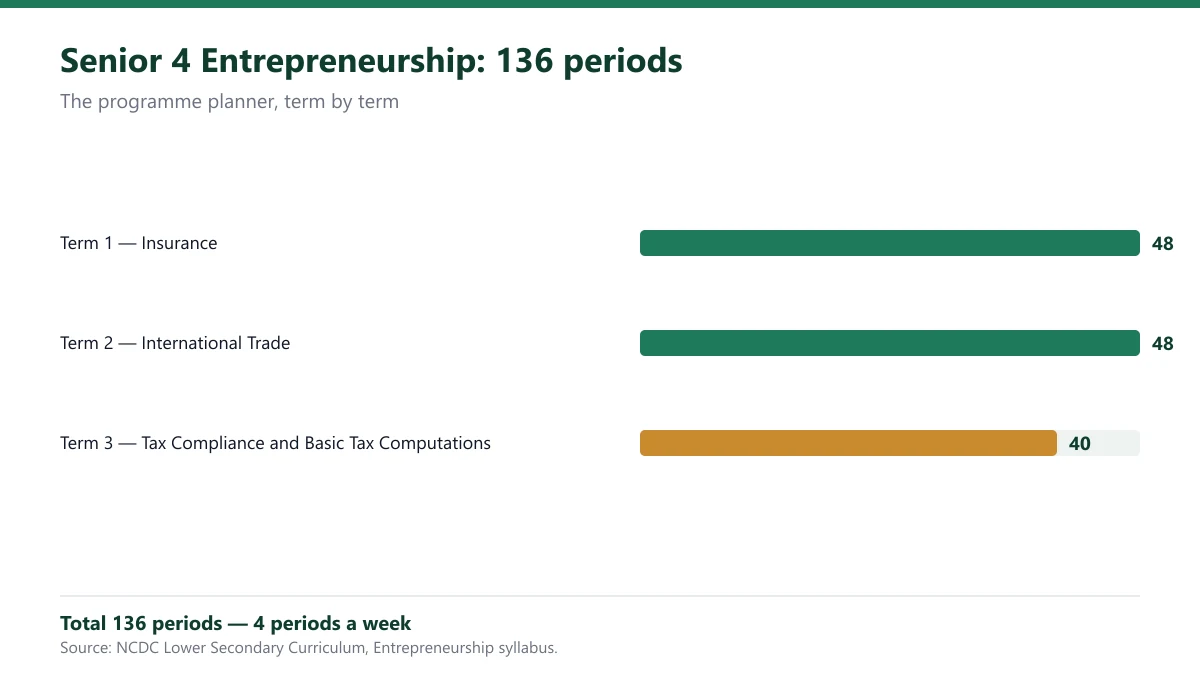
The Senior 4 Entrepreneurship topics span three units across 136 periods: Insurance in Term 1, International Trade in Term 2, and Tax Compliance in Term 3. All three sit under the Business Support theme and are set by Uganda’s National Curriculum Development Centre (NCDC). This breakdown lists every sub-topic, its period count, its competency and its learning outcomes.
- 136 periods total — 48 in Term 1, 48 in Term 2 and 40 in Term 3.
- Three topics — Topic 13 Insurance, Topic 14 International Trade and Topic 15 Tax Compliance.
- Eight sub-topics — four under Insurance, two under International Trade and two under Tax Compliance.
- One theme — Business Support runs through all three terms.
- Elective subject — four periods a week in Senior 3 and Senior 4.
- Outcome codes — (k), (u), (s), (v) and (gs) tag every learning outcome.
What are the Senior 4 Entrepreneurship topics?
The Senior 4 Entrepreneurship topics are the three final units of Uganda’s O-level Entrepreneurship course: Topic 13 Insurance (48 periods), Topic 14 International Trade (48 periods), and Topic 15 Tax Compliance (40 periods). Together they total 136 periods and complete the lower secondary subject after the Senior 3 topics.
Senior 4 picks up exactly where the Senior 3 Entrepreneurship syllabus ends. Senior 3 covered Topic 11 Business Planning and Topic 12 Introduction to Principles of Accounting, plus Tax Administration in Uganda. Senior 4 now adds Insurance, International Trade and Tax Compliance under one Business Support theme.
| Topic | Title | Term | Periods |
|---|---|---|---|
| 13 | Insurance | Term 1 | 48 |
| 14 | International Trade | Term 2 | 48 |
| 15 | Tax Compliance | Term 3 | 40 |
| Total | 136 |

This guide is published by Remedial Corner, a Ugandan inclusive-education and revision platform. The period counts and competencies below follow the NCDC Curriculum Framework, the official source for the lower secondary curriculum.
How many periods is Senior 4 Entrepreneurship?
Senior 4 Entrepreneurship is allocated 136 periods in total. The planner splits these as 48 periods for Insurance in Term 1, 48 for International Trade in Term 2, and 40 for Tax Compliance in Term 3, the shortest topic of the year.
The Senior 4 programme planner sets the year out in three rows, one per term, each carrying the Business Support theme. The table below shows the exact split.
| Term | Theme | Topic | Periods |
|---|---|---|---|
| Term 1 | Business Support | Insurance | 48 |
| Term 2 | Business Support | International Trade | 48 |
| Term 3 | Business Support | Tax Compliance | 40 |
| Total | 136 |
At four periods a week, the year divides naturally across the three terms. Entrepreneurship is compulsory in Senior 1 and Senior 2, then becomes an elective in Senior 3 and Senior 4, so a learner only studies these topics if they chose the subject.
The planner prints Term 3 as two rows — Tax Compliance (20 periods) and Basic Tax Computations (20 periods) — but the syllabus groups both as Topic 15. The two 20-period sub-topics simply split the 40-period topic across the term.
Topic 13: Insurance (Term 1)
Topic 13 Insurance opens the Senior 4 Entrepreneurship topics in Term 1, running for 48 periods under the Business Support theme. Its competency frames the whole topic, and four sub-topics follow it.
The learner knows and uses insurance services.
What are the sub-topics of Insurance?
Insurance has four sub-topics: 13.1 Terms Used in Insurance (9 periods), 13.2 Principles of Insurance (15 periods), 13.3 Insurance Documents and Process (15 periods), and 13.4 Challenges Facing the Insurance Industry (9 periods). Together they total 48 periods, the whole of Term 1.
| Sub-topic | Title | Periods |
|---|---|---|
| 13.1 | Terms Used in Insurance | 9 |
| 13.2 | Principles of Insurance | 15 |
| 13.3 | Insurance Documents and Process | 15 |
| 13.4 | Challenges Facing the Insurance Industry | 9 |
| Total | 48 |
13.1 Terms Used in Insurance (9 periods)
Learners here understand the meaning and importance of insurance, and understand the basic terms used in insurance and the difference between types of insurance. Both outcomes are tagged (u), for understanding. Activities start with the class discussing and agreeing what the term insurance means.
In pairs, learners tell each other why insurance matters and what they would insure in their own lives and why. They discuss examples where a lack of insurance caused considerable financial difficulty, and the opposite case where paying for insurance became a financial burden. They then identify two businesses in the local community and find out the importance of insurance to those businesses.
13.2 Principles of Insurance (15 periods)
Learners appreciate the principles of insurance (u, gs) and understand the types and classes of insurance (k). In groups they research and discuss the principles with guidance from the teacher, then work in pairs to define each principle with an example.
Small groups think critically about the effects of these principles on the way people live. Finally, each learner completes an assignment on the principles of insurance, which lets the teacher check understanding in writing.
13.3 Insurance Documents and Process (15 periods)
Learners know the documents used in insurance (k, u), understand the steps to take up an insurance policy (k), and know the steps taken to settle a claim (k, v). Groups research the documents that carry the key features of the insurance process.
Each group then considers an insurance they would need to take out, lists the steps and documents involved, and presents the process to the class, explaining the steps for making a claim. Individually, learners write an instruction guide for taking up a policy and settling a claim.
13.4 Challenges Facing the Insurance Industry (9 periods)
Learners appreciate the challenges facing the insurance industry (u, gs) and know possible solutions to those challenges (u, s). They interview an insurance broker, asking key questions to identify the challenges and suggest solutions.
Learners then prepare a summary of their learning about insurance, outlining possible solutions to the challenges the industry faces. Assessment observes how well a written assignment captures the key features of these challenges.
Topic 14: International Trade (Term 2)
Topic 14 International Trade runs for 48 periods across Term 2, also under the Business Support theme. Its competency is broader than Insurance: it asks the learner to find and use opportunities on the international market.
The learner identifies and exploits business opportunities on the international market.
What are the sub-topics of International Trade?
International Trade has two sub-topics: 14.1 Introduction to International Trade (24 periods) and 14.2 Regional Cooperation (24 periods). Both run in Term 2 under the Business Support theme, and together they total 48 periods, the same allocation given to Insurance in Term 1.
| Sub-topic | Title | Periods |
|---|---|---|
| 14.1 | Introduction to International Trade | 24 |
| 14.2 | Regional Cooperation | 24 |
| Total | 48 |
14.1 Introduction to International Trade (24 periods)
This is the longest single sub-topic in the Senior 4 Entrepreneurship syllabus, with eight learning outcomes. They run from understanding what international trade means, through its forms and documents, to the requirements for import and export trade. The outcomes are listed below.
- understand what is meant by international trade (u)
- know the forms of international trade, including e-commerce (u, s)
- understand reasons for international trade and the various challenges it presents (u, s) (k)
- know International Commercial Terms (INCO terms) (u)
- understand the documents used in international trade (u)
- know the commercial tools used to control international trade (k)
- understand the factors affecting international trade (u, v, s)
- understand the requirements for export and import trade (k)
Activities begin with learners brainstorming the meaning and divisions of international trade, then agreeing a class definition. Groups discuss why a country needs international trade and its different forms, then study the commercial terms and their implications. They interpret and prepare international trade documents, and identify the commercial tools used to control trade.
For assessment, learners identify Uganda’s main imports and exports and produce a table or diagram of them, judging how far the products reflect key aspects of trade in Uganda. They also research changes in international trade over the last ten years and predict what might happen next.
14.2 Regional Cooperation (24 periods)
Learners know regional cooperation and give examples (u, gs), appreciate its benefits (u, v, s), and understand its challenges (u, gs). Groups discuss the regional cooperations Uganda belongs to and outline the features of key ones.
Groups then prepare a summary of the benefits and challenges of regional cooperation, using local and international examples. Learners explore why these cooperations began, linking them to political and economic change, compare them to other kinds of businesses with charts, and present their findings as a radio show or an advert.
Topic 15: Tax Compliance (Term 3)
Topic 15 Tax Compliance runs for 40 periods across Term 3, the final term of the lower secondary course. Like the rest of Senior 4 it sits under the Business Support theme, and its competency closes the subject by joining the local and international market to tax rules.
The learner identifies and exploits business opportunities in the local and international market and complies with tax regulations.
What are the sub-topics of Tax Compliance?
Tax Compliance has two sub-topics: 15.1 Tax Compliance (20 periods) and 15.2 Basic Tax Computations (20 periods). Together they total 40 periods in Term 3, the shortest and final of the three Senior 4 topics that close the O-level course.
| Sub-topic | Title | Periods |
|---|---|---|
| 15.1 | Tax Compliance | 20 |
| 15.2 | Basic Tax Computations | 20 |
| Total | 40 |
15.1 Tax Compliance (20 periods)
This sub-topic carries six learning outcomes, from knowing what tax compliance means to suggesting ways to improve it. Learners also appreciate the factors affecting compliance and weigh its advantages against the disadvantages of non-compliance.
- know tax compliance (k)
- appreciate factors affecting tax compliance (u, gs)
- understand the elements of tax compliance (s, u)
- know the advantages of tax compliance (u, gs)
- know the disadvantages of non-tax compliance (u, gs)
- suggest ways of improving tax compliance (u, s)
Groups study case studies that illustrate both tax compliance and non-compliance, then sort them by an agreed criterion and justify the sorting with evidence. They agree a definition of tax compliance, identify the factors that affect it in each case, and debate its advantages and disadvantages with another group.
Learners also agree a list of ways to improve tax compliance and research statements about it on the Internet, then draft their own statement for a local government website. For assessment they produce a strategy for government organisations to respond to non-compliance. The O-Level Entrepreneurship Education textbook expands on this content.
15.2 Basic Tax Computations (20 periods)
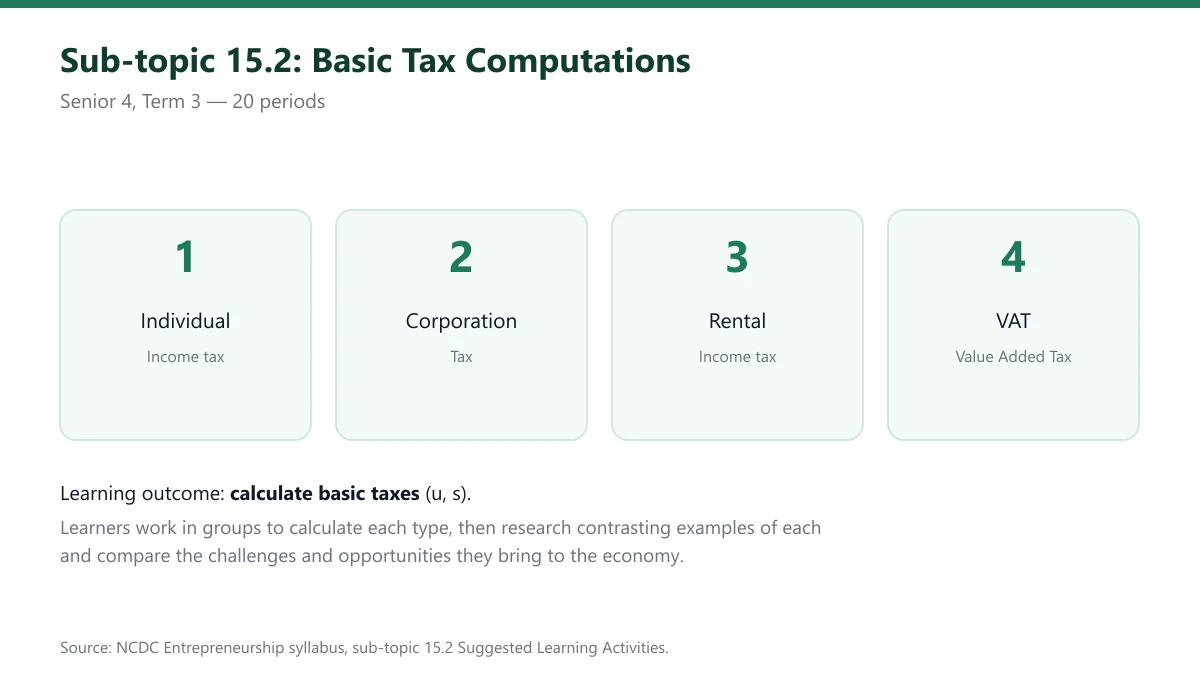
This sub-topic has a single learning outcome: calculate basic taxes (u, s). Learners are first shown how to calculate basic taxes, then work in groups to calculate four of them.
- Individual Income tax
- Corporation tax
- Rental Income tax
- VAT
Learners then research contrasting examples of these taxes and compare the challenges and opportunities each brings to the economy and communities. For assessment, they calculate basic taxes using several business examples and other accounts, with the teacher observing how accurate the calculations are.
What do the learning-outcome codes (k), (u), (s), (v) and (gs) mean?
The learning-outcome codes tag each learning outcome by type: (k) knowledge, (u) understanding, (s) skills, (v) values, and (gs) generic skills. They appear in parentheses after outcomes so teachers can see at a glance whether an outcome targets knowing, doing or valuing.
| Code | Meaning |
|---|---|
| (k) | Knowledge |
| (u) | Understanding |
| (s) | Skills |
| (v) | Values |
| (gs) | Generic skills |
Because one outcome can carry more than one code, the letters also tell a teacher how to assess it. A knowledge outcome is tested differently from a skills outcome, and a values outcome is observed rather than marked. For example, 13.2 Principles of Insurance tags “appreciate the principles” as (u, gs), while 13.1’s “understand the meaning and importance of insurance” is tagged (u) alone.
How should teachers use the three-column layout?
Teachers should base lesson plans on the Learning Outcomes column and treat the Suggested Learning Activities as a guide only. The syllabus states these are not the only possible activities, and encourages teachers to extend them or devise their own to fit the class.
These are not the only possible learning activities, teachers are encouraged to extend these and devise their own that are appropriate to the needs of their class.
The three columns map onto a lesson: Learning Outcomes are the objectives, Suggested Learning Activities are ideas for the lesson body, and the Sample Assessment Strategy shows how to check understanding. A teacher planning 15.2 Basic Tax Computations writes the objective from its single outcome, then chooses the four taxes to practise, and finally observes the accuracy of the calculations.
Because the activities are a guide, a teacher in an inclusive classroom can adapt each one to mixed abilities. A spoken question-and-answer can replace a written test without changing the Learning Outcome, which matters to an inclusive platform like Remedial Corner.
Frequently asked questions about the Senior 4 topics
The Senior 4 Entrepreneurship topics run in a fixed order across the year, term by term.
- Term 1 — Insurance, 48 periods
- Term 2 — International Trade, 48 periods
- Term 3 — Tax Compliance, 40 periods
Is Entrepreneurship compulsory in Senior 4?
No. Entrepreneurship is compulsory in Senior 1 and Senior 2, and becomes an elective in Senior 3 and Senior 4. A Senior 4 learner studies it for four periods a week, but only if they chose it as one of their electives.
How many periods a week is Entrepreneurship taught in Senior 4?
Entrepreneurship is taught for four periods a week in Senior 3 and Senior 4. By comparison, Senior 1 and Senior 2 allocate two periods a week. Across the full year, the Senior 4 timetable totals 136 periods for the subject.
What are the three Senior 4 Entrepreneurship topics?
The three Senior 4 Entrepreneurship topics are Topic 13 Insurance (48 periods in Term 1), Topic 14 International Trade (48 periods in Term 2), and Topic 15 Tax Compliance (40 periods in Term 3). Together they total 136 periods under the Business Support theme.
What is the Insurance competency in Senior 4?
The Topic 13 competency is: “The learner knows and uses insurance services.” It frames all four sub-topics in Term 1, from the terms and principles of insurance, through the documents and claims process, to the challenges facing the insurance industry.
What is the International Trade competency in Senior 4?
The Topic 14 competency is: “The learner identifies and exploits business opportunities on the international market.” It frames both sub-topics across the 48 periods of Term 2, from the meaning and forms of international trade to regional cooperation and its benefits and challenges.
What taxes do learners calculate in Senior 4?
In Topic 15.2 Basic Tax Computations, learners calculate four basic taxes: Individual Income tax, Corporation tax, Rental Income tax, and VAT. They practise in groups, then research contrasting examples and compare the challenges and opportunities each tax brings to communities.
Where can I read the official Senior 4 Entrepreneurship syllabus?
Uganda’s National Curriculum Development Centre (NCDC) publishes the lower secondary Entrepreneurship syllabus that sets this structure. This page summarises the Senior 4 content in one place — every sub-topic, its exact period count and its outcome codes — so you do not need to search further.
For more subject breakdowns, browse the Remedial Corner blog, and read about Remedial Corner to meet the team behind these guides.
Sources and further reading
The sources behind this article, and where to read further.
- NCDC Curriculum Framework (ncdc.go.ug)
- O-Level Entrepreneurship Education textbook (ura.go.ug)


Leave a Reply