
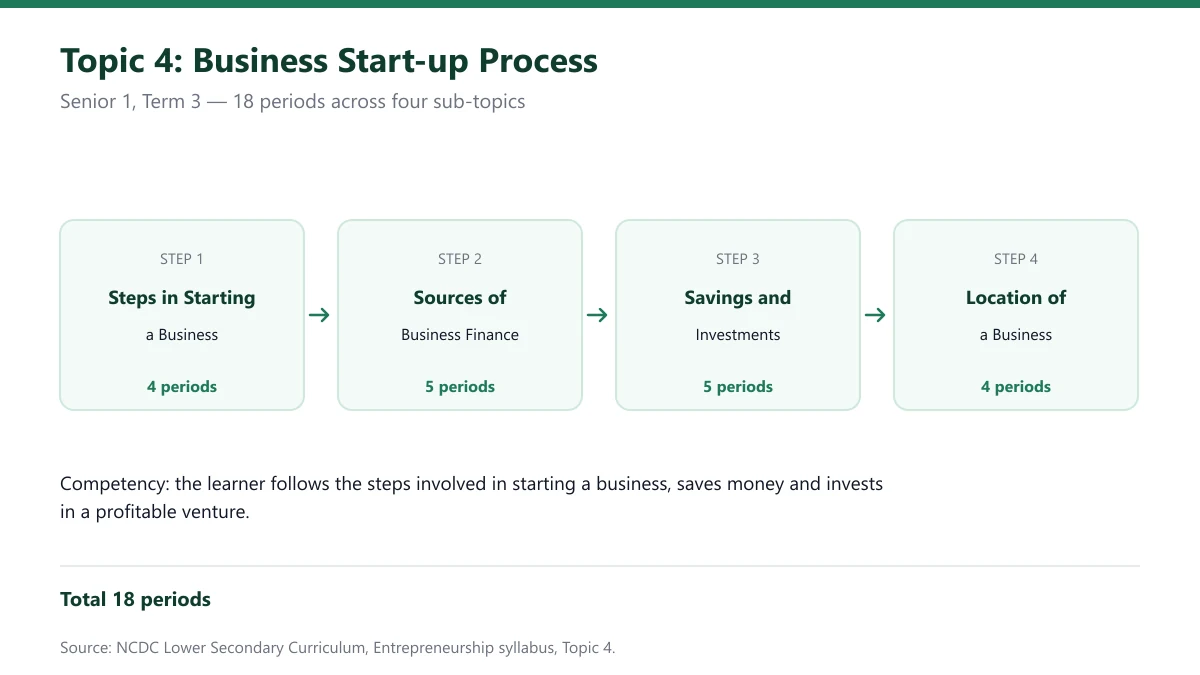
The Business Start-up Process is Senior 1 Topic 4 in Uganda’s lower secondary Entrepreneurship syllabus, taught across 18 periods in Term 3. It takes learners through the steps in starting a business, the sources of business finance, savings and investments, and how to choose a business location. This guide breaks down every learning outcome, activity and assessment so a teacher can plan the whole unit.
- 18 periods in Term 3 — Topic 4 sits under the Start-up Process theme.
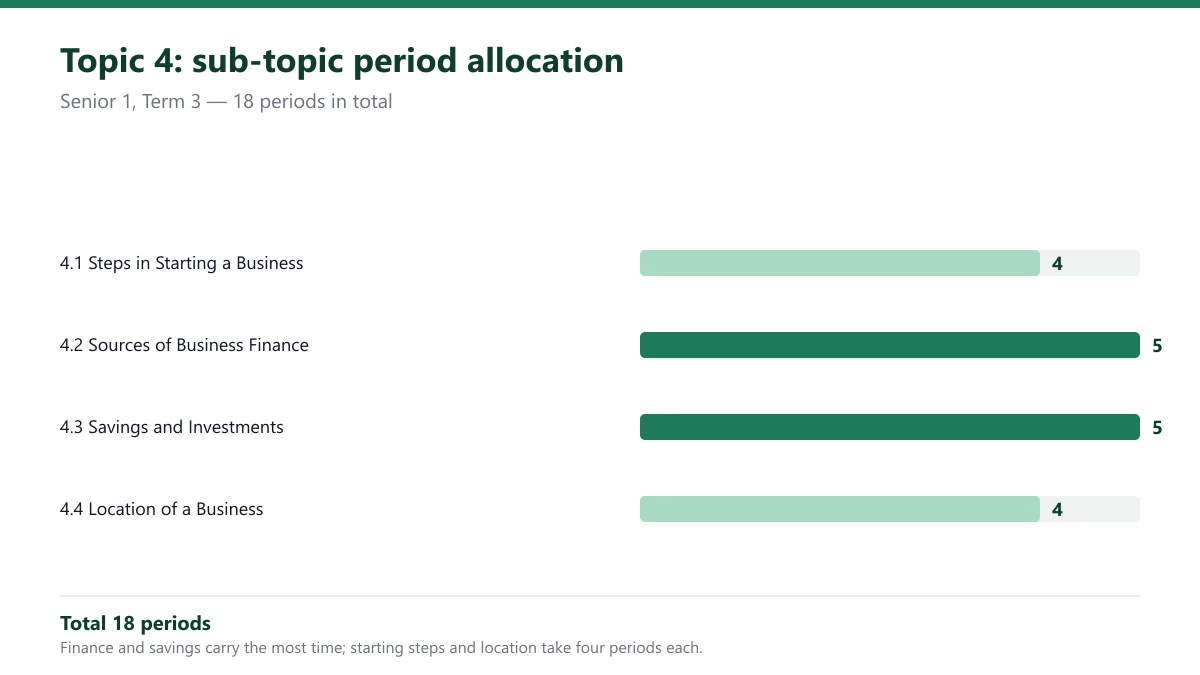
- Four sub-topics — Steps in Starting a Business (4), Sources of Business Finance (5), Savings and Investments (5), Location of a Business (4).
- One competency — the learner follows the steps in starting a business, saves money and invests in a profitable venture.
- 72 periods — the full Senior 1 Entrepreneurship year, with Topic 4 as its Term 3 centrepiece.
- Three-column layout — learning outcomes, suggested activities and sample assessment for every sub-topic.
What is the Business Start-up Process in Senior 1?
The Business Start-up Process is the fourth topic in the Senior 1 Entrepreneurship syllabus, allocated 18 periods in Term 3 under the theme “Start-up Process”. It teaches learners how a new venture is born: the steps to follow, where start-up money comes from, how savings and investments work, and how to pick a business location.
This topic closes the Senior 1 year. It follows Topic 3, Business Ideas and Opportunities, where learners have already generated ideas and run a market survey, so Topic 4 is the natural next step — turning a selected opportunity into a real, funded and well-located business.
Topic 4 is not the whole of Term 3. It is followed by Topic 5, Introduction to Government Revenue, which runs for six periods. Together the two topics complete the 72-period Senior 1 year set out in the programme planner.
| Term | Theme | Topic | Periods |
|---|---|---|---|
| Term 1 | Creating an Entrepreneurial Awareness | Introduction to Entrepreneurship Education | 24 |
| Term 2 | Scanning the Environment | Businesses in Uganda | 12 |
| Term 2 | Scanning the Environment | Business Ideas and Business Opportunities | 12 |
| Term 3 | Start-up Process | Business Start-up Process | 18 |
| Term 3 | Start-up Process | Introduction to Government Revenue | 6 |
| Total | 72 |
This guide is published by Remedial Corner, a Ugandan inclusive-education and revision platform. The period counts, sub-topic names, competency and learning outcomes below come from the official lower secondary Entrepreneurship syllabus, and the NCDC Curriculum Framework is the governing document for that curriculum.
What competency does Topic 4 build?
The competency for the Business Start-up Process states that the learner follows the steps involved in starting a business, saves money and invests in a profitable venture. Every learning outcome in the four sub-topics feeds this one sentence, so assessment always returns to whether the learner can act on it.
The learner follows the steps involved in starting a business, saves money and invests in a profitable venture.
The competency has three parts, and they match the sub-topics in order. “Follows the steps involved in starting a business” belongs to sub-topic 4.1. “Saves money” and “invests in a profitable venture” belong to 4.3, Savings and Investments. Sub-topics 4.2 on finance and 4.4 on location support the first and third parts.
Because the competency is the anchor, a teacher writes every lesson objective from it first. The syllabus then lists the learning outcomes that show, in measurable terms, what following the steps or investing in a profitable venture actually means for a Senior 1 learner.
How do the four sub-topics build on one another?
The four sub-topics run in a logical chain. Learners first master the steps in starting a business (4 periods), then study where the money comes from in Sources of Business Finance (5 periods), then turn to Savings and Investments (5 periods), and finally choose a Location (4 periods). Each stage feeds the next.
- Steps in Starting a Business (4 periods) — plan the venture and set its budget.
- Sources of Business Finance (5 periods) — find and weigh the money.
- Savings and Investments (5 periods) — build and grow the money.
- Location of a Business (4 periods) — place the venture.
| Sub-topic | Title | Periods |
|---|---|---|
| 4.1 | Steps in Starting a Business | 4 |
| 4.2 | Sources of Business Finance | 5 |
| 4.3 | Savings and Investments | 5 |
| 4.4 | Location of a Business | 4 |
| Total | 18 |
The sequence mirrors how a real founder thinks. You cannot finance what you have not planned (4.1 to 4.2), you cannot invest savings you have not understood (4.2 to 4.3), and you cannot locate a venture you have not decided to fund (4.3 to 4.4).
One source file labels the three later sub-topics under “Topic 5” instead of “Topic 4”, but the competency line and the 18-period total confirm they all belong to the Business Start-up Process. Teachers should read “Topic 5” as a print error, since the sub-topic numbers read 4.3 and 4.4.

4.1 Steps in Starting a Business (4 periods)
Steps in Starting a Business opens Topic 4 with four periods. It is where the learner first moves from an idea to a plan, covering the enabling factors, the correct sequence of steps, basic record keeping and the preparation of a budget.
What are the learning outcomes in Steps in Starting a Business?
Sub-topic 4.1 sets three learning outcomes. Learners know the factors that enable a person to start up a business, including basic principles of effective record keeping; they follow the correct steps in starting a business that lead to a business plan; and they prepare a budget, recognising its value to business development.
- Know the factors that enable an individual to start up a business, including some basic principles of effective record keeping (k).
- Follow the correct steps in starting a business which will eventually lead to developing a business plan (k, s).
- Prepare a budget, recognising its value to business development (u, s, gs).
What learning activities does Steps in Starting a Business suggest?
Learners brainstorm the factors that enhance start-ups and explain why each matters. They listen to a presentation from a community entrepreneur on how that person began, then prepare and ask questions. In groups they summarise the steps in starting a business and share them, including how to prepare a budget from sample formats.
- Brainstorm the factors that enhance business start-ups and explain why they are important.
- Listen to a community entrepreneur explain how they started, then prepare and ask questions.
- In groups, summarise the steps in starting a business and share them with the class.
- Learn how to prepare a budget from useful budget formats and strategies.
How is Steps in Starting a Business assessed?
Assessment has learners share opinions and experiences on good strategies for starting a new business, with the teacher evaluating how well they identify key features of success. Learners also produce a written group report describing important aspects of the entrepreneur’s presentation, showing they can capture the essential points.
- In conversation, evaluate how learners identify key features of success when sharing start-up strategies.
- Assess a written group report on the entrepreneur’s presentation for how well it captures important features.
4.2 Sources of Business Finance (5 periods)
Sources of Business Finance follows with five periods. Here learners meet the different places a new business can get money, and — just as importantly — weigh the benefits and challenges of each so they can judge which source fits which venture.
What are the learning outcomes in Sources of Business Finance?
Sub-topic 4.2 sets two learning outcomes. Learners know the different sources of business finance, and they assess the benefits and challenges of each source. This pairing means they do not just list sources; they must weigh each one, which builds the judgement a real founder needs before borrowing or seeking capital.
- Know the different sources of business finance (k).
- Assess the benefits and challenges of each source of business finance (s, u, v, gs).
What learning activities does Sources of Business Finance suggest?
Learners discuss the sources of business finance in groups and justify why these sources are a starting point. They read case studies on the benefits and challenges of each source, discussing similarities and differences. In groups they then explore each source’s challenge and benefit and agree reasons for their responses.
- Discuss the sources of business finance and justify why they are a starting point.
- Read case studies on the benefits and challenges of each source and discuss similarities and differences.
- Explore and identify each source’s challenge and benefit, agreeing reasons for responses.
How is Sources of Business Finance assessed?
Learners write a case study describing a business person in their community, illustrating the source of that person’s funds, the benefits of that source and its challenges. In conversation, the teacher assesses how well learners understand the effects of how businesses are funded — not just the labels.
- Write a case study of a local business person showing the source, benefits and challenges of their funds.
- In conversation, assess understanding of how businesses are funded.
4.3 Savings and Investments (5 periods)
Savings and Investments is the most practical of the four. Learners move from studying money to managing it: defining saving and investment, understanding their forms and purposes, and building a personal savings plan.
What are the learning outcomes in Savings and Investments?
Sub-topic 4.3 sets four learning outcomes. Learners know the factors that determine saving and investment, appreciate the reasons for and forms of saving, understand how to prepare a savings plan using spreadsheets, books and calculators, and know the factors to consider before taking an investment decision.
- Know the factors that determine saving and investment (u, s, gs).
- Appreciate the reasons for and forms of saving (k, v).
- Understand how to prepare a savings plan, including how spreadsheets, books and calculators are used (u, s, gs).
- Know factors to consider before taking an investment decision (k, u).
What learning activities does Savings and Investments suggest?
Learners first agree definitions for saving and investment as a class, then investigate the purpose and forms of each in groups. They agree a general statement on when to save versus when to invest, prepare a personal savings plan, form a savings group or SACCO, and start saving.
- Agree definitions for saving and investment as a class.
- Investigate the purpose and forms of saving, and the purpose and forms of investment, in groups.
- Agree a general statement on when to save and when to invest, with reasons.
- Prepare a personal savings plan.
- Form a savings group or SACCO and start saving.
- Investigate a range of investment plans and agree on one, explaining its benefits.
How is Savings and Investments assessed?
Learners write a monthly report on their savings and investment activities, identifying any challenges and considering practical solutions. The teacher observes how well the report is written, weighing the accuracy of the information and the nature of its content rather than just its length.
- Write a monthly report on savings and investment activities, noting challenges and practical solutions.
- Observe how well reports are written for accuracy of information and nature of content.
4.4 Location of a Business (4 periods)
Location of a Business closes Topic 4 with four periods. It turns learners’ attention outward, to the question of where a venture should sit — and why the wrong location can hold a good idea back.
What are the learning outcomes in Location of a Business?
Sub-topic 4.4 sets a single learning outcome: learners know the factors considered for locating a business. Although it is one line, it is dense — it asks learners to connect a chosen location to the type of business and to recognise when a location does not match.
- Know factors that are considered for locating a business (k, u).
What learning activities does Location of a Business suggest?
Learners discuss the factors that influence business location in groups and present them to the class. They study contrasting locations and try to link each to its type of business, explaining cases where a location does not seem to match, then design a guide for entrepreneurs choosing a site.
- Discuss the factors that influence business location and present them to the class.
- Discuss contrasting locations and link each chosen location to the type of business.
- Explain situations where a location does not seem to match the type of business.
- Design a guide for entrepreneurs selecting a business location.
How is Location of a Business assessed?
Learners identify and describe a business in their community and find out the factors that led to its location. The teacher observes how well learners explain their ideas and how relevant those ideas are to business development — linking location back to a real venture.
- Identify and describe a community business and find the factors behind its location.
- Observe how well learners explain their ideas and how relevant they are to business development.
How should a teacher plan the full 18 periods?
Plan the 18 periods of the Business Start-up Process as a build: four for the steps in starting a business, five for sources of business finance, five for savings and investments, and four for location. Base every lesson on the learning outcomes, use the activities as a guide, and match each assessment to its outcome.
| Sub-topic | Periods | Core focus | Sample assessment |
|---|---|---|---|
| 4.1 Steps in Starting a Business | 4 | Factors, steps, record keeping, budget | Conversation plus a written group report |
| 4.2 Sources of Business Finance | 5 | Sources, benefits and challenges | A community case study |
| 4.3 Savings and Investments | 5 | Saving versus investing, savings plan, SACCO | A monthly savings report |
| 4.4 Location of a Business | 4 | Location factors and site selection | Describing a community business location |
These are not the only possible learning activities, teachers are encouraged to extend these and devise their own that are appropriate to the needs of their class.
The three columns map onto a lesson in one step. The learning outcomes are the objectives, the suggested activities are the lesson body, and the sample assessment is how you check understanding. Because the activities are guidance, an inclusive classroom can adapt them to mixed abilities.
The codes (k) knowledge, (u) understanding, (s) skills, (v) values and (gs) generic skills tag every outcome, so a teacher can see whether each one targets knowing, doing or valuing. For classroom reading beyond this page, the O-Level Entrepreneurship Education textbook expands on the finance and start-up concepts.
Frequently asked questions about this Senior 1 unit
Here are the questions teachers and parents ask most often about Topic 4.
How many periods is the Business Start-up Process in Senior 1?
The Business Start-up Process is allocated 18 periods in Senior 1, all taught in Term 3 under the theme Start-up Process. The 18 periods split across four sub-topics, and they sit alongside Introduction to Government Revenue, which adds six more periods to close the 72-period Senior 1 year.
What is the competency for Topic 4?
The competency states that the learner follows the steps involved in starting a business, saves money and invests in a profitable venture. Every learning outcome in the four sub-topics feeds this sentence, so a teacher writes lesson objectives from it and returns to it when assessing each sub-topic.
What are the four sub-topics of Topic 4?
The four sub-topics are Steps in Starting a Business (4 periods), Sources of Business Finance (5 periods), Savings and Investments (5 periods), and Location of a Business (4 periods). Together they total 18 periods and run in that order, each one building on the one before it.
How many periods is the whole Senior 1 Entrepreneurship year?
Senior 1 Entrepreneurship runs for 72 periods in total. Term 1 carries Introduction to Entrepreneurship Education (24 periods), Term 2 carries Businesses in Uganda and Business Ideas and Opportunities (12 each), and Term 3 carries Topic 4 (18) and Introduction to Government Revenue (6).
What topic follows Topic 4 in Senior 1?
Introduction to Government Revenue follows Topic 4, running for six periods to close Term 3. It covers what government revenue is, why the government needs it, and the sources of government revenue. The two topics together complete the Senior 1 year of 72 periods.
For the next step up the ladder, read the Senior 3 Entrepreneurship syllabus breakdown, where Topic 11 turns the steps taught here into a full business plan. Browse the Remedial Corner blog for more subject guides, and read about Remedial Corner to meet the team behind these notes.
Sources and further reading
The sources behind this article, and where to read further.
- NCDC Curriculum Framework (ncdc.go.ug)
- O-Level Entrepreneurship Education textbook (ura.go.ug)



Leave a Reply