
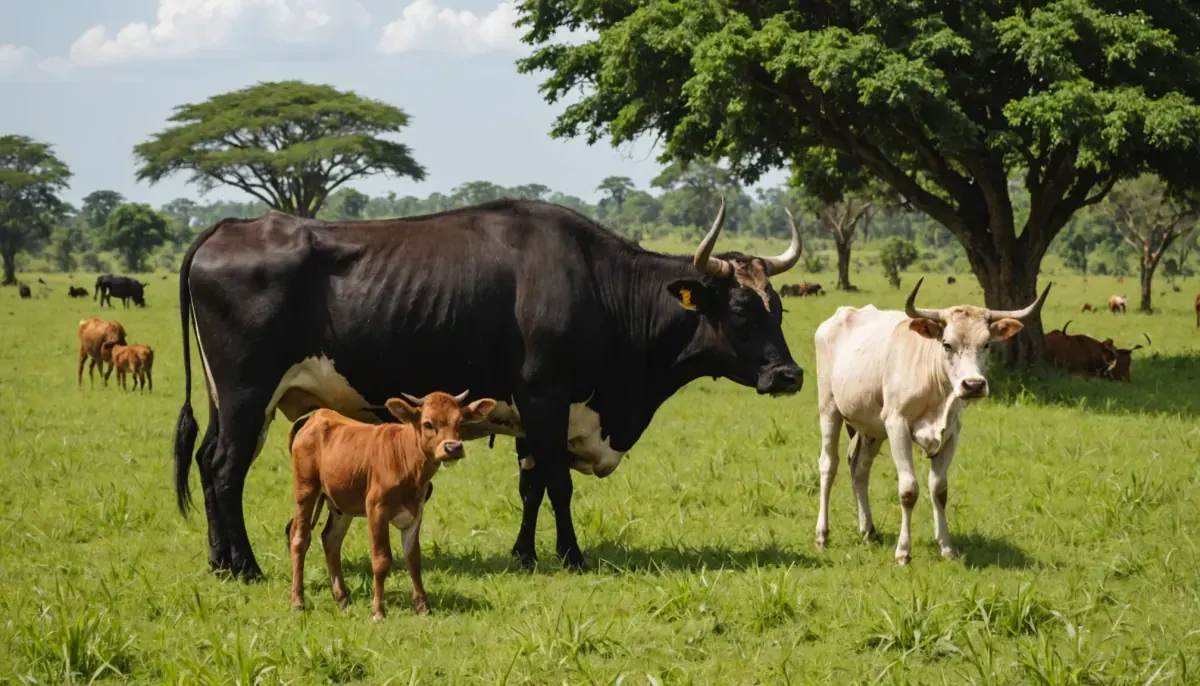
Cattle anatomy and physiology is the study of the body structures (anatomy) of a cow or bull and how those structures work (physiology). For Senior 3 Agriculture in Uganda, it means the internal organs, the four-compartment bovine digestive system, rumination, and the female and male reproductive systems.
A cow turns grass into milk and meat because microbes in its rumen break down fibre the cow cannot digest alone. These notes apply every idea to an Ankole steer on communal grazing and a Friesian in a zero-grazing unit in Wakiso, and they close with a revision summary you can use before your exam.
This page is part of the Senior 3 Agriculture notes on cattle production series. It follows the NCDC Agriculture Syllabus (2019, ISBN 978-9970-00-120-0), theme “Animal Production”, Senior 3 topic “Cattle production” (Term 1, 48 periods), and covers learning outcomes 3.1(c) and 3.1(d) on the internal organs, the digestive system and the reproductive systems. See the full Senior 3 Agriculture notes hub for the other topics in the course.
Internal organs of cattle and their functions
Understanding cattle anatomy and physiology begins with the internal organs, the structures inside the chest and abdomen that keep the animal alive and productive. For the S3 exam, focus on the organs of the digestive tract and the reproductive tract, then the lungs, heart, liver and kidneys that support them. Each organ has one main job, and each fails in a recognisable way.
The same cattle anatomy and physiology serves every Ugandan herd, whether it is an Ankole steer grazing open rangeland in the cattle corridor or a Friesian housed in a zero-grazing stall. Uganda’s national herd stood at 14.5 million cattle in 2021, of which 77% (11.2 million) were indigenous zebu and Ankole and 23% exotic or cross-bred, according to the UBOS National Livestock Census 2021.
A quick check of the share: 14.5 million × 0.77 = 11.165 million, which UBOS rounds to 11.2 million.
- Heart — a muscular pump in the chest that pushes blood through the lungs and around the body, carrying oxygen and nutrients to every organ.
- Lungs — two spongy organs that take in oxygen and remove carbon dioxide, which the blood delivers to and collects from all body tissues.
- Liver — the largest internal organ, which processes nutrients absorbed from the gut, stores energy as glycogen and removes poisons from the blood.
- Kidneys — a pair of organs that filter waste products such as urea out of the blood and send them to the bladder to leave the body as urine.
- Spleen — an organ near the stomach that filters old red blood cells and helps the immune system fight infection.
- Rumen — the first and largest stomach compartment, a fermentation vat where microbes break down the fibre in grass.
- Reticulum — the second stomach compartment, whose honeycomb lining traps heavy objects a cow swallows before they reach the gut.
- Omasum — the third compartment, a book-like organ with many folds that squeezes water and minerals out of partly digested feed.
- Abomasum — the fourth compartment, also called the true stomach, which secretes acid and enzymes to digest protein like a human stomach.
- Small intestine — a long coiled tube where enzymes finish digestion and the villi absorb sugars, amino acids and fatty acids into the blood.
- Large intestine — the wider final part of the gut that absorbs water and forms solid faeces for excretion.
- Ovaries — two organs in the cow that produce ova (eggs) and the hormones oestrogen and progesterone.
- Uterus — the hollow muscular organ where a fertilised egg implants and the foetus grows during pregnancy.
- Testes — two organs in the bull’s scrotum that produce spermatozoa and the male hormone testosterone throughout adult life.
| Organ | Function | What goes wrong when it fails |
|---|---|---|
| Heart | Pumps blood to deliver oxygen and nutrients | Weak circulation, swelling, collapse and death |
| Lungs | Exchange oxygen and carbon dioxide | Laboured breathing and pneumonia |
| Liver | Processes nutrients and removes toxins | Poison build-up, jaundice and poor growth |
| Kidneys | Filter waste from blood into urine | Waste build-up (uraemia) and illness |
| Rumen | Ferments fibre using microbes | Bloat, indigestion and poor body condition |
| Reticulum | Traps heavy swallowed objects | Hardware disease, a pierced gut wall |
| Omasum | Absorbs water and minerals | Dehydration and hard, dry digesta |
| Abomasum | Digests protein with acid and enzymes | Displaced abomasum and poor digestion |
| Small intestine | Absorbs digested nutrients | Diarrhoea and malnutrition |
| Large intestine | Absorbs water and forms faeces | Constipation or scouring |
Common mistake: learners write that the heart “digests food” or that the liver “pumps blood”. Match each organ to its one main job — the heart pumps, the lungs breathe, the liver processes nutrients, and the four stomach compartments digest.
Anatomy of the bovine digestive system
The digestive half of cattle anatomy and physiology follows one long tube from the mouth to the anus, but because cattle are ruminants it begins with four stomach compartments before the small and large intestines. The four compartments — rumen, reticulum, omasum and abomasum — work in that order to turn fibrous grass into nutrients the cow can absorb. Learning the order is worth easy marks in the exam.
Whether an Ankole steer picks grass from open range or a Friesian eats cut Napier in a stall, the same tube processes the feed. The difference between the two is what is fed and how it is managed, which the cattle management systems notes cover. Anatomy stays the same across breeds.
- Mouth and teeth — the cow has no upper incisors; a hard dental pad meets the lower incisors to grip and tear grass.
- Tongue — a long, rough, muscular organ that wraps around grass and pulls it into the mouth.
- Salivary glands — produce large volumes of alkaline saliva that moisten feed and buffer acid produced in the rumen.
- Oesophagus — the tube carrying feed from the mouth to the stomach, and carrying the cud back up during rumination.
- Rumen — the enormous first compartment filling the left side of the abdomen, where billions of microbes ferment fibre.
- Reticulum — the second compartment, a small honeycomb-lined pouch next to the heart that sorts feed and traps heavy objects.
- Omasum — the third compartment, the “book” with many leaf-like folds that absorb water and grind feed particles.
- Abomasum — the fourth compartment, the true stomach, which secretes hydrochloric acid and pepsin to digest protein.
- Small intestine — the duodenum, jejunum and ileum, where enzymes and bile finish digestion and villi absorb nutrients.
- Large intestine — the caecum, colon and rectum, which absorb the remaining water and form faeces.
- Liver — receives nutrient-rich blood from the gut through the hepatic portal vein and processes the absorbed products.
- Pancreas — a gland that releases digestive enzymes and hormones into the small intestine.
- Gall bladder — stores bile produced by the liver and releases it to emulsify fats in the intestine.
- Anus — the exit through which undigested residue leaves the body as faeces.
| Compartment | Also called | Function | Position and size |
|---|---|---|---|
| Rumen | Paunch | Ferments fibre with microbes into volatile fatty acids and microbial protein | Largest; fills the left abdomen |
| Reticulum | Honeycomb | Traps heavy objects and sorts feed for regurgitation | Small; lies next to the heart |
| Omasum | Manyplies / book | Absorbs water and minerals and grinds feed | Many leaf-like folds |
| Abomasum | True stomach | Secretes acid and enzymes to digest protein | Only compartment with glands |
Exam tip: memorise the order with the letters R–R–O–A: Rumen, Reticulum, Omasum, Abomasum. If a question asks for the “true stomach”, the answer is always the abomasum.
Physiological processes of ruminant digestion
A core idea in cattle anatomy and physiology, ruminant digestion is the process by which cattle break down fibrous plant feed using microbes in the rumen before the feed reaches the true stomach. Rumination is the process of bringing back swallowed feed from the rumen, re-chewing it, and swallowing it again. The microbes, not the cow’s own enzymes, do most of the work on cellulose.
A zebu steer on communal grazing eats mature grass and must ruminate for hours to expose the fibre to its rumen microbes. A Friesian in a zero-grazing unit in Wakiso is fed cut-and-carry forage and concentrates, so it spends less time chewing cud. The underlying cattle anatomy and physiology is identical; only the feed quality differs.

- Ingestion — the cow grips grass, chews it only lightly, and swallows it quickly so it can graze for longer.
- Microbial fermentation — bacteria, protozoa and fungi in the rumen break down cellulose, which the cow’s own enzymes cannot.
- Volatile fatty acids — the microbes produce acetate, propionate and butyrate, which the rumen wall absorbs as the cow’s main energy source.
- Microbial protein — the multiplying microbes are later digested in the abomasum, giving the cow protein even from poor grass.
- Rumination — swallowed feed is regurgitated, re-chewed and re-swallowed so microbes can attack more surface area.
- Eructation — the cow belches out fermentation gases such as methane and carbon dioxide; if gas is trapped, bloat follows.
- Reticulo-rumen contractions — rhythmic muscle movements mix the contents and push digested feed onward.
- Passage to the omasum — fine particles flow to the omasum, where water and minerals are squeezed out.
- Abomasal digestion — acid denatures protein and pepsin begins breaking it down, in a process like human digestion.
- Intestinal digestion — pancreatic enzymes and bile complete the breakdown of protein, fat and carbohydrate.
- Absorption — finger-like villi in the small intestine take sugars, amino acids and fatty acids into the blood.
- Saliva buffering — bicarbonate in saliva neutralises the acid produced in the rumen, keeping the microbes alive.
- Bloat — a build-up of trapped gas that can kill a cow, caused by frothy feed or a blocked eructation.
- Calf digestion — a calf’s oesophageal groove lets milk bypass the undeveloped rumen straight to the abomasum.
| Feature | Ruminant (cattle) | Monogastric (pig, human) |
|---|---|---|
| Stomach | One stomach, four compartments | One simple stomach |
| Cellulose digestion | Yes, by rumen microbes | Very limited |
| Chewing | Ruminates (chews the cud) | Chews once and swallows |
| Fermentation vat | Rumen | None (some hindgut in the pig) |
| Main energy source | Volatile fatty acids | Glucose |
| Protein source | Microbial protein plus feed protein | Feed protein only |
| Gas release | Belches methane regularly | Minimal gas |
| Natural diet | Fibrous forage and grass | Grains and mixed feeds |
Common mistake: don’t say a cow “has four stomachs”. It has one stomach with four compartments. Saying “four stomachs” is the single most common error examiners mark wrong.
Female reproductive system in cattle
The reproductive half of cattle anatomy and physiology starts with the female, whose system produces ova (eggs), receives sperm, supports pregnancy and delivers the calf. It lies in the pelvic and abdominal cavity and is made up of the ovaries, oviducts, uterus, cervix, vagina and vulva. The cow is polyoestrous, meaning she comes on heat repeatedly through the year rather than only in one season.
- Ovaries — two small organs that release mature ova and produce the hormones oestrogen and progesterone.
- Ovulation — the release of a mature ovum from the ovary, which in the cow happens during each oestrous cycle.
- Oviducts — the two fallopian tubes that catch the released ovum and are the site where fertilisation occurs.
- Uterus — a hollow organ with two horns and a body, where the fertilised egg implants and the foetus develops.
- Cervix — a thick muscular neck that seals the uterus shut during pregnancy and opens at calving.
- Vagina — the muscular canal that receives the penis during mating and forms part of the birth canal.
- Vulva — the external opening of the female tract through which the calf is born.
- Oestrous cycle — the repeating cycle of about 21 days in which a cow comes on heat, ovulates and returns to heat if not mated.
- Oestrus (heat) — the short receptive period when a cow stands to be mounted and will accept a bull.
- Oestrogen — the hormone that brings a cow into heat and causes the visible signs of oestrus.
- Progesterone — the hormone that maintains pregnancy once the cow has conceived.
- Fertilisation — the joining of a sperm and an ovum in the oviduct to form a zygote.
- Gestation — the period of pregnancy, which in cattle lasts about nine months (roughly 280 days).
- Parturition — the process of giving birth, also called calving, which ends with delivery of the calf.
- Ankole reproductive performance — FAO/UNEP AGRI 15 recorded an Ankole age at first calving of about 51 months and a calving interval of 342 days (historical research-station figures).
| Organ | Function |
|---|---|
| Ovary | Produces ova and the hormones oestrogen and progesterone |
| Oviduct | Catches the ovum; site of fertilisation |
| Uterus | Holds and nourishes the developing foetus |
| Cervix | Seals the uterus during pregnancy |
| Vagina | Receives the penis; forms the birth canal |
| Vulva | External opening of the tract |
Ugandan performance: Ankole on range, Friesian in the shed

The reproductive data explains why Ugandan farmers cross Ankole with Friesian. The FAO/UNEP AGRI 15 Uganda country report recorded these historical research-station figures: an Ankole first calves at about 51 months and gives 882 litres in a lactation, while a zebu first calves at 43 months and gives 692 litres.
A 2008 on-farm study of 18 farms in Kiruhura (Galukande et al.) measured daily yields of 2.4 litres for Ankole and 11.2 litres for a 50% Friesian cross.
| Trait | Ankole | Zebu | Nganda |
|---|---|---|---|
| Age at first calving (months) | 51 | 43 | 42 |
| Lactation length (days) | 243 | 239 | 267 |
| Calving interval (days) | 342 | 362 | 420 |
| Lactation milk yield (litres) | 882 | 692 | 859 |
Two worked examples. First, the difference in daily milk: 11.2 litres minus 2.4 litres equals 8.8 litres more milk per day for the Friesian cross. Second, UBOS recorded 71.7 million litres of milk per week in 2021; multiply by 52 weeks to get 3,728.4 million litres, about 3.7 billion litres a year. Both are re-checked: 11.2 − 2.4 = 8.8, and 71.7 × 52 = 3,728.4.
Exam tip: if asked to trace an ovum, write: ovary → ovulation → oviduct (fertilisation) → uterus (implantation). That four-step path earns full marks on the most repeated reproductive question.
Male reproductive system in cattle
Cattle anatomy and physiology also covers the bull, whose reproductive system produces spermatozoa and the hormone testosterone, then delivers the sperm into the female tract. Its main organs are the testes, epididymis, vas deferens, accessory glands and penis. The testes hang outside the body in the scrotum so they stay a few degrees cooler than the body, which sperm production requires.
- Testes — two oval organs that produce spermatozoa continuously and secrete the male hormone testosterone.
- Scrotum — the skin pouch holding the testes outside the body to keep them cool enough for sperm to form.
- Epididymis — the coiled tube attached to each testis where sperm are stored and mature.
- Vas deferens — the sperm duct that carries sperm from the epididymis to the urethra.
- Accessory glands — the seminal vesicles, prostate and bulbourethral glands add seminal fluid to nourish and carry the sperm.
- Penis — the organ that deposits semen into the cow’s vagina during mating.
- Prepuce (sheath) — the fold of skin that protects the penis when it is not erect.
- Spermatogenesis — the continuous production of sperm in the testes, which happens best at a temperature slightly below body heat.
- Semen — the mixture of spermatozoa and seminal plasma that is ejaculated into the female tract.
- Testosterone — the hormone responsible for the bull’s libido and male characteristics such as a thick neck and muscling.
- Castration — removal of the testes to make a steer or bullock calmer, a syllabus skill done for draught and fattening animals.
- Serving capacity — a bull’s willingness and ability to mate, which determines how many cows one bull can serve.
- NAGRC&DB bull stud — Uganda’s national breeding centre collects semen from selected bulls for artificial insemination across the country.
- Zebu and Ankole bulls — both carry the hump over the shoulder; zebu bulls are also widely used for draught work on Ugandan farms.
| Organ | Function |
|---|---|
| Testis | Produces sperm and testosterone |
| Scrotum | Keeps the testes cooler than the body |
| Epididymis | Stores and matures sperm |
| Vas deferens | Carries sperm to the urethra |
| Accessory glands | Add seminal fluid to semen |
| Penis | Deposits semen in the vagina |
Common mistake: learners write that sperm are made in the penis or the bladder. Sperm are made in the testes, mature in the epididymis, and only travel through the penis during mating. Castration and identification are also part of the routine husbandry practices you must be able to describe.
Frequently asked questions about cattle anatomy and physiology
What are the four stomach compartments of a cow?
A cow has one stomach divided into four compartments: the rumen, reticulum, omasum and abomasum. The rumen ferments fibre with microbes, the reticulum traps heavy objects, the omasum absorbs water, and the abomasum secretes acid and enzymes. Only the abomasum is a true stomach.
Why do cattle chew the cud?
Cattle chew the cud to break fibrous feed into smaller pieces so rumen microbes can digest it faster. Swallowed grass is brought back up from the rumen, re-chewed and re-swallowed in a process called rumination. Extra chewing also produces more saliva, which buffers the rumen.
How is a cow’s stomach different from a human’s stomach?
A human is monogastric and has one simple stomach, while a cow is a ruminant with four compartments. The cow’s rumen holds microbes that digest cellulose and release volatile fatty acids and microbial protein. A human stomach uses only its own acid and enzymes and cannot digest grass fibre.
What are the main internal organs of a cow and their functions?
The main internal organs are the heart, lungs, liver, kidneys, spleen, the four stomach compartments, small and large intestines, and the reproductive organs. These are the ovaries and uterus in the cow and the testes in the bull. Each organ pumps, filters, digests or reproduces, and each fails in a recognisable way.
How long is a cow pregnant for?
A cow is pregnant for about nine months (roughly 280 days), a period called gestation. During this time the foetus grows inside the uterus and is sealed in by the cervix. The cow then delivers the calf in a process called parturition, or calving.
What happens during the oestrous cycle of a cow?
The oestrous cycle is the repeating cycle of about 21 days in which a cow comes on heat, ovulates, and, if she is not fertilised, returns to heat. Oestrogen drives heat and progesterone maintains pregnancy. Cows are polyoestrous, so they keep cycling all year.
Key terms and revision summary
Use this glossary to check your cattle anatomy and physiology revision before you attempt the questions below.
| Term | Definition |
|---|---|
| Anatomy | The study of the body structures of an animal |
| Physiology | The study of how those body structures work |
| Rumination | Bringing back swallowed feed, re-chewing it and re-swallowing it |
| Rumen | The first and largest stomach compartment, a microbial fermentation vat |
| Abomasum | The true stomach, which secretes acid and enzymes |
| Oestrous cycle | The repeating cycle of about 21 days of heat and ovulation in a cow |
| Oestrus | The period of heat when a cow accepts a bull |
| Gestation | The period of pregnancy, about nine months in cattle |
| Ovulation | The release of a mature ovum from an ovary |
| Artificial insemination | Placing semen into the female tract without natural mating |
| Eructation | Belching out fermentation gas from the rumen |
| Monogastric | An animal with a single simple stomach, such as a pig or human |
Exam-style questions
- Name the four stomach compartments of a cow in order and give one function of each. Rumen (ferments fibre), reticulum (traps heavy objects), omasum (absorbs water), abomasum (digests protein with acid and enzymes).
- Explain why a cow can digest grass but a pig cannot. A cow’s rumen microbes break cellulose into volatile fatty acids and microbial protein; a pig is monogastric with no rumen microbes, so it digests very little fibre.
- Outline the path an ovum follows from the ovary until fertilisation. Ovary (ovulation) → oviduct (fertilisation by sperm) → uterus (implantation if fertilised).
- Worked calculation: UBOS recorded 71.7 million litres of milk per week in Uganda in 2021. Work out the annual total in billion litres. Working: 71.7 × 52 = 3,728.4 million litres = 3.7284 billion ≈ 3.7 billion litres a year.
- Worked calculation: an Ankole cow yields 2.4 litres of milk a day while a Friesian cross yields 11.2 litres. Calculate the difference per day. Working: 11.2 − 2.4 = 8.8 litres more milk per day for the cross.
Test yourself with these Agriculture quiz questions, and check the breeds and physical selection of production cattle notes to connect anatomy to the breed you are describing.


Leave a Reply