Tag: senior 3

  • Sustainable Agriculture in Uganda: Challenges and Solutions

    Sustainable Agriculture in Uganda: Challenges and Solutions

    Sustainable agriculture in Uganda means farming in a way that keeps soil, water, forests and wetlands healthy while still producing food and income today and in the future. It answers one question: how can Uganda’s farmers keep the same land productive year after year instead of wearing it out?

    The National Curriculum Development Centre records that more than 70% of Ugandans are directly involved in agricultural production, and that agriculture contributes over 25% of gross domestic product.

    Because so many livelihoods rest on the land, protecting it is a national matter rather than an optional extra. This post defines the idea plainly, sets out the challenges and walks through practices a learner can demonstrate in a school garden. It follows the Senior 3 Agriculture notes on the NCDC syllabus.

    Terraced Ugandan hillside farm with banana plants and mulched crop rows
    A hillside farm kept productive with terracing, mulching and banana cover.

    Meaning and principles of sustainable agriculture

    Sustainable agriculture in Uganda rests on a set of principles that protect the resource base while production continues. These principles guide every choice a farmer makes, from how to till the soil to where to plant trees.

    1. Protect the soil means keeping the fertile top layer in place. Bare, loose soil washes or blows away, so a sustainable farm keeps the ground covered and its structure intact.
    2. Conserve water by holding rainwater where it falls. Captured water supports crops through dry spells and stops valuable moisture from running off the surface.
    3. Maintain organic matter by returning crop residues and manure to the soil. Decaying organic matter feeds soil life and acts like a sponge for water.
    4. Keep ground cover so the soil is never left bare. Living plants and mulch shield the surface from raindrop force and the midday sun.
    5. Diversify crops and animals instead of growing one crop alone. A varied farm spreads risk, breaks pest cycles and uses nutrients in different ways.
    6. Use inputs wisely rather than dumping chemicals. Seed, fertiliser and pesticide are chosen for what the crop needs, not applied by habit.
    7. Recycle nutrients on the farm. Manure, compost and crop residues go back into the soil instead of being burned or thrown away.
    8. Manage pests gently through integrated methods. Cultural, biological and mechanical controls come first, with chemicals saved for a last resort.
    9. Integrate trees into cropland and pasture. Trees anchor soil, provide shade and litter, and supply fodder, fuel and fruit.
    10. Match land use to capability by planting crops and grazing animals only where the land can support them without degrading.
    11. Plan for the long term rather than only the next harvest. A sustainable farm asks what the soil will look like in ten years, not just next season.
    12. Respect wetlands and natural areas by leaving them to store and filter water instead of draining or clearing them.
    13. Work with the local climate by choosing crops and timings that suit Uganda’s rainfall rather than fighting it.
    14. Keep records and learn from what the farm shows. Measured yields and observations guide better decisions each season.
    PrincipleWhat it means on a Ugandan farm
    Protect the soilKeep hillside plots terraced and mulched
    Conserve waterHarvest roof and runoff water for the dry season
    Maintain organic matterCompost kitchen and crop waste into humus
    Diversify cropsIntercrop maize with beans and bananas
    Integrate treesPlant calliandra hedges along the boundary
    Recycle nutrientsReturn animal manure to the vegetable plot

    Exam tip: When you define sustainable agriculture, do not stop at “farming without chemicals”. Examiners want the three strands named together — protecting soil and water, producing enough food, and remaining viable for the future.

    Challenges facing sustainable agriculture in Uganda

    The challenges facing sustainable agriculture in Uganda are the pressures that wear the land down faster than it can recover. Most of them remove cover, exhaust nutrients or depend on rain that no longer arrives on time. Each one below has a direct cause and a practical answer.

    1. Soil erosion strips away the fertile top layer on bare or sloping land. Heavy rain loosens the soil, and runoff carries it downhill, leaving stony, less productive ground behind.
    2. Fertility decline follows continuous cropping without returning nutrients. Harvest after harvest removes nitrogen and organic matter, so yields fall even when rainfall is good.
    3. Deforestation removes trees for charcoal, timber and new farmland. The NCDC syllabus records land under agricultural production growing from 8 million acres in 1997 to 40 million acres, and clearing for that expansion exposes hillsides.
    4. Wetland encroachment drains swamps for rice and vegetables. The drained wetland stops storing and filtering water, so floods rise and dry-season flow shrinks.
    5. Overgrazing keeps more animals than the pasture can feed. Grass is eaten faster than it regrows, leaving bare, compacted soil that erodes easily.
    6. Dependence on rain-fed production leaves crops at the mercy of the seasons. When rain arrives late or ends early, planted fields fail and harvests shrink.
    7. Low use of improved inputs holds yields down. URA notes 80% of Uganda’s land is arable yet only 35% is cultivated, while FinScope Uganda 2023 found only 5% of adults had borrowed to buy improved seed and livestock varieties.
    8. Climate variability brings unpredictable rainfall and longer dry spells. FinScope Uganda 2023 recorded crop failure, livestock death or drought as the negative event for 22% of adults.
    9. Pests and diseases attack crops and animals and are costly to control. Insect pests and plant diseases cut yields and push farmers toward repeated chemical sprays.
    10. Post-harvest losses waste food after it is harvested. Poor storage and processing let grain and produce spoil before it reaches a market or a plate.
    11. Land fragmentation subdivides family land into small, uneconomical plots. As plots shrink through inheritance, farmers struggle to reach any economy of scale.
    12. Limited access to credit stops farmers investing in better seed and tools. Many smallholders cannot borrow affordably, so they keep using low-yielding methods.
    13. Weak extension and research slows the spread of better practice. With few extension workers and little adaptation research, good techniques reach farms slowly.
    14. Poor rural infrastructure raises the cost of moving produce. Bad roads and missing storage increase spoilage and cut the farmer’s final income.
    ChallengeMechanismConsequence
    Soil erosionRunoff carries topsoil from bare slopesThinner, less fertile topsoil
    Fertility declineContinuous cropping without returning nutrientsFalling yields
    DeforestationTrees cleared for charcoal and farmlandHillsides lose cover and anchor
    Wetland encroachmentSwamps drained for cropsLess water stored and filtered
    OvergrazingGrass eaten faster than it regrowsBare, compacted, eroding soil
    Rain-fed dependenceCrops rely on seasonal rainfallFailure when rains fail
    Low improved inputsFew farmers buy improved seed or fertiliserYields stay low
    Climate variabilityUnpredictable rain and longer dry spellsCrop and livestock losses

    Common mistake: Learners often write climate change as the only challenge and stop there. A complete answer names the human pressures too — deforestation, wetland encroachment and overgrazing — because these are the causes a farmer can actually change.
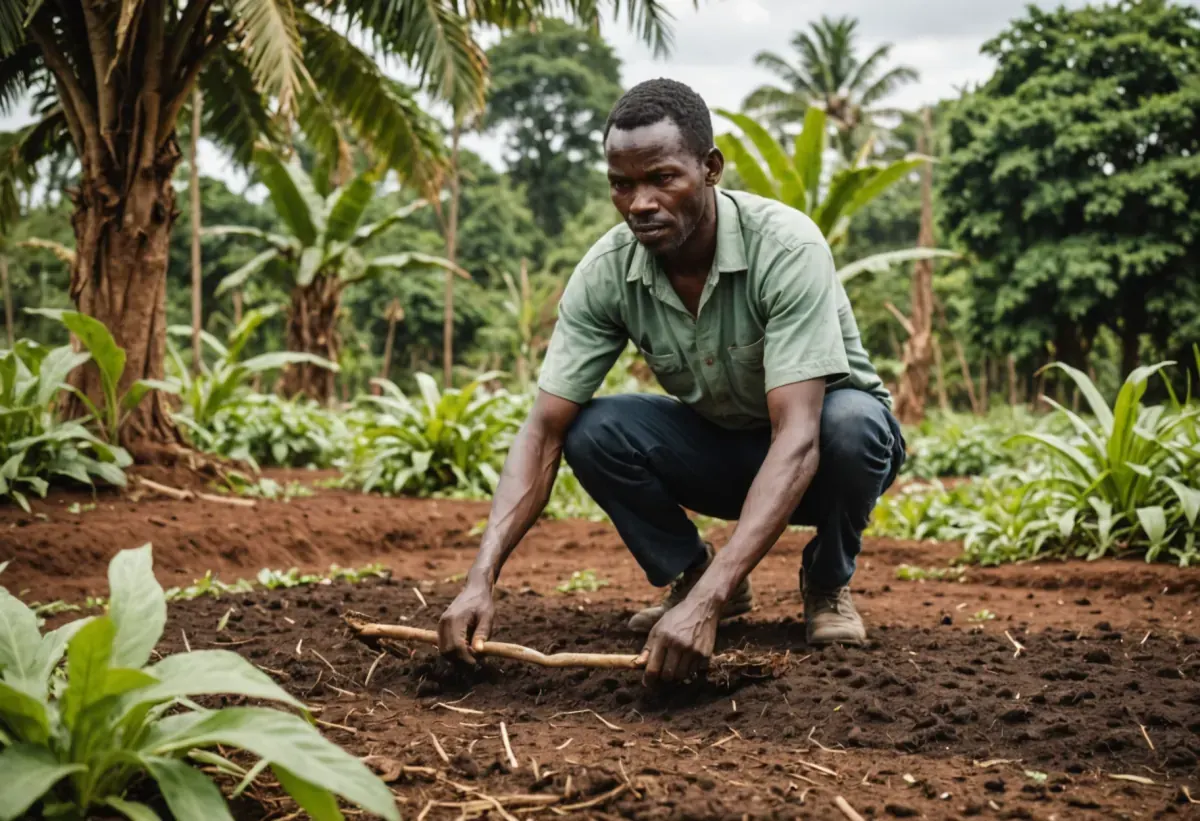
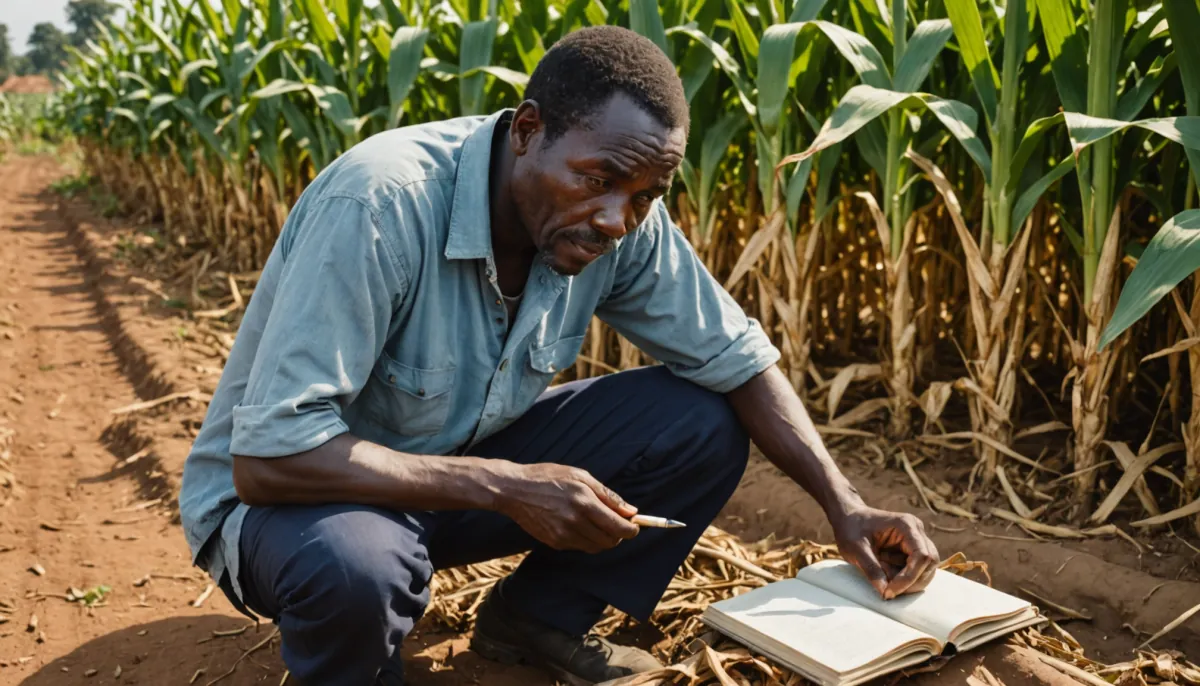
    Farmer spreading mulch over young crops on a Ugandan garden plot
    Mulching a garden plot to protect the soil and hold in moisture.

    Sustainable farming practices for Ugandan soils

    Sustainable farming practices for Ugandan soils are the hands-on techniques that rebuild fertility, hold water and keep the ground covered. Together they form the practical core of sustainable agriculture in Uganda, and most cost labour rather than money. Every practice below can be demonstrated on a school plot.

    1. Mulching spreads crop residues, grass or leaves over the soil. The cover breaks raindrop force, keeps the soil cool and stops moisture evaporating, then rots into organic matter.
    2. Composting heaps plant and kitchen waste until it rots into dark humus. The finished compost feeds soil organisms and slowly releases plant nutrients.
    3. Adding organic matter returns manure, compost and residues to the plot. Organic matter acts like a sponge and feeds the microbes that keep soil fertile, as explained in the notes on soil fertility and microbes.
    4. Crop rotation changes the crop on a plot each season. Rotating breaks pest and disease cycles and balances nutrients, because different crops take and give different things.
    5. Intercropping grows two or more crops on the same plot at once. FinScope Uganda 2023 found 78% of adults already practise mixed cropping, yet only 4% had borrowed to fund it.
    6. Cover crops keep a living plant on the soil between main seasons. The cover shields the surface and its roots hold the soil, so the plot never sits bare.
    7. Green manure ploughs young legume plants back into the soil. The buried plants decay and release nitrogen, feeding the next crop without bought fertiliser.
    8. Agroforestry plants trees and shrubs among crops and pasture. Species such as calliandra, leucaena, gliricidia and sesbania anchor soil, add leaf litter and supply fodder.
    9. Terracing and contour farming build level steps or rows across a slope. Working along the contour slows water and stops furrows turning into downhill channels, as covered in the notes on soil erosion control and moisture conservation.
    10. Trash lines and grass strips place crop residues or grass bands across the slope. These barriers trap soil and let water soak in instead of running away.
    11. Integrated pest management combines cultural, biological and mechanical controls. Traps, resistant varieties and natural enemies cut pest numbers before chemicals are needed.
    12. Water harvesting captures rainwater from roofs and runoff. Stored water carries crops and animals through dry spells instead of relying on rain alone.
    13. Bucket drip irrigation delivers water slowly to plant roots. The NCDC syllabus has learners build one for a 5 m × 2 m garden from a bucket, pipe and used bottles, following the low-cost drip irrigation for forage production notes.
    14. Retention ditches and bunds slow and store runoff in the field. Water held behind a bank or in a trench seeps sideways into the soil beside it.
    PracticeWhat it doesUgandan example
    MulchingCovers soil and slows evaporationCrop residues and napier grass cuttings
    CompostingTurns waste into humusA heap of kitchen and garden waste
    Crop rotationBreaks pest cycles and balances nutrientsMaize, then beans, then groundnuts
    IntercroppingUses light and nutrients differentlyMaize with beans; desmodium with napier
    Cover cropsShields soil between seasonsLablab and mucuna as ground cover
    Green manureAdds nitrogen when buriedYoung lablab ploughed back in
    AgroforestryAnchors soil, adds litter and fodderCalliandra and gliricidia hedges
    Water harvestingStores rain for dry spellsRoof gutters and storage tanks

    Exam tip: Tie each practice to the problem it solves. Writing “mulching reduces evaporation and raindrop impact” scores more marks than a bare list of practice names.
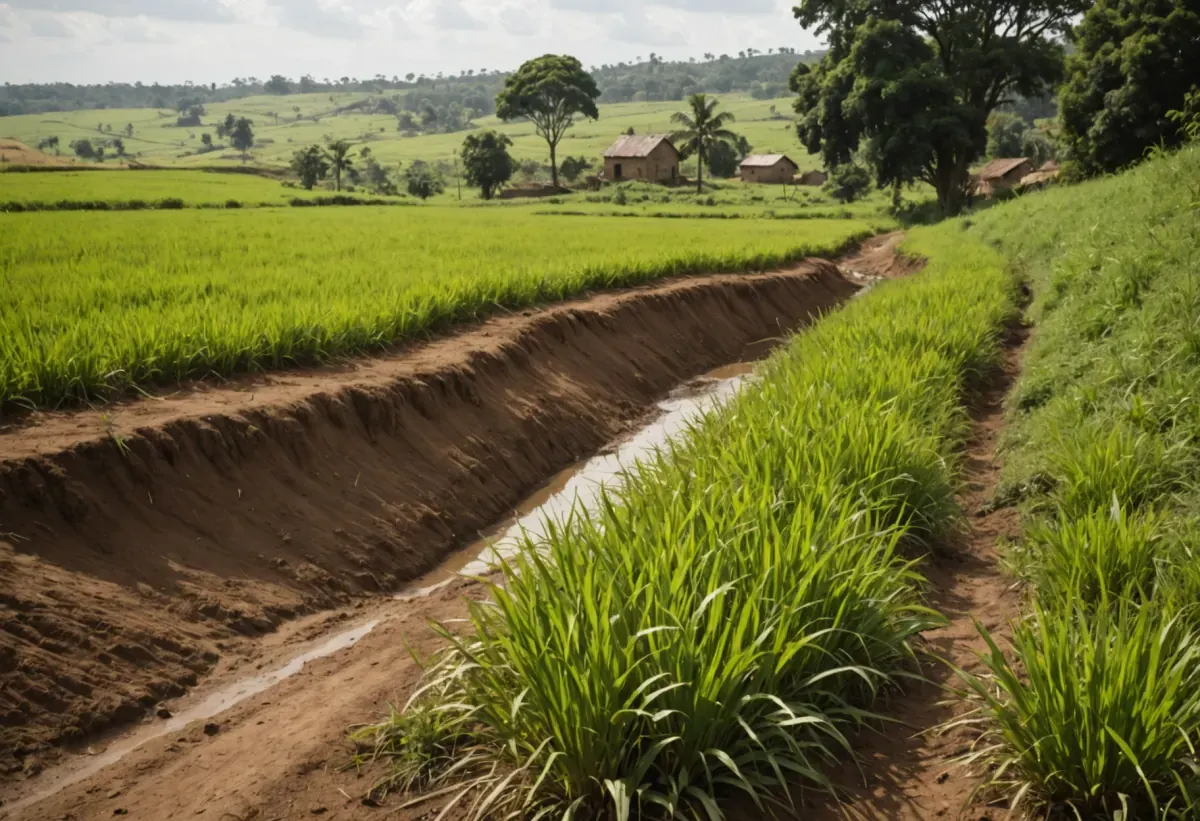
    Contour grass strips and a water-harvesting trench on sloping farmland
    Grass strips and a retention trench slowing water on a sloping field.

    Role of government and organisations in sustainable agriculture

    Government and organisations make sustainable agriculture possible where an individual farmer cannot act alone. They write the curriculum, run research, make inputs affordable and provide the credit and advice that smallholders lack. Their work turns scattered good practice into a national effort.

    1. Setting the curriculum is the National Curriculum Development Centre’s job. The NCDC Agriculture Syllabus (2019) teaches Senior 3 learners the causes of soil erosion and how to conserve soil moisture.
    2. Demonstration sites show farmers new techniques in practice. The Makerere University Agricultural Research Institute (MUARIK) at Kabanyolo hosts demonstrations of agricultural technologies that youth and farmers can learn from, as the Ministry of Agriculture, Animal Industry and Fisheries reports.
    3. Agricultural research develops better crop and pasture varieties. NARO breeds forage species and is the sole supplier of the foundation seed used in production.
    4. Introducing drought-tolerant forages comes through research bodies. NaLIRRI and Makerere University introduced lablab, Setaria sphacelata and Brachiaria mulato to overcome forage scarcity.
    5. Making inputs affordable happens through the tax system. URA zero-rates the supply of seeds, fertilisers, pesticides and hoes, and lists crop extension services, irrigation works and sprinklers among VAT-exempt supplies.
    6. Providing affordable credit helps farmers invest in better practice. The Agricultural Credit Facility lends at up to 12% fixed per year through participating banks.
    7. Offering insurance cushions farmers against crop and livestock loss. The Uganda Agricultural Insurance Scheme subsidises premiums so smallholders can insure crops and animals.
    8. Extension services carry advice to the farm gate. Extension workers train farmers in techniques such as mulching, composting and integrated pest management.
    9. Conserving genetic resources protects Uganda’s animal and plant heritage. NAGRC&DB conserves indigenous animal genetics and spearheads livestock breeding.
    10. Community finance groups such as SACCOs and VSLAs pool savings locally. FinScope Uganda 2023 recorded access to SACCOs rising from 4.3% in 2018 to 12.2% in 2023.
    11. Setting land policy gives farmers secure rights over their plots. Secure tenure encourages the long-term investment that soil and water conservation needs.
    12. Building rural infrastructure such as roads and storage cuts losses. Better infrastructure lets produce reach market quickly, reducing post-harvest waste.
    13. Supporting farmer organisations strengthens cooperatives and self-help groups. Group action helps smallholders share tools, seed and marketing power.
    14. Partnerships join government, NGOs, the private sector and farmers. Working together, these actors tailor solutions to the conditions of each region of Uganda.
    OrganisationWhat it does for sustainable agriculture
    NCDCWrites the Agriculture Syllabus, including soil erosion and moisture conservation
    MAAIFPromotes agricultural technologies and demonstration sites
    NARO and NaLIRRIBreed and distribute forage and crop varieties
    URAZero-rates seeds, fertilisers, pesticides and hoes
    Bank of UgandaAdministers the Agricultural Credit Facility
    NAGRC&DBConserves indigenous animal genetic resources
    SACCOs and VSLAsProvide local savings and credit to members

    Exam tip: A question on the role of government scores best when you name a specific body and its exact function. Writing “NCDC sets the syllabus” earns more than “the government helps farmers”.

    Benefits of sustainable agriculture to communities

    The benefits of sustainable agriculture to communities show up as steadier harvests, cleaner water and more secure incomes. These gains explain why sustainable agriculture in Uganda matters far beyond any single farm. The benefits compound over seasons.

    1. Higher long-term yields come from soil that keeps its fertility. Healthy, covered soil produces dependable harvests for many seasons instead of declining after a few.
    2. More stable incomes follow from diversified farms. A farmer with several crops and animals is not wiped out when one enterprise fails.
    3. Greater food security means households eat through the year. Steadier production reduces the hungry gap between harvests and keeps food on the table.
    4. Cheaper production over time results from recycled nutrients. Compost and manure replace some bought fertiliser, cutting the cash a farmer must find each season.
    5. Cleaner water flows when wetlands and river banks are protected. Vegetation filters runoff, so communities draw cleaner water and suffer less siltation.
    6. Reduced flood and drought risk comes from ground cover and trees. Covered land soaks up rain, so floods fall and springs keep flowing longer into the dry season.
    7. Local jobs and enterprises grow around sustainable practices. Compost making, tree nurseries, beekeeping and seed multiplication all create village work.
    8. Healthier soils support the microbes that recycle nutrients. Rich soil life improves structure and fertility, the heart of the soil fertility and microbes topic.
    9. Climate resilience comes from systems that tolerate variability. Mulch, trees and water harvesting keep farms producing when rain arrives late or short.
    10. More biodiversity thrives where crops, trees and natural areas mix. Diverse farms support pollinators, birds and the beneficial insects that control pests.
    11. Stronger community ties build around shared resources and group projects. Communal tree planting and water schemes teach cooperation and shared management.
    12. Reduced post-harvest losses follow from better storage and processing. Less spoilage means more of the harvest reaches the family and the market.
    13. A future for young people rests on land that remains productive. Fertile, profitable farms give rural youth a reason to stay and farm rather than migrate.
    14. Safer food and water result from fewer agrochemicals. Integrated pest management reduces chemical residues, protecting both consumers and farm families.
    BenefitWhat the community gains
    Steadier harvestsFood available through more of the year
    Cleaner waterSafer drinking water and less silt in streams
    More jobsIncome from compost, nurseries and beekeeping
    Lower input costsLess cash spent on bought fertiliser
    Climate resilienceFarms survive late or short rains
    BiodiversityPollinators and pest-controlling insects
    Youth opportunityProductive land worth staying to farm

    Common mistake: Learners sometimes write that sustainable agriculture produces less. The opposite is true over time — lower input costs and steadier long-term yields are the whole point, even when the first season looks the same.

    Frequently asked questions about sustainable agriculture in Uganda

    These are the questions learners ask most, answered in the short form you can lift straight into a revision card.

    What is sustainable agriculture in simple terms?

    Sustainable agriculture is farming that produces food and income today without wearing out the soil, water, forests and wetlands that future generations will need. In Uganda it means keeping the land fertile, the ground covered and the water stored, so the same plot keeps producing year after year instead of declining after a few seasons.

    Why is soil erosion a serious problem for Ugandan farmers?

    Soil erosion washes away the fertile top layer where crops grow and where nutrients concentrate. Once topsoil is gone, what remains is poorer, stonier ground that yields less, so a farmer must use more fertiliser or clear more land. On slopes, erosion also cuts gullies that make fields harder to work.

    How does mulching improve the soil?

    Mulching covers the soil with crop residues, grass or leaves. The cover breaks the force of raindrops, stops evaporation and keeps the soil cool, then slowly rots into organic matter. Over time this adds nutrients and feeds soil life, which improves structure and water-holding.

    What is the difference between crop rotation and intercropping?

    Crop rotation grows different crops on the same plot in different seasons, one after another, to break pest cycles and balance nutrients. Intercropping grows two or more crops on the same plot at the same time, so a legume and a cereal use light and nutrients differently. Both add diversity to the farm.

    Why should farmers stop encroaching on wetlands?

    Wetlands store and slowly release water, filter runoff and support a rich web of life. When a swamp is drained for crops, it stops holding water, so floods rise in the rains and streams shrink in the dry season. Protecting wetlands keeps water available all year and buffers communities against drought.

    How can a learner practise sustainable agriculture at school?

    Start a school garden using the syllabus practical: mulch a small plot, make compost from kitchen waste, intercrop beans with maize, and build a bucket drip system for a 5 m by 2 m bed. Record what you do and observe the soil, water and yields each term.

    What does the government do to support sustainable farming in Uganda?

    Government writes the curriculum through NCDC, runs research through NARO and NaLIRRI, makes inputs cheaper through URA tax relief, and provides credit through the Agricultural Credit Facility and insurance through the Uganda Agricultural Insurance Scheme. Extension workers then carry the resulting advice to farmers.

    Key terms and revision summary

    This summary ties the meaning, challenges, practices and benefits together, then gives you exam-style questions to practise. Learn the glossary first, then test yourself on the questions below.

    TermMeaning
    Sustainable agricultureFarming that meets today’s needs without damaging soil, water and biodiversity for the future.
    Soil erosionThe removal of topsoil by water or wind.
    Fertility declineThe gradual loss of soil nutrients when crops are grown without returning them.
    MulchingCovering the soil with crop residues, grass or leaves.
    CompostingRotting plant and animal waste into humus for the soil.
    Crop rotationGrowing different crops on the same plot in successive seasons.
    IntercroppingGrowing two or more crops on the same plot at the same time.
    Green manurePloughing young legume plants into the soil to add nitrogen.
    AgroforestryGrowing trees and shrubs together with crops or pasture.
    Integrated pest managementControlling pests with cultural, biological and mechanical methods before chemicals.
    Water harvestingCapturing and storing rainwater for later use.
    OvergrazingGrazing more animals than the pasture can feed, leaving bare soil.

    Exam-style questions

    1. Define sustainable agriculture and state three of its principles. (4 marks) — Define it as farming that meets today’s food needs while protecting soil, water and biodiversity for the future. Principles (any three): protect the soil; conserve water; maintain organic matter; keep ground cover; diversify crops; integrate trees; recycle nutrients.
    2. Explain four challenges facing sustainable agriculture in Uganda. (8 marks) — Any four: soil erosion; fertility decline; deforestation; wetland encroachment; overgrazing; dependence on rain-fed production; low use of improved inputs; climate variability. For each, name the cause and its effect on the land.
    3. Describe how mulching and composting improve soil fertility. (6 marks) — Mulching covers the soil, breaks raindrop force, reduces evaporation and rots into organic matter; composting turns waste into humus that feeds soil organisms and slowly releases nutrients.
    4. Outline the role of government and organisations in promoting sustainable agriculture. (6 marks) — NCDC sets the curriculum; NARO and NaLIRRI breed and distribute varieties; URA zero-rates inputs; the Agricultural Credit Facility lends; extension workers train; SACCOs provide local finance.
    5. Distinguish between crop rotation and intercropping, giving one example of each. (4 marks) — Rotation changes the crop each season, such as maize then beans; intercropping grows two crops together at once, such as maize with beans or desmodium with napier.
  • Farming Systems in Uganda: Types and Characteristics

    Farming Systems in Uganda: Types and Characteristics

    A farming system is the way a farmer combines land, labour, capital and crops or livestock to produce food or income. Uganda runs several farming systems side by side, from small subsistence plots to large commercial estates and cattle ranches. This post classifies the main farming systems in Uganda, compares their characteristics, and shows how to choose the right one for a Ugandan farm.

    The NCDC Agriculture Syllabus (2019) records that more than 70% of Uganda’s population is directly involved in agricultural production, with over half of these people in the subsistence sector, and that farming contributes over 25% of gross domestic product (GDP). Uganda’s tax authority adds that farming is practised on either a commercial or a subsistence basis (URA, A Guide to Taxation of the Agricultural Sector, FY 2025/26).

    Smallholder farm in Uganda mixing banana plants, beans and maize with a few cattle on pasture
    A Ugandan smallholder farm combining food crops with a few cattle, showing subsistence and mixed farming in practice.

    Meaning of a farming system

    A farming system is the organised way a farmer uses land, labour, capital, water and knowledge to produce crops, livestock, or both. It is not just a list of crops; it is the whole pattern of inputs, activities and outputs on a holding. The same district in Uganda can host several different farming systems at once.

    • Definition — A farming system is the combination of land, labour, capital, crops, livestock and management that a farmer uses to produce food and income.
    • System, not a single practice — The term describes the whole farm pattern, covering what is grown, what is reared, and how labour and tools are organised.
    • Land is the base — Every farming system starts from land, and its size, slope, soil and rainfall shape which system will actually work.
    • Labour is the engine — Family labour powers most subsistence farming, while hired workers power commercial and plantation systems.
    • Capital changes the system — Money for seed, fertiliser, machinery and irrigation is the main thing that separates commercial farming from subsistence farming.
    • Crops or livestock — A system can be crop-based (arable), livestock-based (pastoral), or a blend of the two, which is mixed farming.
    • Why classification matters — Classifying a farming system helps a farmer pick suitable techniques, plan the right inputs and compare expected output.
    • The examiner’s angle — The NCDC syllabus expects a learner to describe each system and link it to the resources the farmer has.
    • Subsistence is the majority — Most Ugandan households farm mainly to feed their own families before selling any surplus they may have.
    • Commercial aims at profit — A commercial system produces for the market and is planned around buyers, prices and profit rather than household need.
    • One farm, one dominant system — In an exam, describe the dominant system on a farm even if the household mixes in a little of another.
    • Systems can shift — A farmer can move from subsistence toward commercial by adding capital, better seed and reliable market access.
    • Climate sets the limits — Rainfall and temperature decide whether a region suits crops, livestock, or both, before any other factor.
    • Meaning versus type — “Farming system” describes how production is organised, while “type” such as subsistence or commercial is the label given to that organisation.

    Exam tip: When asked to define a farming system, give the definition first, then name the resources it combines (land, labour, capital, management), and finish with one Ugandan example.

    Types of farming systems in Uganda

    Uganda’s farming systems fall into six main types: subsistence, commercial, mixed, plantation, pastoral and organic. Each type is defined by its main aim — feeding the family or selling for profit — and by what it produces. The table below summarises what each system is and where it is common in Uganda.

    Farming systemWhat defines itWhere it is common in Uganda
    Subsistence farmingSmall plots farmed mainly to feed the family, using hand tools and family labour, with surplus sold only when it exists.Widespread across rural Uganda, where most households grow bananas, beans and maize.
    Commercial farmingLarger farms that grow crops or rear animals mainly for sale, using improved seed, inputs and machinery.Near markets and towns, and in high-rainfall crop belts producing tea, coffee and sugar cane.
    Mixed farmingOne farm combines crop growing with livestock rearing, so manure fertilises crops and crop residues feed animals.Common across central and western Uganda where households keep cattle alongside their crops.
    Plantation farmingLarge estates growing a single cash crop, usually for processing or export, with hired labour and central management.Tea and sugar cane estates, concentrated where rainfall and processing factories support them.
    Pastoral farmingRearing cattle, goats and sheep on natural pasture, often moving with the seasons for water and grass.The semi-arid cattle corridor, especially Karamoja, which holds the country’s largest cattle population.
    Organic farmingGrowing crops and animals using natural inputs and methods, without synthetic pesticides or fertilisers.A growing trend among Ugandan farmers aiming for sustainable, premium-priced produce.
    Arable farmingGrowing crops only, with no livestock, on tilled or planted land.High-rainfall crop regions producing maize, beans, bananas and vegetables.
    • Subsistence farming — Grows food mainly for the family table; common crops are bananas, beans and maize, and any surplus is sold locally.
    • Commercial farming — Produces for sale on a larger scale; key Ugandan products are tea, coffee and sugar cane, often using machinery and improved techniques.
    • Mixed farming — Joins crops and livestock on one holding so income is diversified and household food security improves.
    • Plantation farming — Is commercial farming taken to estate scale, where one cash crop such as tea or sugar cane is grown for processing or export.
    • Pastoral farming — Rears cattle, goats and sheep, mainly in semi-arid regions, and is the dominant system in the cattle corridor; herd management is covered under cattle management systems.
    • Organic farming — Relies on natural inputs and methods and is a growing trend among farmers targeting sustainable agriculture.
    • Arable farming — Means crops only, with no livestock, and suits districts with reliable rain and good crop markets.
    • Karamoja’s pastoralism — UBOS’s 2021 National Livestock Census recorded 14.5 million cattle nationally, with Karamoja holding the most at about 2.4 million (16.7%).
    • The cattle corridor — A belt across Uganda’s drier districts where pastoral and agropastoral systems concentrate because rainfall is too low for reliable crops.
    • Sedentary versus nomadic — Pastoral systems can be sedentary (settled) or transhumant, where herders move in drier months to find water and pasture (MAAIF, 2025).
    • Intensive versus extensive — Systems also differ by the scale of inputs: intensive farming draws high output from small land, while extensive farming spreads low inputs over large land.
    • Distinguish, do not merge — In an exam keep “commercial” (aiming at sale) separate from “plantation” (a single cash crop on an estate), because the two are not identical.
    • One family, several systems — A single Ugandan household may run a subsistence food plot beside a commercial cash crop, so an answer should name the dominant system.
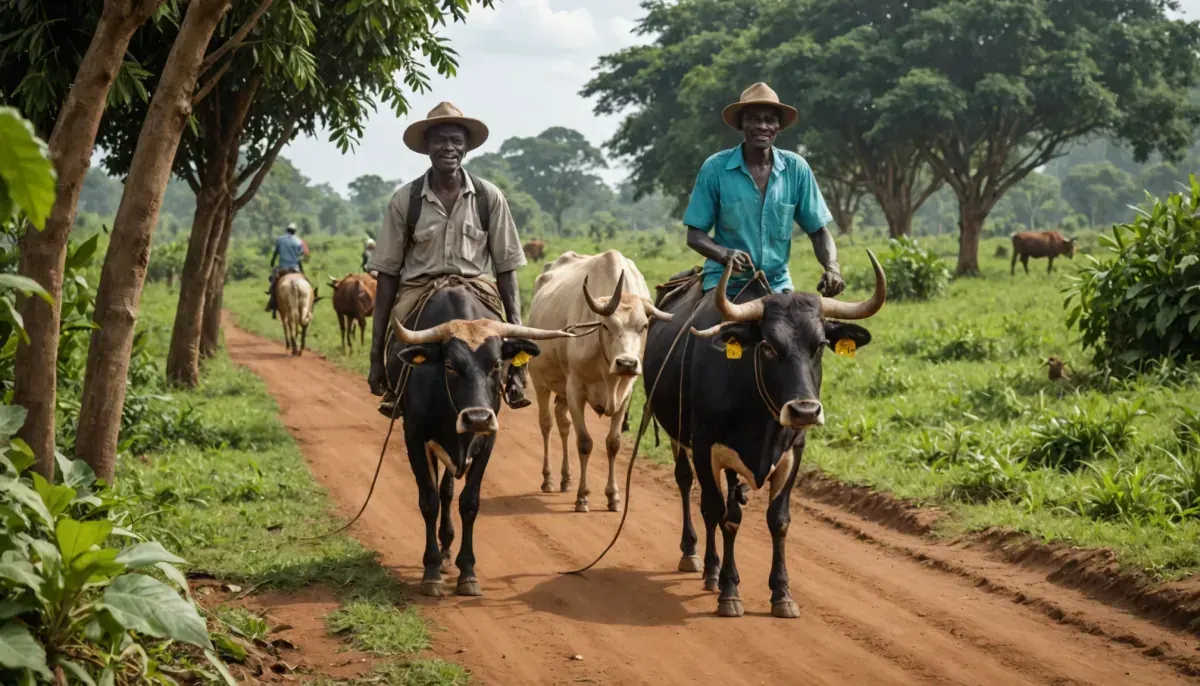
    Cattle grazing open rangeland in Uganda's semi-arid cattle corridor
    Open-range cattle grazing in Uganda’s cattle corridor, the heart of pastoral farming.

    Exam tip: List all six systems in order, then give each one a Ugandan crop or animal and one region. Marks follow the pattern: name, define, example.

    Characteristics of subsistence and commercial farming

    Subsistence and commercial farming sit at opposite ends of the same scale: the first aims at feeding the household, the second at selling for profit. These are the two most widespread farming systems in Uganda, and their characteristics differ in almost every way. The table sets them side by side.

    CharacteristicSubsistence farmingCommercial farming
    Main aimFeed the familySell for profit
    Plot sizeSmall, often only a few acresLarge fields or estates
    LabourFamily labourHired workers
    ToolsHand tools such as the hoe and pangaMachinery and improved tools
    InputsLittle or no fertiliser, local seedImproved seed, fertiliser and agrochemicals
    CapitalLowHigh
    OutputSmall and mostly consumed at homeLarge and mostly marketed
    Crops and animalsBananas, beans, maize and a few animalsTea, coffee, sugar cane, dairy or beef herds
    Record keepingLittle or noneDetailed production and financial records
    RiskLow financial risk, higher food riskHigher financial risk, higher potential return
    SurplusSold only if it existsThe whole point of production
    • Aim decides the system — Subsistence farming is planned around the family’s food needs, while commercial farming is planned around market demand and price.
    • Scale of land — Subsistence plots are small and often fragmented, whereas commercial farms are large, consolidated fields or whole estates.
    • Source of labour — Family members, including children after school, do most subsistence work, while commercial farms hire and pay workers.
    • Capital intensity — Commercial farming needs capital for seed, fertiliser, machinery and irrigation, but subsistence farming runs on very little money.
    • Level of technology — Subsistence farms rely on the hand hoe and simple tools, while commercial farms use tractors, improved seed and irrigation.
    • Crop mix — Subsistence farms grow several food crops together to spread risk, while commercial farms often specialise in one or two cash crops.
    • Purpose of surplus — In subsistence farming the surplus is incidental, but in commercial farming producing a marketable surplus is the entire goal.
    • Record keeping — Commercial farms keep production and financial records to guide decisions, while subsistence farms rarely keep written records.
    • Output per farm — Total output is far higher on a commercial farm, although output per hectare can be higher on a small, well-tended subsistence plot.
    • Risk profile — Commercial farmers risk more capital but earn more in good seasons; subsistence farmers risk less money but face food insecurity in bad seasons.
    • Response to price — Commercial farmers plant what the market pays for, while subsistence farmers plant what the family will eat, whatever the price.
    • Market access — A commercial system only works where a farmer can reach buyers, transport produce and secure a fair price.
    • Scale in Uganda — NCDC notes that more than half of the Ugandans involved in agriculture work in the subsistence sector, so subsistence is the most widespread system.

    Advantages and disadvantages of each farming system

    Every farming system trades something off. Subsistence farming gives food security at low cost but little cash; commercial farming earns money but risks far more capital. The table below sets subsistence against commercial farming, and the points then extend the comparison to the other systems.

    AspectSubsistence farmingCommercial farming
    Advantage — foodGrows the family’s own food, cutting the cost of buying it.Produces large quantities that widen the national food supply.
    Advantage — incomeNeeds very little cash to run.Generates cash income and foreign exchange from exports.
    Advantage — employmentPuts family labour to productive use.Creates paid jobs for many workers.
    Advantage — inputsNeeds few costly purchased inputs.Uses improved seed and technology for high yields.
    Advantage — riskLow financial risk if a crop fails.Scale and diversification can spread losses across the farm.
    Disadvantage — incomeLittle or no cash surplus for the family.Needs large capital to start and to run.
    Disadvantage — marketLittle access to markets and better prices.Depends on markets and can suffer sharp price falls.
    Disadvantage — scaleSmall output limits the chance to grow.Demands large land and a large labour force.
    Disadvantage — inputsLow use of improved seed limits yields.High input costs for fertiliser and chemicals.
    Disadvantage — environmentRepeated cropping can degrade the soil.Monoculture can exhaust soil and spread pests.
    • Subsistence — advantage — Guarantees the family’s daily food, so the household keeps eating even when it earns no money at all.
    • Subsistence — disadvantage — Produces little surplus to sell, leaving little cash for school fees, medicine or improving the farm.
    • Commercial — advantage — Brings cash income and, for export crops such as coffee and tea, earns foreign exchange for the country.
    • Commercial — disadvantage — Needs large capital for land, seed, fertiliser and labour, which most small farmers simply do not have.
    • Mixed — advantage — Livestock manure fertilises crops and crop residues feed animals, so the farm recycles its own nutrients.
    • Mixed — disadvantage — Splitting land, labour and attention between crops and animals can lower the output of each one.
    • Plantation — advantage — Large-scale production and processing create steady jobs and reliable output for factories and export.
    • Plantation — disadvantage — A single crop means one disease outbreak or one price slump can hit the whole estate at once.
    • Pastoral — advantage — Turns semi-arid grassland that cannot grow crops into meat, milk, hides and income.
    • Pastoral — disadvantage — Drought, disease and long movement between water points cause heavy livestock losses.
    • Organic — advantage — Natural inputs protect soil and water, and can earn premium prices from health-conscious buyers.
    • Organic — disadvantage — Lower yields and higher labour make organic produce more costly to grow in the early years.
    • Exam framing — Always pair each system with one advantage and one disadvantage in the same answer, because examiners award both sides of the argument.
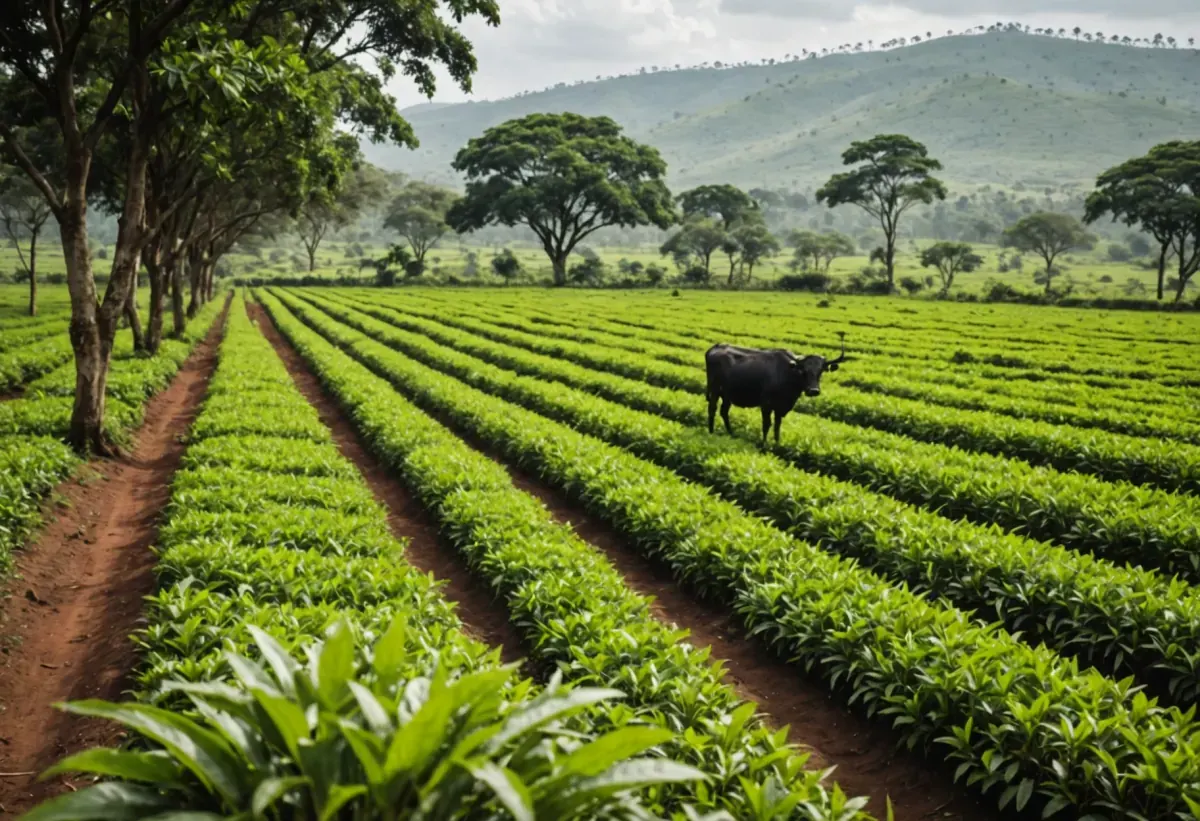
    Rows of green tea bushes on a Ugandan plantation estate
    A tea plantation showing plantation farming, where one cash crop is grown on a large estate for processing and export.

    Common mistake: Calling commercial farming “better” than subsistence farming. Each system suits a different level of capital and land, so examiners want balanced advantages and disadvantages, not a verdict.

    Choosing a farming system for a Ugandan farm

    Choosing among the farming systems in Uganda means matching what a farm has — land, capital, labour and markets — to what each system needs. Six factors decide the choice: land size, capital, labour, market access, climate and risk. The table summarises how each factor points toward a system.

    FactorWhat it decidesWhich system it favours
    Land sizeHow much area can actually be farmed.Small plots favour subsistence or intensive growing; large tracts favour commercial, plantation or extensive pastoral systems.
    CapitalMoney for seed, tools, inputs and machinery.Low capital favours subsistence; high capital favours commercial or plantation farming.
    LabourWho does the work and how many workers there are.Family labour favours subsistence or mixed; hired labour favours commercial or plantation farming.
    Market accessDistance to buyers and the prices they offer.Poor access favours subsistence; good access favours commercial or horticulture.
    ClimateRainfall, temperature and the length of dry seasons.Reliable rain favours crops; semi-arid conditions favour pastoral or agropastoral systems.
    RiskExposure to drought, pests, disease and price swings.Low capital and risk-averse farmers favour subsistence or mixed; those able to absorb loss favour commercial.
    • Land size first — A family with less than an acre cannot run a commercial maize farm, so it chooses subsistence or intensive market gardening.
    • Capital follows land — Without money for improved seed and fertiliser, even a large plot stays a low-yielding subsistence farm.
    • Labour supply — A system that needs many hands, such as vegetable growing or dairying, only works where workers are available and affordable.
    • Market access decides profit — A farmer near a town or tarmac road can sell fresh produce, while a remote farmer grows only what survives the journey to market.
    • Climate is the gatekeeper — In the semi-arid cattle corridor rainfall is too low for reliable crops, so pastoralism dominates the landscape.
    • Risk tolerance — A subsistence farmer avoids debt because one drought would be ruinous, while a commercial farmer borrows and insures against loss.
    • Match crop to climate — Moisture-loving crops such as bananas suit wetter districts, while drier districts turn to livestock, so climate narrows the realistic choices.
    • Start small, then grow — A common Ugandan path is to begin with subsistence farming, then add a cash crop as capital and market access improve.
    • Mixed as a middle path — Where rainfall is adequate and land is moderate, mixed farming spreads risk between crops and animals.
    • Follow the syllabus — The Senior 3 Agriculture notes link cattle production, feed making, pasture, hydroponics and farm economics, and each topic influences the system you choose.
    • Test against a real farm — Before choosing, list the farm’s land, capital, labour and market, then match them to one system in the types table.
    • Price and demand — A farmer should check what buyers actually want — maize, milk, vegetables or beef — before committing land to a system.
    • Revisit the choice — As capital, roads and buyers change, the best system changes too, so the decision is made each season, not once.

    Exam tip: For a “choose a system” question, name the system, then support it with at least two factors (land size, capital, market or climate) and one Ugandan example.

    Frequently asked questions about farming systems in Uganda

    • What are the main farming systems in Uganda? Uganda’s main farming systems are subsistence, commercial, mixed, plantation, pastoral and organic farming. Subsistence farming is the most widespread, with households growing food for their own families, while commercial and plantation systems grow cash crops such as tea, coffee and sugar cane for sale.
    • What is the most common farming system in Uganda? Subsistence farming is the most common system in Uganda. Most households grow crops and rear a few animals mainly for their own consumption, selling only a small surplus. NCDC notes that over half of the Ugandans involved in agriculture work in the subsistence sector.
    • How does subsistence farming differ from commercial farming? Subsistence farming grows food for the family on small plots using hand tools, family labour and little capital. Commercial farming produces for sale on large fields using hired labour, improved seed, machinery and inputs, and it is planned around profit and market demand.
    • Where is pastoral farming most common in Uganda? Pastoral farming is most common in the semi-arid cattle corridor, especially Karamoja. UBOS’s 2021 National Livestock Census recorded 14.5 million cattle nationally, with Karamoja holding about 2.4 million, the largest share at 16.7%. Herders rear cattle, goats and sheep on natural pasture.
    • What are the advantages of commercial farming in Uganda? Commercial farming creates paid jobs, produces large quantities of food for the market, and earns cash income and foreign exchange from exports such as coffee and tea. Its main disadvantages are the large capital it needs and its exposure to market price changes.
    • How do I choose the right farming system for my farm? Match the farm’s resources to the system. Check land size, available capital, labour, market access, climate and risk. Small plots with little money suit subsistence or intensive growing; large land and capital suit commercial or plantation systems; semi-arid land suits pastoralism.

    Key terms and revision summary

    This revision summary ties the farming systems in Uganda together so you can revise fast. Learn the glossary, then attempt the exam-style questions below and check your answers against the outlines.

    TermDefinition
    Farming systemThe organised way land, labour, capital and knowledge are combined to produce crops or livestock.
    Subsistence farmingGrowing food mainly for the family’s own consumption, with little surplus for sale.
    Commercial farmingProducing crops or livestock mainly for sale and profit, using hired labour and improved inputs.
    Mixed farmingCombining crop growing with livestock rearing on the same farm.
    Plantation farmingGrowing a single cash crop on a large estate, usually for processing or export.
    Pastoral farmingRearing cattle, goats and sheep on natural pasture, often in semi-arid regions.
    Organic farmingProducing using natural inputs and methods, without synthetic pesticides or fertilisers.
    Arable farmingGrowing crops only, with no livestock.
    Cattle corridorUganda’s drier belt where pastoral and agropastoral systems concentrate.
    TranshumanceSeasonal movement of livestock to find water and pasture in drier months.

    Test your understanding with these exam-style questions, then check the answer outlines.

    1. State four differences between subsistence and commercial farming. Outline: aim (family food versus sale), plot size (small versus large), labour (family versus hired), inputs and capital (low versus high), and output (consumed versus marketed) — any four earn full marks.
    2. Describe the types of farming systems practised in Uganda. Outline: name subsistence, commercial, mixed, plantation, pastoral and organic, and give one crop or one region for each.
    3. Explain the factors a farmer considers when choosing a farming system. Outline: land size, capital, labour, market access, climate and risk, each linked to the system it favours.
    4. Why is pastoral farming common in Karamoja? Outline: Karamoja is semi-arid with low rainfall, so crops fail often while cattle, goats and sheep survive on natural pasture; UBOS records it as holding the country’s largest cattle population.

    For further practice, attempt the Agriculture past papers and the Agriculture quiz, then return to the revision courses to close any gaps.

  • farm Record-Keeping: examples and importance

    farm Record-Keeping: examples and importance

    What is record keeping on the farm?

    Record-keeping on the farm is the systematic practice of documenting and organizing essential data related to agricultural operations. It involves the recording of various aspects, including financial transactions, crop cultivation, livestock management, resource utilization, and other critical information pertinent to the farm’s activities.

    Record keeping on the farm is a crucial management practice that involves systematically documenting various aspects of farm operations. This includes tracking expenses, income, livestock production, crop yields, fertilizer and pesticide applications, equipment maintenance, and labor. Effective record-keeping allows farmers to make informed decisions, enhancing productivity and profitability.

    By maintaining detailed and accurate records, farmers can analyze trends over time, identify areas for improvement, and optimize resource allocation. For example, recording crop yields against specific inputs like fertilizers or pesticides can help in determining the most cost-effective practices. Similarly, tracking animal health records and breeding cycles aids in managing livestock more efficiently.

    Financial records are essential for budgeting, planning, and securing loans or grants. They provide a clear picture of the farm’s financial health, showing where money is being spent and earned. Additionally, these records are critical for tax preparation, ensuring compliance with regulations and potentially identifying tax-saving opportunities.

    In the digital age, many farmers are turning to software and mobile apps designed for agricultural record keeping. These tools simplify data entry, storage, and analysis, making it easier to access and utilize information for strategic decision-making.

    Overall, effective record keeping is foundational to farm management, supporting sustainability, and long-term success by enabling farmers to track their progress, plan for the future, and respond adaptively to market and environmental changes.

    Common examples of records kept on farms

    Farm record keeping involves a variety of records that are essential for efficient farm management, analysis, and planning. Here are some common types of records kept on farms:

    1. Financial Records:
    1. Income and expenditure records
    2. Receipts and invoices for purchases and sales
    3. Loan and credit records
    4. Asset inventory and depreciation schedules
    5. Tax records and documents
    1. Crop Production Records:
    1. Planting dates, varieties, and locations
    2. Input records (seeds, fertilizers, pesticides, water usage)
    3. Harvest yields and dates
    4. Crop rotation plans and field histories
    5. Pest and disease management logs
    1. Livestock Records:
    1. Birth, death, and purchase records
    2. Health and vaccination records
    3. Breeding and production records (e.g., milk yield, egg production)
    4. Feed consumption and conversion rates
    5. Weight and growth records
    1. Labor Records:
    1. Employee details, roles, and hours worked
    2. Training records
    3. Payroll and compensation details
    1. Equipment and Machinery Records:
    1. Purchase, repair, and maintenance logs
    2. Usage logs (hours of operation)
    3. Depreciation schedules
    1. Inventory Records:
    1. Supplies (seeds, feed, fertilizers, pesticides)
    2. Product inventory (stored crops, livestock products)
    3. Tools and equipment inventory
    1. Environmental and Compliance Records:
    1. Soil tests and health records
    2. Water usage and irrigation schedules
    3. Compliance with agricultural and environmental regulations
    4. Certifications (organic, animal welfare, etc.)
    1. Field and Farm Maps:
    1. Layouts of fields, crop locations, and rotations
    2. Infrastructure locations (buildings, irrigation systems)

    What are two examples of production records?

    A few examples of production records are listed below:

    • Crop cultivation records. This document can include all the various fields or orchard numbers, production size, yield potential and soil analyses of the land used for that specific crop or fruit.
    • Livestock production records. Here, details on production such as milking, breeds and egg laying are written.
    • Labour records. These records capture the workers details.
    • Machinery records. These give information on the farm equipment used.

    Examples of Farm Record Keeping using farm record keeping software

    Effective farm record keeping is essential for ensuring smooth farm operations, optimizing productivity, and maintaining profitability. While traditional methods such as manual record-keeping and spreadsheets are still widely used, the advent of farm record keeping software has transformed how farmers manage and track their farm activities. Below are examples of the key records farmers should keep, alongside how farm record keeping software enhances these processes:

    1. Production Records: These records track crop yields, planting schedules, and harvests. Using farm record keeping software, farmers can easily input data and monitor trends in crop performance over time, helping to improve yields and optimize resource allocation.

    2. Financial Records: This involves keeping track of income and expenses, such as the cost of inputs (seeds, fertilizers, and pesticides), labor costs, and revenue from product sales. With the help of software, farmers can generate automated reports, manage budgets, and ensure financial transparency.

    3. Livestock Records: For those in animal husbandry, it’s important to maintain records of breeding, feeding, health, and vaccinations. Farm record keeping software can be particularly useful for tracking individual animal health, breeding cycles, and production data, improving livestock management efficiency.

    4. Inventory Records: Inventory records help track equipment, inputs, and stock levels of farm products. Software enables real-time tracking and alerts for reordering supplies, ensuring the farm runs without interruptions.

    5. Labor Records: Keeping track of employee hours, wages, and tasks is critical to managing labor effectively. Farm record keeping software can automate payroll and track employee performance, ensuring efficient labor management.

    By using farm record keeping software, farmers can streamline these processes, improve decision-making, and enhance overall farm productivity. This technology offers an organized, accessible way to monitor all aspects of farm operations, leading to more efficient and profitable farming.

    What is the importance of record keeping on a farm?

    The importance of record-keeping on a farm cannot be overstated. It plays a crucial role in the success and sustainability of agricultural operations. Here are several reasons why record-keeping is essential on a farm:

    1. Financial Management: Records help farmers track income and expenses. This is essential for budgeting, financial planning, and ensuring the farm remains profitable. It allows for better decision-making regarding investments, purchases, and pricing strategies.
    • Profitability Analysis: Detailed records enable farmers to analyze the profitability of specific crops, livestock, or farming practices. This information can guide future choices, emphasizing what works best for the farm’s financial health.
    • Resource Management: Recording data on inputs like seeds, fertilizers, water, and labor can help optimize resource use. This reduces wastage and improves resource efficiency.
    • Tax and Legal Compliance: Accurate records are crucial for tax reporting and compliance with government regulations. Failure to maintain proper records can lead to legal issues and financial penalties.
    • Performance Evaluation: Record-keeping allows farmers to assess the performance of different farming seasons and years. It helps in identifying trends, successes, and areas that need improvement.
    • Crop Rotation and Pest Management: Keeping track of which crops were planted where in previous seasons helps in planning for crop rotation and pest management. This can prevent soil depletion and reduce the risk of pest infestations.
    • Livestock Management: For livestock farms, records help in monitoring animal health, breeding cycles, vaccinations, and growth rates. This data is critical for herd management and ensuring the well-being of the animals.
    • Market Planning: Farmers can use historical data to plan for market demands. Knowing what crops or products were in demand during specific times of the year can help in production and marketing strategies.
    • Loan Applications: Many farmers require loans for various purposes, such as purchasing new equipment or expanding operations. Lenders often require detailed records to assess the farm’s creditworthiness.
    1. Disaster Preparedness: In the unfortunate event of a natural disaster or unforeseen circumstances, accurate records are essential for insurance claims and recovery efforts.
    1. Succession Planning: Records can be invaluable for farmers planning to pass on their farm to the next generation. They provide a clear history of the farm’s operations, assets, and challenges.
    1. Environmental Stewardship: Maintaining records related to soil health, water use, and environmental practices can demonstrate a commitment to sustainable and responsible farming, which is increasingly important to consumers and regulatory bodies.

    In summary, record-keeping is a foundational practice for effective farm management. It supports financial stability, decision-making, and regulatory compliance while also aiding in resource optimization, performance evaluation, and long-term sustainability. Farmers who maintain accurate records are better positioned to adapt to changing conditions and achieve success in their agricultural endeavors.

    frequently asked questions related to the importance of record-keeping on the farm:

    1. Why is record-keeping important for a farm?

    Record-keeping is crucial for farms to manage finances, monitor performance, comply with regulations, and make informed decisions about resource allocation and crop management.

    2. What types of records should I maintain on my farm?

    You should maintain records of financial transactions, crop and livestock data, input usage, labor, machinery maintenance, and any other relevant information for your specific farming operation.

    3. How can record-keeping benefit my farm financially?

    Keeping accurate financial records helps you track income and expenses, assess profitability, and make well-informed decisions regarding investments, pricing, and budgeting.

    4. How do records assist in managing resources on the farm?

    Records help you optimize resource use by tracking input quantities, ensuring efficient use of seeds, fertilizers, and water, and minimizing waste.

    5. What role do records play in legal and regulatory compliance on the farm?

    Accurate records are essential for tax reporting and compliance with government regulations. Failure to maintain proper records can result in legal issues and penalties.

    6. How can record-keeping improve crop management and pest control?

    Records help in planning crop rotations and identifying pest management strategies based on previous crop history, reducing soil depletion and the risk of pest infestations.

    7. What are the benefits of livestock records for animal farming operations?

    Livestock records assist in monitoring animal health, breeding cycles, vaccinations, growth rates, and overall herd management, contributing to animal welfare and productivity.

    8. How can records help in market planning for the farm’s products?

    Historical data on market demand for specific crops or products during different seasons allows for informed decisions regarding production and marketing strategies.

    9. Can accurate records assist in applying for loans for my farm?

    Yes, lenders often require detailed records to assess your farm’s creditworthiness when you apply for loans, making it easier to secure funding for various farm needs.

    10. How can record-keeping support disaster preparedness and recovery efforts?

    In the event of a natural disaster or unforeseen circumstances, records are essential for insurance claims, assessing damage, and planning recovery efforts.

    11. How do records contribute to succession planning for the farm?

    Records provide a clear history of the farm’s operations, assets, and challenges, which is valuable for succession planning when passing the farm to the next generation.

    12. What is the role of records in environmental stewardship on the farm?

    Records related to soil health, water use, and environmental practices demonstrate a commitment to sustainable and responsible farming, which is increasingly important for consumers and regulatory compliance.

    Effective record-keeping is a fundamental practice for farm management and plays a pivotal role in the financial, operational, and environmental success of farming operations.

  • The Value of Agriculture to Ugandan Communities

    The Value of Agriculture to Ugandan Communities

    Agriculture sustains Ugandan communities in five connected ways: it feeds households, creates work and income, supplies raw materials to local industries, earns foreign exchange from exports, and carries the social customs that bind communities together. The value of agriculture to Ugandan communities is therefore both economic and cultural, not just a matter of food. These study notes explain each contribution with a Ugandan example and close with revision questions you can practise.

    For the longer history behind this story, see the growth of agriculture in Uganda .

    The ideas here sit inside the NCDC Senior 3 Agriculture syllabus, which covers cattle production, livestock feed making, pasture and conservation, financial services, and farm structures. Each topic in that programme exists because farming matters this much to the country, so use the Senior 3 Agriculture notes hub to revise the syllabus itself. The table below is the whole value of agriculture to Ugandan communities in one view.

    ContributionHow it works (mechanism)Ugandan example
    Food supply and food securityHouseholds grow staples and keep part of the harvest for home mealsMatooke and cassava feed the family all year round
    Employment and income generationFarms, trading and processing give people work and earningsCattle keeping supports about 2.3 million households (UBOS, 2021)
    Raw materials for local industriesFarm produce is turned into flour, feeds, cloth and dairy goodsMaize is milled for flour while its bran becomes livestock feed
    Foreign exchange from agricultural exportsExport crops earn currency from buyers abroadCoffee and cotton are leading export earners
    Social and cultural value of farmingFarming customs share work, food, ceremonies and landCommunal labour, ceremonies and inherited land bind communities
    Ugandan smallholder farm with matooke banana plants and cassava in a green field
    Smallholder farming in Uganda supplies most of the food families eat and the raw materials local industries process.

    Food supply and household food security

    Agriculture supplies the food Ugandan households eat every day. In Uganda most food is grown by the families that consume it, so farming’s first value is a full cooking pot and a steady, safe, affordable supply of matooke, cassava, maize, beans and milk through the year. Food security means having enough nutritious food at all times.

    1. Subsistence farming feeds the family first, because most Ugandan growers keep part of the harvest for home meals before they sell any surplus.
    2. Matooke is the green cooking banana steamed for everyday meals, and it is a staple carbohydrate across central and western Uganda.
    3. Cassava supplies a starchy staple that tolerates dry spells, so it guards households against hunger when other crops fail.
    4. Maize is grown widely and milled into flour for posho, a common cereal food in Ugandan homes and schools.
    5. Beans add affordable plant protein to the staple starches, making the typical Ugandan plate more balanced and nutritious.
    6. Sweet potatoes provide another root staple whose vines also feed livestock, so one crop serves both the kitchen and the farm.
    7. Milk is a major food: Ugandan herds produced about 3.7 billion litres in 2021, a five-fold rise on 2008 (UBOS, 2021).
    8. Vegetables such as greens and tomatoes add vitamins and minerals, improving the nutritional quality of household meals.
    9. Food security means a household has steady access to enough safe, nutritious food to live an active, healthy life.
    10. Mixed cropping spreads risk, and FinScope Uganda 2023 found 78% of farmers practise it, so one failed crop rarely leaves a family with nothing.
    11. Seasonal gluts can be dried or stored, helping families bridge the months when fresh harvests are scarce.
    12. Crop failure is a real threat, because FinScope Uganda 2023 records “crop failure, livestock death or drought” as a shock for 22% of adults.
    13. Home food production cuts household spending, because a family that grows its own matooke and beans buys less from the market.
    Staple foodWhat it suppliesWhy it matters for food security
    MatookeCarbohydrate stapleGrown for home meals across central and western Uganda
    CassavaStarchy stapleTolerates dry spells, guarding against hunger
    MaizeCereal (flour and posho)Widely grown and milled for household and school meals
    BeansPlant proteinBalances the staple starches on the plate
    MilkProtein and energyAbout 3.7 billion litres produced in 2021 (UBOS)
    Sweet potatoesRoot stapleTubers feed people while the vines feed livestock
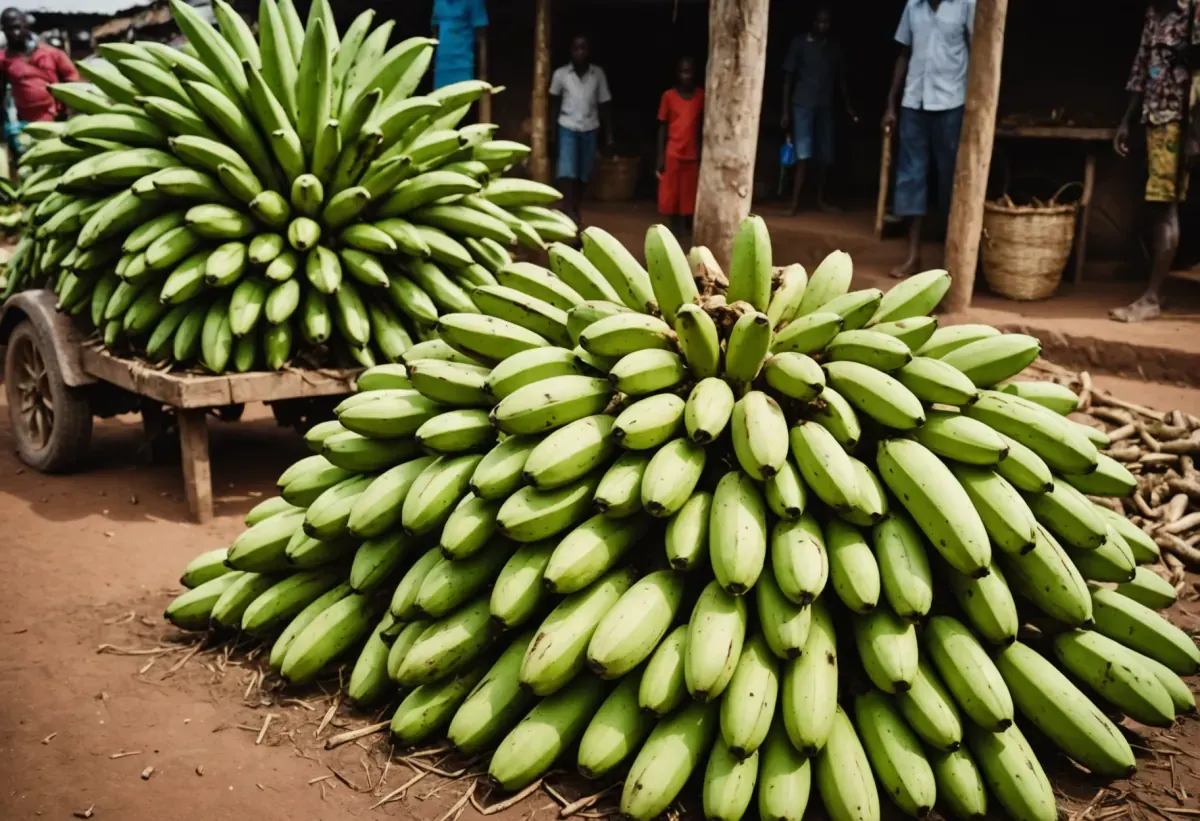
    Bunches of green matooke bananas and cassava roots displayed at a Ugandan market
    Markets turn farm surplus into income while keeping staple foods such as matooke and cassava available to households.

    Common mistake: writing that food security means only “having food”. It means steady access to enough safe, nutritious food, so availability, affordability and safety all belong in the exam answer.

    Employment and income generation

    Farming is Uganda’s biggest employer and the main way many families earn money. It gives people work on their own plots, on other people’s farms, and in the selling and processing of produce, so employment and income move together through the same chain from field to market.

    1. Direct employment is huge: the NCDC syllabus records that more than 70% of the population is directly involved in agricultural production (NCDC, 2019).
    2. Working population — the Uganda Revenue Authority cites an estimate that about 68% of the working population is employed in agriculture (ITA, 2023).
    3. Household reach — around 7 million households, about 80% of all households, farmed land or raised livestock in 2019 (AAS, cited by URA).
    4. Adult involvement — FinScope Uganda 2023 found that 38% of Ugandan adults are involved in agriculture or agribusiness.
    5. Self-employment lets a farmer earn on his or her own plot without waiting for a salaried job, which matters most in rural areas.
    6. Wage labour in weeding, harvesting and herding pays daily or seasonal wages, giving landless neighbours a source of cash.
    7. Cattle keeping supports about 2.3 million households, up from 1.7 million in 2008, and it anchors Senior 3 cattle production notes (UBOS, 2021).
    8. Youth work — 1.4 million livestock-keeping households, one fifth of the total, were headed by young people aged 18–30 in 2021 (UBOS, 2021).
    9. Women’s income — 2.3 million livestock-keeping households, 34.1% of them, were female-headed in 2021 (UBOS, 2021).
    10. Trading and vending buy produce at the farm gate and sell it in markets, creating income for traders and boda-boda transporters.
    11. Agro-processing jobs in mills, dairies and ginneries employ workers to turn raw produce into flour, milk products and cotton lint.
    12. Saving and investment follow, because FinScope 2023 reports that farming and financial savings are the predominant sources of finance for investment, a topic in the financial services and money in agriculture notes.
    13. Income smoothing comes from selling surplus milk, eggs or vegetables, which spreads earnings across the year instead of leaving them to one harvest.
    GroupHow farming gives them incomeVerified figure
    FarmersSelf-employment on their own landAbout 80% of households farm or keep livestock (AAS, 2019)
    Wage labourersPaid for weeding, harvesting and herdingSeasonal and daily cash work
    Cattle keepersMilk, beef and live-animal sales2.3 million households (UBOS, 2021)
    YouthHeading livestock-keeping households1.4 million, or 20.1% (UBOS, 2021)
    WomenHeading livestock-keeping households2.3 million, or 34.1% (UBOS, 2021)
    Traders and processorsBuying, milling, ginning and dairying38% of adults in agribusiness (FinScope, 2023)

    Exam tip: when a question asks how agriculture creates employment, name at least two different kinds of work — self-employment on the family plot, paid farm labour, and processing jobs — not just “people work on farms”.

    Raw materials for local industries

    Agriculture feeds Uganda’s factories and workshops with raw materials. Crops, milk and animal products are processed into flour, feeds, cloth and dairy goods, which shows that farming creates value well beyond the farm gate and keeps local industries supplied with inputs.

    1. Raw materials are farm products used as inputs by another industry, such as seed cotton going to a ginnery.
    2. Maize is milled into flour for food, while maize bran, a milling by-product, becomes livestock feed (ILRI/EADD, 2012).
    3. Rice is husked and milled locally into clean rice for sale, giving mills a steady raw input.
    4. Cotton moves from farmers to ginneries: URA’s own example follows raw cotton from Bukwo farmers to a ginnery and onward to textile processing.
    5. Milk is a raw material for dairies, which process it into pasteurised milk, yoghurt and other products under the Dairy Development Authority Act, 1998.
    6. Cassava is processed into cassava meal and flour, used both as food and as an energy feed ingredient.
    7. Cottonseed cake, a by-product of ginning, is a high-protein feed ingredient named in MAAIF’s Animal Feeds Policy (2004).
    8. Sunflower and soyabean are pressed for oil and cake, supplying both cooking oil and protein-rich feed.
    9. Sugarcane supplies sugar mills, whose by-product molasses becomes an energy feed and whose bagasse becomes fuel.
    10. Fish and lake shells are listed by MAAIF (2004) as feed ingredients, so even lake resources support the feed industry.
    11. Hides and skins from cattle are traded and processed, with the Hides and Skins Act (Cap. 89) licensing the traders.
    12. Agro-processing is the name for turning farm produce into these goods, and it is where most rural value addition happens.
    13. Local supply matters because a mill or dairy that buys from nearby farmers lowers transport costs and spreads income locally.
    Raw materialProcessed intoLocal industry
    MaizeFlour; maize branMilling and feed making
    RiceClean milled riceRice mills
    Seed cottonCotton lint; cottonseed cakeGinneries, textiles and feed
    MilkPasteurised milk, yoghurt, butterDairies (DDA Act, 1998)
    CassavaCassava meal and flourMilling and feed making
    SunflowerCooking oil; cakeOil pressing and feed
    SugarcaneSugar; molasses; bagasseSugar mills
    Hides and skinsLeather goodsTanning and leather trade

    Exam tip: link the crop to its industry in the same sentence — “maize is milled into flour and its bran becomes feed” — because the mark is for showing the connection, not just naming the crop.

    Foreign exchange from agricultural exports

    Agricultural exports earn Uganda foreign exchange, the money from buyers abroad that the country needs to pay for imports. In FY 2022/23 agriculture contributed about 35% of export earnings and about 24% of GDP (URA, citing ITA 2023), so farming sits at the centre of the national economy.

    1. Foreign exchange is currency earned from selling goods abroad, and it lets Uganda pay for imports such as machinery, fuel and medicines.
    2. Export share — URA records that agriculture made up about 35% of Uganda’s export earnings in FY 2022/23.
    3. GDP share — the same URA guide puts agriculture at about 24% of GDP in FY 2022/23.
    4. Coffee is among Uganda’s main cash crops and is covered by the national agricultural insurance scheme (NPA, 2026).
    5. Cotton is exported as lint: URA’s value-chain example traces raw cotton from Bukwo farmers through ginning to textile processing.
    6. Tea is another leading export crop that Uganda’s agricultural insurance scheme lists for cover (NPA, 2026).
    7. Maize is sold both locally and across borders, and it is the most commonly insured crop under the national scheme (NPA, 2026).
    8. Beans are grown for food and sale, and are among the crops the insurance scheme covers (NPA, 2026).
    9. Fish reaches export markets, and Uganda’s aquaculture is included in the scheme’s livestock cover (NPA, 2026).
    10. Hides and skins are traded for export, with the Hides and Skins Act licensing traders and the Cattle Traders Act covering exporters.
    11. Milk and dairy products are regulated for processing and export under the Dairy Development Authority Act, 1998.
    12. Live animals and meat for export require a cattle exporter’s licence under the Cattle Traders Act (Cap. 43).
    13. Diversified exports protect the country, because when one crop’s world price falls, other exports can still earn foreign exchange.
    Export crop or productWhat it earns the country (qualitative)Verified basis
    CoffeeA leading cash crop and export earnerCovered by the insurance scheme (NPA, 2026)
    CottonExport fibre, ginned into lint for textile marketsURA value-chain example (FY 2025/26)
    TeaA traditional export cropListed for insurance cover (NPA, 2026)
    MaizeFood and cross-border saleMost commonly insured crop (NPA, 2026)
    RiceFood crop, milled and soldCovered by the insurance scheme (NPA, 2026)
    BeansFood and sale cropCovered by the insurance scheme (NPA, 2026)
    Bananas (matooke)Staple food and market cropCovered by the insurance scheme (NPA, 2026)
    FruitsMarket and export horticultureCovered by the insurance scheme (NPA, 2026)
    VegetablesMarket and export horticultureCovered by the insurance scheme (NPA, 2026)
    FishFood and export; aquaculture insuredCovered by the insurance scheme (NPA, 2026)
    Cattle and beefLive animals and meat, licensed for exportCattle Traders Act (Cap. 43)
    Hides and skinsTraded and exported, licensedHides and Skins Act (Cap. 89)
    Milk and dairyProcessed and exported, regulatedDairy Development Authority Act, 1998
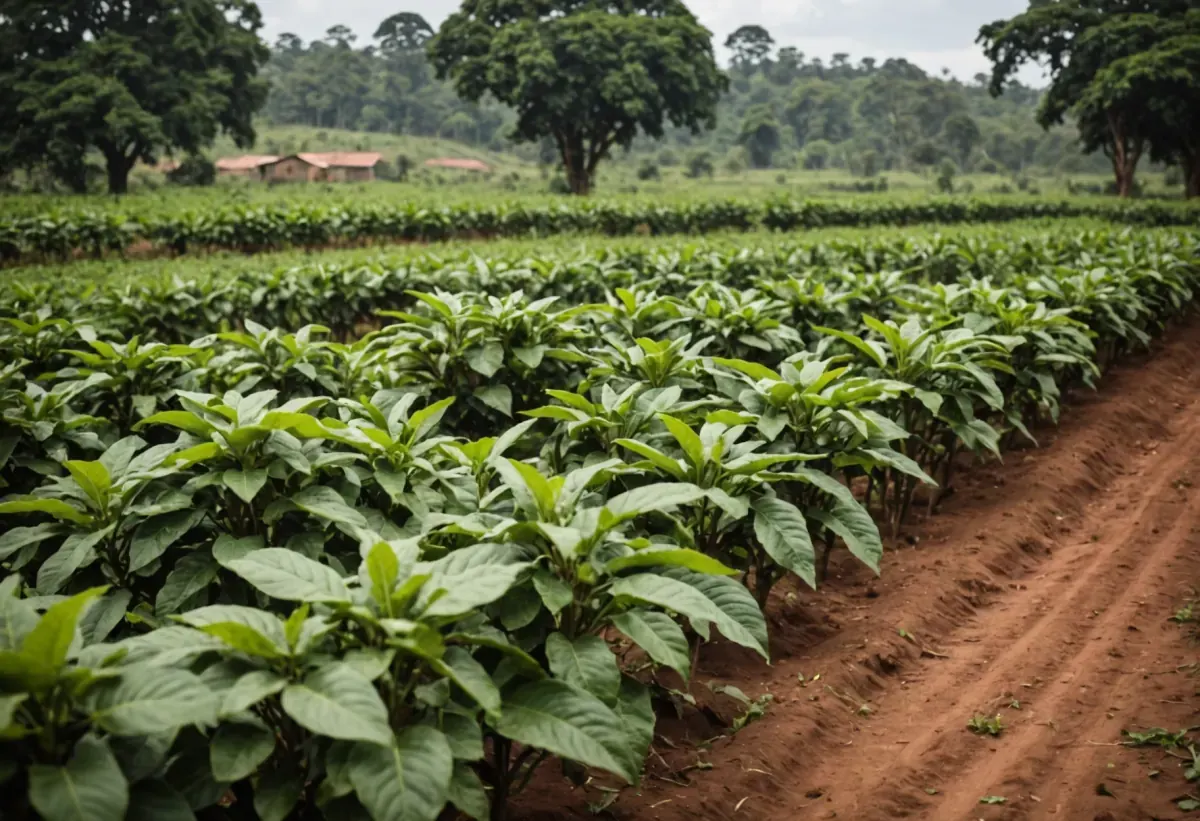
    A Ugandan farmer hand-picks ripe red coffee cherries from a bush in a highland garden
    Coffee is one of Uganda’s leading cash crops and a source of export earnings for the country.

    Common mistake: describing “foreign exchange” as just “money”. Say what it is — currency earned from buyers abroad, used to pay for imports — and back the point with the 35% export-earnings figure.

    Social and cultural value of farming

    Farming also carries social and cultural value, because it is tied to the customs, ceremonies and land that bind Ugandan communities together. Work done together, food shared at gatherings, and land passed down through families all come from the farming way of life. This social side completes the value of agriculture to Ugandan communities.

    1. Communal labour brings neighbours together to clear, plant or harvest, turning heavy farm work into a shared community task.
    2. Food sharing follows the harvest, because surplus produce is given at gatherings, weddings and funerals, strengthening relationships.
    3. Ceremonies use farm produce and animals, since bride price, feasts and thanksgiving events all draw on crops and livestock.
    4. Inheritance of land passes farmland from parents to children, carrying both a livelihood and a family identity across generations.
    5. Cultural identity — studies of Ankole cattle keepers record that some herds are kept “for cultural reasons”, not only for milk or money.
    6. Traditional knowledge about seasons, seeds and soils is taught to children in the field, keeping local skills alive.
    7. Social status can come from livestock, because in some communities cattle signal wealth and responsibility.
    8. Community cohesion grows through cooperative farming and shared land management, which hold neighbours together.
    9. Festivals and harvest events mark the farming calendar and give communities a shared reason to gather and celebrate.
    10. Skills and values such as patience, hard work and care for the land are learned through daily farm routines.
    11. Environmental stewardship through agroforestry and careful water use protects farmland for future generations.
    12. Support for the vulnerable — farm work and food sharing act as a safety net for women, youth and neighbours in need.
    13. Sense of belonging — a family’s connection to ancestral land and crops gives people a rooted place in the community.
    Cultural roleWhat happensWhy it matters
    Communal labourNeighbours join to clear, plant or harvestShares heavy work and builds bonds
    Food sharingSurplus is given at gatherings and funeralsStrengthens relationships and support
    CeremoniesCrops and livestock used in feasts and bride priceMarks life events in the community
    Inheritance of landFarmland passes from parents to childrenCarries livelihood and family identity
    FestivalsHarvest events mark the farming calendarGives a shared reason to celebrate
    Traditional knowledgeElders teach seasons, seeds and soilsKeeps local farming skills alive
    Livestock as statusCattle signal wealth and responsibilityGives social meaning to herding
    Environmental stewardshipAgroforestry and water care on farmsProtects land for future generations

    Exam tip: in a “social value of farming” answer, move beyond economics and name at least one custom — communal labour, food sharing, ceremonies or inheritance — then say how it binds the community.

    Frequently asked questions about the value of agriculture to Ugandan communities

    What is the value of agriculture to Ugandan communities?

    It supplies food, gives most families a way to earn income, provides raw materials to local industries, earns foreign exchange from exports, and carries the social customs that hold communities together. Together these make farming the backbone of household welfare and the national economy.

    Why is agriculture important for food security in Uganda?

    Most Ugandan households grow much of what they eat, so farming keeps matooke, cassava, maize, beans and milk on the table all year. Mixed cropping spreads risk, and surplus harvests can be stored or shared, which protects families when one crop fails or a dry season bites.

    How does agriculture create employment and income in Uganda?

    It employs people directly on farms and in the selling, milling and processing of produce. Around 7 million households farm or keep livestock, and the sector touches most of the working population, so self-employment, wage labour and agro-processing jobs all flow from farming.

    What raw materials does agriculture give to Ugandan industries?

    Maize and rice go to mills, seed cotton to ginneries, milk to dairies, and oilseeds to pressing plants. By-products such as maize bran, cottonseed cake and molasses become livestock feeds, so one farm product can supply several local industries at once.

    How does agriculture earn foreign exchange for Uganda?

    Exports of crops such as coffee, cotton and tea, and of products such as fish, hides and skins, bring in currency from buyers abroad. Agriculture made up about 35% of Uganda’s export earnings in FY 2022/23, which helps the country pay for its imports.

    What is the social and cultural value of farming in Uganda?

    Farming shapes customs such as communal labour, food sharing, ceremonies and the inheritance of land. These practices share work, mark important events, and pass land and knowledge down through families, which is why farming matters beyond money and food alone.

    Key terms and revision summary

    TermDefinition
    Food securitySteady access to enough safe, nutritious food to live an active, healthy life.
    Subsistence farmingGrowing food mainly for the household’s own use, selling only the surplus.
    Cash cropA crop grown mainly for sale rather than for the family’s own meals.
    Raw materialA farm product used as an input by another industry, such as seed cotton for a ginnery.
    Agro-processingTurning farm produce into goods such as flour, feeds, cloth and dairy products.
    Foreign exchangeCurrency earned from selling goods abroad, used to pay for imports.
    Export earningsThe income a country receives from goods sold to foreign buyers.
    Communal labourNeighbours working together on a shared farm task such as clearing or harvesting.
    GDPGross Domestic Product — the total value of goods and services a country produces.

    Exam-style questions

    1. Explain four ways agriculture contributes to household food security in Uganda. Outline: it supplies staple foods (matooke, cassava, maize, beans); home production lowers spending; mixed cropping spreads risk against crop failure; milk and vegetables improve nutrition.
    2. Describe how agriculture generates employment and income in Uganda. Outline: self-employment on family plots; paid wage labour; trading and boda-boda transport; agro-processing jobs; and cattle keeping, including its youth- and women-headed households.
    3. Outline the role of agriculture as a source of raw materials for local industries. Outline: maize and rice to mills; seed cotton to ginneries and textiles; milk to dairies; oilseeds to pressing plants; by-products such as bran and cottonseed cake to feed making.
    4. Explain the social and cultural value of farming to Ugandan communities. Outline: communal labour; food sharing at gatherings; ceremonies that use crops and livestock; inheritance of land; traditional knowledge; and environmental stewardship.
  • Agriculture in Uganda: Growth, Change and Food Security

    Agriculture in Uganda: Growth, Change and Food Security

    Agriculture in Uganda is the growing of crops and the rearing of livestock for food, income and raw materials, and it anchors the lives of most Ugandan families. The NCDC Senior 3 Agriculture syllabus records that more than 70% of the population is directly involved in agricultural production, and that the sector contributes over 25% of gross domestic product.

    Uganda’s journey runs from early subsistence farming, through colonial cash crops, to modern farming that must now deliver food security for a growing nation.

    Green Ugandan farmland with banana plants and smallholder crop gardens
    Green farmland and banana gardens of the kind smallholder families farm across Uganda.

    Early farming in Uganda

    Early farming in Uganda was subsistence farming. Families grew food for their own tables and reared livestock for milk, meat and status, with only a small surplus sold when the harvest allowed. Crops such as bananas, millet and yams supplied the daily food, while cattle such as the long-horned Ankole were kept for cultural reasons as much as for milk.

    • Subsistence farming was the foundation of early farming in Uganda: households grew what they ate and ate what they grew, selling only a small surplus when the harvest allowed.
    • Staple crops such as bananas, millet and yams supplied the daily carbohydrate food that kept a family fed through the seasons and between harvests.
    • Livestock rearing ran alongside the crops, so a family’s cattle, goats and poultry provided milk, meat, hides and manure for the garden.
    • The Ankole long-horned cattle of southwestern Uganda were kept for cultural reasons, as a buffer against drought and disease, and for income from selling live animals. This is the breed covered in the breeds and physical selection of production cattle notes.
    • Indigenous cattle breeds — the Ankole, the Zebu and the Nganda — are well adapted to local heat, disease and feed shortages, which made them the natural choice for early herders.
    • Simple hand tools did the work, because early farmers cleared, planted, weeded and harvested with hoes and other hand implements rather than with machines.
    • Communal life shaped the work, since planting, harvesting and herding were shared by families, clans and whole villages instead of being done alone.
    • Culture and ritual were woven into farming, as crops and animals appeared in ceremonies, marriage customs and the daily social life of the community.
    • Seasons and rainfall set the farming calendar, so families planted when the rains came and harvested when their crops had matured.
    • Food storage mattered greatly, because households dried or stored grain and other food to carry the family through dry periods and lean months.
    • Indigenous knowledge guided the farmer, who chose local seed, knew the soils and read the weather from long experience handed down the generations.
    • Crop diversity on one plot was common, with several crops grown together so that a family still had food if one crop failed.
    • No purchased inputs were needed, because early farmers used saved seed, animal manure and family labour, which kept costs low even though yields stayed modest.
    • Seasonal herding saw cattle keepers move animals to water and pasture in drier months, a practice still seen in Uganda’s cattle corridor today.
    Ankole long-horned cattle grazing on green Ugandan pasture
    Ankole long-horned cattle, the indigenous breed of southwestern Uganda, grazing on pasture.

    Common mistake: writing that “subsistence farming means farmers produce nothing to sell.” Subsistence farmers sell a small surplus when they can; the point is that most of what they grow is for the family’s own food, not for a market.

    The colonial period and cash crops

    The colonial period changed agriculture in Uganda by steering farmers away from growing mainly for the family and toward cash crops grown for export. Cotton and coffee became the main cash crops, and farmers were moved into growing them alongside, and sometimes instead of, their food crops. This linked Uganda’s farms to a global market for raw materials, often through monoculture — planting a single crop over a wide area.

    A Ugandan example shows the chain. Cotton grown by farmers in Bukwo is sold to a ginnery, which cleans the raw cotton into lint, and the lint is then spun into textiles. The farmer at the bottom of that chain sells raw, unprocessed cotton, which is why the farmer carries no value-added tax on it.

    CropTypeGrown for
    Bananas (matooke)Food cropStaple food, cooked and eaten daily across central and western Uganda.
    MilletFood cropCereal grain used for porridge and for local brew.
    MaizeFood cropStaple grain for posho and flour, with maize bran used as animal feed.
    BeansFood cropProtein-rich food eaten with matooke, posho or rice.
    RiceFood cropStaple grain grown in wetlands and under irrigation.
    CassavaFood cropStarchy root food and a drought-tolerant reserve crop.
    Sweet potatoesFood cropRoot food, with the vines fed to livestock.
    SorghumFood cropCereal for food and brew, also used as animal feed.
    CoffeeCash cropGrown for its beans, which are sold on the global market for export income.
    CottonCash cropGrown for its fibre (lint), which is ginned and spun into textiles.
    TeaCash cropGrown for its leaves, which are processed for drinking; Uganda’s highlands suit tea plantations.
    Sugar caneCash cropGrown for sugar, with molasses and bagasse used as energy feed for livestock.
    SoyabeanOilseed cropAn oilseed whose soybean meal is a protein source in animal feed.
    SunflowerOilseed cropAn oilseed whose sunflower cake is a protein source in animal feed.
    Coffee plants growing in rows on a Ugandan smallholder farm
    Coffee bushes, one of Uganda’s main cash crops, grown on a smallholder plot.

    Exam tip: when you classify crops, name what the crop is grown for, not just the crop. Cotton is a cash crop because it is grown for sale as lint; maize is a food crop because most of it is eaten, even though a surplus is sold.

    Agriculture after independence

    After independence, agriculture in Uganda survived political upheaval and economic hardship, and it stayed the backbone of the economy. The country’s own syllabus records a huge expansion: land under agricultural production rose from 8 million acres in 1997 to 40 million acres. The same document records that more than 70% of the population is directly involved in agricultural production.

    • Agriculture stayed the backbone, for even through the political upheaval and economic hardship that followed independence, farming remained the main source of work and income for most Ugandans.
    • The 1997 baseline was small, since the NCDC Agriculture syllabus records only 8 million acres of land under agricultural production in that year.
    • Expansion then accelerated, with the syllabus recording 40 million acres under agricultural production by the time the document was published in 2019.
    • A five-fold rise is what that growth represents, because 40 million acres divided by 8 million acres equals five (40 ÷ 8 = 5).
    • Cooperatives were rebuilt, and the Uganda Cooperative Savings and Credit Union (UCSCU) was established in 1972 to bring savings and credit cooperatives together.
    • A legal framework now guides cooperatives through the Cooperative Societies Act, under which a SACCO must first register before it can be licensed to lend.
    • Government programmes in the late 20th and early 21st centuries aimed to raise productivity, improve access to markets and promote sustainable farming.
    • Improved seed varieties were introduced so that farmers could raise yields beyond what their saved local seed would produce.
    • Climate-smart agriculture became a stated goal, pairing crop and livestock farming with practices that protect soil and water.
    • Technology reached the farm, with mobile phones giving farmers access to weather forecasts, market prices and practical farming advice in a way that was once impossible.
    • The organic farming movement grew as some farmers cut back on synthetic inputs to reach markets that pay a premium for organically produced food.
    • Cash crops remained central, with coffee and tea continuing to earn export income while food crops fed the home market.
    • Youth and women became a stronger focus, as programmes worked to raise their skills, their access to land and their access to capital in farming.
    • Financial services appeared for farmers, with the Agricultural Credit Facility launched in 2009 and the Uganda Agricultural Insurance Scheme launched in 2017 to cover crop and livestock losses.

    Common mistake: writing that Uganda’s farmland shrank after independence. The syllabus shows the opposite — land under production grew from 8 million acres in 1997 to 40 million acres, a five-fold rise.

    Modern farming in Uganda today

    Modern agriculture in Uganda mixes smallholder food production with cash crops, dairy and new technology. The NCDC Agriculture syllabus (2019) records that more than 70% of the population is directly involved in agricultural production and that the sector contributes over 25% of gross domestic product — which underlines the value of agriculture to Ugandan communities.

    • Land under production reached 40 million acres, a huge increase on the 8 million acres that were under use in 1997, according to the NCDC Agriculture syllabus.
    • Population dependence is very high, since more than 70% of the population is directly involved in agricultural production and over half of these are in the subsistence sector.
    • GDP contribution is over 25%, which the NCDC syllabus records as agriculture’s share of Uganda’s gross domestic product and a sign of how much the economy leans on the land.
    • A taught subject, agriculture is an elective from Senior 1 to Senior 4, with four periods a week in Senior 3 and Senior 4 — the focus of the Senior 3 Agriculture notes on this site.
    • The national herd reached 14.5 million cattle in the 2021 National Livestock Census, up from 11.4 million recorded in 2008.
    • Milk output reached 3.7 billion litres a year by 2021, a five-fold increase on the 667.5 million litres recorded in 2008.
    • Mostly indigenous cattle make up the herd, since 77% of the national cattle population is indigenous and only 23% is exotic or cross-bred.
    • Youth-headed herds number 1.4 million livestock-keeping households, or 20.1% of the total, showing that young people already hold a real stake in farming.
    • Women farmers head 2.3 million livestock-keeping households, or 34.1% of the total, which makes women central to Uganda’s livestock economy.
    • A cash and food mix is insured nationally, since the Uganda Agricultural Insurance Scheme covers coffee, tea, maize, rice, beans, bananas, fruits, vegetables, cattle, pigs, poultry and fish.
    • Mobile money reached 65.9% of adults in 2023, up from 54.4% in 2018, which is how many farmers now send and receive payment for produce.
    • Savings groups are widespread, with about three in ten Ugandans belonging to a village savings group and SACCO use rising from 4.3% to 12.2% of adults between 2018 and 2023.
    • New farming methods are spreading, since hydroponics — growing crops without soil — is demonstrated at the Makerere University Agricultural Research Institute in Kabanyolo (MUARIK).
    • Simple tools still dominate, because 81.4% of livestock-keeping households own hand farm tools while only 0.2% own a tractor.

    Exam tip: quote the syllabus’s own figures and name the source. Write “the NCDC Agriculture syllabus (2019) records 40 million acres under production and over 70% of the population in agriculture” — naming NCDC earns the mark for source use.

    Challenges and opportunities for Ugandan agriculture

    Agriculture in Uganda faces real pressures — climate change, land degradation and limited access to finance — but each pressure opens a door for a young farmer who is ready to respond. The skill examiners want is matching each challenge to a practical, affordable solution.

    ChallengeEffect on farming
    Climate changeBrings drought and unreliable rains, so planting seasons shift and yields become harder to predict.
    Land degradationWorn-out soils and erosion reduce the fertility that crops need to grow well.
    Limited access to financeKeeps many farmers from buying improved seed and inputs, because affordable credit is hard to get.
    Crop failure and droughtFinScope Uganda 2023 records that 22% of adults faced crop failure, livestock death or drought — the second most common financial shock after illness.
    Low mechanisationOnly 0.2% of livestock-keeping households own a tractor, so most farm work is still done by hand.
    Animal diseaseFoot and mouth disease and tick-borne diseases such as East Coast fever cost farmers cattle, milk and income.
    Poor livestock shelterOnly 32.5% of cattle-keeping households had a shelter for their cattle in 2021, exposing animals to weather and disease.
    Thin insurance coverageThe Uganda Agricultural Insurance Scheme reaches below 1% of farming households a year, so most losses are not insured.
    Price falls after harvestSome households lose income when the price of their produce drops, especially when many farmers sell at once.
    Scarce equipmentOnly 16.4% of livestock-keeping households own feeding or watering troughs and just 11.3% own a spray pump.
    Rain dependenceBecause most fields rely on rainfall, a poor rainy season quickly becomes a poor harvest for the family.
    Adoption without finance78% of farmers practise mixed cropping but only 4% borrowed to fund it, and 41% use improved seed with only 5% borrowing for it.
    Weak formal savingOnly two in ten Ugandans have ever saved electronically, so much farm money is kept informally and earns nothing.
    OpportunityWhat a young farmer could do about it
    Improved seedPlant higher-yielding, drought-tolerant seed varieties in place of saved local seed to lift yields.
    Mobile technologyUse a phone to check weather forecasts and market prices before planting and before selling.
    Village savings groupsJoin a VSLA to save a little each week and borrow a lump sum for seed or tools.
    SACCOs and cooperativesJoin a SACCO or cooperative to pool resources, share knowledge and reach bigger markets together.
    Agricultural creditApply for Agricultural Credit Facility loans through a bank at up to 12% fixed interest per year.
    Crop insuranceInsure maize, beans, bananas and other crops under the Uganda Agricultural Insurance Scheme.
    HydroponicsLearn to grow leafy vegetables without soil at a demonstration site such as MUARIK in Kabanyolo.
    Drip irrigationBuild a simple drip system from a bucket and pipes to water a small garden in the dry season — the method in the low-cost drip irrigation for forage notes.
    Youth loansBorrow through youth agricultural loans aimed at people aged 18 to 35, often through a group.
    Organic farmingCut back on synthetic inputs and target markets that pay a premium for organically grown produce.
    Livestock improvementCross indigenous cattle with dairy breeds for more milk, or keep hardy local breeds for drought resilience.
    Value additionSell processed or graded produce — such as ginned cotton — to capture more of the value chain.
    Climate-smart practicesConserve soil and water on the farm to protect yields when rainfall becomes unreliable.
    Youth and women programmesJoin initiatives that raise skills, land access and capital for young and women farmers.

    Common mistake: listing only the challenges and stopping there. Examiners award marks for matching each challenge to a realistic response — for example, “limited finance” matched to “join a SACCO or apply for Agricultural Credit Facility credit at up to 12%”.

    Frequently asked questions about agriculture in Uganda

    What is agriculture in Uganda?

    Agriculture in Uganda is the growing of crops and the rearing of livestock for food, income and raw materials. It is the backbone of the economy: the NCDC syllabus records that over 70% of the population is directly involved in agricultural production and that the sector contributes over 25% of gross domestic product.

    Which crops are grown in Uganda?

    Uganda grows food crops such as bananas, maize, beans, rice, millet, sorghum, cassava and sweet potatoes. It also grows cash crops including coffee, cotton, tea and sugar cane, and it keeps livestock such as cattle, goats, pigs and poultry.

    What are the main cash crops of Uganda?

    The main cash crops are coffee, cotton and tea. Coffee is grown for its beans, which are sold on the global market; cotton for its fibre, which is ginned into textiles; and tea for its leaves, which are processed for drinking.

    What share of Ugandans depends on agriculture?

    More than 70% of Ugandans are directly involved in agricultural production, and over half of these work in the subsistence sector. These figures come from the NCDC Agriculture syllabus (2019), and they show how central farming is to Ugandan life.

    Why is agriculture important to Uganda’s economy?

    Agriculture contributes over 25% of Uganda’s gross domestic product and provides work for most of the population. It supplies the nation’s food, earns export income from cash crops such as coffee, and produces raw materials and jobs across rural areas.

    What challenges does agriculture in Uganda face?

    Agriculture in Uganda faces climate change, land degradation and limited access to finance. Farmers also cope with crop failure and drought, animal diseases, poor livestock shelter and very low insurance coverage, so each challenge needs a practical response.

    How can a young person start farming in Uganda?

    A young person can join a savings group or SACCO, learn a method such as drip irrigation or hydroponics, and apply for youth agricultural loans aimed at people aged 18 to 35. Starting small with one or two crops keeps the risk low.

    Key terms and revision summary

    Learn these terms, then attempt the exam-style questions below. Each answer outline shows the points an examiner looks for.

    TermMeaning
    AgricultureThe growing of crops and the rearing of livestock for food, income and raw materials.
    Subsistence farmingGrowing food mainly for the family’s own use, with only a small surplus sold when possible.
    Cash cropA crop grown mainly for sale, such as coffee or cotton.
    Food cropA crop grown mainly to be eaten, such as bananas, maize or beans.
    Gross domestic product (GDP)The total value of the goods and services a country produces in a year.
    Climate-smart agricultureFarming practices that protect soil and water while keeping yields steady as the climate changes.
    CooperativeA group that pools members’ resources to buy inputs, share knowledge and reach markets together.
    SACCOA savings and credit cooperative — a member-owned society that takes savings and lends to its members.
    HydroponicsGrowing crops without soil, in water or a solid growing medium.
    Improved seedHigher-yielding or drought-resistant seed varieties used in place of saved local seed.

    Exam-style questions and answer outlines

    1. State three differences between subsistence farming and commercial cash-crop farming. Outline: subsistence farmers grow mainly for the family’s food while cash-crop farmers grow mainly for sale; subsistence plots are usually small and diverse while cash-crop farms may be larger and planted to one crop; subsistence farming uses saved seed and family labour while cash-crop farming is linked to markets and exports.
    2. Name four food crops and three cash crops grown in Uganda, and state what one cash crop is grown for. Outline: food crops — bananas, maize, beans, millet (or rice, cassava, sweet potatoes); cash crops — coffee, cotton, tea; coffee is grown for its beans, which are sold on the global market.
    3. Using the NCDC Agriculture syllabus figures, describe the size and importance of agriculture in Uganda. Outline: 40 million acres under production (up from 8 million in 1997); more than 70% of the population directly involved; over 25% of GDP. Explain each figure and name NCDC as the source.
    4. Explain two challenges facing Ugandan agriculture and give one practical response to each. Outline: limited finance → join a SACCO or apply for Agricultural Credit Facility credit at up to 12%; climate change and drought → use drought-tolerant seed and drip irrigation; animal disease → vaccination and movement control.
    5. Why did colonial rule shift Ugandan farming from food crops toward cash crops? Outline: the colonial economy wanted raw materials for export, so it steered farmers into cash crops such as cotton and coffee, often grown as monocultures, alongside and sometimes in place of food crops.
  • 20 Emerging Careers in Uganda’s Agriculture Sector for 2024

    20 Emerging Careers in Uganda’s Agriculture Sector for 2024

    Young Ugandan agricultural officer showing two students how to examine a coffee leaf

    Introduction:

    Agriculture remains the backbone of Uganda’s economy, employing approximately 80% of the population. As we embrace technology and sustainable farming practices, the sector is rapidly evolving, offering a myriad of career opportunities. Here, we explore 20 promising careers in Uganda’s agriculture sector, highlighting the diversity and potential for aspiring professionals in 2024.

    Career jobs in Uganda’s agriculture sector

    1. Smallholder Farmers:

    Empowering the backbone of Uganda’s agriculture, smallholder farmers engage in mixed farming, growing crops and rearing livestock on small plots. They are pivotal in sustaining food security and rural livelihoods.

    2. Soil Health Specialists:

    With a focus on sustainable agriculture, soil health specialists analyze soil conditions to advise on conservation practices, ensuring long-term productivity and environmental health.

    3. Agroforestry Technicians:

    Blending agriculture with forestry, agroforestry technicians develop land-use practices that enhance biodiversity, reduce erosion, and increase crop yield through strategic tree planting.

    4. Aquaculture Consultants:

    In response to rising fish demand, aquaculture consultants offer expertise in the sustainable cultivation of aquatic organisms, including fish and plants, contributing to food security and economic growth.

    5. Crop Rotation Advisors:

    Specializing in sustainable crop management, these advisors help farmers implement crop rotation strategies to improve soil health, reduce pests, and increase yield.

    6. Farm Technology Innovators:

    Leveraging technology, these innovators introduce precision farming tools, such as drones and IoT devices, to enhance productivity and resource management in farming operations.

    7. Agricultural Policy Advocates:

    Working within governmental or non-governmental organizations, advocates influence policy-making to support sustainable agricultural practices and rural development.

    8. Sustainable Supply Chain Coordinators:

    These coordinators ensure the ethical, sustainable sourcing of agricultural products, emphasizing fair trade practices and reducing carbon footprints.

    9. Community Supported Agriculture (CSA) Managers:

    CSA managers connect farmers directly with consumers, promoting local, fresh produce subscriptions that support small-scale farmers and community health.

    10. Biofortification Specialists:

    Focusing on nutrition, biofortification specialists develop crops with enhanced nutrients to combat malnutrition, working closely with agricultural biotechnologists.

    11. Agri-Tourism Entrepreneurs:

    Blending agriculture with tourism, these entrepreneurs create experiences that educate visitors about farming, conservation, and sustainable living, diversifying income sources for farmers.

    12. Organic Certification Consultants:

    As demand for organic products rises, certification consultants guide farmers through the process of organic certification, ensuring compliance with national and international standards.

    13. Renewable Energy Technicians in Agriculture:

    Specializing in green energy solutions, these technicians implement solar, wind, and biomass systems on farms to reduce energy costs and carbon footprints.

    14. Water Resource Managers:

    Critical in water-scarce regions, these managers devise efficient irrigation systems and water conservation strategies, ensuring sustainable water use in agriculture.

    15. Agricultural Extension Officers:

    These officers bridge the gap between research and farming, delivering the latest agricultural science and technology to rural communities, enhancing productivity and sustainability.

    16. Permaculture Designers:

    Focusing on sustainable land use design, permaculture designers create resilient agricultural ecosystems that mimic natural processes, promoting biodiversity and ecological harmony.

    17. Seed Sovereignty Coordinators:

    Championing seed conservation, these coordinators work with communities to preserve indigenous seed varieties, ensuring genetic diversity and food sovereignty.

    18. Urban Farming Specialists:

    Addressing food production in urban settings, these specialists develop innovative solutions like rooftop gardens and vertical farming to bring agriculture into cities.

    19. Climate Change Analysts in Agriculture:

    These analysts study the impact of climate change on agriculture, advising on adaptation and mitigation strategies to secure food production against environmental challenges.

    20. Agricultural Finance Advisors:

    They provide financial planning and support to farmers and agribusinesses, facilitating access to credit, insurance, and investment to grow and innovate.

    Conclusion:

    The agriculture sector in Uganda is ripe with opportunities, blending traditional practices with modern innovations. These 20 careers offer a glimpse into the sector’s future, promising a rewarding path for those passionate about agriculture and sustainability. As Uganda continues to embrace agricultural advancements, the potential for growth and development in this sector is boundless.

    Frequently Asked Questions About Careers in Agriculture

    1. What is a career in agriculture?

    A career in agriculture involves various professions related to farming, food production, and the management of natural resources. It encompasses a wide range of roles, from farmers and ranchers to agricultural scientists and environmental specialists.

    2. What qualifications do I need to work in agriculture?

    Qualifications vary depending on the specific career path. Some roles, like farming or livestock care, may require hands-on experience, while others, such as agricultural scientists or engineers, typically require at least a bachelor’s degree in relevant fields.

    3. What are the job prospects in agriculture?

    Job prospects in agriculture are generally stable, as the world’s population continues to grow, and the demand for food and agricultural products remains high. Career opportunities exist in both rural and urban areas.

    4. Is agriculture only about farming and ranching?

    No, agriculture encompasses a wide range of professions beyond farming and ranching. It includes roles in research, technology, business management, marketing, environmental sustainability, and policy development.

    5. How can I get started in a career in agriculture?

    To get started, consider your interests and goals within the field of agriculture. Choose relevant courses or degrees, gain practical experience, and network with professionals in the industry. Internships and entry-level positions are excellent ways to begin.

    6. Are there opportunities for sustainable and organic farming careers?

    Yes, there are opportunities in sustainable and organic farming, which have gained popularity due to increased awareness of environmental and health concerns. Careers in organic farming and sustainable agriculture focus on eco-friendly and ethical practices.

    7. What is the role of technology in agriculture careers?

    Technology plays a crucial role in modern agriculture. Careers in precision agriculture, agribusiness management, and agricultural engineering often involve using advanced tools such as GPS, drones, and data analysis software to enhance productivity and sustainability.

    8. Are there opportunities for advancement in agriculture careers?

    Yes, there are opportunities for advancement in agriculture. Many individuals start in entry-level positions and progress to management, research, or specialized roles as they gain experience and expertise.

    9. What are some challenges in agriculture careers?

    Challenges in agriculture may include unpredictable weather, pest and disease management, market fluctuations, and environmental concerns. Staying informed about industry trends and adopting new technologies can help mitigate these challenges.

    10. Can I make a difference in agriculture careers related to sustainability and the environment?

    Absolutely. Careers in agriculture offer many opportunities to address environmental and sustainability concerns. Roles in sustainable farming, conservation, and environmental sciences are focused on making a positive impact on the planet.

    11. Are there careers in agriculture that do not involve manual labor on a farm?

    Yes, there are numerous careers in agriculture that do not involve manual labor on a farm. These include roles in agricultural research, education, policy analysis, technology development, marketing, and many more.

    12. How do I stay updated on advancements in the agricultural field?

    To stay updated, consider joining agricultural associations, subscribing to industry publications, attending conferences and workshops, and networking with professionals in the field. Many universities and institutions also offer online courses in agricultural topics.

    13. What are the benefits of pursuing a career in agriculture?

    Benefits of an agriculture career can include job security, the opportunity to make a positive impact on food production and the environment, and the potential for career advancement and financial stability.

    14. Are there opportunities to work internationally in agriculture careers?

    Yes, many agricultural careers offer international opportunities, particularly in areas like agricultural development, research, and global trade. These roles may involve collaborating with organizations and governments worldwide.

  • farm Record-Keeping: examples and importance

    farm Record-Keeping: examples and importance

    What is record keeping on the farm?

    Record-keeping on the farm is the systematic practice of documenting and organizing essential data related to agricultural operations. It involves the recording of various aspects, including financial transactions, crop cultivation, livestock management, resource utilization, and other critical information pertinent to the farm’s activities.

    Record keeping on the farm is a crucial management practice that involves systematically documenting various aspects of farm operations. This includes tracking expenses, income, livestock production, crop yields, fertilizer and pesticide applications, equipment maintenance, and labor. Effective record-keeping allows farmers to make informed decisions, enhancing productivity and profitability.

    By maintaining detailed and accurate records, farmers can analyze trends over time, identify areas for improvement, and optimize resource allocation. For example, recording crop yields against specific inputs like fertilizers or pesticides can help in determining the most cost-effective practices. Similarly, tracking animal health records and breeding cycles aids in managing livestock more efficiently.

    Financial records are essential for budgeting, planning, and securing loans or grants. They provide a clear picture of the farm’s financial health, showing where money is being spent and earned. Additionally, these records are critical for tax preparation, ensuring compliance with regulations and potentially identifying tax-saving opportunities.

    In the digital age, many farmers are turning to software and mobile apps designed for agricultural record keeping. These tools simplify data entry, storage, and analysis, making it easier to access and utilize information for strategic decision-making.

    Overall, effective record keeping is foundational to farm management, supporting sustainability, and long-term success by enabling farmers to track their progress, plan for the future, and respond adaptively to market and environmental changes.

    Common examples of records kept on farms

    Farm record keeping involves a variety of records that are essential for efficient farm management, analysis, and planning. Here are some common types of records kept on farms:

    1. Financial Records:
    1. Income and expenditure records
    2. Receipts and invoices for purchases and sales
    3. Loan and credit records
    4. Asset inventory and depreciation schedules
    5. Tax records and documents
    1. Crop Production Records:
    1. Planting dates, varieties, and locations
    2. Input records (seeds, fertilizers, pesticides, water usage)
    3. Harvest yields and dates
    4. Crop rotation plans and field histories
    5. Pest and disease management logs
    1. Livestock Records:
    1. Birth, death, and purchase records
    2. Health and vaccination records
    3. Breeding and production records (e.g., milk yield, egg production)
    4. Feed consumption and conversion rates
    5. Weight and growth records
    1. Labor Records:
    1. Employee details, roles, and hours worked
    2. Training records
    3. Payroll and compensation details
    1. Equipment and Machinery Records:
    1. Purchase, repair, and maintenance logs
    2. Usage logs (hours of operation)
    3. Depreciation schedules
    1. Inventory Records:
    1. Supplies (seeds, feed, fertilizers, pesticides)
    2. Product inventory (stored crops, livestock products)
    3. Tools and equipment inventory
    1. Environmental and Compliance Records:
    1. Soil tests and health records
    2. Water usage and irrigation schedules
    3. Compliance with agricultural and environmental regulations
    4. Certifications (organic, animal welfare, etc.)
    1. Field and Farm Maps:
    1. Layouts of fields, crop locations, and rotations
    2. Infrastructure locations (buildings, irrigation systems)

    Why is record keeping important?

    The importance of record-keeping on a farm cannot be overstated. It plays a crucial role in the success and sustainability of agricultural operations. Here are several reasons why record-keeping is essential on a farm:

    1. Financial Management: Records help farmers track income and expenses. This is essential for budgeting, financial planning, and ensuring the farm remains profitable. It allows for better decision-making regarding investments, purchases, and pricing strategies.
    • Profitability Analysis: Detailed records enable farmers to analyze the profitability of specific crops, livestock, or farming practices. This information can guide future choices, emphasizing what works best for the farm’s financial health.
    • Resource Management: Recording data on inputs like seeds, fertilizers, water, and labor can help optimize resource use. This reduces wastage and improves resource efficiency.
    • Tax and Legal Compliance: Accurate records are crucial for tax reporting and compliance with government regulations. Failure to maintain proper records can lead to legal issues and financial penalties.
    • Performance Evaluation: Record-keeping allows farmers to assess the performance of different farming seasons and years. It helps in identifying trends, successes, and areas that need improvement.
    • Crop Rotation and Pest Management: Keeping track of which crops were planted where in previous seasons helps in planning for crop rotation and pest management. This can prevent soil depletion and reduce the risk of pest infestations.
    • Livestock Management: For livestock farms, records help in monitoring animal health, breeding cycles, vaccinations, and growth rates. This data is critical for herd management and ensuring the well-being of the animals.
    • Market Planning: Farmers can use historical data to plan for market demands. Knowing what crops or products were in demand during specific times of the year can help in production and marketing strategies.
    • Loan Applications: Many farmers require loans for various purposes, such as purchasing new equipment or expanding operations. Lenders often require detailed records to assess the farm’s creditworthiness.
    1. Disaster Preparedness: In the unfortunate event of a natural disaster or unforeseen circumstances, accurate records are essential for insurance claims and recovery efforts.
    1. Succession Planning: Records can be invaluable for farmers planning to pass on their farm to the next generation. They provide a clear history of the farm’s operations, assets, and challenges.
    1. Environmental Stewardship: Maintaining records related to soil health, water use, and environmental practices can demonstrate a commitment to sustainable and responsible farming, which is increasingly important to consumers and regulatory bodies.

    In summary, record-keeping is a foundational practice for effective farm management. It supports financial stability, decision-making, and regulatory compliance while also aiding in resource optimization, performance evaluation, and long-term sustainability. Farmers who maintain accurate records are better positioned to adapt to changing conditions and achieve success in their agricultural endeavors.

    frequently asked questions related to the importance of record-keeping on the farm:

    1. Why is record-keeping important for a farm?

    Record-keeping is crucial for farms to manage finances, monitor performance, comply with regulations, and make informed decisions about resource allocation and crop management.

    2. What types of records should I maintain on my farm?

    You should maintain records of financial transactions, crop and livestock data, input usage, labor, machinery maintenance, and any other relevant information for your specific farming operation.

    3. How can record-keeping benefit my farm financially?

    Keeping accurate financial records helps you track income and expenses, assess profitability, and make well-informed decisions regarding investments, pricing, and budgeting.

    4. How do records assist in managing resources on the farm?

    Records help you optimize resource use by tracking input quantities, ensuring efficient use of seeds, fertilizers, and water, and minimizing waste.

    5. What role do records play in legal and regulatory compliance on the farm?

    Accurate records are essential for tax reporting and compliance with government regulations. Failure to maintain proper records can result in legal issues and penalties.

    6. How can record-keeping improve crop management and pest control?

    Records help in planning crop rotations and identifying pest management strategies based on previous crop history, reducing soil depletion and the risk of pest infestations.

    7. What are the benefits of livestock records for animal farming operations?

    Livestock records assist in monitoring animal health, breeding cycles, vaccinations, growth rates, and overall herd management, contributing to animal welfare and productivity.

    8. How can records help in market planning for the farm’s products?

    Historical data on market demand for specific crops or products during different seasons allows for informed decisions regarding production and marketing strategies.

    9. Can accurate records assist in applying for loans for my farm?

    Yes, lenders often require detailed records to assess your farm’s creditworthiness when you apply for loans, making it easier to secure funding for various farm needs.

    10. How can record-keeping support disaster preparedness and recovery efforts?

    In the event of a natural disaster or unforeseen circumstances, records are essential for insurance claims, assessing damage, and planning recovery efforts.

    11. How do records contribute to succession planning for the farm?

    Records provide a clear history of the farm’s operations, assets, and challenges, which is valuable for succession planning when passing the farm to the next generation.

    12. What is the role of records in environmental stewardship on the farm?

    Records related to soil health, water use, and environmental practices demonstrate a commitment to sustainable and responsible farming, which is increasingly important for consumers and regulatory compliance.

    Effective record-keeping is a fundamental practice for farm management and plays a pivotal role in the financial, operational, and environmental success of farming operations.

×
Listen to Remedial Radio

Listen to Remedial Radio

Enjoy the rhythm of knowledge. where books sing!
Learn More
🚀 Stuck in School? Catch Up and Stand Out!

🚀 Stuck in School? Catch Up and Stand Out!

Don't let difficult topics hold you back. Our fast-track Remedial Courses are designed to bridge the gap and boost your confidence instantly.

What We Offer:

  • Speak Kiswahili From Day One: Master conversational Swahili with zero stress.

  • English for Locals: Perfect your grammar and speak English with absolute confidence.

  • Targeted Remedial Support: Easily catch up on core subjects you find challenging.

Stop struggling. Start mastering.


Learn More