
Cattle disease control is the set of practices a farmer uses to prevent diseases and parasites, to stop them spreading, and to obey Uganda’s animal disease law. It protects the farmer’s biggest investment: healthy animals that grow, give milk and stay fit for sale. A disease caught late can wipe out a herd or close a whole district’s livestock markets.
This page covers the four diseases the NCDC Agriculture Syllabus (2019, ISBN 978-9970-00-120-0) names — red water, heart water, foot and mouth disease and anthrax — plus roundworms and ticks, and the legislation on notifiable diseases, movements and quarantine. The topic sits in Theme: Animal Production, under the Senior 3 topic “Cattle production” (Term 1, 48 periods).
Study it alongside the Senior 3 Agriculture notes on cattle production pillar and the Senior 3 Agriculture notes course hub.
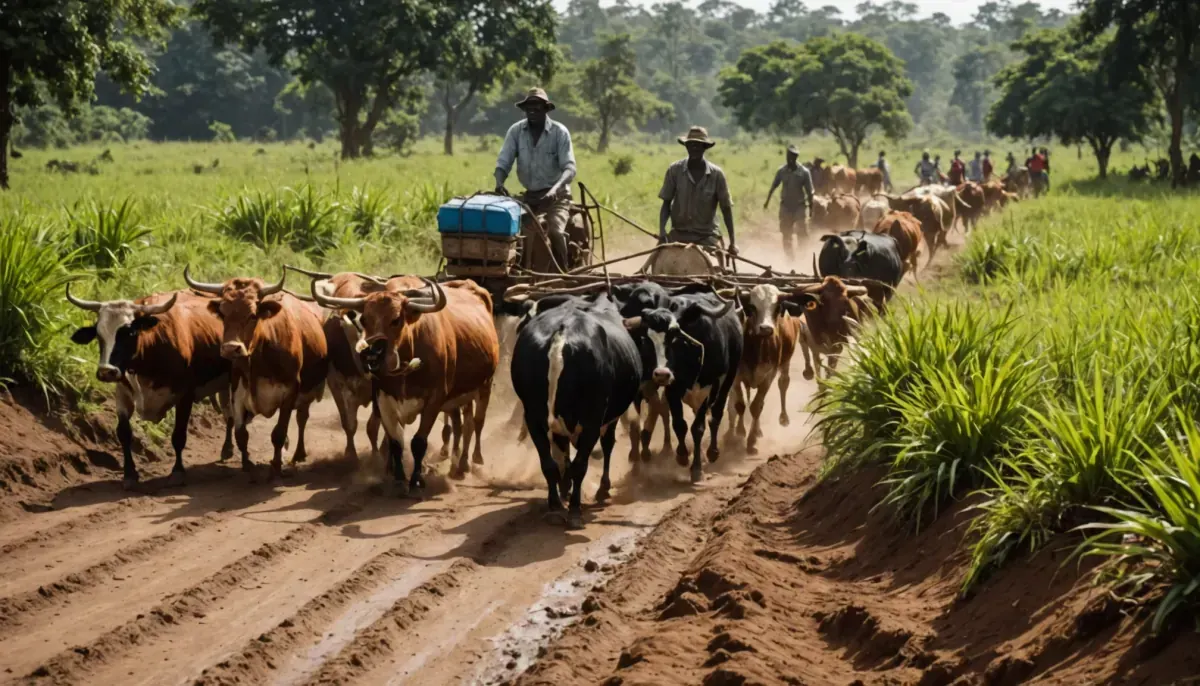
The clinical signs below are standard veterinary descriptions. The NCDC syllabus names these diseases but does not print their symptoms, and this post deliberately gives no Ugandan prevalence or death-rate figure where none is verified. The four diseases at a glance:
| Disease | Cause | Key symptoms | What the farmer does first |
|---|---|---|---|
| Red water | Babesiosis — blood parasites carried by ticks | Dark red or coffee-coloured urine, fever, weakness, anaemia | Report to the nearest veterinary officer and control ticks |
| Heart water | Heartwater (cowdriosis) — carried by ticks | High-stepping or unsteady walk, circling, head-pressing, fever | Report to the nearest veterinary officer and control ticks |
| Foot and mouth disease | Highly contagious disease spread by contact and through markets | Blisters in the mouth, on the tongue and on the feet, drooling, lameness | Report immediately, isolate animals and stop all movement |
| Anthrax | Serious disease that can also infect people | Sudden death, often the first sign is a dead animal | Never open, sell or eat the carcass; report it at once |
Symptoms and causes of red water and heart water
Red water and heart water are the first two diseases in cattle disease control, both tick-borne and both named by the NCDC syllabus. Red water is the disease babesiosis, caused by blood parasites that ticks pass into the animal. Heart water is the disease heartwater (cowdriosis), also spread by ticks. Both damage the blood or the nervous system, so early recognition and reporting matter.
- Red water is babesiosis. The syllabus’s “red water” is the disease babesiosis, a blood infection caused by parasites that ticks pass into the animal when they bite.
- Heart water is cowdriosis. The syllabus writes “heart water” as two words, but the same disease is technically called heartwater, and it harms the nervous system and the lining around the heart.
- Both are tick-borne. Kasaija and colleagues (2021) confirm that anaplasmosis, babesiosis and heartwater are among the prevalent tick-borne diseases of cattle in Uganda.
- Red water destroys red blood cells. The parasites break down red blood cells, which is why the animal becomes anaemic, weak and short of oxygen.
- Red urine is the hallmark sign. A cow passing dark red or coffee-coloured urine is the classic sign a learner must name for red water in the exam.
- Fever and dullness follow. An affected animal is feverish, off its feed and dull because its oxygen-carrying blood cells are being destroyed.
- Heart water shows nervous signs. An animal with heartwater may walk with a high-stepping, unsteady gait, move in circles, or press its head against a wall.
- One vector type carries both. Because ticks spread both diseases, controlling the tick is the single most important prevention measure a farmer can use.
- Early reporting saves animals. The quicker a farmer reports a suspected case to the nearest veterinary officer, the better the chance of treatment and of stopping spread.
- No quiet self-medication. Treating on the farmer’s own without a veterinary diagnosis risks using the wrong drug and letting the disease move through the herd.
- The syllabus names, not the signs. The NCDC syllabus lists red water and heart water as diseases to study but does not print their symptoms — the signs above are standard veterinary descriptions.
- No invented prevalence. This post gives no Uganda-specific death rate for these two diseases, because none is verified in the sources.
- Prevention is cheaper than cure. Keeping ticks down through dipping or spraying costs far less than losing an animal to either disease.
- Record the first signs. Writing down when signs started and which animals are affected helps the veterinary officer act quickly and trace the outbreak.
| Disease | Technical name | How ticks pass it | What it does in the body | Prevention |
|---|---|---|---|---|
| Red water | Babesiosis | Ticks inject blood parasites while feeding | Destroys red blood cells, causing anaemia and dark red urine | Acaricide dipping or spraying against ticks |
| Heart water | Heartwater (cowdriosis) | Infected ticks pass the organism during feeding | Affects the nervous system and the lining around the heart | Acaricide dipping or spraying against ticks |
Common mistake: confusing the two diseases in the exam. Name red urine for red water and nervous signs for heart water — each disease has its own hallmark, so do not swap them.
Symptoms and causes of foot and mouth disease and anthrax
Foot and mouth disease (FMD) and anthrax complete the cattle disease control picture, because both move beyond a single animal. FMD spreads fast through herds and markets, while anthrax can also infect people. A learner must know the signs of each and, above all, must report them instead of treating quietly.
- FMD is highly contagious. Foot and mouth disease spreads through direct contact, contaminated equipment, vehicles, feed and clothing, and even through the air as aerosols.
- Four serotypes circulate. Uganda has recorded serotypes O, A, SAT 1 and SAT 2 since 2001, with SAT 3 identified in buffaloes in 2003, according to MAAIF.
- Blisters are the hallmark. FMD causes painful blisters in the mouth, on the tongue and on the feet, which make the animal drool and go lame.
- Endemic since 1953. MAAIF reports that Uganda has been an endemic FMD country since 1953, so the disease is a standing national problem, not a one-off.
- Markets and drought drive it. Open livestock markets, communal grazing and watering, and dry-season cattle movement (transhumance) are all named risk factors.
- Report FMD, never hide it. FMD is a notifiable disease, so a learner or farmer must report suspected cases to the nearest veterinary officer instead of treating them quietly.
- Vaccination is compulsory. MAAIF states that vaccination against FMD is compulsory, and susceptible animals are to be vaccinated twice a year.
- Anthrax infects people too. The Sembabule outbreak showed that people who ate meat from dead cattle (79%) or slaughtered dead cattle (58%) fell ill, so anthrax is not just a cattle disease.
- Sudden death is the classic sign. In anthrax, the first sign a farmer often sees is a dead animal, because death can strike suddenly and without warning.
- Never open a dead animal. A carcass must never be opened, sold or eaten; the UNIPH report found eating and slaughtering dead cattle were the main risky behaviours.
- Vaccination is the best tool. The Ministry of Health’s field report states that livestock vaccination is the most effective tool for preventing and controlling anthrax.
- The Sembabule chain of failure. Infected cattle were introduced from a neighbouring district, mixed with resident herds, and deaths went unreported — a real Ugandan example of what not to do.
- Unvaccinated herds were the trigger. The source farm and the destination farm had no previous history of vaccination, and poor farm biosecurity let the disease spread.
- The cattle corridor is higher risk. Anthrax is linked to districts in Uganda’s cattle corridor, and Sembabule is surrounded by eight districts that lie within it.
| Disease | Nature | Hallmark sign | Main spread | Farmer’s legal first step |
|---|---|---|---|---|
| Foot and mouth disease | Highly contagious, notifiable | Blisters in the mouth and on the feet, lameness | Contact, markets, communal grazing and watering | Report to the veterinary officer; stop movement |
| Anthrax | Can also infect people | Sudden death of an apparently healthy animal | Dead animals opened, sold or eaten | Never touch the carcass; report at once |
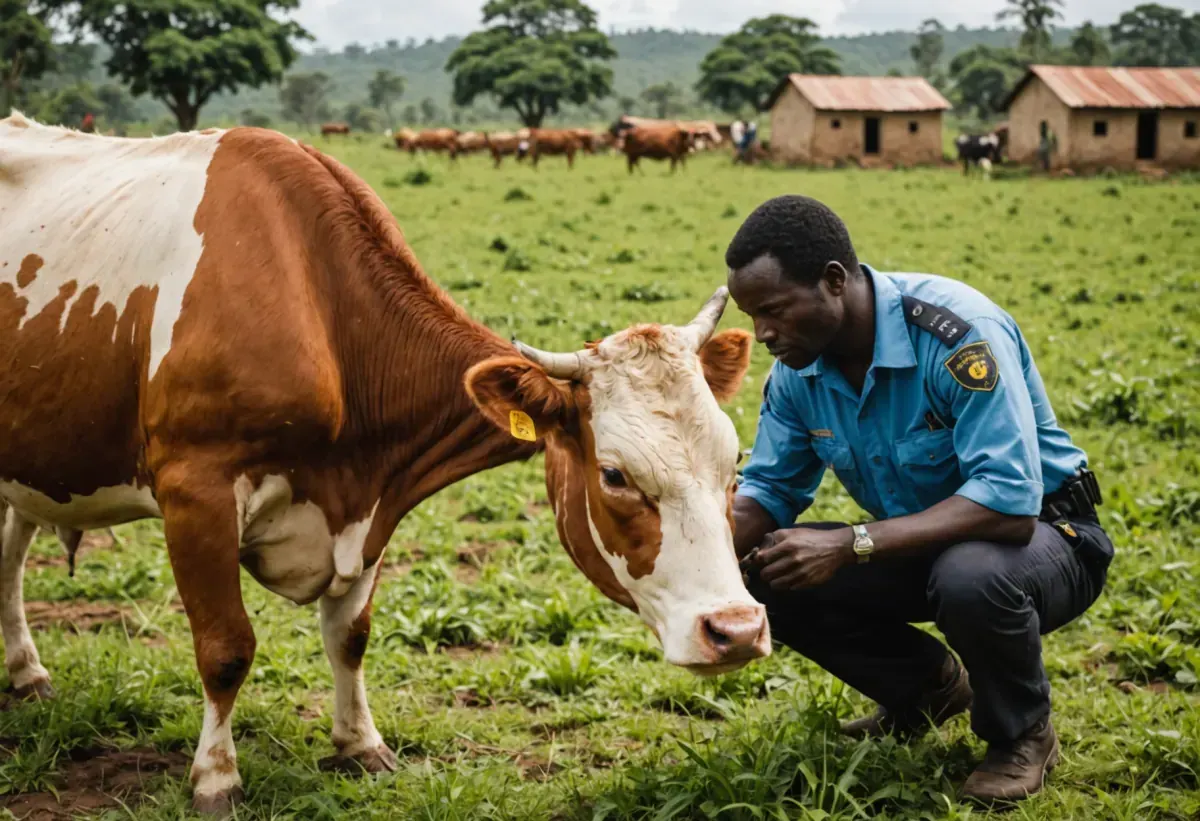
Common mistake: writing that anthrax only affects cattle. Anthrax also infects people who handle or eat dead animals, which is why it is reported to both veterinary and health authorities.
MAAIF’s May 2024 campaign shows the scale. The ministry secured 12.85 million vaccine doses and delivered 12 million across 136 district local governments, against a target of 82.7% of Uganda’s 14.5 million cattle. Re-check the arithmetic: 14.5 × 82.7% = 11.99, which rounds to about 12 million — the doses delivered match the coverage target.
Control of roundworms and ticks in cattle
Cattle disease control in Uganda rests on two jobs: removing worms from inside the animal and ticks from outside it. Roundworms live in the gut, while ticks attach to the skin and carry diseases. Both must be controlled on a schedule, because a single treatment never keeps an animal clear for long.
- Roundworms are the commonest gut parasite. In a 2024 Makerere study of 335 cattle in Kakumiro district, 76.4% carried gastrointestinal worms in their gut.
- Strongyles dominate. Strongyle worms were the most prevalent at 66.3%, followed by Taenia (21.8%), Schistosoma (21.5%) and Fasciola (16.7%).
- Most infections are mixed. Of the infected cattle, 59.8% carried more than one worm type at once, so treating for a single worm is often not enough.
- Grazing system matters. The same study found that grazing system and deworming frequency were statistically significant risk factors for worm infection.
- Reinfection is fast. A Ugandan calf study found worm eggs rose again within about two to three weeks because larvae on pasture are eaten during grazing, especially in the rains.
- Deworm on a schedule, not once. Because reinfection is rapid, strategic, repeated deworming timed to the grazing season controls worms better than a single treatment.
- Anthelmintics are the main drug. Deworming uses anthelmintic drugs, and a Ugandan study found Albendazole 10% more effective than the two herbal extracts tested.
- Rotate or rest the pasture. Moving cattle off contaminated pasture and rotating grazing reduces the number of worm larvae they swallow each day.
- Ticks are vectors, not just pests. Ticks spread East Coast fever, anaplasmosis, babesiosis (red water) and heartwater, so tick control is disease control.
- The brown ear tick carries ECF. East Coast fever, Uganda’s most important tick-borne disease, is carried by the brown ear tick (Rhipicephalus appendiculatus).
- Acaricides are the main tool. Uganda’s main method of controlling tick-borne disease is intensive tick control with acaricides, applied by dipping or spraying.
- Dipping and spraying are regulated. Uganda’s Animal Diseases Rules govern the manner of spraying or dipping cattle, sheep and goats.
- Acaricide resistance is real. Heavy acaricide use has selected resistant tick populations, so farmers must rotate products and use integrated control.
- ECF vaccination exists. Vaccination against East Coast fever and selective breeding for tick resistance are named alternatives that slow acaricide resistance.
- Few households own spray pumps. Only 11.3% of livestock-keeping households owned a spray pump in 2021, so many keepers lack even the basic application equipment.
- Exotic dairy cattle need more control. Tick-susceptible exotic dairy breeds in western and central Uganda demand intensive acaricide use for tick control.
| Parasite | Kind | Where it lives | Control method |
|---|---|---|---|
| Roundworms (Strongyles, Fasciola, Taenia, Schistosoma) | Internal | Inside the gut and organs | Anthelmintic deworming on a schedule, plus rotational grazing |
| Brown ear tick (Rhipicephalus appendiculatus) | External | On the skin, especially ears | Acaricide dipping or spraying, rotating products to slow resistance |
| Other disease-carrying ticks | External | On the skin and body surface | Acaricide dipping or spraying, integrated control, limiting exposure |
Exam tip — the tick-control calendar. Tick control is intensive and repeated, not once-off, because one acaricide application cannot protect an animal for the whole season. The interval between dipping or spraying follows the product label and the veterinary officer’s advice — this post does not invent a fixed number of days.
Common mistake: deworming once and expecting the problem to end. Larvae on pasture reinfect cattle within two to three weeks, so deworming must be repeated on a schedule, especially in the rains.
Grazing and husbandry connect directly to parasite pressure and to effective cattle disease control, which is why learners should read the notes on cattle management systems and on routine husbandry practices alongside this page.
Legislation on animal diseases and notifiable diseases
Uganda’s cattle disease control law is the Animal Diseases Act, Cap. 38. It regulates the import, export, handling and transport of animals so that pests, vectors and diseases do not enter or spread. Its central duty for a learner to remember is simple: report any diseased animal, and never treat a notifiable disease in secret.
- The Animal Diseases Act, Cap. 38. Uganda’s main animal disease law regulates import and export, animal handling and transport to stop pests, vectors and diseases spreading.
- Owners must report diseased animals. The Act obliges animal owners and handlers to report any diseased animal in their possession to the nearest veterinary officer.
- The Minister can declare diseases. Under the Act the Minister may declare a disease notifiable, and a 2007 Instrument used that power to declare highly pathogenic avian influenza.
- Tick-borne diseases are on the list. MAAIF’s guidance records that statutory instruments added all tick-borne diseases of cattle, brucellosis and lumpy skin disease of cattle.
- The Schedule was not verified. The Act’s full Schedule of notifiable diseases was not read, so this post does not print a numbered “First Schedule” list.
- Report, never treat quietly. The core lesson is that a suspected notifiable disease must be reported to the veterinary officer — never medicated in secret.
- The Commissioner Animal Health. The Act gives the Commissioner Animal Health power to issue import permits and international veterinary health certificates.
- Inspectors may enter and inspect. Veterinary inspectors can enter any establishment, vessel, truck, container or place to inspect animals and verify health and welfare.
- Cap. 38 versus Cap. 48. The gazetted instrument cites Cap. 38, while MAAIF’s FMD material also says Cap. 48, so this post uses Cap. 38 as the stronger form.
- FMD vaccination is compulsory. MAAIF states that vaccination against foot and mouth disease is compulsory for susceptible animals, which are to be vaccinated twice a year.
- Farmers pay for the dose. Under the cost-recovery policy, farmers pay for each animal vaccinated while the government bears administration and logistical support.
- The law is a family of statutes. Related laws include the Animal Breeding Act 2001 and the Cattle Traders Act Cap. 43, which licenses cattle traders and exporters.
- Notifiable means reportable by law. A notifiable disease is one the law requires a keeper to report to the authorities, and reporting is the first duty in cattle disease control.
- Kazo district is the live example. In Kazo district in July 2026, mass vaccination, ring vaccination and animal movement checkpoints were the actual response used against FMD.
| Notifiable disease group | Required response |
|---|---|
| Tick-borne diseases of cattle (East Coast fever, anaplasmosis, babesiosis, heartwater) | Report to the nearest veterinary officer; apply acaricide tick control |
| Foot and mouth disease | Report immediately; compulsory vaccination; quarantine and stop movement |
| Anthrax | Report every unexplained death; never open, sell or eat the carcass |
| Brucellosis and lumpy skin disease of cattle | Report to the veterinary officer, as both are among the diseases added by statutory instrument |
Common mistake: writing “the farmer treats it quietly”. The Animal Diseases Act obliges the owner to report any diseased animal to the nearest veterinary officer — silence is the one response the law does not allow.
The ministry’s own inspection procedures summarise these powers in one place, in the MAAIF Standard Operating Procedures for Veterinary Inspections. That document is the source for the reporting duty, the import permits and the quarantine-at-entry powers named above.
Regulations on animal movements and quarantine
Movement control and quarantine complete the cattle disease control system: they are the legal tools Uganda uses to stop a disease travelling once it appears. The rules restrict when, where and how animals may move, and they close infected areas. A learner must be able to describe these measures and explain why each one works.
- Movement control is a legal rule. The Act prohibits movement of animals from, through and into infected areas in order to stop disease spread.
- Movement permits are required. Veterinary officers inspect animals and issue a veterinary health certificate or movement permit before animals may move.
- No movement at night. The law prohibits the movement of live animals at night, and separate rules restrict cattle movement through infected areas.
- Stock routes are designated. The Act designates stock routes that animals must follow while being transported through the country.
- Quarantine at entry points. Animals entering Uganda at ports of entry are placed under quarantine under the Animal Diseases Act.
- Quarantine covers a whole district. During an FMD outbreak, quarantine in Uganda restricts an entire district because of how contagious the disease is.
- Quarantine restricts entrance and movement. The Animal Diseases (Quarantine) Rules restrict entrance and movement in places of quarantine unless the veterinary officer permits.
- The owner feeds the quarantined animal. Quarantine rules place responsibility for animals kept in quarantine on their owner, and prescribe fees for holding them there.
- The Kazo movement example. In Kazo district, movement permits had to be supported by clearance letters from the LC I chairperson, security authorities and veterinary officers.
- Markets close during outbreaks. In the Kazo response, livestock markets across the district were temporarily closed for more than two weeks during the FMD outbreak.
- Quarantine has a real cost. Nakaseke district lost about $5.05 million in live animal sales and $0.55 million in milk sales over a six-month quarantine in 2014.
- Households bear the cost. In Karamoja in 2021, each household lost about $696 a year to FMD, mostly through mortality (39%) and abortion (30%) losses.
- Quarantine is not optional. A farmer who ignores quarantine and moves animals spreads disease to neighbours and breaks the law.
- Learn the chain of permission. The correct order is report, then veterinary inspection, then a movement permit, then the stock route, then respect for quarantine.
| Control measure | What it does | Source |
|---|---|---|
| Movement permit | Allows animals to move only after a veterinary officer inspects them | Animal Diseases Act, Cap. 38 (as summarised by MAAIF) |
| Night movement ban | Prohibits moving live animals at night | Animal Diseases Act, Cap. 38 (as summarised by MAAIF) |
| Quarantine | Restricts movement into, out of and within an infected area | Animal Diseases (Quarantine) Rules |
| Stock routes | Direct animals along designated routes when transported | Animal Diseases Act, Cap. 38 (as summarised by MAAIF) |
Common mistake: thinking quarantine is a suggestion. Quarantine is a legal restriction, and the Karamoja cost breakdown shows why — its shares add to 100% (39 + 30 + 15 + 6.9 + 6 + 1.6 + 1.5 = 100), covering mortality, abortion, crop, milk, salvage, treatment and traction losses together.
Frequently asked questions about cattle disease control
Learners most often ask these questions about cattle disease control in class and before the UNEB Agriculture paper. Each answer is written so you can lift it straight into a revision card.
- What is cattle disease control? Cattle disease control means the practices a farmer uses to prevent diseases and parasites, stop them spreading, and obey Uganda’s animal disease law. It combines tick and worm control, vaccination, hygiene, reporting sick animals, and respecting movement permits and quarantine. Healthy cattle grow, give milk and stay fit for sale.
- What causes red water in cattle? Red water is babesiosis, a disease caused by blood parasites that ticks pass into cattle when they bite. The parasites destroy red blood cells, which makes the animal weak and turns its urine dark red. Because ticks carry it, controlling ticks by dipping or spraying is the main prevention.
- What should I do if I suspect foot and mouth disease? Report it to the nearest veterinary officer immediately and stop all animal movement. Foot and mouth disease is notifiable, so never treat it quietly. Quarantine may cover the whole district, and markets close during outbreaks. Early reporting stops the disease spreading to neighbours.
- How do farmers control ticks in Uganda? Uganda’s main method is intensive tick control with acaricides, applied by dipping or spraying on a regular schedule. Farmers should rotate acaricides to slow resistance and use integrated control, including East Coast fever vaccination and limiting tick exposure. Only 11.3% of livestock-keeping households owned a spray pump in 2021.
- What does Uganda’s animal disease law require of a farmer? The Animal Diseases Act, Cap. 38, obliges a farmer to report any diseased animal to the nearest veterinary officer, get a movement permit before moving animals, avoid moving animals at night, and respect quarantine. Breaking these rules spreads disease and is against the law.
- Is anthrax dangerous to people? Yes. Anthrax can infect people, usually through eating meat from a dead animal, slaughtering a dead animal, or carrying its meat. In the Sembabule outbreak, 79% of people had eaten meat from dead cattle. Never open, sell or eat a dead animal; report it instead.
When you can recall every answer above without looking, try the Agriculture quiz to test yourself under timed conditions.
Key terms and revision summary
| Term | Definition |
|---|---|
| Notifiable disease | A disease the law requires a keeper to report to the veterinary authorities rather than treat quietly |
| Acaricide | A chemical used to kill ticks and mites, applied to cattle by dipping or spraying |
| Quarantine | The legal restriction of animal movement into, out of, or within an infected area |
| Vector | An organism, such as a tick, that carries a disease agent and passes it to an animal |
| Babesiosis (red water) | A tick-borne disease in which blood parasites destroy red cells, turning urine dark red |
| Heartwater (cowdriosis) | A tick-borne disease that causes nervous signs and affects the lining around the heart |
| Foot and mouth disease (FMD) | A highly contagious notifiable disease that causes blisters in the mouth and on the feet |
| Anthrax | A serious disease that can also infect people, spread by handling or eating infected dead animals |
| Roundworm (gastrointestinal helminth) | A worm that lives in the gut; Strongyles, Fasciola, Taenia and Schistosoma were recorded in a Kakumiro study |
| Movement permit (veterinary health certificate) | A document a veterinary officer issues to allow an animal to be moved legally |
| Plunge dip | A dipping facility through which cattle are walked to coat them in acaricide |
| Zoonosis | A disease that can pass between animals and people, as anthrax can |
These exam-style questions test the same cattle disease control facts you will meet in the UNEB Agriculture paper. For each one, write a full answer, then check it against the outline.
- Question 1 — Name two tick-borne diseases of cattle and state one control method for each. Outline: red water (babesiosis) and heartwater are both tick-borne; control each by acaricide dipping or spraying against ticks, plus early reporting to the veterinary officer.
- Question 2 — Distinguish between an internal and an external parasite, giving one example and one control method for each. Outline: an internal parasite lives inside the body (roundworm) and is controlled by anthelmintic deworming; an external parasite lives on the skin (tick) and is controlled by acaricide dipping or spraying.
- Question 3 — A farmer in a cattle-corridor district finds a cow dead with no prior illness. Explain what the farmer must do and must not do, and why. Outline: must not open, sell or eat the carcass because anthrax can infect people; must report to the nearest veterinary or health authority and vaccinate the herd.
- Question 4 — State the legal duty of a cattle owner when an animal shows signs of a notifiable disease, and describe two movement-control measures. Outline: report to the nearest veterinary officer; movement permits before moving animals, a ban on night movement, and quarantine of infected areas.
- Question 5 — Explain why dipping and spraying must be done on a regular schedule rather than once. Outline: one acaricide application cannot protect an animal all season; ticks re-attach, so repeat on the product-label interval and the veterinary officer’s advice, and rotate products to slow resistance.
Exam tip: in every disease question, close with the legal step. An answer that names the symptom, the cause and the report-to-the-veterinary-officer duty scores the marks other learners drop.


Leave a Reply