
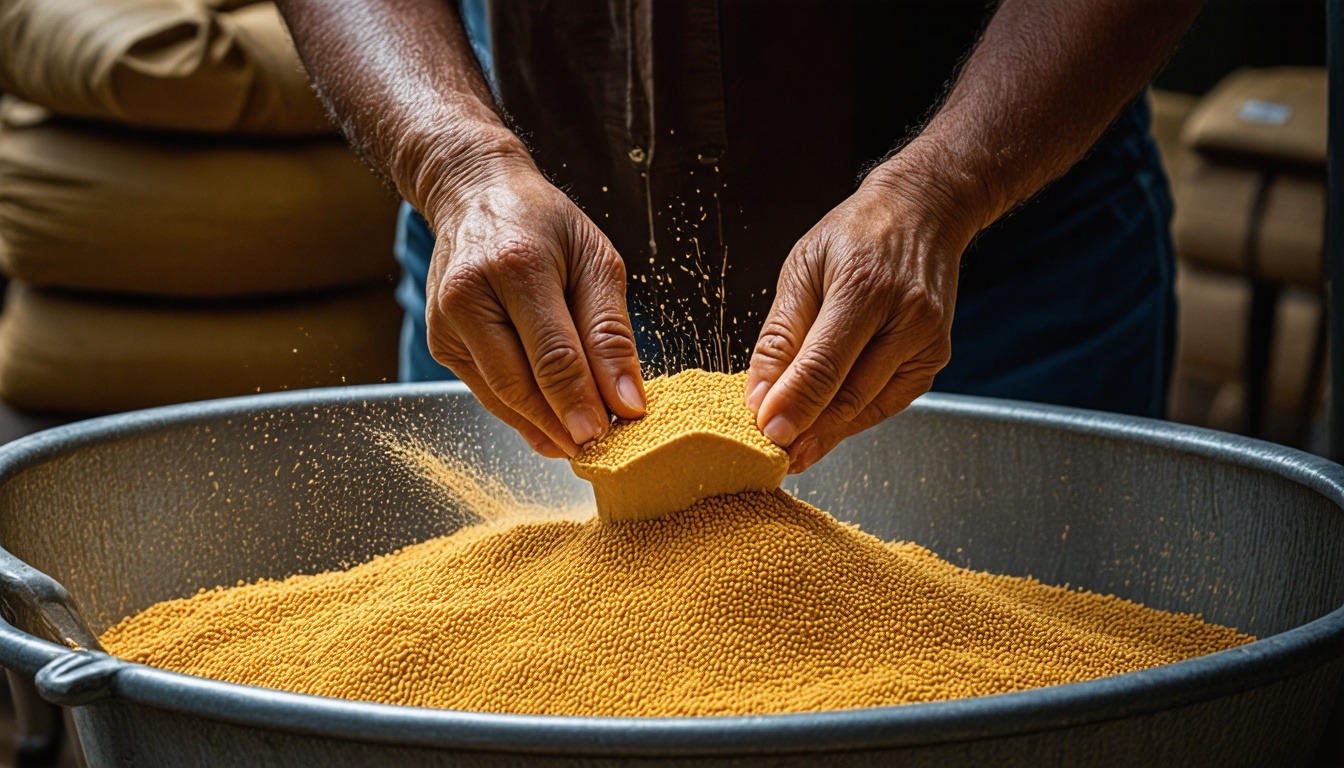
Mathematical Formulation and Blending of Compound Feeds
In the livestock industry, the mathematical formulation and blending of compound feeds stands as a cornerstone of animal nutrition and farm profitability. Whether you are raising poultry, swine, cattle, rabbits, or fish, the quality of feed directly influences growth rates, reproductive performance, and overall herd health. This comprehensive academic note delves into the scientific principles and practical techniques for creating balanced, cost-effective compound feeds. It covers essential calculation methods, step-by-step formulation strategies for specific animal classes, and the critical art of blending feed ingredients to achieve uniform nutrient distribution. By mastering these concepts, students, feed mill operators, and farmers can optimize animal performance and reduce feed costs.
Technique for making air-dried livestock compound feeds
Air-dried compound feeds are the most common form of commercial livestock feed because they are easy to store, handle, and feed. The technique involves a series of deliberate steps that transform raw ingredients into a stable, palatable, and nutritious meal or pellet. The process requires careful planning and hygiene to prevent spoilage and contamination.
Key Steps in the Production of Air-Dried Feeds
- Ingredient Selection and Quality Control: Only high-quality grains (maize, wheat, sorghum), protein sources (soybean meal, fish meal, groundnut cake), and micronutrients (vitamins, minerals) should be used. Each ingredient must be thoroughly inspected for mould, insect damage, and foreign matter.
- Grinding and Particle Size Reduction: Whole grains and oilseed cakes are ground to a uniform particle size, typically 500–800 microns for poultry and 800–1000 microns for pigs and ruminants. Grinding increases the surface area for digestion and ensures uniform mixing.
- Weighing and Batching: Each ingredient is accurately weighed according to the formulated recipe. Even small deviations can lead to nutrient imbalances or toxicity.
- Mixing: The weighed ingredients are thoroughly mixed in a horizontal or vertical mixer to achieve a homogeneous blend. This is critical to ensure that every animal consumes the correct proportion of nutrients.
- Conditioning (Optional for Mash): For mash feeds, mixing may be followed by the addition of molasses or oil to reduce dustiness and improve palatability. The mix is left to aerate for a short period.
- Drying (if needed): Some feeds include wet ingredients like fresh fish or kitchen waste; these must be air-dried or sun-dried to a moisture content of 10–12% to prevent microbial growth. Air-drying involves spreading the mix in thin layers on clean, raised racks in a well-ventilated area.
- Pelleting (optional): For pelleting, the mash is conditioned with steam and pressed through a die to form pellets. Pellets reduce ingredient segregation and feed wastage.
- Cooling and Packaging: After drying or pelleting, the feed is cooled to ambient temperature, then bagged in moisture-proof bags, labeled with the date and composition.
Important: The entire process must minimize heat exposure, as high temperatures can destroy heat-labile vitamins and reduce protein quality.
The air-drying technique is particularly suitable for small to medium-scale operations because it requires minimal equipment and is energy-efficient. It is extensively used for making mash feeds for poultry and pigs, as well as for producing calf weaner meals and rabbit pellets.
Mathematical calculations for balanced feed nutrients
To formulate a balanced feed, one must calculate the exact amounts of ingredients needed to meet the animal’s nutrient requirements—most importantly, energy (expressed as Metabolizable Energy or ME), crude protein (CP), and essential amino acids. Several mathematical methods are employed, from simple algebraic equations to linear programming.
1. Pearson Square Method
The Pearson square (or rectangle) is a simple tool for blending two feedstuffs to achieve a desired nutrient level. for instance, to create a feed with 18% crude protein using maize (10% CP) and soybean meal (45% CP):
- Draw a square; write the desired CP (18%) in the center.
- Write the CP of each ingredient at the left corners (10 on top-left, 45 on bottom-left).
- Subtract diagonally and take absolute values: 45-18=27 parts of maize; 18-10=8 parts of soybean meal.
- Total parts = 27+8=35. Thus, proportion of maize = 27/35 = 77.14%, soybean meal = 8/35 = 22.86%.
| Ingredient | CP % | Parts | Percentage |
|---|---|---|---|
| Maize | 10 | 27 | 77.14% |
| Soybean meal | 45 | 8 | 22.86% |
| Total | 35 | 100% |
This method is limited to two ingredients but can be extended by fixing some ingredients in the diet and using the square for the two protein sources.
2. Algebraic Equations
When more than two ingredients are involved, a system of equations is set up. for instance, if we need 100 kg of feed with 22% CP, and we have maize (10% CP) and groundnut cake (40% CP), we solve:
- Let x = kg of maize, y = kg of groundnut cake.
- x + y = 100 (total weight)
- 0.10x + 0.40y = 22 (total protein)
- Solving gives x = 60 kg, y = 40 kg.
3. Linear Programming
For commercial feed mills, linear programming (LP) software calculates the least-cost blend that meets all nutritional constraints. LP considers ingredient prices, nutrient limits, and ingredient availability. It is the most powerful and flexible method, handling dozens of ingredients and nutrients simultaneously.
4. Calculating Nutrient Composition
After formulating proportions, the total nutrient composition is calculated as the weighted average of each ingredient’s contribution. For instance, if a diet is 70% maize (9% CP) and 30% soybean meal (45% CP), the total CP = 0.70 × 9 + 0.30 × 45 = 6.3 + 13.5 = 19.8%. The same principle is applied for energy, calcium, phosphorus, and amino acids.
Remember: Always account for moisture content and or inclusion of vitamin-mineral premixes (usually at 0.2–3% of the diet).
Mastering these mathematical calculations is essential for those seeking to produce cost-effective and nutritionally precise compound feeds.
Formulating calf pellets and calf weaner
Calf nutrition demands a delicate balance between milk-derived nutrients and solid feed to stimulate rumen development. Calf pellets and weaner diets are formulated to provide around 18-20% crude protein and high energy (ME > 12 MJ/kg DM).
Nutrient Requirements for Calves
| Nutrient | Calf Starter (Early Weaning) | Calf Weaner (Post-Weaning) |
|---|---|---|
| Crude Protein (%) | 20-22 | 18-20 |
| ME (MJ/kg DM) | 12-13 | 11-12 |
| Calcium (%) | 0.8-1.0 | 0.7-0.9 |
| Phosphorus (%) | 0.5-0.6 | 0.4-0.5 |
Formulation Strategy
Calf pellets are dense, small-diameter pellets (3/16 inch) that prevent selective eating. They are often crumbled for very young calves.
- Ingredients: Maize, soybean meal, wheat bran, molasses, dicalcium phosphate, limestone, vitamins and minerals.
- Example recipe (per 100 kg):
Maize: 50 kg, Soybean meal: 25 kg, Wheat bran: 15 kg, Molasses: 5 kg, Dicalcium phosphate: 2 kg, Limestone: 1 kg, Premix: 2 kg. This handles approx. 20% CP.
Calf weaner is introduced at 4-6 weeks of age to encourage dry feed intake. Palatability is enhanced with molasses and flavourings. The weaner diet must be physically stable to withstand cloven-hoof trampling and water exposure.
Formulation targets: The pelleting process requires a binder like wheat bran or lignosulfonate to maintain pellet durability. The pellets must pass a durability test with >95% intact after tumbling.
Practical Tip: Start calves with a small amount of fresh calf pellets on top of milk to create positive association; gradually increase over 3 weeks.
Formulation of chick mash broiler starter and layer mash
Poultry feeds are the most technically demanding due to extreme sensitivity of birds to nutritional imbalances. Three main categories are covered: chick mash, broiler starter, and layer mash.
Chick Mash (0-8 Weeks)
Chick mash is a finely ground, crumbly feed designed for day-old chicks. It must contain 20-22% CP, 11-12 MJ/kg ME, and be extremely palatable. Key formulation:
- Maize: 55%, Soybean meal: 30%, Fish meal: 4%, Wheat bran: 5%, Vegetable oil: 2%, Dicalcium phosphate: 1.5%, Limestone: 1%, Premix: 0.25%, Methionine: 0.1%.
- All ingredients are ground to a fine particle size (500 microns) and mixed thoroughly. Chick mash is often given as a crumble to reduce waste.
Broiler Starter (0-3 Weeks)
Broiler starter has higher protein (23% CP) and energy (12.5 MJ/kg) to support rapid growth. The formulation often includes high-quality protein sources like fish meal and soybean meal. Example:
| Ingredient | Inclusion (%) |
|---|---|
| Maize | 50 |
| Soybean meal | 30 |
| Fish meal | 5 |
| Wheat bran | 8 |
| Vegetable oil | 3 |
| Limestone | 1 |
| Dicalcium phosphate | 1.5 |
| Vit/Min premix | 0.5 |
| Lysine & Methionine | 0.2 each |
This mixture provides approx. 23% CP and 12.4 MJ/kg ME.
Layer Mash (18+ Weeks)
Laying hens need a diet with 16-18% CP but high calcium (3.5-4%) for eggshell formation. Layer mash has reduced protein and increased limestone. A typical formulation:
- Maize: 60%, Soybean meal: 20%, Wheat bran: 5%, Fish meal: 3%, Limestone: 8%, Dicalcium phosphate: 1%, Vegetable oil: 1%, Premix: 1%, Salt: 0.5%.
- Calcium is supplied partly as large particles (oyster shell) to allow hens to consume it as needed.
Important: Never use layer mash for broiler starters; the high calcium will cause kidney damage in growing birds.
Formulating sow weaner rabbit pellets and fish meal
This section covers three distinct species and products: sow weaner diets, rabbit pellets, and fish meal formulations—each with unique nutritional considerations.
Sow Weaner Feed
Weaned piglets (around 21-28 days) require a highly digestible diet with complex protein sources to minimize post-weaning lag. Sow weaner feed should contain 20-22% CP, 14 MJ/kg ME, and high levels of milk by-products or high-quality proteins.
- Ingredients: Maize, soybean meal, skimmed milk powder, whey powder, fish meal, plasma protein, enzymes, and organic acids. The feed is often pelleted to 3mm diameter.
- Formulation: A common recipe: Maize 45%, Soybean meal 20%, Whey powder 15%, Fish meal 10%, Vegetable oil 3%, Dicalcium phosphate 1%, Limestone 1%, Premix 1%, Lysine 0.3%, Methionine 0.2%. Acidifiers like citric acid are added at 1% to lower stomach pH.
- It is critical to ensure ingredients are fresh and high-quality; weaner pigs are very sensitive to mycotoxins.
Rabbit Pellets
Rabbits require high-fiber (12-16% crude fiber) diets to prevent digestive disorders. The pellet mash should be ground to 1-2 mm and formed into 4mm pellets to encourage chewing. For growing rabbits, CP of 16-18% and ME of 9-10 MJ/kg is adequate.
- Ingredients: Alfalfa hay (40%), maize (20%), wheat bran (15%), soybean meal (10%), barley (10%), limestone (2%), premix (1%), molasses (2%). This mixture provides enough fiber.
- Rabbits are prone to hairball formation; adding 5-10% dehydrated grass or lucerne improves fiber length.
Fish Meal as an Ingredient
Fish meal is a major protein source in livestock feeds, especially for aquaculture and young animals. It isn’t a feed itself but a critical ingredient. When formulating sow weaner, rabbit pellets, or poultry feed, fish meal is included at 5-10%.
Nutritional profile: Fish meal contains 60-72% CP, rich in lysine and methionine, and is an excellent source of calcium and phosphorus. but, over-inclusion can cause rancid odor and high cost. Proper storage is essential to prevent oxidation.
Formulation note: The inclusion of fish meal in rabbit pellets is limited because rabbits are herbivores. A maximum of 2% is used when needed for amino acid balance. For piglets and poultry, fish meal is a gold-standard protein source.
Blending prepared livestock feeds
Blending—often called mixing or compounding—is the final step that ensures uniform distribution of all nutrients and additives throughout the feed. Even the best formula fails if the blend is inconsistent. This section covers blending techniques, mixer types, and quality control.
Why Blending Matters
- Prevents segregation of fine and large particles.
- Ensures every animal receives the same dose of vitamins, minerals, and drugs.
- Improves palatability by combining flavors.
- Allows the addition of small quantities of potent ingredients (e.g., premixes) safely.
Types of Mixers
| Mixer Type | Ideal For | Advantages | Disadvantages |
|---|---|---|---|
| Horizontal ribbon mixer | Mash feeds with dry ingredients | Even mix, short time (5-10 min) | Requires high maintenance |
| Vertical screw mixer | Smaller batches, low cost | Simple, low capital | Longer mixing time (15-20 min), less uniform |
| Twin-shaft paddle mixer | High-volume commercial mixes | Fast (3-5 min), excellent homogeneity | Expensive |
Mixing Process
- Pre-mixing: Micro-ingredients (vitamins, minerals, drugs) are first blended with a carrier (wheat flour or soybean meal) in a small mixer to make a premix. This ensures they are diluted safely.
- Loading: The bulk ingredients (maize, soybean meal) are loaded into the main mixer first, followed by the premix and oil/molasses.
- Mixing time: Over-mixing can cause particles to separate; under-mixing leaves nutrient pockets. The optimal time varies with mixer type (check manufacturer’s specification).
- Quality Checks: Samples are taken from different locations for uniformity tests (e.g., coefficient of variation < 5%).
Air-Dried Feeds and Blending
For air-dried compound feed, blending is done before drying if wet ingredients are used. After drying, the mix may be crumbled or pelleted. To blend dry ingredients, care must be taken to avoid dust explosions; bonding agents like molasses are often added to bind fines.
Pro Tip: Always clean mixers between batches to prevent cross-contamination, especially when mixing medicated and non-medicated feeds.
Conclusion
The mathematical formulation and blending of compound feeds is both a science and an art. It demands a solid grasp of animal nutrient requirements, ingredient compositions, and mathematical methods—from simple Pearson squares to complex linear programming. The technique for making air-dried livestock compound feeds ensures shelf-stability, while accurate mathematical calculations guarantee balanced macro- and micronutrients. Formulations for different species—calf pellets, chick mash, broiler starter, layer mash, sow weaner, rabbit pellets—are tailored to exact physiological needs. Finally, careful blending of prepared livestock feeds is the arbiter of feed uniformity and nutrient delivery. Master these principles, and you are equipped to produce high-quality, cost-effective feeds that enhance animal performance and farm profitability. Whether you are an agronomy student, an animal scientist, or a commercial feed manufacturer, the future of livestock nutrition depends on precise feed formulation.
Frequently Asked Questions (FAQ)
1. What is the Pearson Square method in feed formulation?
The Pearson Square is a visual, algebraic method used to calculate the proportions of two feed ingredients needed to achieve a desired nutrient concentration. It is most commonly used for crude protein. You place the desired nutrient level in the center, list the nutrient concentrations of the two ingredients on the left, subtract diagonally, and take the absolute values to get the parts of each ingredient. Summing those parts gives the total; the proportion of each is its part divided by the total.
2. How do you calculate a balanced feed ration?
To calculate a balanced ration, you first identify the animal species, age, and production stage to determine nutrient requirements (ME, CP, Ca, P, etc.). Then, select available feedstuffs and determine their nutrient compositions. Using methods like algebra, Pearson’s square, or linear programming, you calculate the amounts of each ingredient that together meet all requirements while minimizing cost. Finally, verify by calculating the total nutrients and adjust as needed.
3. What are the main ingredients in calf weaner feed?
Calf weaner feed typically includes cereal grains (maize, oats), protein sources (soybean meal, milk by-products), wheat bran for fiber, molasses for palatability, dicalcium phosphate and limestone for minerals, and a vitamin-mineral premix. The aim is to provide 18-20% crude protein and encourage solid feed intake to develop the rumen.
4. How do I formulate chick mash at home?
For a simple chick mash, combine 50% maize, 30% soybean meal, 5% fish meal, 8% wheat bran, 2% vegetable oil, 1% limestone, 1% dicalcium phosphate, 0.5% salt, and 0.25% vitamin-mineral premix. Grind all ingredients to a fine particle size, mix thoroughly, and feed from day one. Ensure the mix is fresh and protected from moisture.
5. Why is blending important in prepared livestock feeds?
Blending ensures uniformity of nutrients, vitamins, and medications in the feed. Without proper blending, animals may selectively consume ingredients, causing nutrient excesses or deficiencies. for instance, medicated feeds rely on even distribution to prevent underdosing or toxicity. A coefficient of variation of less than 5% is often used to indicate ideal blending.
6. Can I use layer mash for broilers?
No, layer mash has high calcium (3-4%) to support eggshell formation and slightly lower protein (16-18%). Broilers need high protein (20-23%) and less calcium (0.9-1%). Feeding layer mash to broilers can cause calcium toxicity, kidney issues, and poor growth. Always use species-appropriate feeds.
7. What is the ideal particle size for poultry crumble?
For chicks, fine mash particles of 500 microns are ideal. For broilers and layers, a crumble texture (ground pellets) is recommended. Particle size affects feed intake and digestion; too fine can lead to beak irritation, too coarse can cause sorting. The feed industry standard for broiler mash is 600-800 microns.



Leave a Reply